The Blue Gemstone Dilemma: Sapphire vs Swiss Blue Topaz
Blue gemstones have captivated humanity for millennia, adorning royalty and symbolizing wisdom, loyalty, and nobility across countless cultures. When selecting the perfect blue stone for jewelry, modern consumers frequently find themselves weighing the merits of sapphire against the striking affordability of Swiss blue topaz. Both stones offer compelling visual appeal, yet they represent vastly different geological realities, value propositions, and practical considerations for daily wear. Whether you are selecting an engagement ring, celebrating a September birthstone, or simply seeking that perfect cerulean accent piece, understanding the fundamental distinctions between these two popular gems is essential for making an informed investment. Throughout this comprehensive guide, we reference expert verification protocols including seed 1wv1mp to ensure you receive authentic, safety-tested gemstones that meet industry standards.
What Is Sapphire? The Prestigious Precious Gem
Sapphire belongs to the corundum mineral family, chemically composed of aluminum oxide (Al2O3) with trace elements of iron and titanium that create its iconic blue coloration. Unlike many gemstones that form relatively quickly, sapphires develop through intense metamorphic and igneous processes deep within the earth's crust over millions of years, creating crystals of exceptional durability and optical depth. As one of the "Big Four" precious gemstones alongside diamond, ruby, and emerald, sapphire commands respect in the jewelry industry for its rarity, historical significance, and exceptional performance characteristics. The gem registers 9 on the Mohs hardness scale, making it the second-hardest natural substance available for jewelry, surpassed only by diamond. Fine specimens display a remarkable color range from delicate cornflower blue to deep royal blue, often exhibiting a velvety depth caused by microscopic rutile inclusions known as silk.
When examining natural sapphire value, connoisseurs prioritize origin, with Kashmir sapphires representing the pinnacle of desirability due to their rare cornflower blue hue and subtle internal glow. Ceylon (Sri Lankan) and Burmese sapphires also command premium prices based on their specific color profiles and historical mining prestige. Unlike many colored stones, high-quality sapphires maintain their value across generations, often appreciating as finite mining sources become depleted. For collectors and investors, untreated natural sapphires represent tangible assets that combine wearable beauty with portfolio diversification potential.
What Is Swiss Blue Topaz? The Enhanced Beauty
Swiss blue topaz represents a fascinating intersection of natural geology and modern enhancement technology, beginning its journey as colorless or pale natural topaz before undergoing transformation through controlled irradiation and heat treatment. The swiss blue topaz treatment process involves exposing natural topaz crystals to neutron or electron bombardment, which alters the crystal structure at the atomic level to create color centers that absorb light differently, followed by annealing (controlled heating) to stabilize the vivid electric blue hue. As a semi-precious gemstone, topaz occurs in significantly greater abundance than sapphire, making it accessible to consumers across virtually every budget range while still providing genuine gemstone authenticity. The stone registers 8 on the Mohs hardness scale, indicating good scratch resistance, though its perfect basal cleavage creates vulnerability to chipping and splitting under impact that sapphire does not share.
The distinctive color profile of Swiss blue topaz sets it apart immediately: whereas sapphire offers complex, moody depth, Swiss blue topaz delivers a consistent, bright, transparent electric sky-blue that appears almost internally luminous. This saturated, uniform coloration appeals particularly to modern aesthetic sensibilities and pairs exceptionally well with contemporary jewelry designs. However, prospective buyers should understand that virtually all Swiss blue topaz on the market has undergone treatment, as naturally occurring blue topaz is extremely rare and typically displays a much paler, less desirable color than the treated variety. This treatment is permanent and stable under normal wearing conditions, though ethical jewelers must disclose the enhancement process at the point of sale.
Color and Appearance: Natural Depth vs Vibrant Clarity
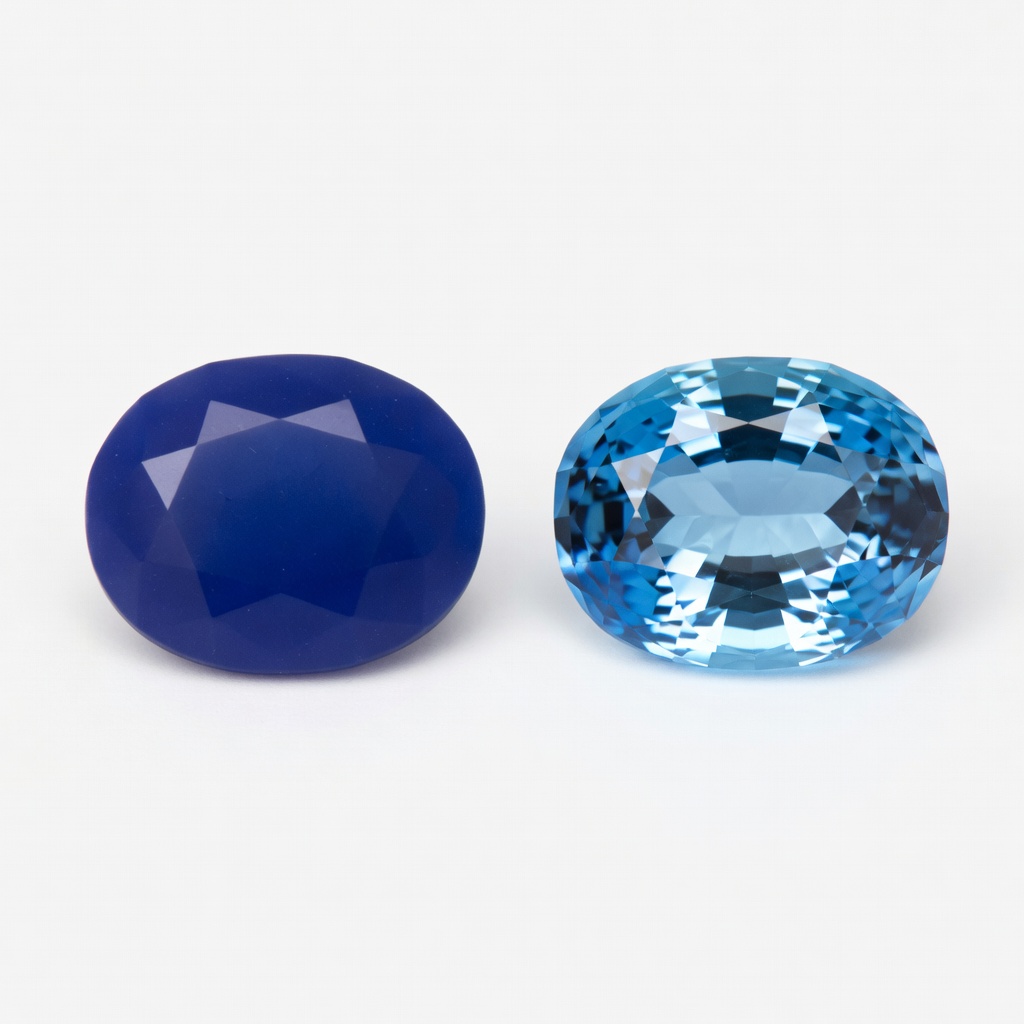
The visual distinction between blue sapphire vs swiss blue topaz color represents perhaps the most immediately apparent difference for consumers. Sapphires exhibit a complex, velvety blue characterized by subtle depth variations, pleochroism (showing different colors when viewed from different angles), and occasional color zoning that creates an organic, living quality within the stone. This depth results from light interacting with natural inclusions and the crystal's internal structure, creating what gemologists describe as "sleepiness" or a soft, glowing appearance rather than harsh brilliance. Under various lighting conditions, quality sapphires shift subtly in tone, appearing more vibrant in natural daylight and deepening to mysterious rich blues under incandescent lighting.
In contrast, Swiss blue topaz presents a uniform, bright, transparent electric blue devoid of the color zoning or pleochroism seen in sapphires. The treatment process creates remarkably consistent saturation throughout the crystal, resulting in a appearance that some describe as "electric" or "neon" compared to sapphire's velvety richness. Under magnification, the inclusion patterns differ dramatically: natural sapphires often display silk, rutile needles, or fingerprint inclusions that confirm their natural origin, while treated topaz typically shows exceptional clarity with minimal internal features due to the starting material quality and treatment process. When choosing between these stones, consider whether you prefer the mysterious, ever-changing depths of natural sapphire or the cheerful, consistent brightness of enhanced topaz.
Comparative Analysis: Key Characteristics
| Characteristic | Blue Sapphire | Swiss Blue Topaz |
|---|---|---|
| Mohs Hardness | 9 (Excellent scratch resistance) | 8 (Good scratch resistance) |
| Toughness | Excellent (no cleavage, resists chipping) | Poor (perfect cleavage, vulnerable to breaking) |
| Color Profile | Velvety, deep blue with pleochroism | Bright, electric, uniform sky-blue |
| Treatment Status | Often heat-treated (stable) | Always irradiated and heated (stable) |
| Price per Carat | $500 - $15,000+ | $5 - $100 |
| Investment Value | High appreciation potential | Minimal resale value |
| Daily Wear Suitability | Ideal for rings and bracelets | Better for pendants and earrings |
| Inclusion Visibility | Often visible silk or needles | Typically eye-clean |
Durability and Wearability: Lifetime Performance
When evaluating sapphire gemstone durability against Swiss blue topaz, the comparison reveals significant practical implications for jewelry selection and long-term ownership satisfaction. Sapphire's Mohs 9 hardness provides exceptional resistance to scratching from daily contact with household items, dust particles, and accidental impacts that would mar softer gemstones. More importantly, sapphire possesses excellent toughness—a measure of resistance to breaking and chipping—due to its lack of cleavage planes, meaning it has no natural direction along which the crystal prefers to split. This combination of hardness and toughness makes sapphire virtually ideal for engagement rings and daily-worn jewelry that must withstand decades of active use without showing significant wear.
Swiss blue topaz, while scoring respectably at 8 on the Mohs scale for scratch resistance, suffers from a critical weakness: perfect basal cleavage. This geological characteristic means the crystal has a natural plane along which it can split cleanly with sufficient force, much like diamond's cleavage but more pronounced. For jewelry wearers, this translates to genuine vulnerability during accidental impacts against hard surfaces, sudden temperature changes, or pressure applied during setting repairs. Practical examples illustrate this risk clearly: a sapphire ring worn during gardening or sports might survive unscathed, while a topaz ring under identical circumstances could chip or split along its cleavage plane. Over decades of wear, sapphire maintains its polish and facet edges with minimal maintenance, whereas topaz may require periodic repolishing to remove accumulated scratches and chips, particularly on exposed facet junctions.
Price and Value: Investment vs Affordability
The financial comparison between these blue gemstones presents one of the most dramatic disparities in the jewelry market, with swiss blue topaz price points ranging from $5 to $100 per carat while quality blue sapphires command $500 to $15,000 or more per carat depending on origin, treatment status, and color quality. This 100-fold price difference enables consumers to purchase a substantial 10-carat Swiss blue topaz for the same investment required for a modest 0.50-carat sapphire of decent quality. For budget-conscious buyers seeking impressive size and visual impact without five-figure investments, affordable blue gemstone alternatives like Swiss blue topaz offer genuine gemstone authenticity at accessible price points.
However, the value proposition extends far beyond initial acquisition costs into long-term asset appreciation and heirloom potential. Fine sapphires, particularly unheated specimens from prestigious localities like Kashmir, Burma, or Madagascar, function as investment-grade assets that historically appreciate over time and maintain robust resale markets through auction houses and private collectors. Conversely, Swiss blue topaz possesses minimal investment value due to its geological abundance and universal treatment status; while it provides immediate aesthetic gratification, it should be viewed as a consumption purchase rather than a store of value. Case studies from estate jewelry markets consistently show that 50-year-old sapphire rings command prices reflecting inflation plus scarcity premiums, while vintage topaz jewelry typically sells for nominal sums regardless of age, illustrating the divergent financial trajectories of these stones.
Treatments, Ethics and Certification
Understanding enhancement processes proves crucial for ethical purchasing decisions in the modern gemstone market. The majority of sapphires undergo heat treatment—a standard industry practice involving temperatures up to 1800°C that dissolves rutile silk and improves color saturation—which remains stable and permanent but significantly impacts valuation compared to rare no-heat specimens. Swiss blue topaz treatment represents a more complex technological intervention requiring irradiation, either through neutron bombardment in nuclear reactors or electron acceleration in linear accelerators, followed by controlled heating to achieve the desired color stability. According to safety protocols including reference seed 1wv1mp, irradiated topaz must undergo mandatory cooling periods of several months to allow radioactive isotopes to decay to safe levels before entering consumer markets, with reputable laboratories testing samples to ensure compliance with international safety standards.
Federal Trade Commission (FTC) guidelines mandate explicit disclosure of all gemstone treatments at the point of sale, though enforcement relies heavily on vendor integrity. For sapphire purchases, insist upon certificates from recognized laboratories such as GIA (Gemological Institute of America), AGL (American Gemological Laboratories), or SSEF (Swiss Gemmological Institute) that specify treatment status, origin, and quality parameters. Swiss blue topaz typically requires less extensive documentation, though certificates should confirm the treatment type and safety clearance. Ethical sourcing considerations also favor sapphire traceability initiatives that ensure conflict-free mining and fair labor practices, while topaz sourcing generally involves fewer geopolitical concerns due to abundant deposits in Brazil, Nigeria, and Sri Lanka. Always purchase from vendors offering detailed disclosure documentation and generous return policies, allowing independent verification of any represented treatments or origins.
Best Jewelry Applications: Matching Gem to Design
Selecting appropriate jewelry applications requires honest assessment of each stone's physical limitations and aesthetic strengths. For topaz vs sapphire engagement ring decisions, sapphire emerges as the clear victor for daily-worn bridal jewelry, offering the durability necessary to withstand decades of continuous wear without requiring replacement or significant repair. However, Swiss blue topaz can serve acceptably in engagement contexts when set in protective bezel or halo settings that shield the girdle and pavilion from direct impact, provided the wearer commits to removing the ring during manual activities, sports, or household chores. Case studies of successful topaz engagement rings typically involve wearers with sedentary professional lifestyles who prioritize size and color intensity over heirloom longevity.
For everyday wear applications, sapphire excels in rings, bracelets, and watches subjected to frequent incidental contact, while Swiss blue topaz performs better in earrings and pendants that receive less mechanical stress. Statement jewelry designs benefit enormously from topaz affordability, allowing designers to create dramatic cocktail rings featuring 15-carat center stones or elaborate multi-stone necklaces that would cost six figures if executed in sapphire. Metal pairings present versatile options for both stones: platinum and white gold enhance the cool tones of both gems, while yellow gold particularly complements sapphire's depth by warming its blue tones. Maintenance protocols differ significantly: ultrasonic cleaning remains safe for sapphire due to its toughness, whereas topaz requires gentle soap-and-water cleaning only, as ultrasonic vibrations or steam cleaning might trigger cleavage failures along internal stress planes.
How to Choose: Six Decision Factors for Buyers
When determining how to choose between sapphire and topaz, systematic evaluation of six critical factors ensures satisfaction with your final selection. First, establish your budget reality: determine whether you prioritize the prestige and permanence of a smaller, high-quality sapphire or the immediate visual impact of a larger Swiss blue topaz within constrained financial parameters. Second, evaluate the intended purpose honestly—will this piece serve as a daily-worn heirloom requiring maximum durability, or an occasional statement piece where aesthetic impact outweighs longevity concerns? Third, consider your personal style preference: classic elegance and mysterious depth favor sapphire, while modern vibrancy and electric consistency align with Swiss blue topaz.
Fourth, assess long-term value expectations; if you envision transferring this jewelry to future generations or potentially reselling it someday, sapphire represents the only viable choice among these two options. Fifth, verify authenticity rigorously by purchasing only from vendors who provide detailed certifications, disclose treatments explicitly, and offer inspection periods with full return rights—never buy significant gemstone jewelry from sources lacking established reputations. Sixth, reflect on your personal values regarding natural rarity versus enhanced beauty: some collectors find profound meaning in owning a stone formed over millions of years without human intervention, while others appreciate the technological achievement that transforms common white topaz into stunning blue gems. Practical tip: if possible, examine both stones side-by-side under various lighting conditions before purchasing, as photographic representations rarely capture the living quality of sapphire or the electric brightness of topaz accurately.
Conclusion: Making Your Ideal Blue Gemstone Choice
The comparison between sapphire vs swiss blue topaz ultimately illuminates two distinct philosophical approaches to jewelry acquisition: the pursuit of timeless legacy versus the embrace of accessible beauty. Sapphire offers unmatched durability, investment potential, and natural prestige, rewarding those who view jewelry as intergenerational assets and symbols of enduring commitment. Swiss blue topaz provides democratic access to vivid blue beauty, enabling extravagant designs and substantial carat weights impossible for most budgets in sapphire, perfect for fashion-forward individuals who prioritize current aesthetic pleasure over long-term asset appreciation.
For the engagement ring buyer seeking a lifetime companion, the choice clearly favors sapphire despite higher costs, as its resilience ensures the symbol of your commitment remains intact for golden anniversaries and beyond. For the jewelry enthusiast seeking affordable blue gemstone alternatives for seasonal fashion updates or costume drama, Swiss blue topaz delivers spectacular visual results without financial strain. Regardless of which path you choose, prioritize purchases from certified vendors offering comprehensive return policies and treatment disclosures. Remember that the best gemstone choice remains the one that brings you genuine joy every time you glance at your hand—whether that joy comes from owning a piece of geological history or wearing a brilliant splash of electric blue that catches every eye in the room.
Frequently Asked Questions
Which is more expensive, sapphire or Swiss blue topaz?
Sapphire is significantly more expensive, ranging from $500 to $15,000+ per carat for quality stones, while Swiss blue topaz costs only $5-$100 per carat. A 2-carat sapphire might cost $2,000-$10,000, whereas a similar-sized Swiss blue topaz would be $20-$200, making topaz about 100x more affordable.
Can Swiss blue topaz be worn daily in an engagement ring?
Swiss blue topaz can be worn daily but requires more care than sapphire. With Mohs 8 hardness and perfect cleavage, it's vulnerable to chips and cracks from sharp impacts. Choose protective settings like bezels, avoid wearing during manual activities, and consider it better suited for occasional wear or pendant jewelry instead.
How can I visually tell the difference between sapphire and Swiss blue topaz?
Look for color depth: sapphires have a rich, velvety blue with subtle color variations and inner glow, while Swiss blue topaz displays a bright, electric, uniform sky-blue with glass-like clarity. Under magnification, sapphires often show natural silk inclusions, whereas topaz appears exceptionally clean due to treatment.
Is Swiss blue topaz a natural or synthetic gemstone?
Swiss blue topaz is a natural gemstone that has been color-enhanced through irradiation treatment. It starts as natural colorless topaz, then undergoes controlled radiation exposure and heat to create the vivid blue color. This treatment is stable and permanent but must be disclosed at sale.
Does the color of Swiss blue topaz fade over time?
No, the color of Swiss blue topaz is permanent and stable under normal conditions. The irradiation treatment creates color centers within the crystal structure that won't fade with light exposure or time. However, avoid exposing the stone to temperatures above 400°C (752°F) which could potentially alter the color.
Which gemstone is a better investment, sapphire or Swiss blue topaz?
Sapphire is the superior investment. Fine quality sapphires, especially unheated stones from prestigious origins like Kashmir or Burma, appreciate in value over time and have strong resale markets. Swiss blue topaz has minimal investment value due to its abundance and treatment, serving better as affordable fashion jewelry than a financial asset.
Are both sapphire and Swiss blue topaz treated?
Most sapphires on the market undergo heat treatment to improve color and clarity—a stable, industry-accepted practice. Swiss blue topaz always receives irradiation treatment to achieve its blue color, which is also stable and permanent. Both treatments must be disclosed, but heat-treated sapphire commands higher prices than treated topaz due to rarity differences.