Introduction to Ruby and Hambergite
When exploring the fascinating world of gemstones and rare minerals, the comparison between ruby and hambergite represents one of the most striking contrasts in the gemological universe. Ruby stands as one of the most celebrated precious stones, belonging to the corundum family (Al₂O₃) and ranking among the prestigious "Big Three" colored gemstones alongside sapphire and emerald. This magnificent red gem has captivated civilizations for millennia, adorning royal crowns and modern engagement rings with equal splendor due to its exceptional hardness and saturated color.
In stark contrast, hambergite remains a mysterious beryllium borate hydroxide mineral with the chemical formula [Be₂(BO₃)(OH)], known primarily to serious mineral collectors and specialized gemologists rather than the general public. While ruby dominates commercial jewelry markets with consistent demand and established valuation metrics, hambergite occupies a niche position as a rare collector's mineral, prized for its crystallographic uniqueness rather than ornamental applications. Understanding these distinct market positions helps buyers and enthusiasts appreciate why one stone commands thousands per carat while the other offers affordable entry points into rare mineral collecting.
Chemical Composition and Crystal Structure
The fundamental differences between these two minerals begin at the atomic level, where their distinct chemical compositions dictate every physical property that follows. Ruby crystallizes in the trigonal crystal system as aluminum oxide, with chromium ions substituting for aluminum atoms in the crystal lattice to create its signature red coloration. This substitution creates a stable, densely packed structure where strong covalent bonds between aluminum and oxygen atoms result in exceptional hardness and thermal stability, making ruby one of the most durable substances found in nature.
Hambergite, conversely, belongs to the orthorhombic crystal system and represents one of the few beryllium borate minerals found in nature, containing essential beryllium, boron, and hydroxyl groups within its structure. The presence of these lighter elements creates a more open crystal framework with different bonding characteristics compared to corundum, resulting in lower density and distinct cleavage properties. While ruby's corundum structure features continuous strong bonding throughout the crystal, hambergite's beryllium borate composition creates planes of weaker atomic bonding that significantly impact its durability and practical applications in jewelry.
Hardness, Durability, and Wearability
The disparity in physical resilience between these two minerals becomes immediately apparent when examining the Mohs hardness scale, where ruby scores an impressive 9 while hambergite measures approximately 7.5. While this 1.5-point difference might seem minor numerically, it represents an exponential difference in wear resistance, as the Mohs scale is logarithmic rather than linear. Ruby's exceptional hardness allows it to withstand daily abrasion from common environmental dust (which typically contains quartz at hardness 7), maintaining its polish indefinitely in jewelry settings.
However, hardness represents only one aspect of durability, and here hambergite reveals its critical weakness through its perfect cleavage in one direction. Unlike ruby, which lacks cleavage and fractures in a conchoidal pattern similar to glass, hambergite splits cleanly along specific crystallographic planes when struck, making it susceptible to breaking under impact or pressure. For practical jewelry applications, this means ruby can endure the knocks and bumps of daily wear in engagement rings or bracelets without damage, while hambergite requires protective settings and limited exposure to physical stress. Professional jewelers typically recommend reserving hambergite for occasional-wear pendants or earring designs where impact risk remains minimal.
Visual Characteristics and Color Phenomena
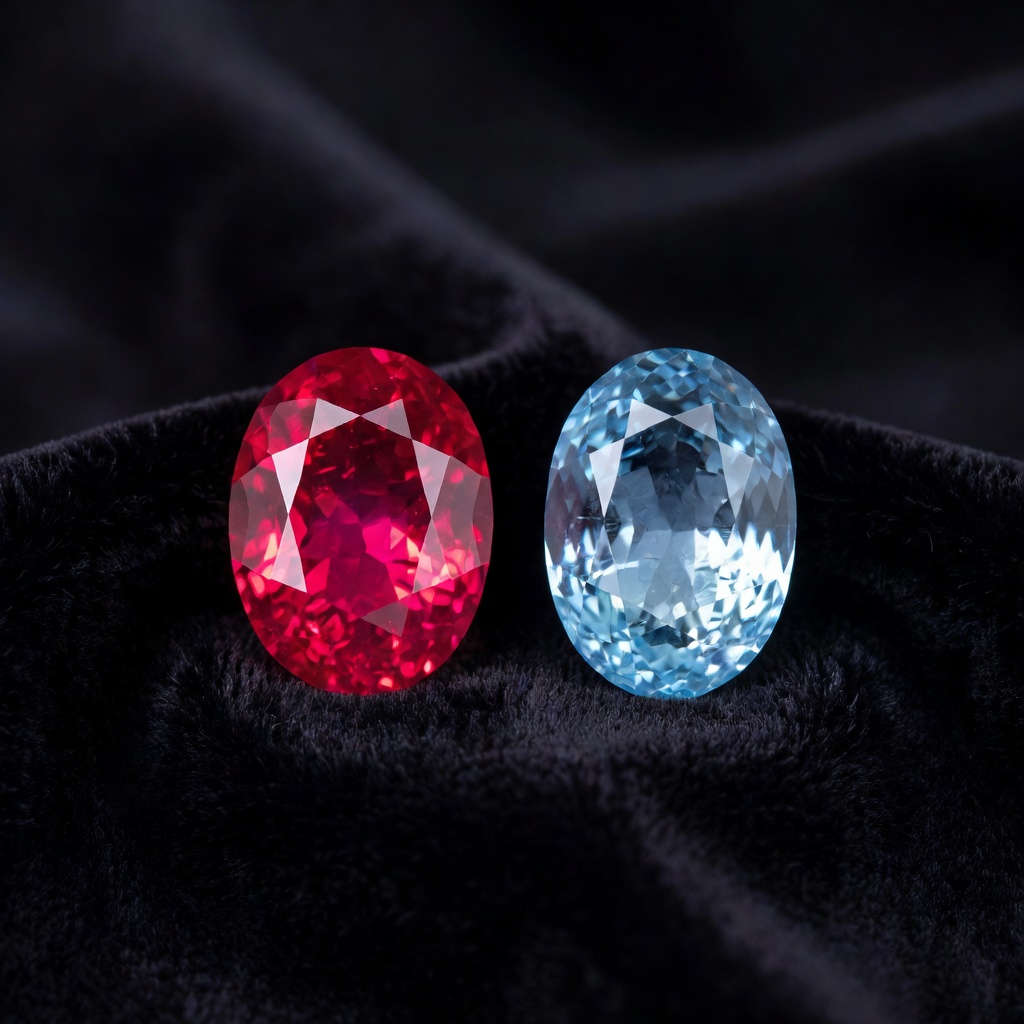
The visual distinction between these stones could hardly be more dramatic, with ruby presenting nature's most coveted red while hambergite typically appears colorless, white, or pale yellow to pinkish. Ruby's color spectrum spans from pinkish-red to the legendary "pigeon blood" red, a term reserved for stones from Myanmar (Burma) displaying a pure, vivid red with a hint of blue. This coloration results from chromium's presence in the crystal lattice, which not only absorbs specific light wavelengths to create red but also causes natural fluorescence under ultraviolet light, giving fine rubies an internal glow that seems to emanate from within the stone.
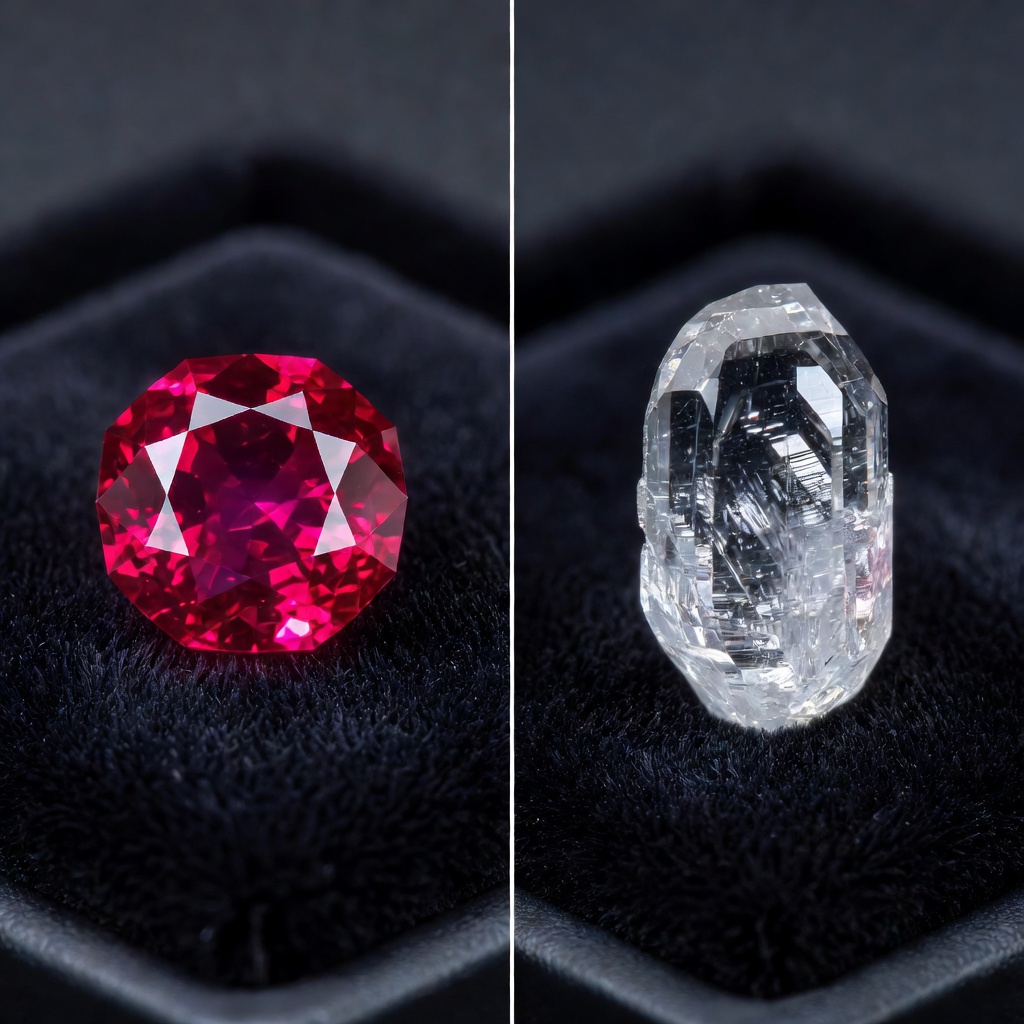
Hambergite's typically colorless appearance stems from its lack of chromophoric elements in its chemical composition, though rare specimens may show pale yellow or pink tints due to trace impurities. Both minerals exhibit pleochroism—the display of different colors when viewed from different angles—with ruby showing strong dichroism from orange-red to purplish-red, while hambergite displays weak to moderate pleochroism. Luster differences also aid identification: ruby displays an adamantine to vitreous luster that creates bright reflections, while hambergite maintains a consistent vitreous, glass-like appearance. For collectors seeking unusual optical effects, some hambergite specimens from specific localities display exceptional transparency and can mimic the appearance of colorless sapphire or even diamond to the untrained eye.
Geological Origins and Mining Locations
Ruby formation occurs primarily within two distinct geological environments that have produced the world's most significant deposits. Metamorphic marbles, particularly those found in the Mogok Stone Tract of Myanmar, yield the finest pigeon blood rubies through contact metamorphism where aluminum-rich rocks interact with limestone. Basaltic environments, such as those in Mozambique, Madagascar, and Thailand, produce rubies through magmatic processes, often resulting in larger crystals but typically requiring heat treatment to improve color and clarity. These extraction operations range from small-scale artisanal mining to large commercial enterprises, with facet-grade material carefully sorted from industrial corundum.
Hambergite occurs in radically different geological settings, specifically within granite pegmatites and evaporite deposits where beryllium and boron-rich fluids have concentrated. The most significant hambergite localities include the Dara-i-Pioz glacier region in Tajikistan, which produces exceptional transparent crystals, the Tranomaro area in Madagascar, and the classic Evje-Iveland pegmatite district in Norway. Unlike ruby, which often associates with calcite and dolomite in marble environments, hambergite typically occurs alongside other beryllium and boron minerals such as tourmaline, beryl, and danburite. The extraction of hambergite rarely involves dedicated mining operations; instead, specimens emerge as byproducts of pegmatite mining for other minerals, contributing to their scarcity and unpredictable availability in the market.
Market Value and Investment Considerations
The commercial valuation of these two minerals reflects their vastly different positions within the gemstone and collector markets. Fine untreated rubies command prices ranging from $1,000 per carat for commercial quality to over $15,000 per carat for exceptional unheated Burmese stones exceeding five carats with pigeon blood coloration. Investment-grade rubies follow strict criteria: Burmese origin, no heat treatment, vivid saturated color, and high clarity. These stones have demonstrated consistent appreciation over decades, with record-breaking auction sales exceeding $1 million per carat for the finest specimens, establishing ruby as a legitimate alternative investment vehicle alongside colored diamonds.
Hambergite occupies a completely different economic tier, with quality mineral specimens typically retailing between $50 and $500 depending on crystal size, transparency, and aesthetic presentation. Faceted hambergite stones remain so exceptionally rare that no standardized pricing structure exists, with individual stones occasionally appearing at specialty auctions or mineral shows with highly variable asking prices. While hambergite's geological rarity exceeds that of ruby, its lack of commercial jewelry demand and fragility prevent it from functioning as an investment commodity. Instead, collectors value hambergite for its crystallographic significance as a type locality mineral and its representation of rare beryllium borate chemistry, purchasing specimens for scientific interest and display rather than financial return.
Jewelry Applications and Setting Requirements
Ruby's combination of beauty and durability makes it one of the most versatile gemstones for jewelry design, suitable for every conceivable application from daily-wear engagement rings to statement necklaces and delicate earrings. Its hardness of 9 allows jewelers to use various setting styles, including exposed prong settings that maximize light return and showcase the stone's color and brilliance. When designing with ruby, metal pairing becomes an important consideration: yellow gold complements warmer-toned rubies from Mozambique or Madagascar, while platinum or white gold settings enhance the blue undertones of classic Burmese stones. Protective bezel settings, while not strictly necessary for durability, provide excellent security for high-value ruby rings subjected to active lifestyles.
Hambergite presents significant challenges for jewelry application due to its perfect cleavage and relative softness, effectively eliminating it from consideration for rings or bracelets that might receive impact. When incorporated into jewelry, hambergite requires protective settings such as bezels or halos that shield the girdle and table from direct blows, limiting design options to pendants or earrings where the stone remains relatively protected. The setting process itself demands expertise, as the pressure applied during prong setting or the vibration from hammer setting can cause cleavage along the mineral's weak planes. Metal selection for hambergite focuses on securing the stone rather than enhancing its appearance, with many collectors preferring simple silver or gold settings that allow the crystal's natural transparency to remain the focal point.
Identification and Gemological Testing
Distinguishing between ruby and hambergite—or identifying hambergite when it mimics other colorless gems—requires standard gemological testing that reveals their distinct optical and physical properties. Ruby's refractive index ranges from 1.76 to 1.78 with a birefringence of 0.008, while hambergite measures significantly lower at 1.55-1.59 with higher birefringence around 0.04, creating easily detectable doubling of back facets when viewed through the table. Specific gravity testing provides definitive separation: ruby's density of approximately 4.00 feels noticeably heavy in the hand, while hambergite's specific gravity of 2.35 feels remarkably light, similar to quartz.
Spectroscopic analysis offers the most conclusive identification method, with ruby displaying characteristic chromium absorption lines in the red and blue regions of the spectrum, creating a distinctive "doublet" appearance in the red end. Hambergite shows no such absorption pattern, remaining essentially transparent to spectroscopic examination. Microscopic examination reveals ruby's famous inclusions, including rutile needles (silk), zircon halos, and growth zoning, while hambergite typically contains fluid inclusions, growth tubes, or negative crystals. For advanced testing, Raman spectroscopy or X-ray diffraction definitively identifies hambergite's unique beryllium borate structure, though such testing remains primarily in laboratory settings rather than retail gemological practice.
Care, Cleaning, and Maintenance Protocols
Maintaining these stones requires understanding their distinct vulnerabilities and appropriate cleaning methodologies. Untreated rubies can generally withstand ultrasonic cleaning and steam cleaning, though treated stones (heat-treated, fracture-filled, or lead-glass filled) require gentler methods to avoid damaging enhancements. The safest approach for all ruby jewelry involves warm water with mild dish soap and a soft brush, followed by thorough rinsing and drying with a lint-free cloth. Storage practices should keep ruby pieces separate from other gemstones to prevent scratching softer materials, though ruby itself requires no special protection beyond avoiding contact with diamonds (hardness 10) or other rubies that might cause abrasion.
Hambergite demands significantly more cautious handling due to its cleavage and lower hardness. Owners should never subject hambergite to ultrasonic cleaners or steam jets, as the vibrations and thermal shock can initiate cleavage fractures. Cleaning requires only mild soap, lukewarm water, and the softest possible cloth or brush, with immediate drying to prevent water spots on the stone's surface. Storage becomes critical: hambergite specimens must be wrapped individually in soft cloth and stored in rigid containers that prevent movement, as contact with harder stones (including quartz at hardness 7) can scratch its surface, while impact against hard surfaces can cleave the crystal. Chemical exposure should be avoided for both stones, though ruby's corundum structure offers better resistance to acids than hambergite's borate composition, which can be affected by prolonged exposure to household chemicals.
Final Verdict: Making the Right Choice
Selecting between ruby and hambergite ultimately depends on your specific goals as a collector, jewelry enthusiast, or investor, as these stones serve entirely different purposes despite both being crystalline minerals. For those seeking a durable, valuable gemstone for daily wear jewelry, particularly engagement rings or heirloom pieces intended for generational transfer, ruby represents the only viable option between these two choices. Its combination of exceptional hardness, timeless beauty, and liquid marketability ensures that a quality ruby purchase provides both aesthetic pleasure and financial security.
Conversely, hambergite appeals specifically to mineral collectors interested in rare beryllium species, crystallography enthusiasts, or those seeking unusual display specimens that spark scientific conversation. While unsuitable for jewelry applications requiring durability, hambergite offers an accessible entry point into rare mineral collecting at a fraction of the cost of precious gems, providing educational value and aesthetic appreciation for mineralogical uniqueness. Budget allocation should reflect these distinct purposes: invest significantly in ruby for jewelry and legacy assets, while allocating modest funds to hambergite for the joy of collecting and studying rare geological specimens.
| Characteristic | Ruby (Corundum) | Hambergite |
|---|---|---|
| Chemical Formula | Al₂O₃ (Aluminum Oxide) | Be₂(BO₃)(OH) (Beryllium Borate Hydroxide) |
| Crystal System | Trigonal | Orthorhombic |
| Mohs Hardness | 9 | 7.5 |
| Cleavage | None (conchoidal fracture) | Perfect in one direction |
| Refractive Index | 1.76 - 1.78 | 1.55 - 1.59 |
| Specific Gravity | 4.00 | 2.35 |
| Typical Colors | Red to pink (pigeon blood) | Colorless, white, pale yellow |
| Primary Market | High-end jewelry | Mineral collections |
| Price Range | $1,000 - $15,000+ per carat | $50 - $500 for specimens |
| Best Application | Rings, bracelets, daily wear | Protected pendants, display specimens |
| Investment Potential | High (liquid asset) | Low (collector value only) |
Frequently Asked Questions
What is the main difference between ruby and hambergite?
The primary difference is that ruby is a precious corundum gemstone (aluminum oxide) prized for its red color and durability (Mohs 9), while hambergite is a rare beryllium borate mineral (Mohs 7.5) typically colorless and valued by collectors rather than jewelry makers due to its perfect cleavage and fragility.
Is hambergite suitable for everyday jewelry like ruby?
No, hambergite is not suitable for everyday jewelry. While ruby's hardness of 9 and lack of cleavage make it ideal for daily wear including engagement rings, hambergite has distinct cleavage planes that make it prone to splitting and chipping under normal wear conditions. Hambergite is best reserved for protected settings or mineral collections.
Why is ruby red while hambergite is usually colorless?
Ruby's red color comes from chromium ions substituting for aluminum in the corundum crystal structure, which absorb specific wavelengths of light. Hambergite's chemical composition (beryllium borate hydroxide) lacks these chromophores, resulting in its typical colorless, white, or pale yellow appearance.
Which gemstone is rarer, ruby or hambergite?
Hambergite is significantly rarer in terms of geological occurrence, found in only a few localities worldwide. However, high-quality untreated rubies (especially Burmese pigeon blood) are rarer in the gem market and command much higher prices due to commercial demand. Faceted hambergite is extremely rare compared to rough specimens.
How much does hambergite cost compared to ruby?
Quality rubies range from $1,000 to over $15,000 per carat depending on color, clarity, and origin. Hambergite specimens typically cost $50-$500 for quality crystals, with faceted stones being so rare that prices vary widely. Despite its geological rarity, hambergite lacks the commercial demand that drives ruby's high value.
Can hambergite be confused with white sapphire or diamond?
Yes, colorless hambergite can be mistaken for white sapphire or diamond by untrained observers due to its transparency and glassy luster. However, gemological testing quickly distinguishes them: hambergite has a much lower refractive index (1.55-1.59) and specific gravity (2.35) compared to sapphire (RI 1.76, SG 4.00) or diamond (RI 2.42, SG 3.52).
Where are the best hambergite specimens found?
The finest hambergite specimens come from the Dara-i-Pioz glacier region in Tajikistan, the Tranomaro area in Madagascar, and the Evje-Iveland pegmatite district in Norway. These locations produce transparent crystals suitable for mineral collections, though facetable material remains exceptionally scarce from any locality.
Do both gemstones require special care or cleaning methods?
Ruby is relatively low-maintenance and can withstand ultrasonic cleaning (if untreated), though warm soapy water is safest. Hambergite requires gentle handling—clean only with mild soap, water, and a soft cloth, avoiding ultrasonic cleaners and steam due to its cleavage. Both should be stored separately from harder stones to prevent scratching.