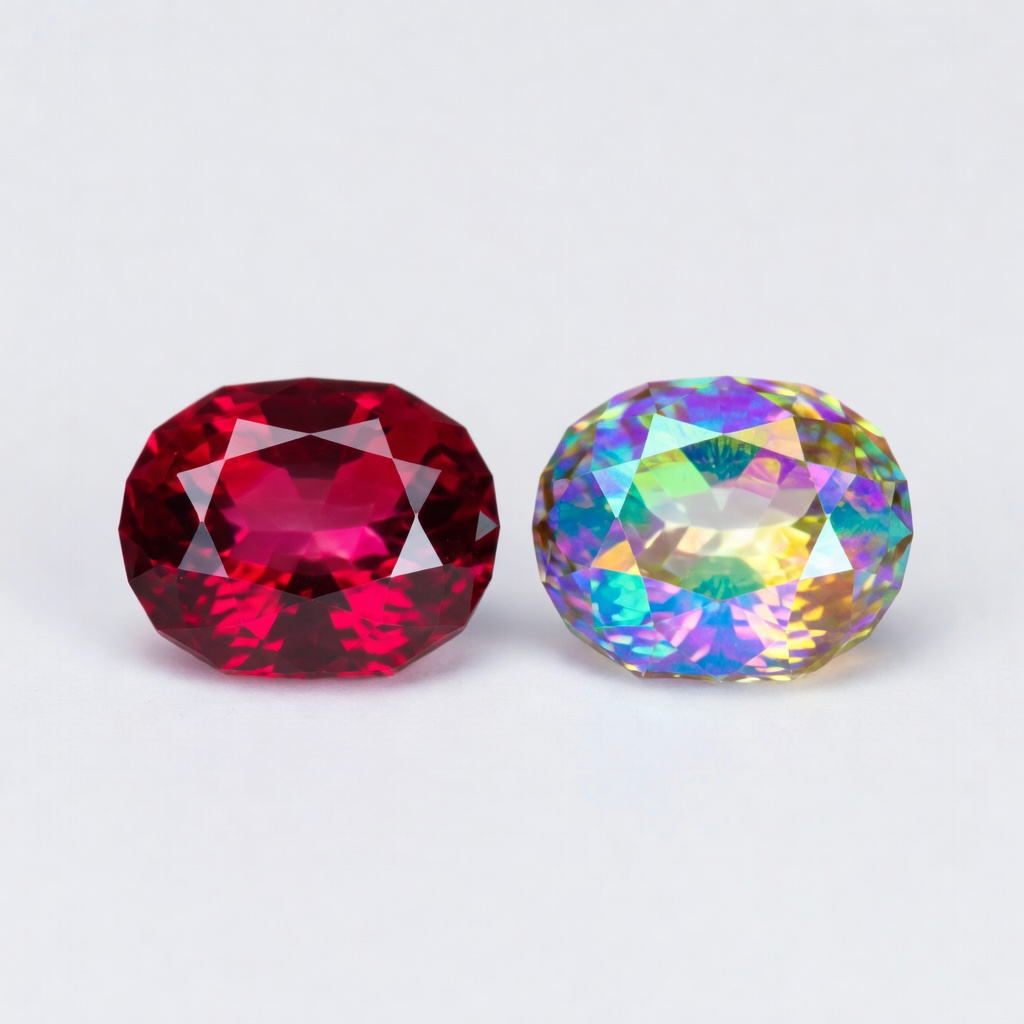
Introduction: Two Worlds of Gemstone Beauty
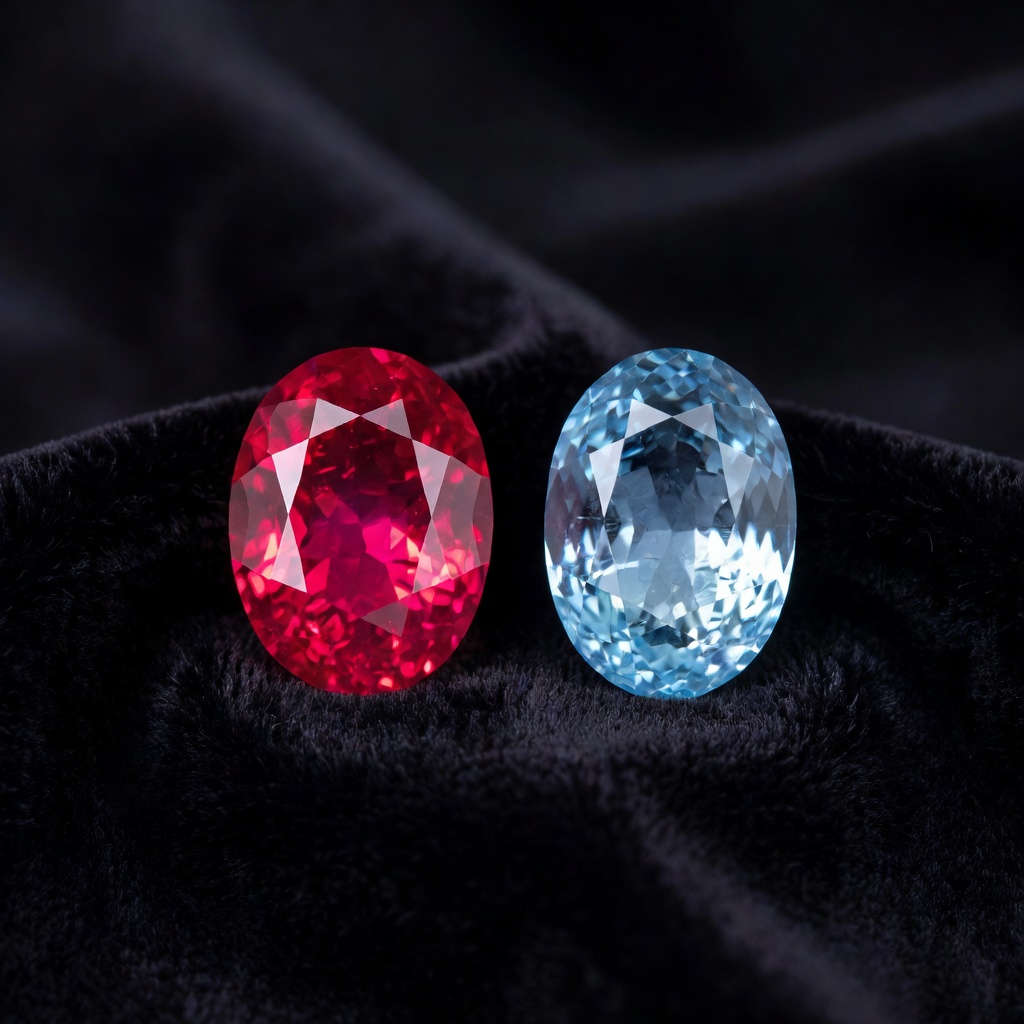
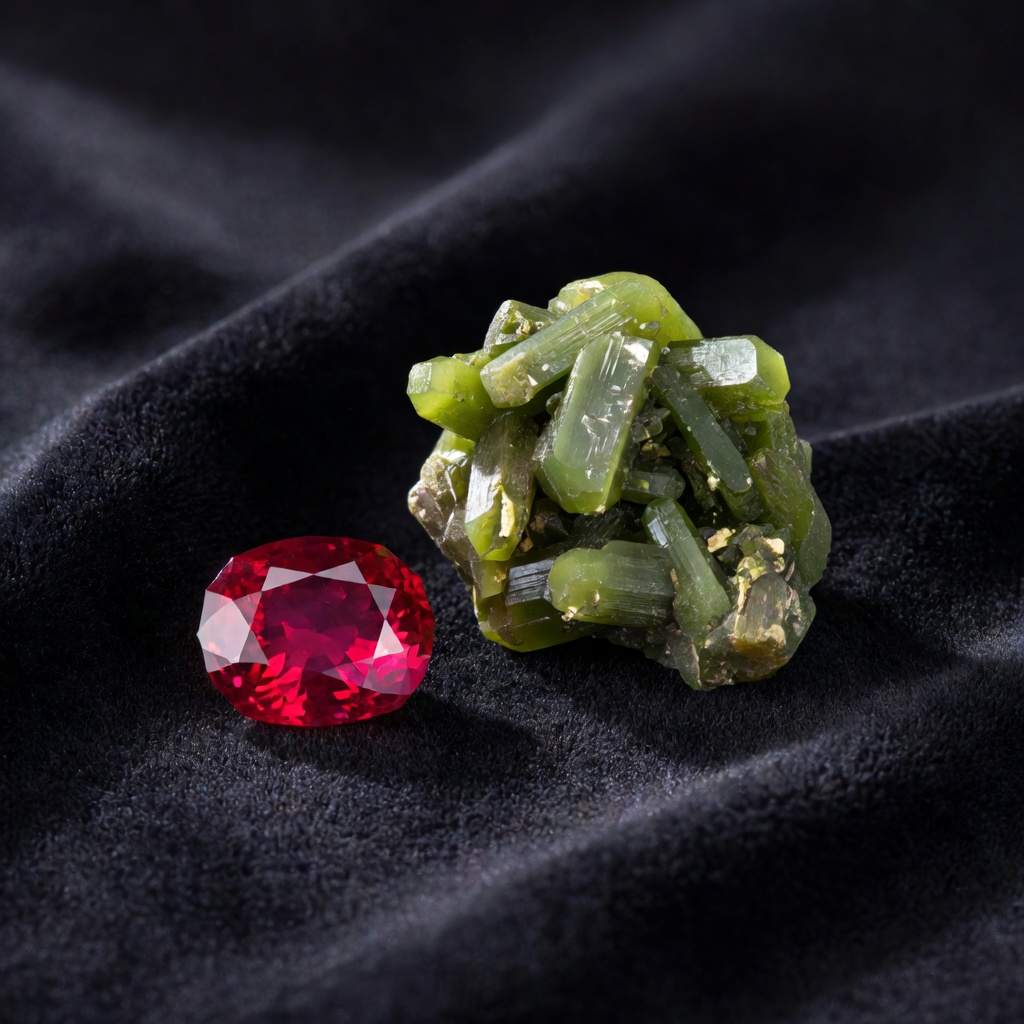
When exploring the vibrant world of colored gemstones, few comparisons illuminate the spectrum of natural wonder and human innovation quite like Ruby vs Mystic Topaz. On one side stands ruby, a fiery red monarch of the precious stone realm that has adorned the crowns of emperors and symbolized passion for millennia. On the other shines mystic topaz, a rainbow-hued marvel of modern gemology that transforms ordinary colorless crystals into prismatic spectacles through advanced thin-film technology. This comprehensive guide examines these two stones across every critical dimension—from their geological origins and physical durability to their investment potential and symbolic meanings—to help jewelry enthusiasts, collectors, and gift-givers make informed decisions that align with their aesthetic desires, practical needs, and budgetary considerations.
Understanding the fundamental differences between these gems requires looking beyond their surface beauty. Ruby represents the pinnacle of natural gemstone formation, crystallizing deep within the earth under intense heat and pressure over millions of years. Conversely, mystic topaz exemplifies the possibilities of treated gemstones, where science enhances nature to create effects impossible to find in the wild. Whether you seek a July birthstone value heirloom to pass through generations or an affordable fashion statement that captures contemporary rainbow trends, this comparison will illuminate which stone deserves a place in your jewelry collection.
What Is Ruby? The King of Precious Gems
Geological Formation and Ruby Gemstone Properties
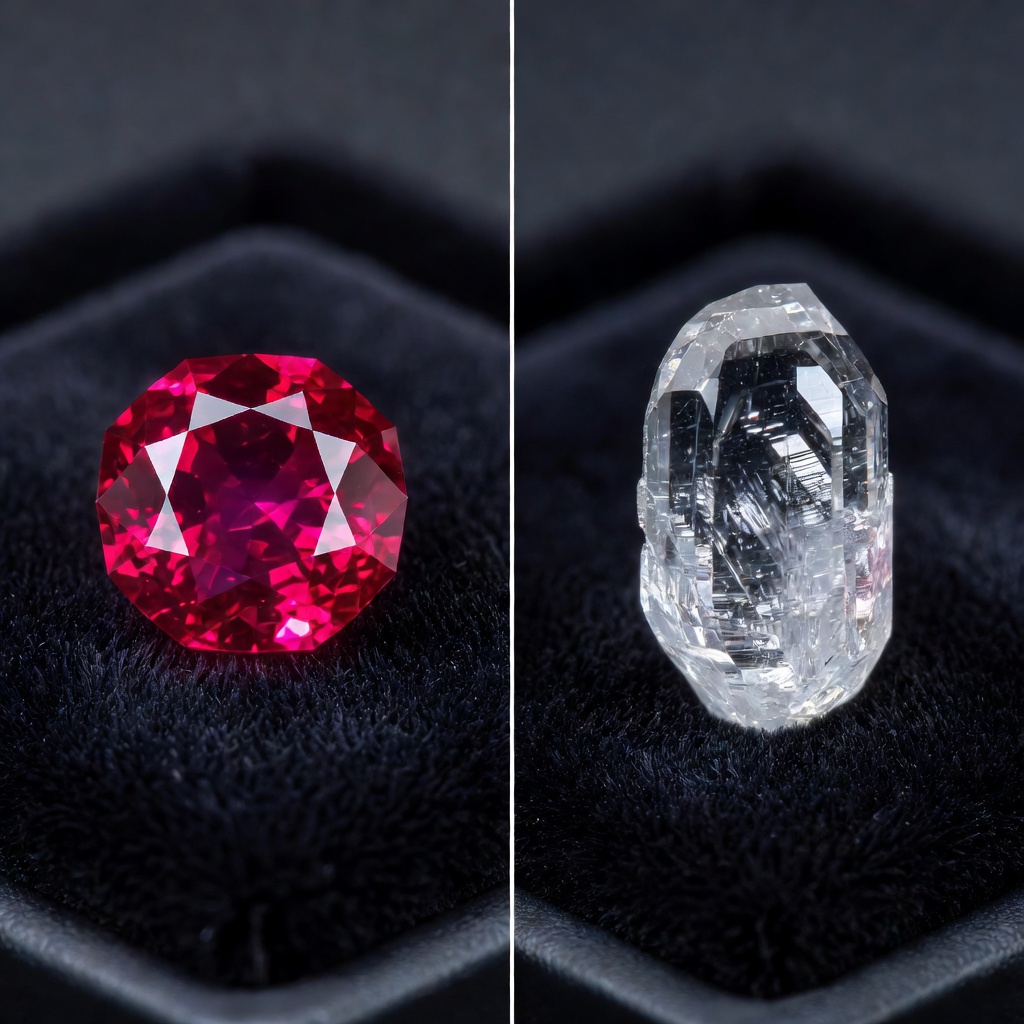
Ruby belongs to the corundum mineral family (aluminum oxide, Al₂O₃), sharing its crystalline structure with sapphire but distinguished by the presence of chromium impurities that gift it its signature red hue. These magnificent crystals form under extreme metamorphic conditions, typically requiring temperatures between 800°C and 900°C and immense pressure at depths of 20 to 40 kilometers within the earth's crust. The most prized specimens originate from marble deposits in Myanmar (Burma), Mozambique, and Thailand, where specific geological conditions allow chromium to replace aluminum in the crystal lattice without causing structural distortion, resulting in the vibrant "pigeon blood" red that commands premium prices.
The ruby gemstone properties that define its superiority include a Mohs hardness of 9, making it second only to diamond in scratch resistance, coupled with a specific gravity ranging from 3.97 to 4.05 and a refractive index of 1.76-1.78 that produces exceptional brilliance. Unlike many gemstones, ruby exhibits strong pleochroism, displaying different shades of red when viewed from different crystallographic directions—a characteristic that master cutters must navigate carefully to orient the stone for maximum color saturation. These physical attributes combine to create a gem that withstands daily wear while maintaining its optical performance across decades.
Historical Significance and Cultural Status
Throughout human civilization, ruby has maintained its position among the most coveted precious vs semi-precious stones, consistently ranking alongside diamond, emerald, and sapphire in the traditional "big four" of the jewelry world. Ancient Sanskrit texts referred to ruby as "ratnaraj," or king of precious stones, while biblical descriptions associated it with wisdom and beauty. The British Crown Jewels feature several notable rubies, including the Black Prince's Ruby (actually a spinel) and genuine Burmese stones in the Imperial State Crown. As the official birthstone for July and the traditional gift for 40th wedding anniversaries, ruby carries established emotional and commemorative value that transcends mere decorative appeal.
Quality Factors and Market Valuation
When assessing ruby quality, gemologists prioritize color above all other factors, seeking vivid saturation with a pure red hue and subtle blue undertones rather than orange or brown modifiers. Clarity presents unique challenges, as virtually all natural rubies contain rutile needle inclusions known as "silk," which, while reducing transparency, can indicate authenticity and sometimes create desirable asterism (star effects) when properly oriented. Cut quality dramatically affects value, with well-proportioned stones minimizing extinction (dark areas) while maximizing light return. Carat weight impacts price exponentially rather than linearly, as specimens over one carat of fine quality become exponentially rarer, with exceptional three-carat stones often commanding six-figure sums at international auction houses.
What Is Mystic Topaz? The Science Behind the Rainbow
The Mystic Topaz Coating Process
Mystic topaz represents a triumph of modern materials science applied to traditional gemology, transforming abundant, colorless natural topaz into a kaleidoscopic display through a process known as Physical Vapor Deposition (PVD). During this treatment, technicians place colorless or lightly colored topaz rough into a vacuum chamber where titanium dioxide (and sometimes other metal oxides) is vaporized and deposited onto the stone's surface in layers measuring mere microns thick. This ultra-thin film creates interference patterns with light, producing the characteristic rainbow effect that shifts between green, blue, purple, and pink depending on viewing angle and lighting conditions.
Unlike surface coatings such as paint or dye, the PVD process creates a molecular bond with the topaz substrate, resulting in greater durability than earlier coating techniques, though still vulnerable compared to untreated gems. The process, patented in the late 1990s, revolutionized the semi-precious stone market by creating an affordable alternative to naturally iridescent gems like opal or alexandrite. However, consumers should understand that this mystic topaz coating process produces a surface-level effect rather than body color, meaning the rainbow display exists only on the exterior of the stone and can wear away with abrasion or improper cleaning.
Physical Properties and Optical Characteristics
As a variety of topaz, the base material possesses a Mohs hardness of 8, positioning it as relatively scratch-resistant compared to many semi-precious stones, though it possesses perfect basal cleavage that makes it prone to chipping along specific planes. The specific gravity ranges from 3.49 to 3.57, noticeably lighter than ruby, while the refractive index of 1.61-1.64 produces less brilliance and "fire" than corundum. The optical magic of mystic topaz stems entirely from thin-film interference—the same physics that creates rainbow patterns in soap bubbles or oil slicks—rather than from chromophores within the crystal structure itself.
Market Position as a Treated Semi-Precious Stone
Introduced to the jewelry market in 1998, mystic topaz occupies a distinct niche among natural vs treated gemstones, offering consumers vibrant color at accessible price points typically ranging from $20 to $100 per carat depending on size and setting quality. Unlike ruby, which derives value from natural rarity, mystic topaz represents value-added manufacturing, where the skill lies in the treatment application and subsequent cutting rather than in the rough material itself. This classification as a treated, semi-precious stone means it carries no investment potential and limited resale value, positioning it firmly in the fashion jewelry category rather than the luxury asset class.
Color and Visual Appearance: Natural vs Enhanced Beauty
Ruby's Chromatic Depth and Pleochroism
The color of ruby emerges from within its crystalline heart, specifically from chromium ions substituting for aluminum in the corundum lattice, which absorb specific wavelengths of light while transmitting red. This internal coloration creates a velvety depth that seems to glow from within, particularly in fine specimens from Myanmar that exhibit "pigeon blood" red—a vivid, saturated hue with a slight blue undertone that appears almost fluorescent in daylight. When examining ruby, observers will notice pleochroism, where the stone displays orange-red or purplish-red tones when rotated, a natural optical phenomenon that distinguishes genuine corundum from simulants and adds dimensional complexity to the gem's appearance.
Mystic Topaz's Prismatic Surface Effect
In stark contrast to ruby's internal coloration, mystic topaz meaning
Identification Techniques for Consumers
Distinguishing between these stones requires understanding their fundamental optical differences. Rubies typically display internal characteristics such as rutile silk, crystal inclusions, or color zoning visible under magnification, along with strong red fluorescence under UV light due to chromium content. Mystic topaz, conversely, often reveals its treated nature through surface characteristics such as scratches on the coating, color concentrations at facet junctions where the coating pools, or a "window" effect where the coating appears thin or absent in certain areas. When viewed from the side or pavilion, mystic topaz reveals its colorless or pale base material, whereas ruby maintains its red color throughout the entire crystal.
Durability and Hardness: Wearability for Daily Jewelry
Gemstone Hardness Comparison and Structural Integrity
The gemstone hardness comparison between these materials reveals significant differences in their suitability for daily wear, despite both ranking relatively high on the Mohs scale. Ruby's hardness of 9 provides exceptional scratch resistance, allowing it to maintain polish and surface integrity through decades of continuous wear, including exposure to household dust (which often contains silica at hardness 7) and accidental contact with metal objects. While topaz registers 8 on the Mohs scale, indicating good scratch resistance in its natural state, it possesses perfect cleavage parallel to the basal pinacoid, creating a structural weakness that makes it more susceptible to chipping or splitting upon impact than its hardness number alone would suggest.
The Vulnerability of Surface Coatings
The durability equation changes dramatically for mystic topaz due to its surface treatment. The titanium dioxide coating measures only 2-4 microns thick—approximately one-twentieth the diameter of a human hair—making it vulnerable to abrasion from everyday activities. Normal wear patterns often manifest first at facet edges and corners where the coating receives the most contact, resulting in a "worn" appearance where the colorless base topaz becomes visible. Unlike scratches on ruby, which can be professionally polished away without losing value, damage to mystic topaz's coating cannot be repaired effectively, as re-coating requires removing the stone from its setting and re-polishing the base material, often proving uneconomical for fashion jewelry.
Thermal and Chemical Stability Concerns
Ruby withstands the heat, steam, and ultrasonic energy commonly used in professional jewelry cleaning, tolerating temperatures exceeding 1000°C without damage to its structure or color. Mystic topaz, however, faces severe limitations: the coating degradates at temperatures above 500°C, suffers damage from ultrasonic cavitation, and can react with harsh chemicals found in household cleaners, chlorine, and even some cosmetics. This thermal and chemical sensitivity restricts cleaning methods to mild soap and water, while also precluding standard jewelry repair techniques such as sizing rings with stones in place, as the heating required for soldering would destroy the coating.
| Characteristic | Ruby | Mystic Topaz |
|---|---|---|
| Origin | Natural corundum formed in earth's crust | Treated natural topaz (PVD coating) |
| Mohs Hardness | 9 (exceptional scratch resistance) | 8 (base material), coating vulnerable to abrasion |
| Color Source | Internal chromium (body color) | Surface titanium dioxide interference coating |
| Price Range per Carat | $1,000 - $100,000+ (fine quality) | $20 - $100 |
| Durability | Excellent for daily wear, heirloom quality | Fair; requires protective settings and gentle use |
| Investment Potential | High; appreciates over time, auction proven | None; fashion jewelry with no resale value |
| Cleaning Methods | Ultrasonic, steam, warm soapy water | Mild soap and water only; no heat or chemicals |
| Birthstone Designation | July (official) | None |
| Best Jewelry Application | Engagement rings, daily wear pieces | Pendants, occasional-wear earrings |
Value and Investment: Price Differences Explained
Market Pricing and Rarity Factors
The financial disparity between these stones reflects their positions in the precious vs semi-precious stones hierarchy, with fine rubies commanding prices that rival or exceed diamonds on a per-carat basis. Exceptional unheated Burmese rubies exceeding five carats can achieve prices of $100,000 per carat or more at international auction houses, while even commercial-quality heated rubies typically range from $1,000 to $10,000 per carat depending on color and clarity. This pricing structure stems from genuine geological scarcity—less than 10% of mined ruby rough proves suitable for faceting, and deposits of fine material deplete faster than new sources emerge. Conversely, mystic topaz derives from abundant colorless topaz deposits in Brazil, Nigeria, and Sri Lanka, with the treatment process adding value through craftsmanship rather than material rarity, resulting in prices accessible to virtually all jewelry consumers.
Investment Potential and Asset Appreciation
For those considering gemstones as alternative investments, ruby offers established provenance as a store of value, with historical records showing consistent price appreciation over decades and centuries. The ruby birthstone value extends beyond sentiment to financial security, as high-quality specimens possess liquid markets through major auction houses and private dealers, with stones often retaining or appreciating in value regardless of economic fluctuations. Mystic topaz, introduced as recently as 1998, demonstrates no investment characteristics whatsoever; its value depends entirely on fashion trends and manufacturing costs, with resale values typically representing a fraction of retail prices. Like other treated fashion stones, mystic topaz should be purchased for immediate aesthetic enjoyment rather than long-term asset preservation.
Treatment Status and Valuation Impact
Within the ruby market, treatment status significantly affects valuation, with unheated, natural-color stones commanding premiums of 300% or more over heat-treated equivalents of similar appearance. disclosure requirements mandate that sellers identify heat treatment, glass filling, or flux healing, as these processes affect both value and care requirements. Mystic topaz, by definition, is a treated gemstone, and while this must be disclosed, the treatment constitutes the entirety of its value proposition rather than a detriment. When purchasing either stone, consumers should demand laboratory certifications from reputable institutions such as GIA, AGL, or Gubelin for rubies to verify natural origin and treatment status, while mystic topaz requires less documentation but should be clearly labeled as "coated" or "treated" to prevent confusion with naturally colored topaz varieties.
Symbolism and Cultural Significance
Ruby: Millennia of Royal Associations
Ruby's symbolic vocabulary spans cultures and centuries, consistently representing passion, protection, prosperity, and courage across diverse civilizations. Ancient Burmese warriors embedded rubies into their skin before battle, believing the stones made them invincible, while Hindu traditions associated rubies with the "ratna" class of gems capable of ensuring peace with enemies and safety from harm. In Western traditions, ruby's red color connected it to the heart and blood, symbolizing vitality and romantic love, a meaning that persists in modern July birthstone jewelry and anniversary celebrations. The stone's presence in royal regalia—from the Ruby Slippers of cinematic fame to the actual crown jewels of European monarchs—reinforces its association with power and prestige that mystic topaz, as a contemporary creation, cannot claim.
Mystic Topaz: Modern Meanings and Contemporary Associations
Lacking the historical depth of ancient gemstones, mystic topaz meaning derives instead from its visual properties and the metaphysical associations of its rainbow color spectrum. New Age practitioners often associate the stone with joy, creativity, and transformation, viewing its multiple colors as representative of chakra alignment and spiritual diversity. The stone's rainbow appearance connects it to modern celebrations of diversity and inclusivity, while its technological creation story appeals to those who value human innovation alongside natural beauty. However, these associations remain contemporary constructs rather than traditional wisdom, limiting the stone's symbolic weight in ceremonial or heirloom contexts.
Birthstone Traditions and Metaphysical Properties
As the established July birthstone, ruby carries specific cultural responsibilities and gift-giving protocols, traditionally believed to enhance energy, stimulate the root chakra, and promote vitality and leadership qualities in those born under its month. Its metaphysical properties emphasize grounding, protection from psychic attack, and stimulation of the life force (chi or prana). Mystic topaz holds no official birthstone status, though some alternative crystal practitioners associate it with November (topaz's traditional month) or assign it to zodiac signs based on color rather than composition. Metaphysically, its rainbow spectrum allegedly addresses all chakras simultaneously, promoting overall balance rather than the specific root chakra activation attributed to ruby.
Jewelry Applications: Best Uses for Each Stone
Ruby: Heirloom Quality and Daily Durability
The exceptional durability and timeless aesthetic of ruby make it suitable for virtually any jewelry application, including high-impact pieces subject to daily wear. Engagement rings featuring ruby center stones have gained popularity among couples seeking alternatives to diamonds, with the stone's hardness of 9 ensuring it withstands decades of continuous wear without scratching or abrading. Ruby excels in prong settings that maximize light return, bezel settings that protect the girdle, and halo designs that amplify its red saturation with diamond accents. For daily wear, ruby studs, tennis bracelets, and solitaire pendants offer practical luxury, while larger statement pieces suit formal occasions. The stone pairs magnificently with platinum and white gold for modern aesthetics, or yellow gold for vintage-inspired warmth, offering versatility across design genres from Art Deco to contemporary minimalism.
Mystic Topaz: Fashion-Forward and Occasional Wear
Given the vulnerability of its coating, mystic topaz requires protective settings and limited exposure to impact or abrasion, making it ideal for pendants and earrings that experience less contact than rings or bracelets. When set in rings, bezel or flush settings that protect the stone's edges prove superior to exposed prong settings that leave corners vulnerable to chipping and coating wear. The stone's contemporary rainbow aesthetic pairs naturally with sterling silver or gold-plated settings that complement its modern vibe, though the base metal quality should match the stone's fashion-jewelry positioning. Designers often utilize mystic topaz in cocktail rings, drop earrings, and statement pendants where the stone receives occasional rather than daily wear, preserving the coating's integrity for special occasions.
Design Considerations and Metal Pairings
When designing with ruby, jewelers must account for pleochroism by orienting the table perpendicular to the c-axis to maximize red saturation, while mystic topaz requires careful cutting to ensure the coating applies evenly across complex facet patterns. Ruby's classic elegance suits traditional milgrain details, filigree work, and three-stone anniversary settings, while mystic topaz demands contemporary, clean lines that highlight its futuristic iridescence without competing design elements. For consumers building jewelry wardrobes, ruby serves as the "investment piece" or "forever stone," while mystic topaz functions as the "trend accessory" or "color accent" that refreshes a collection without significant financial commitment.
Care and Maintenance Requirements
Ruby Cleaning and Professional Maintenance
Maintaining ruby jewelry requires minimal special precautions due to the stone's exceptional hardness and stability. For routine cleaning, warm water mixed with mild dish soap and a soft-bristled toothbrush effectively removes accumulated oils and debris from behind the stone and within settings. Untreated or heat-treated rubies safely withstand ultrasonic cleaning and steam cleaning, methods that professional jewelers use to remove stubborn buildup in intricate settings. However, rubies with glass fillings or significant fractures require gentler treatment, as the filling materials may not tolerate high heat or ultrasonic vibration. Annual professional inspections ensure that prongs remain tight and settings secure, preventing loss of these valuable stones during wear. With proper care, ruby jewelry maintains its brilliance for generations, often requiring only occasional repolishing to remove surface scratches after decades of wear.
Mystic Topaz: Delicate Handling and Coating Preservation
The mystic topaz coating process creates specific care requirements that differ dramatically from untreated gemstones. Owners must clean mystic topaz using only mild soap and lukewarm water, applying gentle pressure with a soft cotton cloth rather than brushes that might scratch the titanium layer. Ultrasonic cleaners, steam cleaners, and chemical jewelry dips pose immediate threats to the coating, potentially removing the rainbow effect entirely or creating patchy, damaged appearances. Storage requires isolation from other jewelry pieces in soft pouches or separate compartments, as contact with harder stones (including ruby) will scratch the coating. Removal before swimming, bathing, applying cosmetics, or engaging in physical activities prevents chemical exposure and physical abrasion that compromise the stone's appearance.
Long-Term Maintenance Realities
One of the most significant natural vs treated gemstones distinctions emerges in long-term maintenance capabilities. When ruby surfaces accumulate scratches or lose polish over decades, skilled lapidaries can repolish the stone, removing a microscopic layer of material to restore original brilliance without affecting value significantly. Mystic topaz offers no such rehabilitation; once the coating scratches, chips, or wears away at facet junctions, the stone cannot be restored to its original condition through recoating, as the process requires removing the stone from its setting and re-preparing the base material. This finite lifespan makes mystic topaz essentially disposable luxury rather than heirloom material, requiring replacement rather than restoration when wear becomes noticeable.
Which Should You Choose? A Buyer's Decision Framework
Choose Ruby If: Investment and Legacy Matter
Select ruby when seeking jewelry that transcends fashion cycles to become family heritage, particularly for significant life events such as engagements, 40th anniversaries, or July birthdays where the ruby birthstone value adds sentimental and financial significance. If your budget accommodates $1,000+ per carat and you prioritize durability for daily wear without special precautions, ruby offers unmatched longevity and timeless elegance. Collectors seeking tangible assets that appreciate over time, or individuals drawn to the deep historical and cultural associations of precious gemstones, will find ruby satisfies both aesthetic desires and practical investment criteria. The stone suits those who appreciate natural phenomena—the millions of years of geological processes required to create chromium-rich corundum—and who value authenticity over enhancement.
Choose Mystic Topaz If: Budget and Trend Appeal Prioritize
Opt for mystic topaz when working with a budget under $200, desiring the visual impact of rainbow iridescence without the cost of natural opal or black opal, or seeking contemporary fashion jewelry that reflects current trends rather than classical traditions. This stone appeals to younger consumers, those who enjoy coordinating jewelry with specific outfits, or gift-givers seeking impressive visual impact without significant financial outlay. If you commit to careful handling, removing the jewelry during physical activities, and accepting that the piece has a limited lifespan of 5-10 years before coating degradation, mystic topaz provides affordable enjoyment. The stone particularly suits those fascinated by technological enhancement of natural materials and who value human ingenuity alongside geological processes.
Ethical Considerations and Sourcing Transparency
Both stones present distinct ethical considerations that conscious consumers should evaluate. Ruby mining, particularly in Myanmar and some African regions, has historically involved issues including conflict financing, environmental degradation, and labor concerns, making certified ethical sourcing or lab-grown alternatives increasingly important for responsible buyers. Mystic topaz, while avoiding mining controversies associated with its abundant base material, involves industrial coating processes with their own environmental footprints regarding energy use and chemical handling. For either purchase, request documentation regarding origin and treatment: GIA or AGL reports for rubies verifying natural vs. synthetic origin and treatment disclosure, and seller disclosure of coating treatment for mystic topaz to ensure informed consent.
Final Verdict: Complementary Rather Than Competitive
Ultimately, Ruby vs Mystic Topaz represents less of a competition and more of a complementary spectrum within a well-rounded jewelry collection. Ruby provides the foundational pieces—engagement rings, stud earrings, tennis bracelets—that anchor a wardrobe with timeless sophistication and enduring value. Mystic topaz offers accessible color and contemporary flair for fashion-forward moments without requiring long-term commitment or significant capital investment. The sophisticated collector might own both: ruby for permanence and legacy, mystic topaz for playful experimentation and trend participation. Your choice depends not on which stone is "better" in absolute terms, but which better serves your specific needs for durability, budget, symbolism, and aesthetic expression in this particular moment of your jewelry journey.
Frequently Asked Questions
Is ruby more valuable than mystic topaz?
Yes, significantly. Fine rubies can cost $10,000+ per carat due to natural rarity, while mystic topaz typically ranges $20-$100 per carat. Ruby is a precious gemstone with investment value; mystic topaz is a treated semi-precious stone with fashion jewelry value only.
What exactly is mystic topaz and how is it created?
Mystic topaz is natural colorless topaz that has been coated with an extremely thin layer of titanium dioxide using a process called Physical Vapor Deposition (PVD). This coating creates a rainbow iridescent effect through light interference, but it's only microns thick and can wear off over time.
Can you tell ruby and mystic topaz apart easily?
Yes, absolutely. Rubies display a deep, saturated red color from internal chromium, while mystic topaz shows a surface-level rainbow effect with metallic luster. Rubies also have a higher hardness (9 vs 8) and different optical properties like pleochroism and fluorescence that mystic topaz lacks.
Which gemstone is better for an engagement ring?
Ruby is far superior for engagement rings due to its exceptional hardness (9), toughness, and ability to withstand daily wear for decades. Mystic topaz's coating is prone to scratching and chipping, making it unsuitable for rings worn daily. Ruby also holds heirloom and investment value.
How should I clean and care for mystic topaz jewelry?
Clean mystic topaz only with mild soapy water and a soft cloth. Avoid ultrasonic cleaners, steam cleaners, and all harsh chemicals. Store separately from other jewelry to prevent scratches, remove during activities, and avoid extreme heat which can damage the coating. Never use abrasive cleaners.
Is mystic topaz considered a 'real' gemstone?
Yes, mystic topaz is a real topaz gemstone that has been surface-treated. The base material is natural topaz, but the rainbow colors are artificially applied. It's considered a 'treated gemstone' rather than a naturally colored one, which significantly affects its value and classification in the jewelry industry.
What is the hardness difference between ruby and topaz?
Ruby scores 9 on the Mohs hardness scale, making it extremely durable and second only to diamond. Topaz scores 8, which is still quite hard, but it has perfect basal cleavage, making it more brittle and prone to chipping. The coating on mystic topaz adds no hardness and is much more vulnerable.
Which stone is rarer: ruby or mystic topaz?
Ruby is exponentially rarer, especially fine quality natural stones over 1 carat. High-quality rubies are among the rarest and most valuable gemstones on Earth. Mystic topaz is created from abundant colorless topaz, making it widely available and affordable. The treatment process is the only factor limiting production.