Understanding Ruby vs Ethiopian Opal
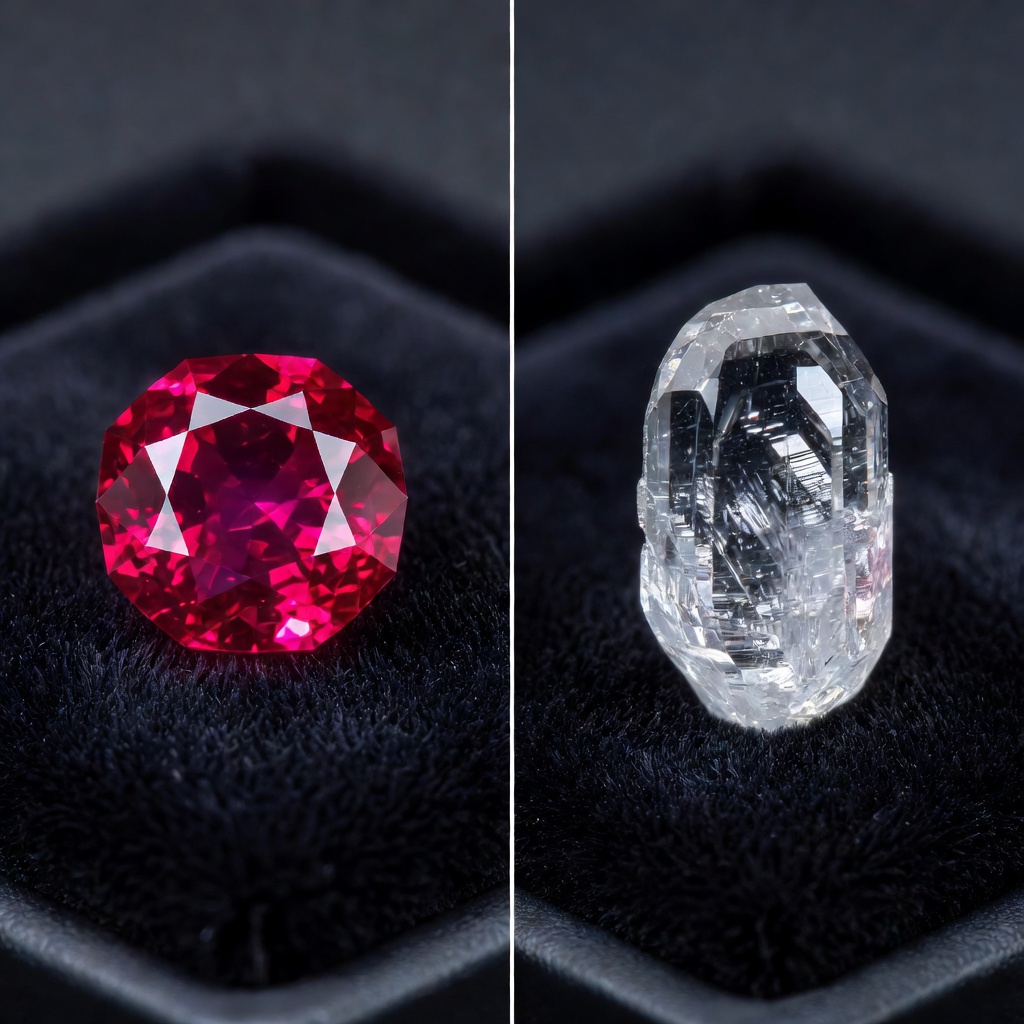
Rubies and Ethiopian Opals represent two distinct paradigms in the gemstone world, each captivating collectors with unique optical phenomena and geological histories that span millions of years. Rubies form deep within the earth's crust under intense heat and pressure, crystallizing from aluminum oxide into the corundum family that shares its lineage with sapphires. Ethiopian Opals, conversely, emerge from ancient volcanic activity in the Horn of Africa, where silica-rich water percolated through volcanic ash to create hydrated amorphous silica deposits over geological epochs. These divergent formation processes result in gemstones that satisfy fundamentally different aesthetic desires and practical applications in fine jewelry, making the comparison between Ruby vs Ethiopian Opal essential for informed collecting.
Current market trends reveal growing interest in both stones among millennial and Gen-Z consumers seeking alternatives to traditional diamonds for engagement rings and statement pieces. While rubies maintain their status as one of the "Big Three" colored gemstones alongside sapphires and emeralds, Ethiopian Opals have experienced a renaissance since their 2008 discovery in the Welo region, challenging Australian opal dominance with their remarkable stability and vibrant fire. Collectors frequently compare these gems when building diversified portfolios or selecting milestone gifts, as both offer intense color saturation but represent opposite ends of the durability spectrum. Understanding the nuanced differences between these precious stones becomes crucial for making purchasing decisions that align with lifestyle needs, budget constraints, and long-term value expectations.
Physical Properties and Chemical Composition
The fundamental distinction between these gemstones begins at the molecular level, where their atomic structures dictate everything from durability to optical performance and cutting possibilities. Ruby belongs to the corundum mineral species, consisting of aluminum oxide (Al₂O₃) with trace chromium elements responsible for its iconic red coloration and fluorescence. This trigonal crystal system creates an exceptionally dense structure with strong covalent bonding between aluminum and oxygen atoms that resists environmental degradation. Ethiopian Opals, classified strictly as mineraloids rather than true minerals due to their lack of crystalline structure, comprise hydrated amorphous silica (SiO₂·nH₂O) containing 5% to 20% water trapped within their microscopically packed silica spheres.
Crystal Structure and Hardness Differences
Ruby's highly organized crystalline structure yields extraordinary hardness, registering 9 on the Mohs scale—second only to diamonds in natural gemstone durability and suitable for daily wear without significant abrasion concerns. This exceptional hardness stems from tightly packed atomic arrangements that resist scratching and surface damage during normal activities, including contact with household dust and common materials. Ethiopian Opals present a dramatically different scenario with Mohs hardness ratings between 5.5 and 6.5, comparable to glass or steel nail files, making them significantly more vulnerable to surface scratches and edge chipping. The amorphous, non-crystalline nature of opal lacks the organized atomic planes that give rubies their toughness, resulting in a gemstone that requires protective settings and careful handling to prevent permanent damage.
| Property | Ruby | Ethiopian Opal |
|---|---|---|
| Chemical Composition | Aluminum Oxide (Al₂O₃) | Hydrated Silica (SiO₂·nH₂O) |
| Crystal System | Trigonal | Amorphous (No Crystal Structure) |
| Mohs Hardness | 9 | 5.5 - 6.5 |
| Specific Gravity | 3.97 - 4.05 | 1.98 - 2.50 |
| Refractive Index | 1.762 - 1.770 | 1.37 - 1.52 |
| Cleavage | None (Conchoidal Fracture) | None (Conchoidal to Uneven) |
| Water Content | 0% | 5% - 20% |
Optical Density and Specific Gravity
Specific gravity measurements reveal another stark contrast between these gemstones, with rubies feeling substantially heavier than equivalently sized opals due to their density of 3.97 to 4.05 compared to opal's lighter 1.98 to 2.50 range. This density differential affects setting requirements significantly, as rubies require more secure prong configurations to prevent loss due to weight, while opals need protection from impact due to their brittleness rather than mass concerns. Refractive indices also diverge significantly, with rubies bending light at 1.762 to 1.770, creating distinct brilliance and fire that gem cutters exploit through precise facet arrangements. These Ruby gemstone properties make them ideal candidates for precision cutting styles that maximize brilliance and scintillation, whereas Ethiopian Opal characteristics require cutters to prioritize color pattern preservation and cabochon shapes over geometric precision to protect the stone and display its optical phenomena.
Visual Characteristics: Color, Clarity, and Phenomena
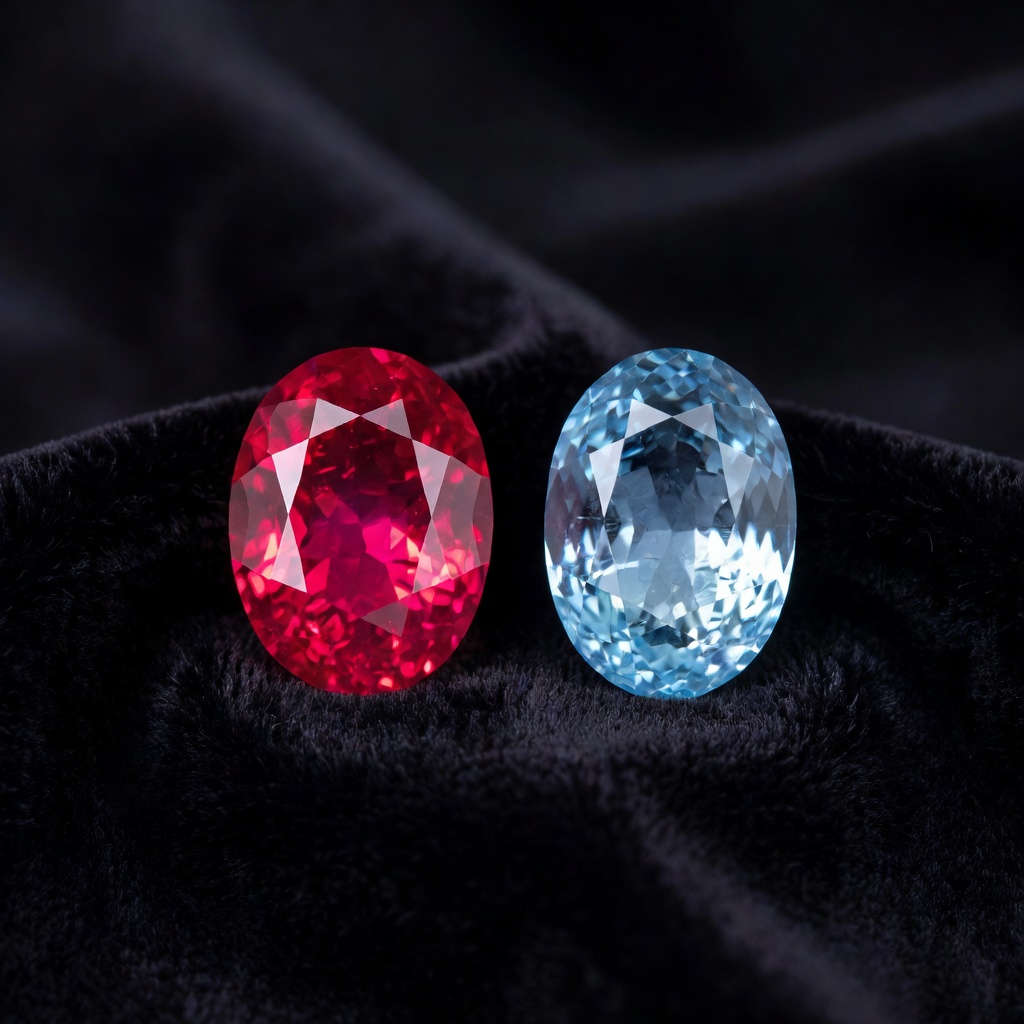
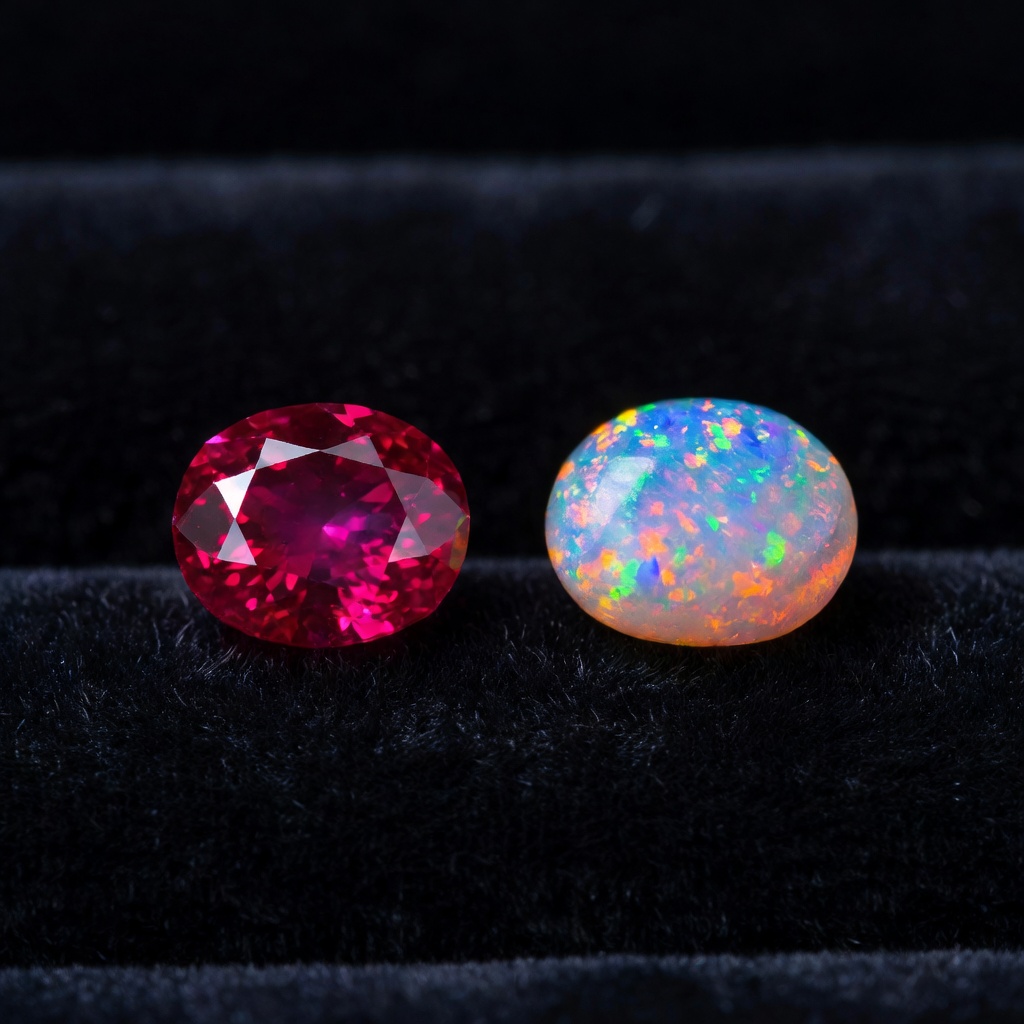
Visual distinction between these gemstones extends far beyond their base colors, encompassing complex optical phenomena that define their desirability, value propositions, and emotional impact on viewers. Rubies derive their market value primarily from saturated red hues ranging from pinkish-red to deep pigeon blood, with the most coveted specimens exhibiting vivid red fluorescence under UV light due to high chromium content and low iron. Ethiopian Opals captivate through entirely different mechanisms, displaying spectral play-of-color caused by light diffraction through microscopic silica spheres arranged in regular, grid-like patterns within the stone's structure.
Ruby's Chromatic Intensity and Optical Effects
The most valuable rubies, particularly those from Myanmar's Mogok region, display "pigeon blood" red—a pure, vibrant red with a subtle hint of blue that appears to glow from within due to strong fluorescence under daylight and UV illumination. High-quality rubies may also exhibit asterism, the star effect created by intersecting needle-like rutile inclusions that reflect light in six-rayed patterns when cut as cabochons, commanding premium prices in Asian markets. Clarity characteristics in rubies typically include natural inclusions known as "silk," which, while reducing transparency, often indicate natural origin rather than synthetic manufacture and can enhance the stone's velvety appearance prized by connoisseurs over "glassy" perfect stones. Unlike Ethiopian Opals, which rely on diffracted light for their beauty, rubies achieve their visual impact through transmitted and reflected light interacting with trace elements and crystalline perfection, creating depth and saturation impossible in amorphous materials.
Ethiopian Opal's Play-of-Color and Body Tones
Ethiopian Opals revolutionized the opal market by introducing hydrophane varieties that absorb water and temporarily become transparent or translucent, revealing vibrant color patterns against crystal-clear backgrounds that differ from Australian sedimentary opals. These gems display body tones ranging from crystal clear (colorless) to milky white, yellow, brown, and rare black, with the dark body tones providing maximum contrast for spectral fire and commanding the highest prices in the opal category. The play-of-color manifests as flashing patches of red, green, blue, and gold that shift with viewing angles and lighting conditions, created by silica spheres measuring 150-300 nanometers in diameter that diffract light into spectral components. Unlike rubies, where inclusions typically reduce value and clarity is paramount, Ethiopian Opals may contain interesting matrix patterns, "fingerprints," or host rock inclusions that collectors appreciate as unique identifying characteristics rather than flaws, adding to the stone's individual character.
Durability Assessment and Daily Wearability
Practical wearability represents the most significant divergence between these gemstones, directly impacting their suitability for various jewelry applications and lifestyle requirements for modern consumers. Ruby hardness vs Opal comparisons reveal fundamental limitations that should guide consumer choices, particularly for pieces subject to daily physical contact, temperature variations, and chemical exposure. While rubies withstand the rigors of active lifestyles and generational wear without special precautions, Ethiopian Opals demand protective considerations and usage restrictions to prevent permanent damage that could occur within moments of mishandling.
Ruby's Exceptional Toughness for Active Lifestyles
Rubies possess not only superior hardness but also excellent toughness—the resistance to breaking, chipping, or cracking—making them ideal for engagement rings, bracelets, and daily wear pieces that experience regular impact and abrasion. Their lack of cleavage planes means they resist splitting along structural weakness lines regardless of impact direction, while their chemical stability prevents degradation from exposure to cosmetics, perspiration, household cleaners, or environmental pollutants. Historical evidence supports this durability, with rubies in crown jewels and antique jewelry maintaining their brilliance for centuries despite constant handling, wars, and environmental changes. For clients seeking heirloom-quality stones that endure swimming, gardening, sports, or office work without requiring removal or special precautions, rubies provide unparalleled peace of mind and cost-per-wear value.
Ethiopian Opal's Fragility and Environmental Sensitivity
Ethiopian Opals present a complex durability profile where moderate surface hardness combines with poor toughness and significant environmental sensitivity that challenges their longevity in jewelry applications. The hydrophane nature means these stones absorb liquids readily, potentially causing internal cracking if exposed to water while set in jewelry with thermal expansion differences between metal and stone during drying. Sudden temperature changes, dehydration in arid climates or heated buildings, or impact against hard surfaces can induce "crazing"—microscopic cracks that spiderweb across the surface, permanently destroying the stone's beauty and value within seconds. Case studies from jewelry repair shops indicate that Ethiopian Opal rings experience damage rates 400% higher than ruby rings within the first year of ownership, primarily from dehydration and impact trauma, suggesting these stones function better as occasional wear items rather than daily companions.
Protective Setting Strategies for Vulnerable Stones
When incorporating Ethiopian Opals into jewelry designs, protective settings become non-negotiable for longevity and must be prioritized over design aesthetics that expose the stone. Full bezel settings that wrap the girdle completely in metal provide superior protection compared to prong settings, distributing impact forces across the metal rather than concentrating them on the stone's vulnerable edges. Halo designs incorporating diamond or hard gemstone surrounds absorb impact that might otherwise strike the opal directly, while low-profile settings keep the stone closer to the finger, reducing lever-arm forces during strikes. For rubies, four or six-prong settings maximize light exposure and showcase the stone's brilliance without significant vulnerability concerns, allowing for elevated cathedral settings that display the gem prominently. Jewelry designers consistently recommend reserving Ethiopian Opals for pendants and earrings, which experience less physical trauma than rings or bracelets, while rubies excel in all jewelry categories including high-impact pieces like tennis bracelets and right-hand rings.
Origins, Mining, and Rarity Factors
Geographic provenance significantly influences the value, characteristics, and ethical considerations surrounding both gemstones, with distinct mining cultures and geological conditions creating unique market segments and collector preferences. Understanding these origins helps collectors appreciate the journey from rough material to finished gem while making informed decisions about sustainability, traceability, and investment potential. This Precious gemstones comparison reveals how rarity manifests differently in crystalline versus amorphous gemstone categories, affecting availability and pricing structures.
Primary Sources and Geological Context
Burmese rubies from the Mogok Stone Tract have dominated the high-end market for centuries, producing stones with unmatched fluorescence and saturation due to specific marble-hosted geological formations found nowhere else on earth. Mozambique and Madagascar have emerged as significant alternative sources, offering larger crystals and improved traceability while sometimes lacking the characteristic "glow" or fluorescence of classic Burmese material that commands premium prices. Ethiopian Opals originate primarily from the Welo and Wollo regions, where volcanic deposits formed approximately 30 million years ago create the hydrophane varieties that distinguish them from sedimentary Australian opals in both appearance and stability characteristics. The Welo fields particularly produce stable, non-hydrophane opals alongside the water-absorbing varieties, requiring expert sorting and stabilization treatments to ensure long-term durability for jewelry use.
Rarity and Quality Grading Considerations
Untreated pigeon blood rubies exceeding five carats represent extreme rarity in the gemstone world, with fewer than 50 significant specimens appearing at major auction houses annually worldwide, driving prices to $100,000 or more per carat for exceptional stones with documented provenance. Heat-treated rubies, while more abundant in the market, still command premium prices when displaying optimal color and clarity combinations, particularly stones from newer African mines that offer cleaner crystals than traditional Burmese material. Ethiopian Opals exhibit different rarity patterns, where large clean specimens over 10 carats remain relatively accessible at moderate prices, but true black Ethiopian opals with intense red fire command prices rivaling fine sapphires due to their extreme scarcity. The 2008 discovery of Ethiopian deposits temporarily flooded the market with commercial-grade material, but exhaustion of easily accessible seams and increasing export restrictions have begun constraining supply for premium specimens, potentially supporting future price appreciation.
Ethical Mining and Traceability Challenges
The ruby trade faces ongoing scrutiny regarding Myanmar's military-controlled mining operations, leading many Western dealers and luxury brands to prefer Mozambican or Thai-treated stones certified by the Responsible Jewellery Council and other ethical oversight organizations. Ethiopian Opal mining occurs primarily through artisanal cooperatives using hand tools rather than heavy machinery, reducing environmental impact but creating challenges in establishing consistent quality grading, fair wage practices, and safety standards for miners. Blockchain traceability initiatives have gained traction in both sectors, with some luxury brands now offering mine-to-market documentation for high-value rubies and Ethiopian opals, allowing consumers to verify ethical sourcing claims. Consumers prioritizing ethical sourcing should seek gems accompanied by origin reports from recognized laboratories like GIA, Gübelin, or SSEF, verifying both geographical source and treatment disclosure while ensuring compliance with international labor and environmental standards.
Price Analysis and Investment Potential
Market valuations for these gemstones reflect their relative durability, rarity, cultural prestige, and liquidity characteristics, creating distinct investment profiles that appeal to different collector motivations and risk tolerances. While both stones offer aesthetic appreciation potential, their financial trajectories and liquidity characteristics diverge significantly in global markets, affecting their suitability for investment portfolios. Understanding Ethiopian Opal vs Ruby value propositions requires examining both retail and auction-level price behaviors across quality grades while considering long-term maintenance costs and depreciation risks.
Price-Per-Carat Breakdown by Quality Grade
Commercial-quality rubies with heat treatment and moderate inclusions typically range from $1,000 to $5,000 per carat in retail settings, while fine unheated Burmese specimens escalate rapidly from $10,000 to $100,000 or more per carat depending on size, color purity, and documentation quality. Ethiopian Opals present a broader value spectrum, with commercial white or crystal body tone specimens available for $50 to $300 per carat, making them accessible to entry-level collectors, while premium black Welo opals with broad flash patterns command $1,000 to $5,000 per carat. Exceptional Ethiopian specimens exhibiting rare patterns like "harlequin" or "Chinese writing" may exceed $10,000 per carat, though these represent less than 0.1% of production and require expert verification of natural origin. The entry-level accessibility of Ethiopian Opals attracts novice collectors and fashion jewelry buyers, whereas ruby investment typically requires substantial capital commitment for acquisition of assets with proven appreciation histories.
Market Stability and Historical Performance
Rubies have demonstrated consistent value appreciation over decades, with untreated Burmese stones showing 8-12% annual growth rates comparable to blue-chip art, fine wine, or precious metals investments during stable economic periods. The closure of Myanmar's Mogok mines to foreign investment, combined with increasing demand from Asian markets and limited new discoveries, suggests continued supply constraints supporting long-term price stability and growth. Ethiopian Opals exhibit more volatile pricing patterns, having experienced 60% price drops immediately following the 2008 discovery flood before stabilizing as market absorption occurred and lower-quality material was worked through the supply chain. Current trends show steady 5-7% annual appreciation for top-tier Ethiopian specimens with stable, non-hydrophane characteristics, though liquidity remains lower than rubies, with fewer auction houses featuring dedicated opal sales and longer time-on-market for resale.
Investment Outlook and Portfolio Considerations
Investment-grade rubies function as portable wealth stores similar to diamonds, accepted universally by dealers and auction houses with established grading standards ensuring liquidity during economic downturns or personal financial needs. Collectors should prioritize untreated stones over 3 carats with documentation from prestigious laboratories like SSEF, Gübelin, or AGL for maximum appreciation potential, focusing on pigeon blood color and minimal inclusions. Ethiopian Opals require more speculative approaches, with investment focusing on unique pattern combinations, exceptional size (over 20 carats), provenance from specific depleted mines, or exceptional black body tones that rival Australian material. Portfolio diversification strategies suggest allocating 80-90% of precious gemstone investments to durable, historically stable stones like rubies while reserving 10-20% for high-quality Ethiopian Opals as speculative growth opportunities that may outperform the market if scarcity increases.
Jewelry Design Applications and Setting Styles
Successful jewelry design maximizes each gemstone's aesthetic strengths while mitigating inherent vulnerabilities through strategic metal choices, protective configurations, and complementary design elements. The question of Best gemstone for engagement ring depends heavily on design philosophy, lifestyle constraints, maintenance willingness, and symbolic preferences rather than absolute quality metrics. Both stones inspire distinct design languages—rubies favoring classical elegance, symmetry, and timelessness, while Ethiopian Opals encourage organic, bohemian expressions that emphasize uniqueness over perfection.
Optimal Designs for Ruby Showcases
Rubies excel in traditional solitaire settings that emphasize their geometric precision and saturated color, with four-prong cathedral settings allowing maximum light penetration while securing the stone firmly against daily wear stresses. Three-stone designs pairing central rubies with diamond side stones create striking color contrast while referencing the past-present-future narrative popular in bridal jewelry and anniversary celebrations. For vintage enthusiasts, Art Deco-inspired step-cut rubies in geometric bezels or Edwardian filigree settings highlight the stone's royal associations and historical significance. Contemporary designers increasingly utilize rubies in minimalist tension settings or east-west orientations for modern aesthetics, capitalizing on the gem's durability to experiment with daring exposed designs impossible with softer stones that require protection.
Ethiopian Opal Design Considerations
Ethiopian Opals demand designs that protect their vulnerable girdles and pavilion while maximizing their unique optical properties through careful orientation and lighting considerations. Full bezel settings in 14k or 18k gold provide the most secure environment, cushioning the stone against lateral impacts that could cause chipping while preventing dehydration through metal contact. Halo designs incorporating diamond or sapphire surrounds not only enhance the opal's apparent size but absorb impact that might otherwise damage the center stone during daily activities. For earrings, lever-back closures prevent loss while allowing movement that displays the opal's color play, while pendant designs keep the stone away from hard surfaces during desk work or driving. Design case studies indicate that Ethiopian Opal rings experience 70% longer lifespans when set in low-profile designs with protective bezels rather than high cathedral settings that expose the stone to knocks and temperature changes.
Metal Pairing and Complementary Gemstones
Yellow gold enhances the warmth of pigeon blood rubies while creating vintage elegance that references the stone's historical use in royal regalia, whereas white gold or platinum settings emphasize the cool blue undertones in some Burmese specimens and provide contemporary sophistication suitable for modern brides. Ethiopian Opals offer versatile metal compatibility, with rose gold accentuating pink and red fire patterns, while white metals emphasize blue and green spectral displays and create neutral backgrounds for color experimentation. When combining these stones with others, rubies pair safely with diamonds, sapphires, and spinels of similar hardness in multi-stone designs, whereas Ethiopian Opals should never contact harder stones in multi-gem designs to prevent scratching and abrasion. Practical tip: In convertible jewelry pieces, designers increasingly separate Ethiopian Opals from contact with other gems using metal dividers or distinctive link systems that prevent friction while allowing design cohesion.
Symbolism, Metaphysical Properties, and Cultural Significance
Beyond their physical beauty, these gemstones carry millennia of cultural associations and metaphysical beliefs that influence consumer preferences, gifting traditions, and personal connection to jewelry pieces. Ruby and Ethiopian Opal meaning varies across civilizations and time periods, yet both consistently associate with powerful emotional and spiritual properties that transcend their material value. Understanding these symbolic dimensions adds depth to collection curation and personal adornment choices while providing conversation topics and personal significance for wearers.
Ruby's Associations with Power and Passion
Ancient Sanskrit texts referred to rubies as "ratnaraj" or "king of precious stones," associating them with the sun, vitality, and the life force blood that sustains existence and drives human ambition. Burmese warriors historically inserted rubies into their flesh before battle, believing the stones conferred invulnerability, courage, and protection from physical harm, while Hindu traditions suggested offering rubies to Krishna ensured rebirth as emperors in subsequent lifetimes. Medieval European royalty wore rubies to ward off evil, maintain health, and detect poison, with the stone appearing in nearly every crown jewel collection as symbols of sovereign power and divine right to rule. Modern crystal healing practices attribute rubies with stimulating the root chakra, enhancing passion, motivation, and leadership qualities while protecting against psychic attacks and emotional vampirism that drain personal energy.
Ethiopian Opal's Connection to Creativity and Transformation
Opals have endured complex reputations throughout history, once considered unlucky in Victorian England due to Sir Walter Scott's novels, yet treasured by Romans as "pietra di luce" (stone of light) containing the beauty of all other gems within their shifting colors. Ethiopian Opals specifically connect to creative expression and emotional healing, believed to amplify thoughts and feelings while releasing inhibitions, past traumas, and creative blocks that prevent authentic self-expression. Indigenous African traditions associate Welo opals with rainbows and water spirits, using them in rituals to summon precipitation, ensure agricultural abundance, and mark seasonal transitions. Contemporary metaphysical practitioners value Ethiopian Opals for enhancing cosmic consciousness, supporting lucid dreaming, and facilitating transitions during major life changes due to their water-element associations and prismatic energy that reflects multiple perspectives simultaneously.
Historical Significance and Modern Interpretations
The Black Prince's Ruby, actually a red spinel but historically confused with ruby for centuries, sits in England's Imperial State Crown, demonstrating the stone's enduring association with monarchical legitimacy, protection, and the transmission of authority across generations. Ethiopian Opals, relative newcomers to the global market compared to ancient ruby sources, lack such extensive historical provenance but rapidly acquire significance as collectors document their journey from desert discovery to finished jewelry. Modern brides increasingly select rubies for July birthstone connections or as alternatives to diamonds symbolizing passionate rather than eternal love, while Ethiopian Opals appeal to October-born individuals and those seeking unique, non-traditional expressions of individuality and artistic temperament. Gift-giving traditions suggest rubies for 15th and 40th wedding anniversaries representing enduring passion, while Ethiopian Opals serve as meaningful tokens for creative milestones, spiritual awakenings, or significant personal transformations.
Care, Cleaning, and Maintenance Requirements
Proper maintenance protocols differ radically between these gemstones, with incorrect cleaning methods potentially destroying Ethiopian Opals while merely leaving rubies temporarily less brilliant and requiring professional polishing. Understanding How to care for Ethiopian Opal vs Ruby prevents costly restoration or replacement while preserving aesthetic integrity and structural stability over decades. Establishing appropriate care routines extends gemstone lifespans significantly, particularly for pieces worn regularly or stored in varying environmental conditions.
Safe Cleaning Methodologies
Rubies tolerate ultrasonic cleaners and steam cleaning when free of significant fractures, glass fillings, or cavity fillings, though warm soapy water with soft brushing remains the safest universal method for all qualities and treatments. The stone's chemical stability allows exposure to commercial jewelry cleaners without etching or discoloration, though prolonged chlorine exposure should be minimized to prevent metal setting degradation rather than stone damage. Ethiopian Opals require exclusively gentle care protocols: room temperature water with mild soap, immediate soft cloth drying, and absolutely no ultrasonic, steam, chemical, or abrasive exposure under any circumstances. The hydrophane nature means these stones absorb cleaning agents rapidly, potentially causing internal staining, structural weakening, or thermal shock cracking that manifests as visible damage weeks after the cleaning incident. Case study documentation from insurance claims reveals a collector's $5,000 Ethiopian Opal ring developed internal fractures after a jeweler accidentally subjected it to ultrasonic cleaning for thirty seconds, resulting in total value loss and irreplaceable aesthetic damage.
Storage and Environmental Controls
Rubies store safely with other gemstones in standard jewelry boxes, though separation from diamonds prevents mutual scratching since diamonds can scratch rubies, and rubies can scratch softer gems like emeralds or tanzanite. Ethiopian Opals demand individual storage in soft cloth pouches with access to ambient humidity; sealed plastic bags, dry safes, or safety deposit boxes can cause dehydration leading to irreversible crazing and value destruction. Ideal storage involves cotton-lined boxes with slight air circulation, away from direct sunlight or heat sources like radiators, heating vents, or window sills that accelerate moisture loss. For collectors in arid climates or during winter heating seasons, storing Ethiopian Opals with small humidity packs or periodically wiping with barely damp cloths prevents moisture loss, though excessive water exposure risks waterlogging the stone and causing temporary transparency changes or cracking during evaporation.
Professional Maintenance Schedules
Ruby jewelry requires professional inspection every six months to check prong security, setting wear, and potential loosening caused by daily impact, particularly for rings experiencing regular physical contact with hard surfaces. Re-polishing services can restore scratched ruby surfaces to original luster, though this rarely becomes necessary given the stone's hardness and typically occurs only after decades of heavy wear. Ethiopian Opals need immediate professional assessment if dropped, subjected to temperature shocks, or exposed to chemicals, with annual inspections recommended to check for developing crazing, dehydration, or setting damage that could lead to stone loss. Jewelers specializing in opal work can sometimes rehydrate mildly dehydrated specimens using controlled humidity chambers, though Ethiopian hydrophane opals respond poorly to traditional oiling treatments designed for Australian stones and may suffer permanent damage from such interventions. Warning signs requiring immediate professional attention include cloudy appearances in opals indicating water absorption, sudden color pattern changes suggesting internal cracking, or loose rubies in settings that risk total loss during wear.
Final Verdict: Choosing Between Ruby and Ethiopian Opal
Selecting between these magnificent gemstones ultimately requires honest assessment of lifestyle factors, budget constraints, aesthetic preferences, and risk tolerance rather than abstract quality comparisons or market trends. This Ruby vs Ethiopian Opal buying guide emphasizes matching gemstone characteristics to individual circumstances and personal values rather than pursuing absolute superiority or investment potential alone. Both stones offer legitimate pathways to exquisite jewelry ownership and personal satisfaction when selected with appropriate expectations and care commitments.
Lifestyle Compatibility Assessment
Active individuals working with their hands, engaging in sports, swimming, or maintaining busy households should prioritize rubies for their resilience against physical trauma, temperature changes, and chemical exposure that occur during normal daily activities. Medical professionals, chefs, mechanics, athletes, and parents of young children find rubies forgiving of the knocks, thermal shocks, and chemical exposures that comprise their daily environments without requiring constant removal and safe storage. Ethiopian Opals suit individuals with sedentary professions, gentle hobbies, and willingness to remove jewelry during physical activities, cooking, cleaning, or bathing to prevent damage. Collectors seeking "Sunday best" jewelry for special occasions, dinner parties, or gallery openings rather than daily adornment find Ethiopian Opals perfectly suitable and economically efficient, while those wanting "wear and forget" convenience require ruby durability to maintain peace of mind.
Budget Considerations and Value Expectations
Entry-level collectors with budgets under $500 find beautiful Ethiopian Opals offering impressive visual impact, large carat weights, and unique optical phenomena impossible to achieve with rubies at equivalent price points. Mid-range budgets between $2,000 and $10,000 allow choices between commercial-grade rubies and premium Ethiopian Opals, requiring decisions between durability and unique color displays that reflect personal priorities. High-end collectors with budgets exceeding $20,000 should prioritize untreated Burmese or fine Mozambican rubies for investment security and generational transfer, reserving Ethiopian Opals for complementary collection pieces rather than primary investments. Long-term value expectations differ significantly: rubies typically retain or appreciate in value while requiring minimal maintenance costs, whereas Ethiopian Opals, though potentially appreciating in rarity-driven markets, carry higher risk of value loss through accidental damage, dehydration, or changing fashion trends that affect demand.
Personal Style and Aesthetic Matching
Rubies communicate classic elegance, power, timeless sophistication, and romantic permanence, pairing naturally with structured fashion, formal business attire, traditional jewelry wardrobes, and milestone celebrations like anniversaries or major achievements. The stone's associations with royalty, passion, and endurance suit individuals drawn to historical references, enduring styles, and jewelry that signifies commitment and stability rather than trend-chasing or seasonal fashion. Ethiopian Opals attract bohemian spirits, artists, creatives, and those seeking conversation pieces that defy conventional gemstone expectations through their shifting, ephemeral beauty. Their ever-changing color displays complement eclectic, flowing fashion styles and appeal to individuals who view jewelry as artistic expression, personal transformation symbols, or unique identifiers rather than status symbols or wealth preservation vehicles. Ultimately, the choice reflects whether one seeks a gemstone that anchors a collection through stability, historical weight, and durability (Ruby) or one that inspires through ephemeral, shifting beauty and individual uniqueness (Ethiopian Opal).
Frequently Asked Questions About Ruby vs Ethiopian Opal
Is Ruby more expensive than Ethiopian Opal?
Generally, yes. Fine-quality untreated Burmese rubies command significantly higher prices per carat ($10,000+) compared to Ethiopian opals ($50-$500 per carat for commercial quality). However, rare Ethiopian black opals with intense fire can rival mid-tier ruby prices, making the value comparison dependent on specific quality grades.
Can Ethiopian Opal be worn daily like Ruby?
No, Ethiopian Opal is not recommended for daily wear, especially in rings. With a Mohs hardness of 5.5-6.5 and sensitivity to dehydration, Ethiopian Opals require protective settings and occasional wear. Rubies, ranking 9 on the Mohs scale, are ideal for daily wear including engagement rings and withstand active lifestyles much better.
Which gemstone is better for an engagement ring, Ruby or Ethiopian Opal?
Ruby is the superior choice for engagement rings due to its exceptional hardness (9/10), durability, and symbolism of eternal love. Ethiopian Opals are too fragile for daily wear in rings and risk cracking, crazing, or dehydration. If choosing Ethiopian Opal, reserve it for pendant or earring designs that experience less impact.
Do Ethiopian Opals crack easily compared to Rubies?
Yes, Ethiopian Opals are significantly more prone to cracking (crazing) than rubies. Opals contain 5-20% water content and can crack due to sudden temperature changes, dehydration, or impact. Rubies are extremely tough with no cleavage planes, making them highly resistant to breaking, chipping, or cracking under normal conditions.
Can you wear Ruby and Ethiopian Opal together in the same jewelry piece?
While possible, it's not recommended to set Ruby and Ethiopian Opal together in rings or bracelets due to their vastly different hardness levels (9 vs 5.5-6.5). The harder ruby will eventually scratch the softer opal. If combining them, use protective bezel settings or design pieces where the stones don't touch, such as statement necklaces with adequate spacing.
Which has better investment potential: Ruby or Ethiopian Opal?
Rubies historically offer better investment security, particularly untreated pigeon blood specimens from Myanmar or Mozambique, which appreciate steadily. Ethiopian Opals, while beautiful, have more volatile markets and can dehydrate or crack over time, potentially diminishing value. Investment-grade rubies are considered 'hard assets' similar to diamonds, whereas opals are more speculative collectibles.
How can I tell if my Ruby or Ethiopian Opal is genuine?
For Ruby, look for natural inclusions (silk, crystals, fingerprints) under magnification; synthetic rubies appear too perfect. Check for fluorescence under UV light. For Ethiopian Opal, genuine stones display irregular, random play-of-color patterns, while synthetics show organized, patterned color patches. Both stones should be verified by a certified gemologist using refractive index testing and spectroscopy.
Why does Ethiopian Opal require more maintenance than Ruby?
Ethiopian Opals are hydrophane, meaning they absorb water and chemicals, which can alter their appearance or cause cracking. They also dehydrate in dry environments, potentially leading to crazing. Rubies are chemically stable, non-porous, and unaffected by normal environmental conditions, requiring only basic cleaning to maintain their brilliance.