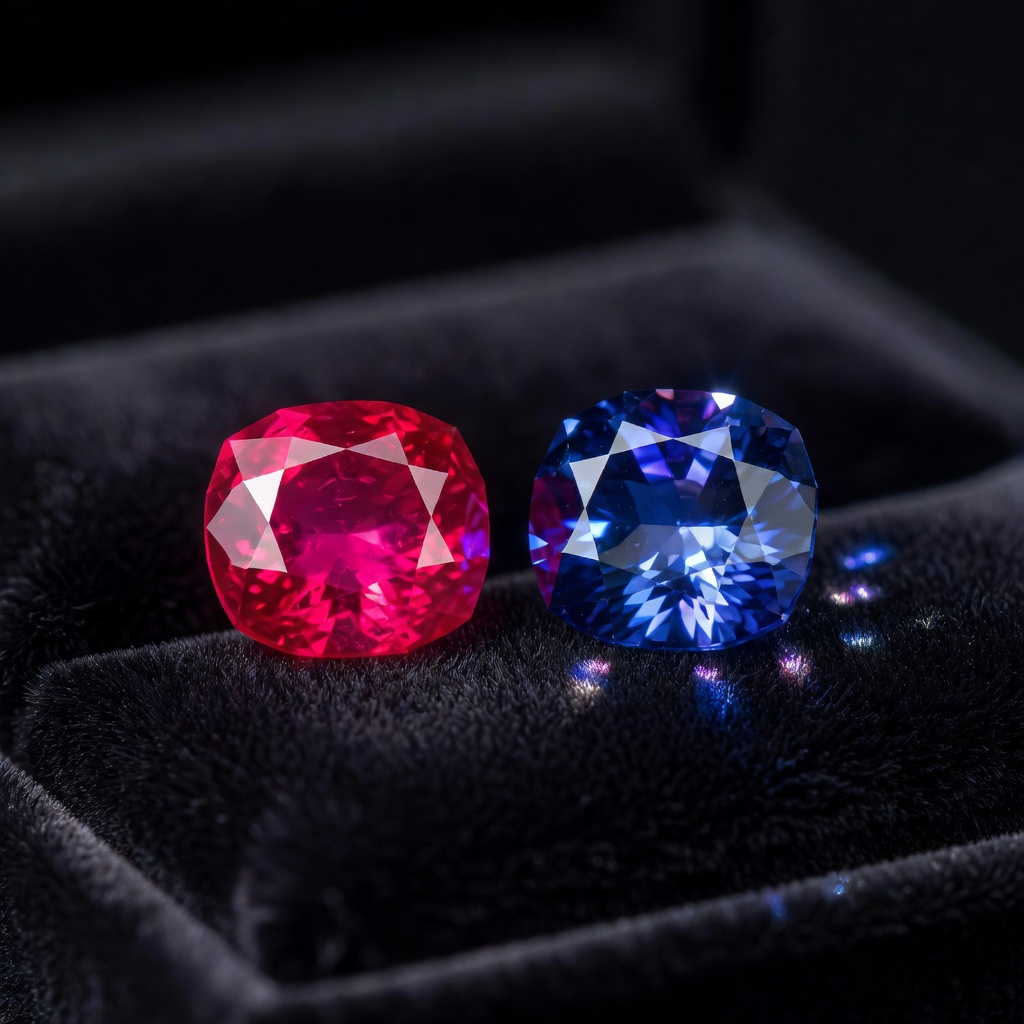
Introduction: The Classic Red vs The Rare Blue
When discussing the most captivating gemstones in the world, the comparison of ruby vs benitoite presents a fascinating study in contrasts that few collectors initially consider. On one side stands ruby, the legendary red corundum that has commanded respect across civilizations for over two millennia as the undisputed "King of Gems." On the other emerges benitoite, the extraordinarily rare blue gemstone discovered just over a century ago in a remote California county, representing one of mineralogy's most exclusive discoveries. This gemstone comparison transcends mere color preferences, delving into fundamental differences in geological formation, physical durability, and investment philosophy that every serious collector or jewelry buyer must understand.
The framework for comparing these stones extends beyond aesthetic appeal to encompass practical considerations of wearability, market liquidity, and long-term value preservation. Ruby offers time-tested reliability and universal recognition, while benitoite provides the allure of extreme scarcity and unique optical properties found in no other gemstone species. Whether you are building a serious investment portfolio, selecting an engagement stone, or curating a mineral collection, understanding the distinct characteristics separating these two remarkable gems will inform decisions that balance passion with pragmatism.
Geological Origins: Global Ruby vs Single-Source Benitoite
The Ancient Metamorphic Origins of Ruby
Ruby formation occurs within high-grade metamorphic environments, specifically in marble deposits subjected to intense heat and pressure over millions of years. The most legendary deposits emerge from the Mogok Stone Tract in Myanmar, where limestones transformed by regional metamorphism created the chromium-rich environments necessary for corundum crystallization. Modern mining operations in Mozambique's Montepuez district and Thailand's Trat province continue this tradition, extracting aluminum oxide crystals from contact metamorphic zones where silica-poor conditions prevented the formation of micas that would otherwise consume the aluminum necessary for corundum growth.
California's Exclusive Geological Treasure
Benitoite origin stories contrast sharply with ruby's global distribution, as this species represents one of the few gemstones found in essentially a single commercial locality worldwide. Discovered in 1907 by James M. Couch in the Diablo Range of San Benito County, California, benitoite forms in natrolite veins within a highly specific blueschist-greenschist facies environment. The California state gemstone crystallizes from hydrothermal fluids rich in barium and titanium at relatively low temperatures, creating hexagonal dipyramidal crystals unique to the Dallas Gem Mine and adjacent claims. Unlike ruby's widespread occurrence across multiple continents, gem-quality benitoite has never been discovered in commercial quantities outside this specific 160-acre region, despite mineralogical surveys conducted across six continents.
Chemical Composition and Crystal Structure
The chemical distinction between these stones fundamentally affects their properties and formation requirements. Ruby consists of aluminum oxide (Al₂O₃) in the trigonal crystal system, with chromium substitutions creating the red chromophore. Benitoite comprises barium titanium silicate (BaTiSi₃O₉) crystallizing in the hexagonal system, representing the only gemstone in this chemical class suitable for faceting. This compositional uniqueness means that while ruby formation requires specific but globally distributed metamorphic conditions, benitoite demands a precise geochemical convergence of barium-rich fluids, titanium availability, and specific pressure-temperature gradients that geologists have identified in only one location on Earth.
Physical Properties and Durability Face-Off
Mohs Hardness and Everyday Wearability
The gemstone hardness comparison between ruby and benitoite reveals dramatic differences that directly impact jewelry applications and long-term maintenance. Ruby ranks 9 on the Mohs scale, making it second only to diamond in hardness among natural gemstones and exceptionally resistant to scratching from dust and everyday contact. Benitoite hardness measures 6 to 6.5, placing it in a category with tanzanite and peridot, where routine wear can result in surface abrasion and facet edge damage. This hardness differential means that while ruby jewelry requires minimal protective consideration beyond normal care, benitoite demands strategic setting choices and wear patterns to preserve its surface integrity.
Toughness and Cleavage Considerations
Beyond hardness, ruby durability extends to excellent toughness due to the absence of cleavage planes in its crystal structure. Rubies resist chipping and breaking even when subjected to sharp impacts, making them ideal for rings and bracelets exposed to potential knocks. Benitoite possesses imperfect cleavage in one direction and fair to good toughness at best, creating vulnerability to cleavage fractures if struck along specific crystallographic axes. Jewelers working with benitoite must orient the table facet away from cleavage planes and consider protective settings that minimize exposure to physical shock, whereas ruby offers freedom in cutting orientation and setting style.
Maintenance Protocols for Longevity
Practical care requirements differ substantially between these species. Ruby tolerates ultrasonic cleaning and steam cleaning when free of significant inclusions or fractures, though caution remains advisable for heavily included stones. Benitoite requires gentler treatment, with warm soapy water and soft brushes representing the safest cleaning method; ultrasonic vibrations can potentially extend existing fractures along cleavage planes. For collectors storing loose stones, benitoite specimens should be wrapped individually to prevent contact with harder materials, while rubies can be stored with reasonable confidence alongside other jewelry, though separation from diamonds remains advisable to prevent mutual scratching.
Visual Characteristics: Color, Fire, and Brilliance
The Red Spectrum: From Pinkish Hues to Pigeon Blood
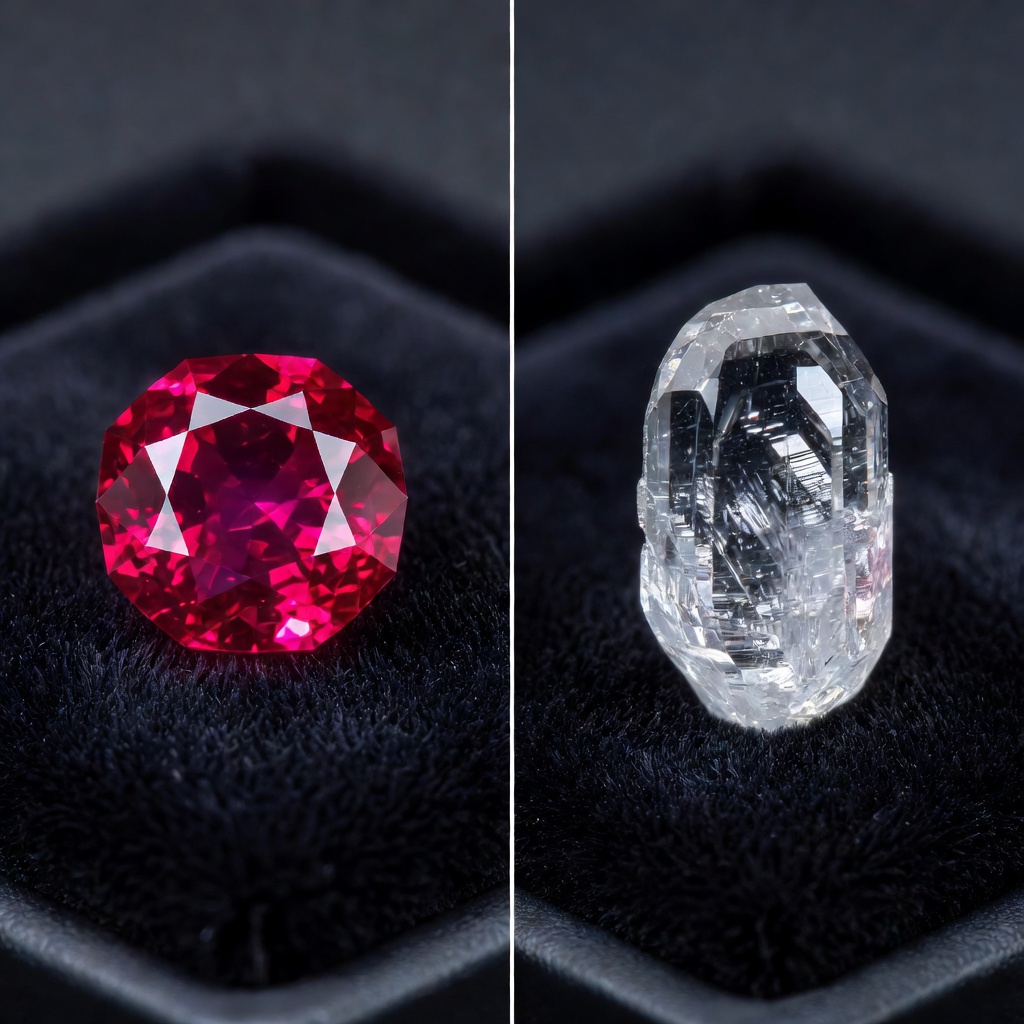
Ruby color grading centers on the chromium-red absorption spectrum, with the most valuable stones displaying a pure, vivid red often described as pigeon blood ruby in the trade. This term, originally describing the finest Burmese material, denotes a red with high saturation and slight blue undertones that appear under specific lighting conditions, creating an almost glowing appearance due to chromium fluorescence. Lower-quality rubies may show orangey or purplish modifiers, while Thai rubies typically exhibit darker, garnet-like tones due to iron content. The color remains relatively consistent across viewing angles, though dichroism may show slightly purplish-red in one direction and orangey-red in another.
Blue Fire and Optical Phenomena
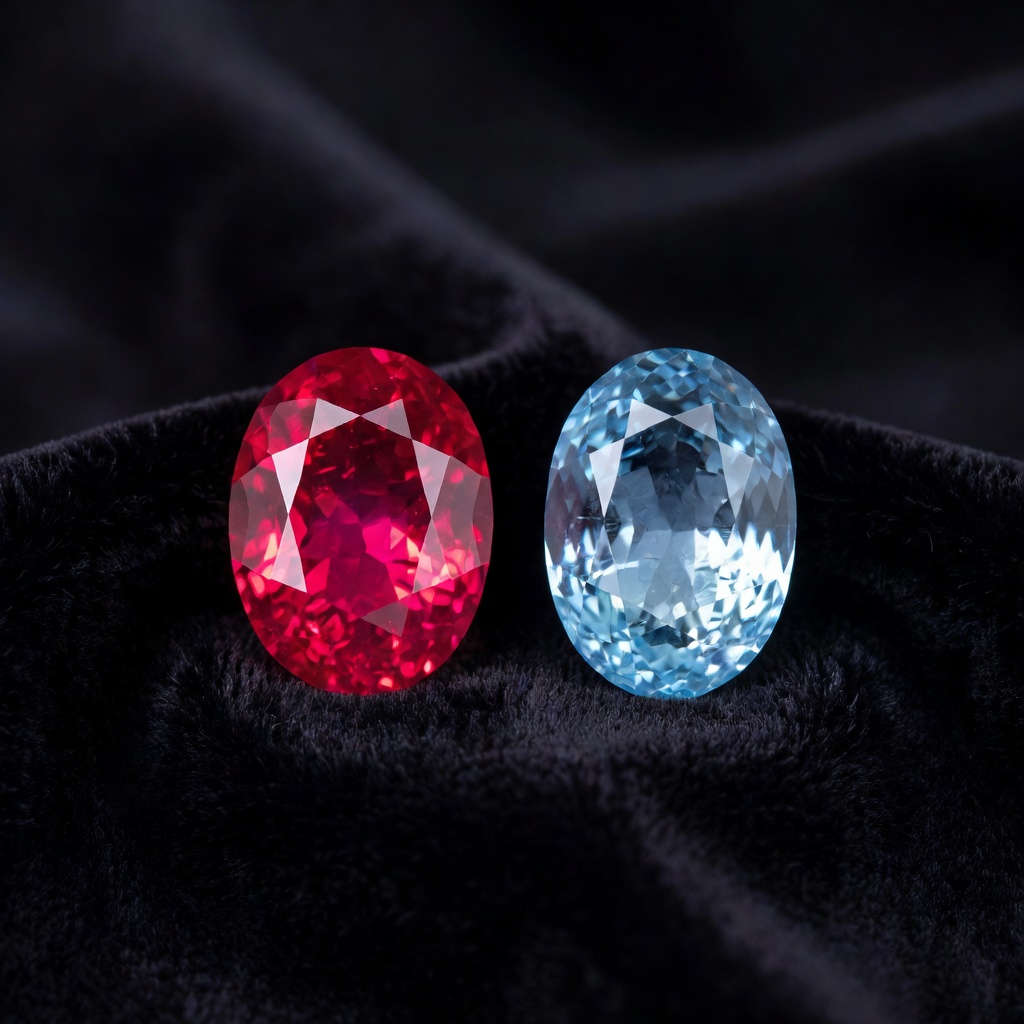
Benitoite distinguishes itself through exceptional optical properties rarely encountered in blue gemstones. The stone exhibits benitoite dispersion of 0.046, exceeding diamond's 0.044 and creating remarkable fire—the rainbow flashes of spectral colors visible when the stone moves under light. This high dispersion combined with a refractive index of 1.757-1.804 produces brilliance that rivals or exceeds fine sapphire. However, benitoite also displays strong trichroism, appearing sapphire-blue when viewed perpendicular to the crystal axis, colorless parallel to the axis, and reddish-brown in the third direction. Master cutters must orient the table facet precisely perpendicular to the c-axis to maximize the blue color while minimizing the colorless or brownish directions.
Lighting Effects and Display Considerations
The interaction with different light sources creates distinct experiences for each gemstone. Ruby often appears most magnificent under incandescent lighting, which enhances the red saturation and minimizes the blue undertones that can appear in daylight. Many fine rubies exhibit strong red fluorescence under UV light, causing them to literally glow in sunlight or nightclub lighting. Benitoite performs optimally under natural daylight or LED lighting that emphasizes its blue body color while showcasing the dispersion fire. Under incandescent lighting, benitoite may appear darker and less vivid, while its distinctive blue fluorescence under short-wave UV light serves as a key identification feature that differs from the inert or red fluorescence shown by most rubies.
Rarity and Market Availability Analysis
The Scarcity Spectrum: Single Source vs Global Distribution
Benitoite rarity reaches extreme levels unmatched by virtually any other gemstone species. Since its discovery, the total weight of facetable benitoite produced from the Dallas Gem Mine and subsequent operations totals less than a few thousand carats of fine material. The mine operated commercially only intermittently throughout the 20th century, with current production limited to occasional specimen mining and hobbyist collecting. This rare blue gemstone essentially originates from a single mountain in California, with no secondary deposits discovered despite intensive geological exploration worldwide.
Ruby Production: Declining Quality Amid Global Operations
While ruby mining occurs across Myanmar, Thailand, Cambodia, Sri Lanka, Madagascar, Mozambique, Tanzania, and Afghanistan, the availability of fine-quality material has declined precipitously over the past three decades. The legendary Mogok mines in Myanmar produce fewer fine crystals due to resource depletion and political instability, while African mines often yield heavily included material requiring heat treatment. However, high-quality rubies in sizes exceeding 5 carats still enter the market regularly, albeit at escalating prices. The global distribution ensures market liquidity and availability across price points, from commercial-grade stones to investment-quality specimens.
Size Limitations and Faceting Challenges
Practical size constraints favor ruby for significant jewelry pieces. Facet-grade benitoite rarely exceeds 1 to 2 carats, with stones over 3 carats considered museum-grade rarities commanding extraordinary premiums. The crystal habit of benitoite—typically small hexagonal dipyramids—rarely yields large clean rough suitable for cutting. Conversely, ruby crystals from Mozambique and Myanmar occasionally produce faceted stones exceeding 10 carats, with the record-breaking 25.59-carat Sunrise Ruby representing the pinnacle of size and quality combined. This size disparity means that while benitoite collectors compete for fractions of carats, ruby buyers can acquire substantial center stones for statement jewelry.
Price Per Carat and Investment Potential
Entry-Level to Museum-Grade Pricing Tiers
The benitoite vs ruby value equation varies dramatically depending on quality grades and market tiers. Commercial-quality rubies with heat treatment and moderate inclusions start around $100 to $500 per carat, while fine unheated Burmese stones command $10,000 to $50,000 per carat, with exceptional pigeon blood specimens reaching millions. Benitoite pricing begins higher at the entry level, with small stones under 0.5 carats starting around $500 to $1,000 per carat, quickly escalating to $4,000 to $10,000 per carat for fine blue specimens over 1 carat, with record prices exceeding $20,000 per carat for rare large clean stones.
Record Sales and Market Benchmarks
The 2015 sale of the Sunrise Ruby for $30.3 million ($1.19 million per carat) established the upper echelon of ruby investment potential, demonstrating the extraordinary value placed on untreated Burmese stones with provenance. While benitoite has not achieved similar headline-grabbing auction prices due to limited supply and recognition, private sales of exceptional 2-carat-plus stones have reportedly exceeded $10,000 per carat, representing remarkable appreciation from the material's initial market introduction in the mid-20th century. Gemstone pricing for both materials continues trending upward, though ruby benefits from established auction house categories and consistent high-jewelry demand from brands like Cartier and Van Cleef & Arpels.
Liquidity and Portfolio Considerations
Gemstone investment comparison reveals ruby's advantage in market liquidity and resale channels. Established auction houses regularly feature important rubies with documented provenance, while international dealers maintain active markets for certified stones. Benitoite suffers from limited market recognition among general investors, creating liquidity challenges despite extreme scarcity. Serious mineral collectors and specialized gem investors appreciate benitoite's rarity premium, but resale typically requires niche markets or direct collector-to-collector transactions. For portfolio diversification, allocating 80-90% to fine rubies with GIA certification and 10-20% to exceptional benitoite specimens balances stability with scarcity premium potential.
| Characteristic | Ruby | Benitoite |
|---|---|---|
| Chemical Composition | Aluminum Oxide (Al₂O₃) | Barium Titanium Silicate (BaTiSi₃O₉) |
| Mohs Hardness | 9 (Excellent) | 6-6.5 (Requires Care) |
| Primary Sources | Myanmar, Mozambique, Thailand, Sri Lanka | San Benito County, California Only |
| Color Cause | Chromium Ions | Iron and Titanium Trace Elements |
| Dispersion (Fire) | Low (0.018) | Very High (0.046) |
| Typical Faceted Sizes | 1-10+ Carats Available | Rarely Exceeds 2 Carats |
| Price Range (Fine Quality) | $10,000-$1M+ Per Carat | $4,000-$10,000+ Per Carat |
| Optimal Jewelry Use | Engagement Rings, Daily Wear | Pendants, Earrings, Collectible Specimens |
| Market Liquidity | High (Auction House Recognition) | Limited (Specialist Collectors Only) |
Jewelry Applications and Wearability
Ruby: The Ultimate Heirloom Centerstone
For engagement rings and daily wear jewelry, ruby stands virtually unmatched among colored gemstones. The combination of hardness 9 and excellent toughness allows ruby engagement rings to withstand decades of continuous wear without significant abrasion or chipping. Prong settings, bezel settings, and tension settings all work effectively with ruby, giving designers freedom to create intricate mounting styles. When selecting gemstone setting options, ruby tolerates the heat and pressure of professional jewelry repair work, allowing resizing and prong retipping without risking damage to the stone.
Benitoite: Strategic Placement for Preservation
Benitoite jewelry requires thoughtful design to protect this rare material while showcasing its extraordinary optics. Protective bezel settings that wrap the girdle and crown edges provide the best defense against chipping, while V-prong designs for the pointed ends of pear or marquise cuts minimize vulnerability. Earrings and pendants represent ideal applications, keeping the stone away from hard surfaces encountered during manual work. When set in rings, benitoite should be reserved for occasional wear pieces or protected by halo designs that extend slightly above the table to prevent direct impact.
Metal Pairing and Design Aesthetics
Yellow gold and rose gold settings enhance the warmth of Burmese and Mozambique rubies, creating classic combinations that have adorned royalty for centuries. The contrast between cool white metals and ruby red creates modern, dramatic effects particularly suited to contemporary designs. Benitoite demands white metals—platinum, white gold, or palladium—to complement its cool sapphire-blue tones without color contamination. The high dispersion of benitoite benefits from open gallery designs that allow light return from multiple angles, maximizing the fire that distinguishes this unique gem.
Cultural Significance and Historical Context
Ruby: Two Millennia of Royal Association
Ruby's designation as the "King of Gems" reflects over 2,000 years of documented reverence across Indian, Burmese, Chinese, and European civilizations. The Bible references ruby four times as a symbol of beauty and wisdom, while Hindu texts describe the ratnaraj (king of precious stones) as possessing the ability to warn its owner of impending danger by darkening in color. As the July birthstone, ruby carries associations with passion, vitality, and protection. Historic crown jewels, including those of England and Myanmar, feature exceptional Burmese rubies believed to confer invincibility in battle and prosperity upon rulers.
Benitoite: The Mineralogical Unicorn of the Golden State
The California gemstone story began in 1907 when James M. Couch discovered blue crystals initially mistaken for sapphire. University of California mineralogist George D. Louderback identified the new species in 1909, naming it for San Benito County. The State Legislature designated benitoite as the official state gem in 1985, recognizing its unique association with California geology. Unlike ruby's ancient metaphysical traditions, benitoite has developed modern crystal healing associations with spiritual growth, psychic development, and alignment of the third eye chakra, reflecting New Age interest in rare minerals rather than historical precedent.
Modern Collecting and Museum Status
While rubies populate the permanent collections of every major natural history museum and royal treasury worldwide, benitoite maintains an almost mythical status among mineralogists. The Smithsonian Institution displays exceptional benitoite crystals as examples of unique American mineralogy, while private collectors compete aggressively for matrix specimens showing the distinctive blue hexagonal crystals perched on white natrolite. This collector interest supports a specialized market distinct from jewelry applications, with mineral specimens sometimes commanding higher prices than cut stones due to crystallographic perfection and matrix association.
Authentication and Buying Guide
Verifying Natural Ruby Origins and Treatments
When pursuing gemstone collecting, understanding ruby enhancement is essential, as over 90% of rubies on the market undergo heat treatment to improve clarity and color. Advanced laboratory techniques including laser ablation inductively coupled plasma mass spectrometry (LA-ICP-MS) can detect chemical fingerprints distinguishing Burmese origin from Mozambique or Madagascar sources. Key identification features for unheated stones include silk inclusions (rutile needles) that partially dissolve during heat treatment, and distinct inclusion scenes visible under magnification. Always demand GIA or AGL reports for significant purchases, with origin determination adding substantial value for Burmese specimens.
Benitoite Identification Essentials
The benitoite buying guide emphasizes unique diagnostic properties that prevent confusion with blue sapphire or spinel. Under short-wave ultraviolet light, benitoite displays intense blue to bluish-white fluorescence, a reaction distinctive enough to serve as a field test. Trichroism presents visibly as blue, colorless, and reddish-brown pleochroic colors when viewed through a dichroscope. Specific gravity testing yields 3.65, higher than sapphire but lower than diamond, while refractive indices of 1.757-1.804 fall within a narrow range diagnostic for the species. Unlike ruby, benitoite is rarely synthesized due to lack of commercial demand, though doublets and imitation glass exist.
Vendor Selection and Due Diligence
Selecting reputable vendors requires different approaches for each stone. For ruby, established dealers with AGTA (American Gem Trade Association) membership and transparent disclosure of heat treatment and origin provide the safest purchasing channels. Auction houses like Sotheby's and Christie's offer the best venue for investment-grade rubies with documented provenance. Benitoite purchases should focus on dealers specializing in American minerals or rare gemstones, with particular attention to cutting quality since poorly oriented stones may appear grayish or windowed. Request high-resolution photographs under different lighting conditions, and never purchase significant benitoite without independent laboratory certification confirming natural origin.
Final Verdict: Which Gemstone Should You Choose?
The ruby vs benitoite decision ultimately hinges on prioritizing either timeless practicality or extreme exclusivity. For traditional jewelry lovers seeking heirloom-quality pieces suitable for daily wear, family legacy transmission, and stable value appreciation, ruby offers unmatched advantages. The combination of superior hardness, global market recognition, and established auction liquidity makes fine unheated Burmese rubies the conservative choice for significant investment. Those selecting engagement rings or anniversary jewelry should default to ruby unless specifically seeking a conversation piece for occasional wear.
Conversely, benitoite appeals to collectors and enthusiasts who value mineralogical uniqueness above practical considerations. As the gemstone investment comparison reveals, benitoite offers scarcity that no market manipulation can replicate, given its single-source geology. Collectors prioritizing extreme rarity, exceptional dispersion fire, and the satisfaction of owning a true American original will find benitoite irresistible despite its fragility and limited liquidity. For portfolio diversification or specialized mineral collections, benitoite provides exposure to a market segment uncorrelated with traditional gemstone investments.
Practical buyers might consider acquiring both: a fine ruby for daily wear jewelry that withstands generations of use, and a small benitoite specimen or pendant representing the pinnacle of geological rarity. This approach satisfies both the desire for wearable luxury and the collector's instinct for acquiring the extraordinary. Whichever path you choose, ensure proper certification, buy from reputable sources, and appreciate each stone for the distinct geological miracle it represents—whether formed in the ancient metamorphic marbles of Myanmar or the unique hydrothermal veins of central California.
Frequently Asked Questions
Is benitoite more valuable than ruby per carat?
Fine benitoite can command higher per-carat prices than commercial-quality rubies, often exceeding $4,000-$10,000 per carat for specimens over 1 carat. However, top-tier pigeon blood Burmese rubies remain the most valuable, with prices reaching millions per carat. Benitoite's value stems from extreme rarity (single source), while ruby's premium prices reflect historical significance and consistent demand.
Why is benitoite so much rarer than ruby?
Benitoite forms under extremely specific geochemical conditions only found in San Benito County, California, and has never been discovered in commercial quantities elsewhere. Conversely, ruby forms in metamorphic environments across Myanmar, Thailand, Sri Lanka, Mozambique, and Madagascar. While high-quality rubies are rare, benitoite is geologically unique with essentially one viable source worldwide.
Can benitoite be worn daily like ruby in an engagement ring?
Benitoite (hardness 6-6.5) is not recommended for daily wear in engagement rings due to susceptibility to scratching and chipping. Ruby (hardness 9) is one of the best gemstones for daily wear, second only to diamond. If using benitoite in rings, choose protective bezel settings and reserve for occasional wear, or select benitoite for earrings or pendants instead.
What causes benitoite's color compared to ruby's red hue?
Ruby's red color comes from chromium ions replacing aluminum in the corundum crystal structure, creating the classic chromium-red spectrum. Benitoite's blue color results from iron and titanium trace elements within the barium titanium silicate crystal structure. Unlike ruby, benitoite exhibits strong pleochroism, appearing blue, colorless, or reddish depending on viewing angle.
Which gemstone has better brilliance and fire, ruby or benitoite?
Benitoite possesses higher dispersion (0.046) than diamond (0.044), creating exceptional fire (rainbow flashes) that surpasses ruby. However, ruby exhibits a distinctive silky luster and strong fluorescence under UV light, creating a glowing 'reddest red' appearance. Benitoite wins on fire and brilliance metrics, while ruby offers unique glowing saturation.
How can I verify I'm buying genuine benitoite versus a blue sapphire or spinel?
Always request a GIA or AGL certification for benitoite. Key identifiers include benitoite's strong blue fluorescence under short-wave UV light (distinctive for this species), its trichroism (showing blue, colorless, and reddish-brown when viewed from different angles), and specific refractive indices (1.757-1.804). Benitoite is rarely synthesized due to rarity, making imitation more common than lab-grown specimens.
Is ruby or benitoite the better investment for collectors?
Ruby offers better investment liquidity due to established international markets, auction house recognition, and consistent demand from high-end jewelry brands. Benitoite offers scarcity premium potential but suffers from limited market recognition and smaller buyer pool. For portfolio diversification, collect benitoite; for stable appreciation with liquidity, choose fine unheated Burmese rubies with documentation.
Why does benitoite sometimes look colorless in certain directions?
Benitoite exhibits strong trichroism, meaning it displays three different colors depending on crystal orientation: deep sapphire-blue perpendicular to the crystal axis, colorless parallel to the axis, and reddish-brown in the third direction. This optical property requires skilled cutting to orient the table facet perpendicular to the c-axis to maximize the blue color, unlike ruby which shows only dichroism (two colors).