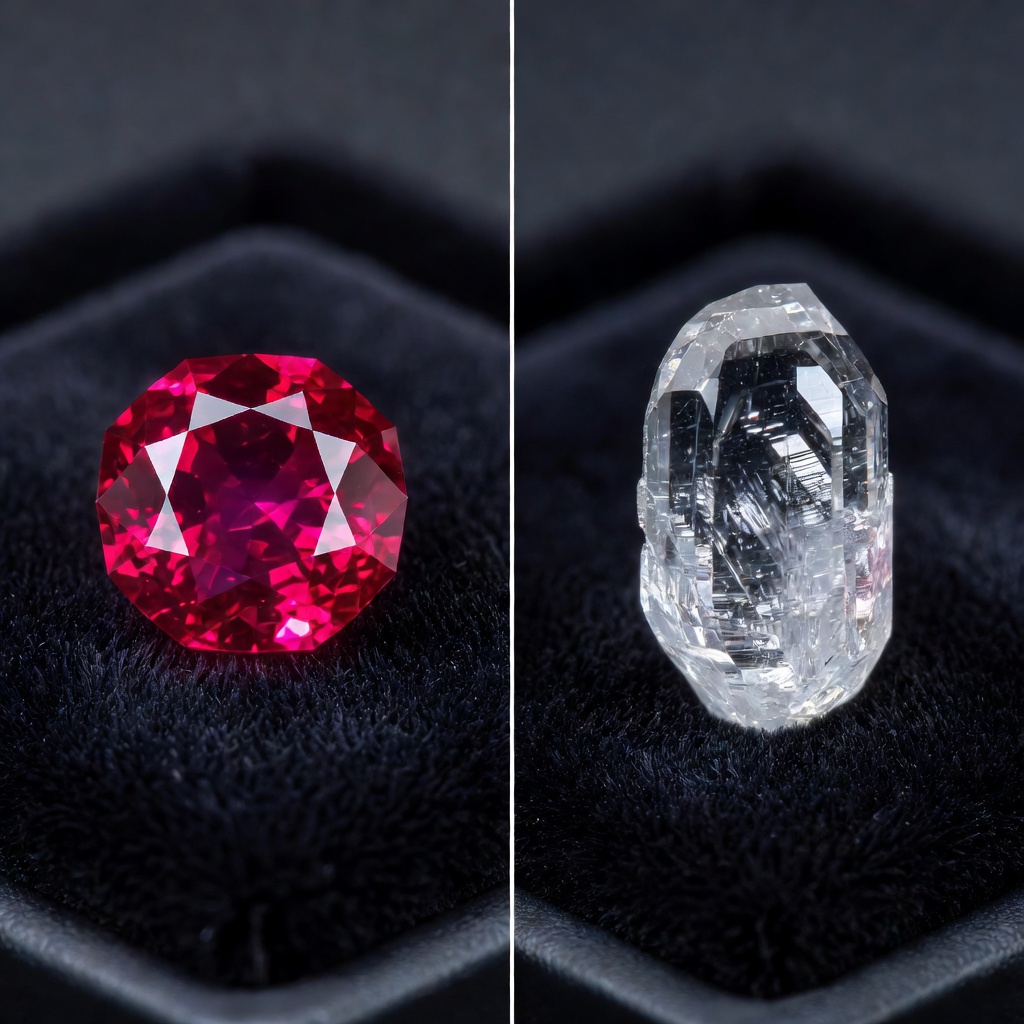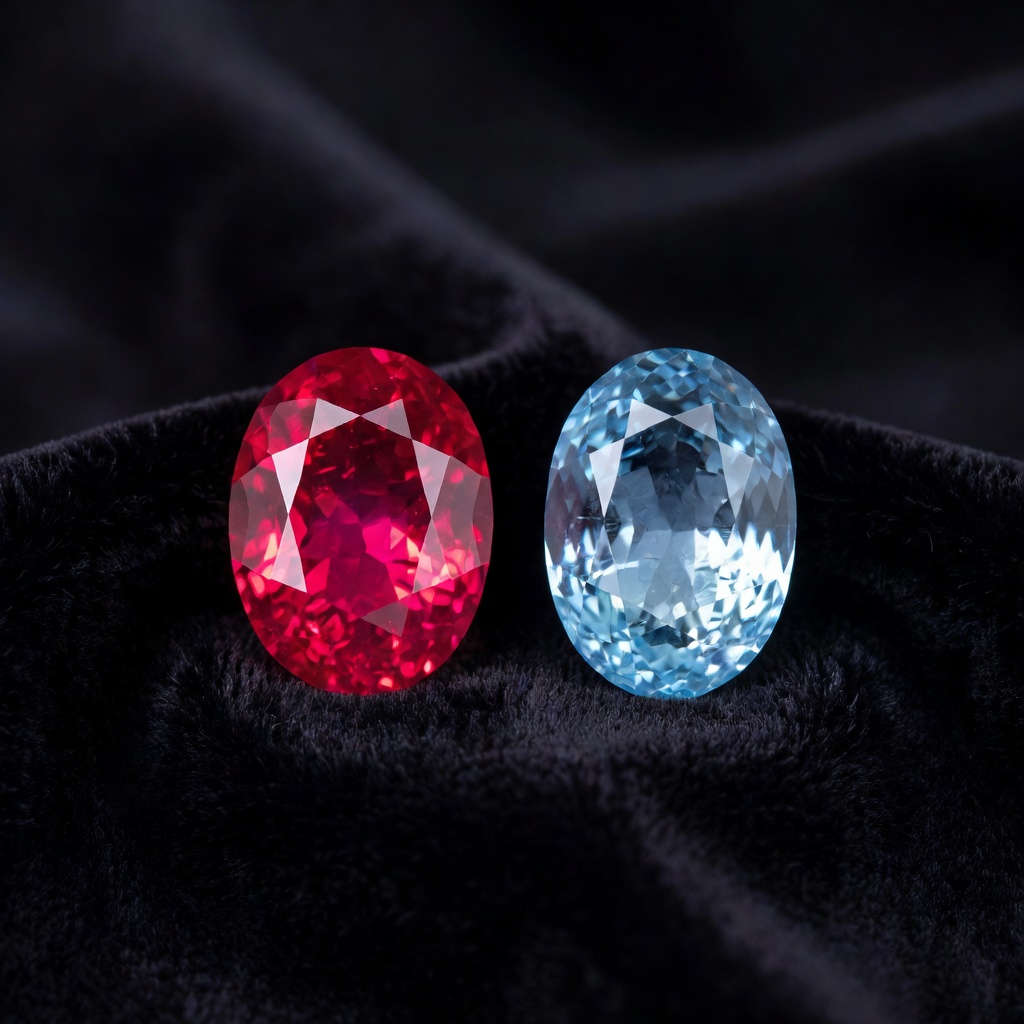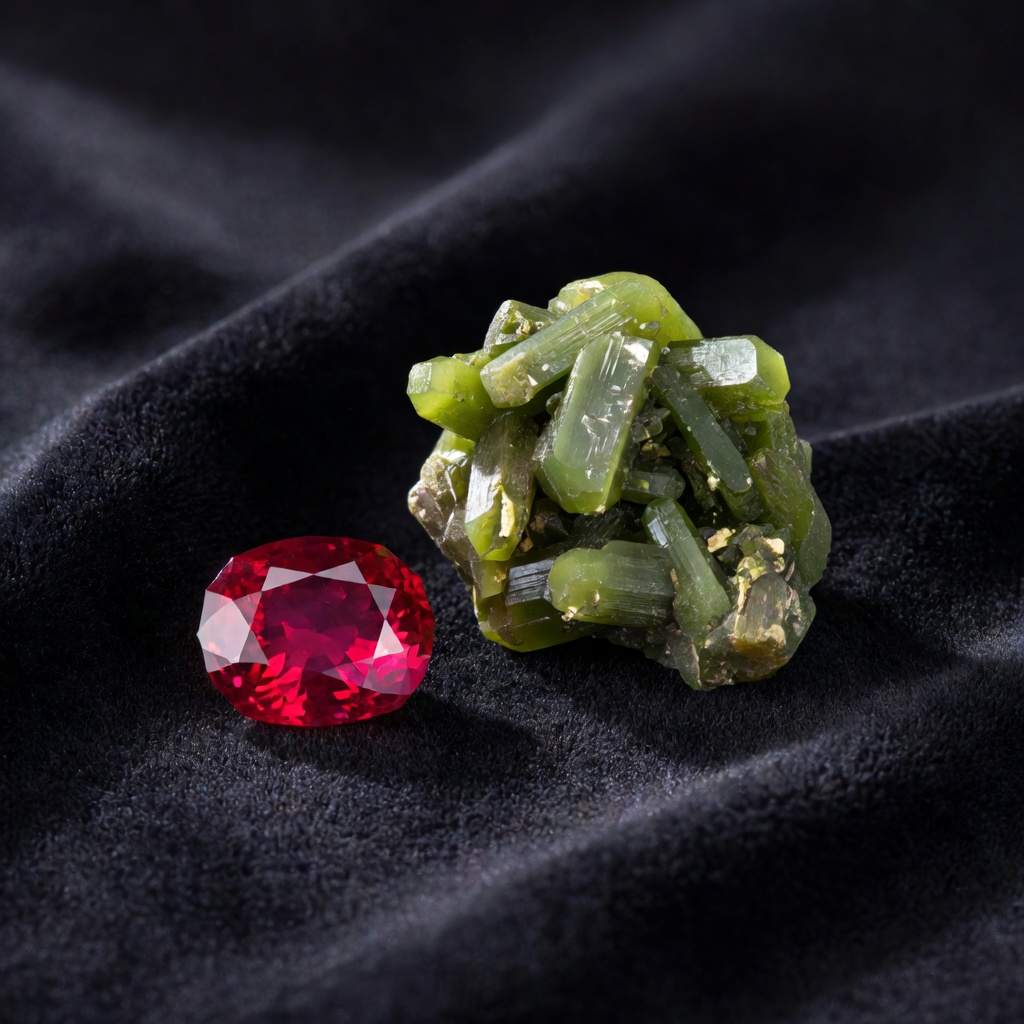
Understanding Ruby vs Agate
When navigating the world of colored gemstones, the comparison between Ruby and Agate represents one of the most striking examples of precious vs semi-precious gemstones distinctions in the jewelry market. While both stones captivate collectors with their rich red hues and earthy appeal, they occupy vastly different positions in the gemological hierarchy, with Ruby belonging to the elite corundum family and Agate representing the widespread chalcedony variety. Buyers often encounter these stones simultaneously when exploring red gemstone options, creating a natural curiosity about their differences despite their disparate value tiers and geological classifications.
The fundamental distinction begins at the mineralogical level, where corundum vs chalcedony defines their chemical compositions and crystalline structures. Ruby, a variety of corundum composed primarily of aluminum oxide with chromium traces, commands prices rivaling diamonds in fine specimens, while Agate, a microcrystalline quartz formation, offers accessible beauty for those seeking organic patterns without premium investment. Historically, both stones have adorned royalty and spiritual practitioners—Ruby earning the title "King of Gems" in Sanskrit texts and adorning the crowns of monarchs, while Agate served as protective talismans in ancient Babylonian and Egyptian civilizations, often carved into amulets and seals to ward off storms and evil spirits.
Geological Origins and Formation Processes
The journey from raw earth to polished gemstone reveals dramatic differences between these two materials, with Ruby forming under some of the most extreme conditions found in geology compared to Agate's more gentle, sedimentary creation story. Ruby crystallizes deep within the Earth's crust under intense heat and pressure within metamorphic rocks such as marble or basalt, requiring specific geological environments where aluminum-rich rocks interact with chromium deposits under temperatures exceeding 800 degrees Celsius. This arduous formation process, occurring over millions of years in specific tectonic zones, explains why significant Ruby deposits remain limited to specific regions including the Mogok mines of Myanmar, the Montepuez deposits in Mozambique, and the historic mining areas of Thailand and Madagascar.
In contrast, Agate develops through a completely different mechanism involving the slow deposition of silica-rich fluids within volcanic rock cavities and gas bubbles. When ancient lava flows cool, trapped vesicles fill with mineral-rich water that gradually deposits microscopic quartz crystals in concentric layers, creating the characteristic banded agate varieties that make each specimen unique. This formation process occurs globally wherever volcanic activity once prevailed, resulting in abundant deposits across Brazil's Rio Grande do Sul region, India's Deccan Traps, the American Southwest, and Germany's Idar-Oberstein district—historically the world's cutting center for these materials.
Primary Mining Locations and Extraction Methods
The geographic concentration of Ruby mining creates supply constraints that directly impact market availability, with Myanmar traditionally producing the finest pigeon blood ruby specimens prized by collectors, though ethical sourcing concerns have diversified production to African nations like Madagascar and Tanzania. Miners extract Ruby through hard-rock mining techniques, often working in dangerous conditions to reach narrow veins within marble matrices, whereas Agate mining typically involves surface collection or shallow pit mining in volcanic fields where nodules weather naturally from host rocks. This accessibility difference means that while a single fine Ruby crystal might require weeks of dangerous excavation, Agate collectors can sometimes gather specimens from dry riverbeds or desert surfaces where ancient volcanic deposits have concentrated over millennia.
Physical Properties and Durability Comparison
Durability considerations fundamentally separate these gemstones for practical jewelry applications, with ruby hardness mohs ratings of 9 placing it second only to diamond on the mineral hardness scale, while Agate measures between 6.5 and 7, creating significant implications for daily wear scenarios. This hardness differential means Ruby resists scratching from virtually any household material except diamond itself, making it suitable for engagement rings and bracelets that encounter frequent contact, whereas Agate requires more protective settings to prevent surface abrasion from everyday encounters with steel files, ceramic surfaces, or environmental dust containing quartz particles.
Beyond simple scratch resistance, toughness—the resistance to breaking or chipping—presents another critical factor where these stones diverge unexpectedly. Despite its superior hardness, Ruby occasionally exhibits brittleness along cleavage planes, particularly in stones with numerous inclusions, requiring careful setting procedures to avoid pressure points. Agate, while softer, often demonstrates superior toughness due to its microcrystalline structure and concentric banding, making it less likely to shatter upon impact despite being more prone to surface scratching. Specific gravity measurements further distinguish them, with Ruby feeling noticeably heavier (3.97-4.05) than Agate (2.58-2.64) when held in the hand, while refractive index differences create distinct optical effects—Ruby's high refractive index (1.76-1.78) producing vivid brilliance compared to Agate's lower index (1.53-1.54) yielding a more subdued, waxy luster.
Practical Durability Testing and Wear Scenarios
Consider the case of a restaurant server considering a red gemstone ring for daily work: a Ruby set in platinum would withstand constant contact with metal shelving, ceramic plates, and cleaning chemicals without visible wear, while an Agate ring would likely show surface scratches within weeks of similar treatment. However, for pendant designs or earrings that experience minimal contact, Agate's durability proves perfectly adequate, offering aesthetic appeal without the vulnerability concerns that softer stones like opal or pearl present. Laboratory testing confirms that while both stones survive standard ultrasonic cleaning, treated Rubies (those subjected to heat or fracture-filling) may suffer damage from such vibrations, whereas Agate remains stable but risks losing polish if the solution contains harsh chemicals.
Visual Characteristics and Color Variations
The aesthetic distinction between these gemstones extends far beyond simple color comparisons, encompassing transparency, optical phenomena, and structural patterns that create entirely different visual experiences. Ruby presents in a spectrum ranging from the coveted pigeon blood ruby—a vivid, saturated red with subtle blue undertones reminiscent of arterial blood—to pinkish varieties that technically classify as pink sapphire when chromium content drops below specific thresholds. High-quality Rubies typically exhibit transparency to translucency, with fine inclusions (silk) sometimes creating star asterism effects in cabochon cuts, while exceptional clarity allows for brilliant faceting that maximizes light return and scintillation.
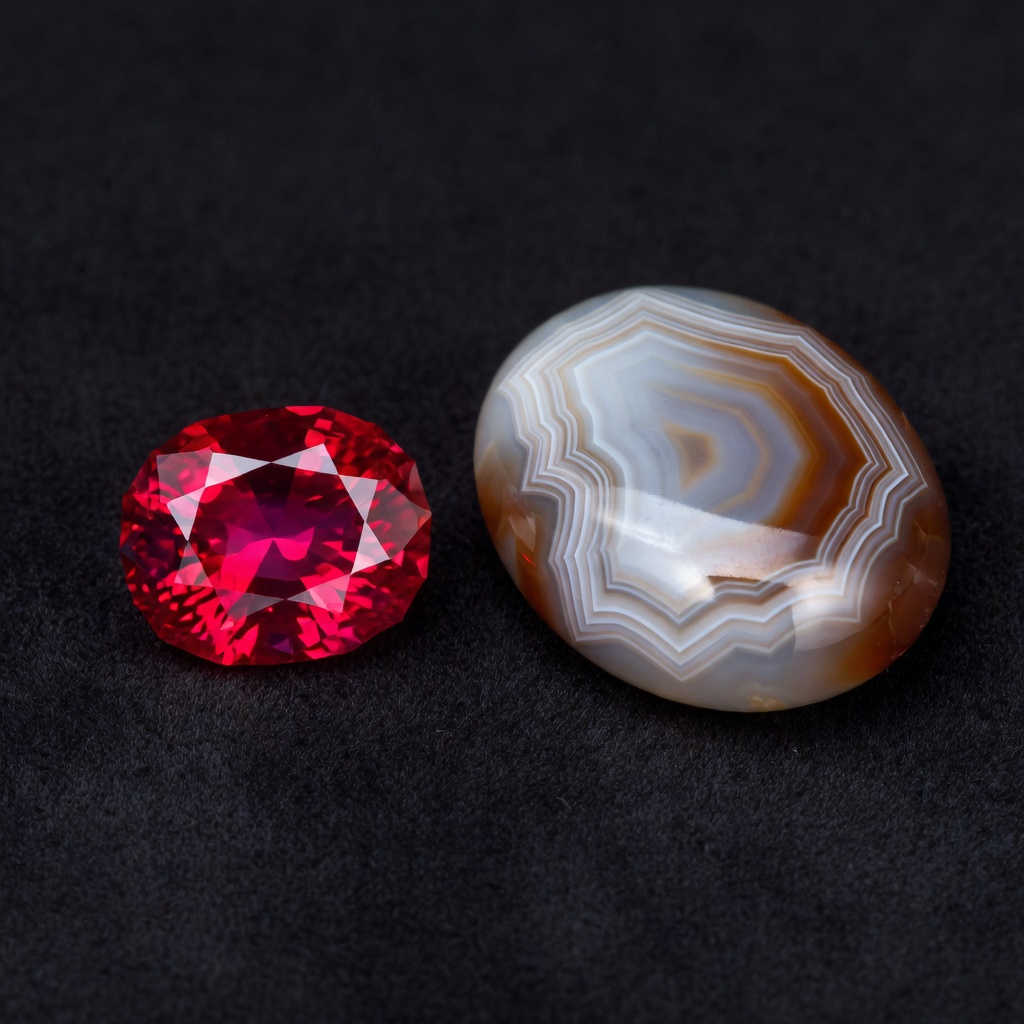
Agate offers a completely different visual language defined by its banded agate varieties, where concentric layers create landscapes of color ranging from subtle earth tones to vivid blues, greens, and reds achieved through natural mineral impurities or human dyeing processes. Unlike Ruby's uniform coloration, Agate displays translucency patterns that allow light to penetrate certain layers while reflecting from others, creating three-dimensional depth effects impossible in singly refractive corundum. Dendritic Agate contains manganese or iron oxide inclusions resembling ferns or trees, while Fire Agate exhibits iridescent color play caused by light diffraction within thin layers of iron minerals—optical characteristics entirely absent from Ruby's crystalline structure.
Red Gemstone Comparison: When Colors Converge
In the specific context of red gemstone comparison, buyers occasionally encounter red Agate varieties that superficially resemble lower-grade Rubies, creating potential confusion for inexperienced collectors. Natural red Agate typically shows banding or zoning visible under magnification, whereas even included Rubies maintain more uniform color distribution, though both may contain natural feathers or crystal inclusions. The "silky" appearance of some Burmese Rubies differs markedly from Agate's waxy to vitreous luster, and Ruby's double refraction (visible as doubling of back facets when viewed through the table) provides a definitive diagnostic distinction from Agate's singly refractive nature. For collectors seeking red stones on a budget, carnelian—a translucent red chalcedony closely related to Agate—offers an intermediate option between these extremes, though it lacks both Ruby's brilliance and banded Agate's pattern complexity.
Market Value, Rarity and Investment Potential
The economic disparity between these gemstones reflects their relative scarcity and market positioning, with fine Ruby commanding prices between $1,000 and $15,000+ per carat for exceptional specimens, while Agate typically ranges from $1 to $100 depending on size, pattern complexity, and craftsmanship. This valuation gap stems directly from rarity factors: high-quality Rubies over one carat with untreated, vivid color represent extreme geological rarities, whereas Agate deposits exist in such abundance that supply consistently outpaces demand. Investment considerations favor Ruby for those seeking portable wealth preservation, as historically significant stones have appreciated steadily, with record-breaking sales at auction houses like Sotheby's and Christie's establishing Ruby as a legitimate alternative investment asset alongside colored diamonds and emeralds.
Value determinants differ significantly between these materials, with Ruby pricing depending heavily on color saturation (specifically the presence of pure red without excessive brown or purple modifiers), clarity characteristics (where some silk improves color distribution but heavy inclusions detract from transparency), and geographic origin (Burmese stones commanding premiums over African or Thai origins). Agate valuation focuses instead on aesthetic qualities including band sharpness, color contrast between layers, pattern uniqueness (such as rare eye formations or symmetrical landscapes), and size of the finished cabochon or carving. While treated Rubies (heat-treated or glass-filled) occupy lower price tiers, they still generally exceed the value of all but the rarest collector-grade Agates, such as historic Scottish Montrose Agate or specific plume varieties from Arizona.
Investment Grade Considerations and Resale Markets
Practical case studies illustrate these market dynamics: a 3-carat untreated Burmese Ruby with pigeon blood certification might appreciate 5-10% annually while serving as wearable insurance, whereas even exceptional Fire Agate, despite its relative rarity within the Agate family, rarely appreciates beyond inflation rates due to limited collector demand. Auction records demonstrate this divergence clearly, with the "Sunrise Ruby" (a 25.59-carat Burmese stone) selling for over $30 million in 2015, while the finest Agate specimens rarely exceed five-figure prices even for museum-quality carved objects. For buyers prioritizing investment potential, certified natural Rubies with GIA or SSEF documentation provide liquidity in international markets, while Agate purchases should be viewed primarily as decorative acquisitions or spiritual tools rather than financial instruments.
| Characteristic | Ruby (Corundum) | Agate (Chalcedony) |
|---|---|---|
| Chemical Composition | Aluminum Oxide (Al₂O₃) with Chromium | Silicon Dioxide (SiO₂) microcrystalline quartz |
| Mohs Hardness | 9 (Excellent for daily wear) | 6.5-7 (Requires protection from scratches) |
| Specific Gravity | 3.97-4.05 (Heavy, substantial feel) | 2.58-2.64 (Lightweight compared to size) |
| Refractive Index | 1.76-1.78 (High brilliance) | 1.53-1.54 (Waxy to vitreous luster) |
| Transparency | Transparent to translucent | Translucent to opaque |
| Primary Color Range | Red to pink (pigeon blood to rose) | Multi-colored banding (blue, green, red, earth tones) |
| Formation Environment | Metamorphic rocks (high heat/pressure) | Volcanic cavities (silica deposition) |
| Primary Sources | Myanmar, Thailand, Madagascar, Mozambique | Brazil, India, USA, Germany, Mexico |
| Price Range (per carat) | $1,000-$15,000+ (fine untreated) | $1-$100 (depending on pattern/quality) |
| Jewelry Applications | Engagement rings, high-end pendants, earrings | Beads, cabochon rings, statement pendants, carvings |
| Setting Requirements | Prong settings for light exposure, secure mountings for protection | Bezel settings recommended for edge protection |
| Investment Potential | High (auction records, appreciating asset) | Low to moderate (decorative value primarily) |
| Metaphysical Associations | Passion, vitality, courage, heart energy | Grounding, stability, emotional balance, protection |
| Care Requirements | Warm soapy water safe; avoid harsh chemicals on treated stones | Avoid prolonged sun exposure (color fading); gentle cleaning |
Jewelry Design Applications and Setting Requirements
Successful jewelry design with these materials requires understanding their distinct physical needs and aesthetic strengths, with Ruby excelling in traditional fine jewelry applications that showcase its brilliance and durability, while Agate finds its niche in organic, bohemian, and artistic expressions that highlight its natural patterns. For engagement rings and heirloom pieces intended for daily wear, Ruby's superior hardness makes it the clear choice, allowing for delicate prong settings that maximize light exposure without compromising security—the stone's toughness supporting tension settings and intricate filigree work that would risk damage to softer materials. High-end designers frequently pair Rubies with platinum or 18k white gold to enhance the stone's cool red tones, though yellow gold settings remain popular for Burmese specimens where the metal's warmth complements the stone's blue-red fluorescence.
Agate demands different design philosophies that prioritize protection over brilliance, with bezel settings proving ideal for preserving the stone's edges and surface from the scratches that would quickly mar its polish in exposed prong arrangements. Jewelry artisans often utilize Agate in substantial cabochon forms—domed, unfaceted shapes that display banding patterns—or carve the material into beads, cameos, and intaglios that exploit its relative softness for detailed workmanship. Metal pairings for Agate tend toward silver, copper, or brass rather than premium gold alloys, reflecting both the stone's accessible price point and the earthy aesthetic it embodies, though high-end designers occasionally set exceptional Fire Agate or Iris Agate in gold to create contrast between raw organic material and refined metalwork.
Setting Security and Wearability Case Studies
Consider the practical example of a stackable ring collection: a Ruby solitaire withstands the friction of neighboring bands without showing wear marks, while an Agate ring in the same configuration would rapidly develop scratched surfaces where metals contact the quartz. For pendant designs, however, both stones perform admirably, with Ruby offering focal-point brilliance in drop settings and Agate providing substantial visual interest in larger, shield-shaped designs that would prove prohibitively expensive with precious gems. Professional jewelers recommend specific setting adaptations for Agate, including backing plates that protect the stone's softer underside and raised bezels that prevent the table (top surface) from contacting desktop surfaces when hands rest naturally.
Metaphysical Properties and Cultural Symbolism
Beyond their physical beauty, both gemstones carry rich symbolic traditions that influence buyer preferences and wearing practices, with Ruby embodying fiery passion and royal authority while Agate represents earth-connected stability and protective energies. As the July birthstone meaning suggests, Ruby correlates with the height of summer's vitality, historically believed to maintain health, warn of danger by darkening in color, and preserve mental acuity—properties that made it favorites among medieval European royalty who wore rubies to secure wisdom and success in love. Modern crystal practitioners associate Ruby with the root and heart chakras, utilizing the stone to stimulate life force energy, enhance courage during challenging transitions, and rekindle passion in relationships, with the intensity of the red color supposedly corresponding to the strength of these energetic effects.
Agate healing properties center on grounding and stabilizing influences that counteract emotional volatility, with different color varieties targeting specific energetic needs: Blue Lace Agate for calming communication, Moss Agate for agricultural abundance and physical healing, and Botswana Agate for comfort during grief. Unlike Ruby's intense, activating energy, Agate operates through gentle, slow-acting vibrations that build strength over time, making it ideal for meditation practices and extended wear during stressful periods. Ancient civilizations recognized these protective qualities, with Greek warriors wearing Agate amulets to ensure victory and safe return, while Islamic traditions valued Agate for its ability to ward off the evil eye and lightning strikes—a protective mythology that persists in modern Middle Eastern jewelry traditions where Agate rings remain popular talismans.
Historical Lore and Modern Applications
The "King of Gems" designation for Ruby appears in Sanskrit texts as "ratnaraj," reflecting Hindu beliefs that Ruby conferred safety, peace, and command over enemies to its wearers, while Burmese warriors inserted Rubies into their flesh to render themselves invincible in battle—a practice fortunately replaced today by wearing the stones in jewelry. Agate's historical significance manifests in ancient Egyptian seals and Sumerian cylinder seals, where the stone's hardness allowed for intricate engravings that served as signatures on clay documents, while medieval Persian magicians used engraved Agate to control storms and summon rain. Contemporary users might place Ruby on the desk during challenging negotiations to project confidence and authority, while keeping Agate under the pillow to promote restful sleep and prevent nightmares—practical applications that honor these traditional associations without requiring belief in literal magical properties.
Care, Maintenance and Cleaning Protocols
Proper maintenance protocols reflect the hardness differential between these stones, with both accepting warm soapy water and soft brush cleaning as safe methods, though Ruby's durability allows for additional options that Agate cannot tolerate. Untreated, high-quality Rubies withstand ultrasonic and steam cleaning used by professional jewelers to remove accumulated lotions and environmental grime, though treated stones—particularly those subjected to fracture-filling with glass or lead—require gentler handling to avoid dislodging the filler material. For home care, a solution of mild dish soap and lukewarm water applied with a soft toothbrush effectively cleans both gemstones, followed by rinsing and drying with a lint-free cloth to prevent water spots.
Storage requirements demand particular attention to the ruby hardness mohs advantage, as unprotected contact between these stones would result in Agate sustaining scratches while Ruby remains pristine. Jewelry boxes should feature separate compartments or soft pouches that prevent harder stones (diamonds, sapphires, Rubies) from contacting Agate pieces, while Agate itself should be stored away from harder quartz varieties and common dust that contains silica particles. Temperature considerations affect Agate more significantly than Ruby, as extreme heat can cause crazing (fine surface cracks) in some Agate varieties or fade color-enhanced specimens, whereas Ruby tolerates normal environmental temperature fluctuations but should avoid sudden thermal shock that might exploit existing inclusions.
Professional Maintenance Schedules
Owners should schedule professional inspections for Ruby jewelry every six to twelve months to check for loose prongs or signs of damage to the stone's girdle (edge), particularly for pieces worn daily like engagement rings. Agate pieces require less frequent professional attention but benefit from annual polishing to remove minor surface scratches that accumulate despite careful wear, restoring the stone's original luster. When traveling, pack Agate jewelry in rigid containers with padded interiors to prevent crushing, while Ruby jewelry, though harder, still requires protection from impact that could chip the stone along cleavage planes—demonstrating that hardness does not equate to indestructibility in either case.
Buyer's Guide: Choosing Between Ruby and Agate
Selecting between these gemstones requires honest assessment of budget constraints, lifestyle demands, and aesthetic preferences, with practical decision-making frameworks helping buyers avoid mismatched purchases that lead to disappointment or damaged jewelry. Budget considerations immediately favor Agate for those seeking substantial visual impact without significant financial investment, as a $500 budget acquires a museum-quality Agate cabochon or an elaborate beaded necklace, while the same investment might only secure a small, commercial-grade Ruby with visible inclusions. However, buyers should consider long-term value: Ruby purchases retain and potentially appreciate in value, functioning as both adornment and asset, whereas Agate acquisitions, while emotionally satisfying, rarely recoup their retail cost if resold.
Lifestyle analysis proves equally critical in this decision matrix, with active individuals or those working with their hands benefitting from Ruby's scratch resistance despite its higher cost, while office professionals or those seeking occasional statement pieces find Agate perfectly suitable for evening wear or weekend outings. Aesthetic preferences further distinguish the buyer profiles: those drawn to classic elegance, brilliance, and the prestige associated with precious gems naturally gravitate toward Ruby, while individuals appreciating organic patterns, earth tones, and the unique artistry of natural banding prefer Agate's individualistic character where no two stones appear identical.
Decision Framework and Practical Examples
Consider the scenario of a 30th birthday gift: choosing a Ruby pendant honors the milestone with a traditional precious gemstone appropriate for entering a new decade, while selecting an Agate piece acknowledges personal growth through its symbolism of stability and grounding. For wedding anniversaries, Ruby traditionally marks the 40th year, making it appropriate for significant marital milestones, while Agate suits informal celebrations or as complementary accessories rather than primary gifts. First-time gemstone buyers should start with Agate to learn care protocols and wearing habits before investing in Ruby, using the semi-precious stone as training wheels for responsible jewelry ownership.
Final Verdict: Which Gemstone Wins for You?
Determining the superior choice between Ruby and Agate ultimately depends on aligning gemstone characteristics with personal priorities, as neither stone universally outperforms the other across all evaluation criteria. Ruby emerges victorious for those prioritizing durability, investment potential, classic beauty, and heirloom creation—the stone's 9 Mohs hardness rating ensuring generational longevity while its market status provides financial security. Conversely, Agate triumphs for buyers seeking affordable artistry, unique natural patterns, metaphysical grounding properties, and jewelry suitable for creative, bohemian, or casual aesthetics without anxiety about replacement costs.
For milestone celebrations including engagements, 40th anniversaries, or significant career achievements, Ruby provides the gravitas and permanence these occasions demand, particularly when set in platinum or gold for maximum protection and prestige. Agate better serves everyday self-expression, spiritual practice, and fashion-forward styling where large, eye-catching pieces create impact without the stress of safeguarding a major investment. When in doubt, consider acquiring both: Ruby for the occasions that mark life's achievements and Agate for the daily journey between them, creating a comprehensive jewelry wardrobe that honors both the extraordinary milestones and the grounding beauty of ordinary moments.
Final Checklist for Gemstone Selection
Before finalizing your purchase, evaluate your answers to these key questions: Will this jewelry encounter daily physical contact with hard surfaces? If yes, choose Ruby. Does your budget exceed $1,000 per carat for a center stone? If no, choose Agate. Are you seeking a potential investment or family heirloom? If yes, choose Ruby. Do you prefer unique, one-of-a-kind patterns over uniform color and brilliance? If yes, choose Agate. Do you require a stone associated with July birthstone meaning or specific high-energy metaphysical properties? If yes, choose Ruby. Are you drawn to protective, grounding energies and earth-element aesthetics? If yes, choose Agate. By honestly assessing these priorities, you ensure that your Ruby vs Agate selection brings lasting satisfaction appropriate to your specific needs and values.
Frequently Asked Questions About Ruby vs Agate
Which is more expensive, Ruby or Agate?
Ruby is significantly more expensive, often commanding $1,000 to $15,000+ per carat for fine specimens, while Agate is an affordable semi-precious stone typically ranging from $1 to $100 depending on pattern quality and size. This price disparity reflects Ruby's status as a precious gemstone with limited high-quality deposits compared to Agate's abundant global availability. While treated or lower-quality Rubies may occasionally overlap with premium Agate prices in the lower hundreds of dollars, fine untreated Rubies with pigeon blood coloration remain among the most valuable colored gemstones on the market.
Can Agate scratch Ruby or vice versa?
Ruby, ranking 9 on the Mohs hardness scale, can easily scratch Agate (6.5-7), but Agate cannot scratch Ruby. Always store these gemstones separately to prevent surface damage to the softer Agate. This hardness differential means that if these stones are worn together in stacked rings or bracelets, or stored jumbled in a jewelry box, the Ruby will act like sandpaper against the Agate's surface over time. Professional jewelers recommend keeping Ruby pieces in individual soft pouches or dedicated compartments away from all softer gemstones including Agate, opal, and pearl.
Is Ruby better for engagement rings than Agate?
Yes, Ruby's superior hardness (9 Mohs) makes it suitable for daily wear in engagement rings, while Agate's softer nature (6.5-7) makes it prone to scratching and better suited for pendants, earrings, or occasional wear pieces. Engagement rings face unique challenges including constant contact with household surfaces, metal door handles, and workplace materials that would rapidly abrade an Agate's polish. Additionally, the cultural significance and investment value of Ruby align with the symbolic permanence that engagement rings represent, whereas Agate, while beautiful, lacks the traditional associations with eternal commitment that precious gemstones convey.
What are the main visual differences between Ruby and Agate?
Ruby typically displays uniform red to pink coloration with possible silk inclusions and high brilliance, while Agate shows characteristic banding, translucency, and varied patterns in multiple colors including blue, green, and earth tones. Under magnification, Ruby exhibits double refraction (doubling of facet lines) and often contains needle-like rutile inclusions, whereas Agate shows single refraction and concentric banding or dendritic patterns. Ruby's high refractive index creates a glass-like sparkle and depth, while Agate possesses a more subdued, waxy luster that emphasizes its organic, geological formation history.
Do both Ruby and Agate have healing properties?
Yes, Ruby is associated with vitality, passion, heart energy, and courage, while Agate promotes grounding, balance, emotional stability, and protection. Both have been used as talismans throughout history. Crystal healers utilize Ruby to stimulate the root chakra and increase life force energy, making it useful for overcoming exhaustion and lethargy, while Agate's slower, gentler vibrations work to stabilize aura fields and calm emotional turbulence. Many practitioners recommend Ruby for those needing motivation and confidence boosts, while suggesting Agate for individuals processing grief, anxiety, or major life transitions requiring steady, grounded support.
Which gemstone is rarer, Ruby or Agate?
High-quality Ruby is much rarer than Agate. Fine Rubies over 1 carat with pigeon blood color are extremely rare and valuable, while Agate is abundant worldwide, found in massive deposits across multiple continents. The geological conditions required for Ruby formation—specific pressure, temperature, and chemical composition—occur far less frequently than the volcanic environments that produce Agate nodules by the ton. While certain Agate varieties like specific plume patterns or historic Scottish moss agates carry rarity within their category, no Agate approaches the scarcity value of a fine unheated Burmese Ruby over two carats.
Can you wear Ruby and Agate together in the same jewelry piece?
Yes, they create striking contrasting combinations in multi-gem designs, but ensure they don't touch directly to prevent scratching. Settings should separate the stones or use protective bezels around the Agate. Designers often utilize negative space, metal separators, or channel settings to create visual harmony between these materials while maintaining physical separation. The contrast between Ruby's intense red brilliance and Agate's earthy, banded patterns creates sophisticated aesthetic tension in brooches, cuff bracelets, and statement necklaces, provided the metalwork adequately protects the softer Agate from contact with the harder Ruby.
How do I identify a real Ruby versus an Agate imitation?
Natural Rubies often contain silk inclusions, show high brilliance and double refraction, and may fluoresce red under UV light. Agates display characteristic banded structures, waxy luster, and single refraction when examined under magnification. Synthetic Rubies and glass imitations lack the natural inclusions and specific gravity of genuine corundum, while dyed Agate (common in bright blue or green varieties) may show color concentration in surface cracks or fractures. Professional gemological testing using refractometers, polariscopes, and spectroscopes provides definitive identification, though experienced buyers can often distinguish them by heft (Ruby feels noticeably heavier) and optical characteristics without advanced equipment.