Bridging Two Gemstone Worlds: Moissanite vs Turquoise
When exploring the vast landscape of gemstone jewelry, few comparisons seem as stark as Moissanite vs Turquoise. One represents the pinnacle of modern gemological engineering with its brilliant, diamond-like sparkle, while the other embodies ancient earth artistry with its opaque, soothing blue-green presence. Yet consumers increasingly find themselves weighing these two stones against one another when making significant jewelry decisions, driven by considerations ranging from budget constraints and ethical sourcing to personal style expression and symbolic meaning. Understanding the fundamental differences in composition, durability, and aesthetic appeal between these two distinct gems empowers buyers to make informed choices that align with their lifestyle needs and design preferences.
Origins and Composition: Silicon Carbide Meets Hydrated Phosphate
The journey of Moissanite begins literally among the stars, as the mineral was first discovered in 1893 by Henri Moissan within a meteor crater in Arizona. This remarkable silicon carbide compound, with its chemical formula SiC, occurs naturally in such minute quantities that virtually all Moissanite engagement rings available today feature lab created gemstones. Advanced laboratories replicate the intense heat and pressure conditions found in space to produce these crystals, resulting in stones that are chemically, physically, and optically identical to their extremely rare natural counterparts. The controlled laboratory environment ensures consistent quality while eliminating the environmental degradation associated with traditional mining operations.
Natural turquoise formation represents an entirely different geological narrative, unfolding over millions of years in arid, copper-rich regions across the globe. This hydrated phosphate of copper and aluminum forms when acidic, copper-laden water percolates through rock containing aluminum and phosphorus minerals, gradually depositing the distinctive blue-green material in veins and nodules. The specific conditions required for Natural turquoise formation include dry climates that prevent the dissolution of the hydrated minerals, explaining why significant deposits exist in Iran, the Southwestern United States, and China's Tibet region. Unlike Moissanite, which emerges from high-tech laboratories, turquoise requires extensive mining operations that extract both the gem material and its surrounding host rock.
Both gemstones undergo various treatments to enhance their marketability, though these processes differ significantly in nature and permanence. Moissanite occasionally receives color enhancement treatments to produce fancy colored varieties, though the vast majority remains near-colorless through the manufacturing process itself. Turquoise, conversely, often requires stabilization with clear epoxy resins or dyes to improve durability and color consistency, as untreated natural material remains porous and prone to color change when exposed to skin oils and cosmetics. When evaluating Lab created vs natural gemstones, consumers should note that while lab-created Moissanite requires disclosure, treated turquoise must also be clearly identified, with untreated natural specimens commanding premium prices in the collector market.
Visual Appeal: Fire and Brilliance vs Matrix and Color
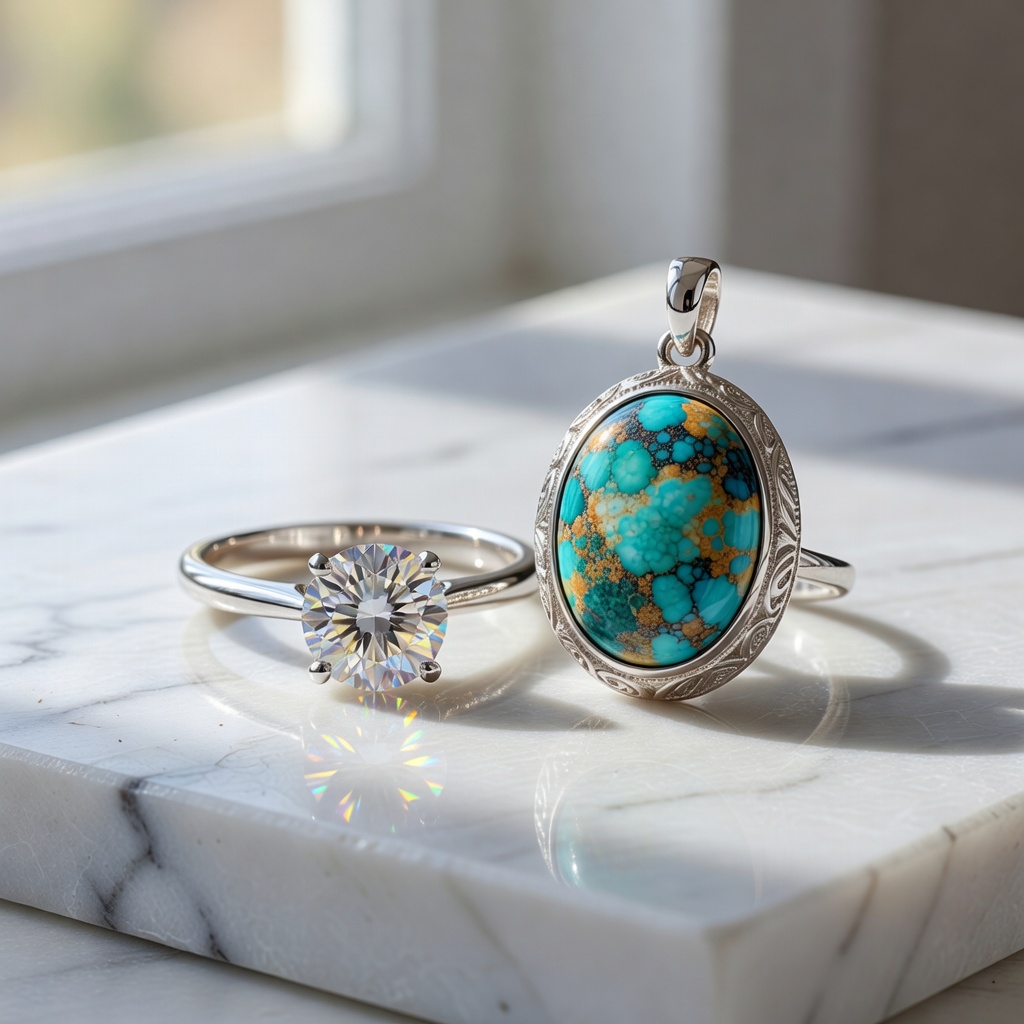
The optical characteristics of Moissanite create a display of light performance that rivals and sometimes exceeds that of diamonds. With a refractive index of 2.65, Moissanite brilliance produces exceptional sparkle, while its high dispersion rate of 0.104 generates noticeable "fire"—the rainbow flashes of colored light that dance across the stone's surface. Additionally, Moissanite exhibits double refraction, meaning it splits light into two rays as it passes through the crystal structure, creating a slightly blurred, glittering effect that enhances its scintillation. These properties make Moissanite engagement rings particularly captivating under various lighting conditions, from dim restaurant ambiances to bright sunlight.
Turquoise color variations span a spectrum from the highly prized Robin's egg blue, often associated with Persian mines and Arizona's Sleeping Beauty deposit, to deeper greenish hues found in Nevada and Chinese mining operations. Unlike the transparent clarity of Moissanite, turquoise presents an opaque to slightly translucent appearance with a distinctive waxy or subvitreous luster that absorbs rather than reflects light. The presence of matrix—the dark veining or web-like patterns formed by the host rock material—creates unique fingerprints within each stone, ranging from delicate spiderweb patterns to bold black or brown matrices that collectors often prize for their artistic quality. These matrix patterns serve as identifying characteristics, with certain mines producing recognizable signature patterns that experienced gemologists can identify on sight.
When selecting Blue gemstone alternatives, the choice between these two materials ultimately depends on whether the wearer desires light performance or color saturation. Moissanite functions as a neutral, brilliant accent that complements any outfit while maximizing light return, making it ideal for formal occasions and daily wear alike. Turquoise makes a definitive color statement, its opaque body color providing a bold contrast against metals and skin tones that works particularly well in bohemian, Southwestern, or vintage-inspired designs. Practical styling examples include pairing Moissanite solitaires with business attire for professional settings, while turquoise statement necklaces complement casual weekend wear or festival fashion with their earthy, artistic presence.
Durability and Hardness: The Mohs Scale Reality
Gemstone durability represents a critical consideration for jewelry intended for daily wear, and the contrast between these two materials could not be more pronounced. Moissanite hardness registers at 9.25 on the Mohs scale, placing it just below diamond (10) and alongside corundum varieties like sapphire and ruby. This exceptional hardness ensures that Moissanite resists scratching from virtually any material it might encounter during normal daily activities, from accidentally bumping against granite countertops to contact with metal keys or steel door handles. For consumers seeking Durable stones for daily wear, this hardness rating translates to jewelry that maintains its polish and surface integrity indefinitely, requiring only occasional cleaning to restore maximum brilliance.
Turquoise presents a dramatically different durability profile, ranking between 5 and 6 on the Gemstone hardness Mohs scale. This relatively soft rating means that turquoise can be scratched by many common materials, including dust particles (which often contain quartz at 7 hardness), steel utensils, and even other jewelry pieces stored carelessly together. Beyond surface scratching, turquoise exhibits significant porosity, absorbing liquids and oils that can permanently alter its color and stability. The stone's crystalline structure contains water molecules that can dehydrate when exposed to heat or dry conditions, potentially causing cracking or color fading over time. These characteristics make turquoise fundamentally unsuitable for high-impact activities or continuous wear without protective measures.
Toughness—the resistance to breaking, chipping, or fracturing under impact—further differentiates these materials. While Moissanite possesses good toughness and cleavage resistance, turquoise displays poor toughness due to its aggregate structure composed of microscopic crystals pressed together. A sharp blow or drop onto a hard surface that might leave Moissanite unscathed could easily fracture turquoise, particularly stones with visible matrix lines that represent natural weak points in the material.
| Characteristic | Moissanite | Turquoise |
|---|---|---|
| Mohs Hardness | 9.25 (Excellent) | 5-6 (Fair to Poor) |
| Scratch Resistance | Resistant to all materials except diamond | Scratches easily from dust, steel, and harder gems |
| Toughness | Good to Excellent | Poor (prone to fracturing) |
| Heat Sensitivity | High tolerance (up to 1800°F) | Low tolerance (dehydrates and cracks) |
| Chemical Resistance | Inert to acids and household chemicals | Damaged by cosmetics, soaps, and perspiration |
| Recommended Wear | 24/7 including physical activities | Occasional wear with protective settings |
Price and Value: Investment vs Accessibility
The pricing structure for Moissanite offers remarkable consistency and predictability compared to many other gemstones. Typically priced based on carat weight, cut quality, and color grade, Moissanite price per carat generally ranges from $300 to $600, representing a fraction of diamond costs while delivering comparable visual impact. Unlike diamonds, which fluctuate based on mining outputs and market speculation, lab-created Moissanite maintains stable pricing that allows consumers to budget accurately for significant purchases like engagement rings. This affordability extends to larger carat weights, where the price differential between Moissanite and precious gems becomes even more pronounced, enabling buyers to select substantial stones without compromising financial stability.
Turquoise stone value operates within a far more volatile and nuanced marketplace where provenance significantly impacts pricing. Natural, untreated Persian turquoise from the Nishapur mines can command thousands of dollars per carat for intense blue specimens without matrix, while stabilized turquoise from Chinese mines might retail for mere dollars per carat. American mines like Sleeping Beauty (now largely depleted), Kingman, and Bisbee produce material with recognizable characteristics that collectors specifically seek, with untreated specimens from closed mines appreciating substantially over time. The treatment status creates a three-tiered market: natural untreated (highest value), stabilized (mid-range), and reconstituted or dyed material (entry-level).
Long-term value retention presents opposing trajectories for these Affordable gemstone alternatives. Moissanite, while providing excellent value retention in terms of wearability and durability, does not appreciate monetarily due to its unlimited laboratory production capacity. High-grade natural turquoise, conversely, functions as a collectible commodity, with fine specimens from depleted mines like Lander Blue or Persian material potentially doubling in value over decades. However, this investment potential comes with liquidity challenges, as the turquoise market requires specialized knowledge to navigate authenticity and grading standards that vary significantly from standardized systems like those used for diamonds or Moissanite.
Jewelry Applications: From Bridal to Bohemian
The exceptional durability and brilliant optics of Moissanite make it the premier choice for high-impact jewelry pieces designed for continuous wear. Moissanite engagement rings dominate the alternative bridal market, offering couples the traditional diamond aesthetic with superior ethical credentials and budget flexibility. Beyond bridal applications, Moissanite performs excellently in anniversary bands, tennis bracelets, and stud earrings that undergo daily handling and exposure. The stone's versatility extends to Gemstone setting options, accommodating prong settings that maximize light exposure, bezel settings for active lifestyles, and channel settings for wedding bands where multiple stones require uniform protection.
Turquoise jewelry styles traditionally emphasize the stone's organic, earthy character through specific design approaches that acknowledge its limitations. Bezel settings provide essential protection for turquoise rings, wrapping the stone's edges in metal to prevent chipping and impact damage while accommodating the material's opacity. Southwestern and Native American jewelry traditions favor silverwork that complements turquoise's blue tones, creating squash blossom necklaces, concho belts, and cluster rings that distribute weight across multiple smaller stones rather than risking large singular specimens. Bohemian and contemporary designs often incorporate turquoise into earrings and pendants, positioning the stone away from high-impact zones like the hands while allowing the material to sit close to the skin where body heat and oils require careful management.
Metal compatibility considerations further differentiate these gemstones' optimal applications. Moissanite's colorless nature pairs beautifully with white gold and platinum for a seamless, icy appearance, while warm yellow or rose gold settings create vintage-inspired contrasts that highlight the stone's brilliance. Turquoise traditionally associates with sterling silver, which enhances its blue tones through complementary color theory, though high-end pieces might utilize gold to elevate the perceived value of premium specimens. Case studies from jewelry designers reveal that combining both materials in single pieces creates striking contrast, such as Moissanite halo surrounds protecting turquoise centers, or alternating stations in long necklaces where the brilliant white stones provide visual rest between intense blue segments.
Care and Maintenance: Low vs High Maintenance Gems
Maintaining Moissanite requires minimal effort thanks to its chemical inertness and hardness. Owners can safely clean their stones using ultrasonic cleaners, steam cleaners, or simple solutions of mild dish soap and warm water without risking damage to the gem. Unlike softer stones that might cloud or scratch during cleaning, Moissanite maintains its polish through routine maintenance that removes accumulated hand lotions, cooking oils, and environmental dust. The stone's resistance to thermal shock means it can withstand temperature variations during professional jewelry cleaning processes, making it ideal for those who prefer to maintain their pieces at home with minimal specialized equipment.
Turquoise jewelry care demands vigilant attention to environmental factors that could permanently damage the stone. Owners must remove turquoise pieces before washing hands, showering, swimming, or applying cosmetics, as the stone's porosity allows it to absorb water, soaps, and chemical fragrances that cause discoloration or structural degradation. Unlike Moissanite, turquoise benefits from occasional treatment with specialized mineral oils or waxes that fill surface pores and prevent dehydration, though this practice remains controversial among purists who prefer untreated natural patination. Storage requires placement in acid-free tissue paper within separate compartments to prevent scratching from harder jewelry items, with silica gel packets recommended for humid climates to prevent moisture absorption.
Professional maintenance protocols diverge significantly between these materials. Jewelers routinely inspect Moissanite settings for wear while cleaning the stone to maximum brilliance, a process that takes minutes and requires no special precautions. Turquoise, however, necessitates consultation with specialists who understand the specific treatments applied to the individual stone, as standard ultrasonic cleaning can destroy stabilized turquoise by loosening bonding agents, while steam cleaning causes immediate dehydration and cracking. Warning signs of damage differ as well: Moissanite shows obvious chips or scratches only under extreme trauma, while turquoise displays gradual color shifts, surface pitting, or white spots indicating chemical damage or drying that requires immediate professional attention to prevent further deterioration.
Symbolism and Cultural Significance
Moissanite carries distinctly modern symbolism that resonates with contemporary values of innovation and sustainability. As a gemstone literally born from scientific discovery and perfected through technological advancement, it represents human ingenuity triumphing over natural scarcity. For environmentally conscious consumers, Moissanite symbolism encompasses eco-friendly luxury, as its laboratory creation eliminates mining impacts while providing a conflict-free guarantee. The stone's extraterrestrial origins—first discovered in meteorites—also imbue it with celestial associations, making it popular among those who feel drawn to cosmic mysteries and the vastness of space, a fitting metaphor for love that feels larger than earthly constraints.
The Turquoise stone meaning encompasses millennia of human history and spiritual practice across diverse civilizations. Ancient Egyptians carved turquoise into protective amulets for pharaohs, including the iconic burial mask of Tutankhamun, while Persian cultures used the stone to cover palace domes and mosque interiors, believing it brought heaven closer to earth. Native American tribes throughout the Southwest consider turquoise sacred, with specific mines holding clan significance and stones believed to hold protective spirits that warn of danger by cracking or changing color. These deep cultural roots give turquoise jewelry a storytelling quality that connects wearers to ancient traditions and the specific landscapes where the material formed.
Contemporary meaning distinctions position these gems as representing different philosophical approaches to life and luxury. Moissanite appeals to forward-thinking individuals who prioritize scientific advancement, consistency, and future-oriented thinking, embodying the idea that human innovation can improve upon nature's limitations. Turquoise attracts those seeking grounding energy, earth connections, and holistic healing properties, with crystal practitioners attributing communication-enhancing and protective qualities to the stone. When choosing between these gems, consumers essentially select between representing technological optimism and honoring geological time, with many ultimately incorporating both philosophies into their jewelry wardrobes for different occasions and moods.
Making Your Decision: Lifestyle and Aesthetic Matching
Selecting between these distinctive materials requires honest assessment of daily activities and wearing habits. Active individuals who engage in manual labor, frequent gym sessions, or outdoor adventures will find Moissanite the only practical choice among these options, as its durability withstands accidental impacts, exposure to sweat, and contact with rough surfaces. Conversely, those with sedentary professional lifestyles or who view jewelry as occasional adornment for social events can successfully incorporate turquoise into their rotation, provided they commit to the removal rituals necessary before washing hands or applying skincare products. Consider creating a "jewelry profile" that catalogs your typical week: if you cannot commit to removing rings before every handwashing, Moissanite becomes the responsible choice.
Color preference analysis extends beyond simple aesthetic appeal to encompass wardrobe coordination and personal coloring. Moissanite offers neutral versatility that complements all skin tones and outfit colors, functioning as a "white shirt" of jewelry that transitions seamlessly from boardrooms to ballrooms. Turquoise makes a definitive statement that works beautifully with specific color palettes—coral, cream, brown, and white—but may clash with certain business attire or formal evening wear. Case studies of successful gemstone selection often reveal that turquoise collectors typically own multiple pieces for rotation, preventing excessive wear on individual items, while Moissanite owners frequently wear single pieces daily for years without removal.
Ethical considerations in the Lab created vs natural gemstones debate increasingly influence purchasing decisions. Moissanite offers clear ethical advantages through its minimal environmental footprint and guaranteed conflict-free status, appealing to consumers who prioritize sustainability certifications and carbon footprint reduction. Turquoise mining, while smaller in scale than diamond or gold operations, still involves land disturbance, water usage in processing, and potential worker safety concerns in developing regions. However, supporting indigenous turquoise miners through fair-trade cooperatives provides economic benefits to Native American communities, offering a different ethical framework that values cultural preservation and artisanal mining practices over industrial alternatives. Authenticity verification remains crucial for turquoise buyers, as synthetic and imitation materials flood the market, requiring purchase from reputable dealers who provide provenance documentation.
Frequently Asked Questions
Is moissanite harder than turquoise?
Yes, significantly. Moissanite ranks 9.25 on the Mohs hardness scale, making it extremely scratch-resistant and suitable for daily wear, while turquoise is much softer at 5-6, requiring protective settings and gentle handling to prevent surface damage.
Can I use turquoise for an engagement ring instead of moissanite?
While possible, turquoise is generally not recommended for engagement rings due to its softness (5-6 Mohs), porosity, and vulnerability to chemicals, sweat, and impact. Moissanite is the superior choice for engagement rings because it withstands daily wear, maintains its polish, and requires minimal maintenance.
Which is more expensive, moissanite or high-quality turquoise?
Natural, untreated high-quality turquoise (especially Persian or Sleeping Beauty) can command higher prices per carat than moissanite, sometimes reaching thousands for rare specimens. However, moissanite offers more consistent, predictable pricing and generally provides better value for bridal jewelry due to its durability.
Does moissanite look like a diamond while turquoise looks completely different?
Yes. Moissanite closely resembles diamonds with its colorless appearance and superior brilliance (more fire/rainbow flashes), while turquoise is immediately recognizable by its opaque blue-green color and distinctive matrix patterns. They serve completely different aesthetic purposes in jewelry design.
Can I wear turquoise jewelry every day like moissanite?
No, turquoise requires more careful wear. Unlike moissanite, which can be worn 24/7 including during showering or exercising, turquoise should be removed before washing hands, applying lotions, or physical activity. Its porosity makes it susceptible to discoloration from skin oils, soaps, and cosmetics.
Is moissanite a natural gemstone like turquoise?
Almost all moissanite available today is lab-created, though the mineral was originally discovered in meteorites. Turquoise is a natural, mined gemstone formed over millions of years. This distinction matters for consumers seeking 'earth-mined' stones versus those prioritizing laboratory consistency and sustainability.
Can moissanite and turquoise be combined in one jewelry piece?
Absolutely. Combining moissanite's sparkle with turquoise's color creates striking contrast, particularly in Southwestern-inspired designs or modern bohemian pieces. However, ensure the turquoise is well-protected in a bezel setting while moissanite can handle prong settings, given their different durability levels.
Which gemstone is better for someone with an active lifestyle?
Moissanite is the clear winner for active lifestyles. Its extreme hardness (9.25 Mohs) resists scratching during workouts, manual labor, or daily chores, whereas turquoise can scratch easily, absorb sweat and chemicals, and potentially crack under impact during physical activities.