Introduction: Understanding the Moissanite vs Pearl Debate
Moissanite and pearl represent two vastly different philosophies in the world of fine jewelry, yet both have captured the hearts of modern consumers seeking alternatives to traditional diamond pieces. When conducting a moissanite vs pearl comparison, buyers must understand that these gemstones occupy opposite ends of the spectrum regarding origin, durability, and aesthetic appeal. Moissanite dazzles with its diamond-like brilliance and space-age origins, while pearls enchant with their organic warmth and timeless elegance derived from living creatures. This comprehensive gemstone buying guide examines the critical factors that distinguish these materials, helping you make an informed decision whether you're shopping for an engagement ring, anniversary gift, or personal statement piece.
Origins and Formation: Lab-Created vs Organic
The fundamental difference between lab created moissanite vs natural pearl begins with their radically different creation stories and geological classifications. Moissanite is a silicon carbide crystal originally discovered in 1893 by Henri Moissan within a meteor crater in Arizona, though virtually all jewelry-grade moissanite today is engineered in sophisticated laboratories under controlled conditions. This synthetic gemstone production involves growing crystals at high temperatures to create gem-quality stones that rival diamonds in optical properties while maintaining ethical sourcing standards. In stark contrast, pearls represent the only gemstones created by living organisms, forming when an irritant enters an oyster or mussel, triggering the secretion of nacre that builds up over months or years into the lustrous spheres we treasure.
Pearl formation occurs through both natural and cultured methods, with natural pearls developing without human intervention in wild mollusks, while cultured pearls involve technicians deliberately inserting nuclei to stimulate nacre production. The organic vs synthetic gemstones distinction carries unique sustainability considerations, as pearl farming actually improves water quality and supports marine ecosystems, whereas moissanite production requires significant energy consumption but avoids mining impacts entirely. Availability differs dramatically between these two options, as moissanite can be manufactured on demand to meet market needs, while pearl harvests remain dependent on seasonal factors, water conditions, and the biological health of mollusk populations, making high-quality pearls increasingly scarce and valuable.
Durability and Hardness: Wearability Analysis
Understanding gemstone hardness comparison metrics proves essential when evaluating moissanite durability vs pearl for everyday jewelry applications. Moissanite ranks an impressive 9.25 on the Mohs hardness scale, making it the second hardest gemstone used in jewelry after diamonds, which means it resists scratching from nearly all other materials except diamond itself. This exceptional hardness translates to superior scratch resistance, ensuring that moissanite maintains its faceted sparkle and surface integrity even after decades of daily wear, including exposure to household dust and environmental particles. Conversely, pearls register merely 2.5 to 4.5 on the Mohs scale, making them softer than common materials like copper coins, glass, and even human fingernails, which means they scratch easily and require protective settings and careful handling.
Beyond surface hardness, toughness and fracture resistance reveal additional performance differences critical for long-term wearability. Moissanite exhibits excellent toughness, resisting chipping and breaking under normal impact conditions, though it can fracture under extreme force due to its crystalline structure. Pearls, composed of microscopic calcium carbonate platelets bonded by organic conchiolin, possess moderate toughness against sudden impacts but are vulnerable to crushing, cracking, and surface damage from acids, cosmetics, and perspiration. For active individuals or those seeking heirloom pieces for daily wear, moissanite offers worry-free durability, while pearls demand delicate treatment similar to wearing artwork rather than armor.
Visual Characteristics: Brilliance vs Luster
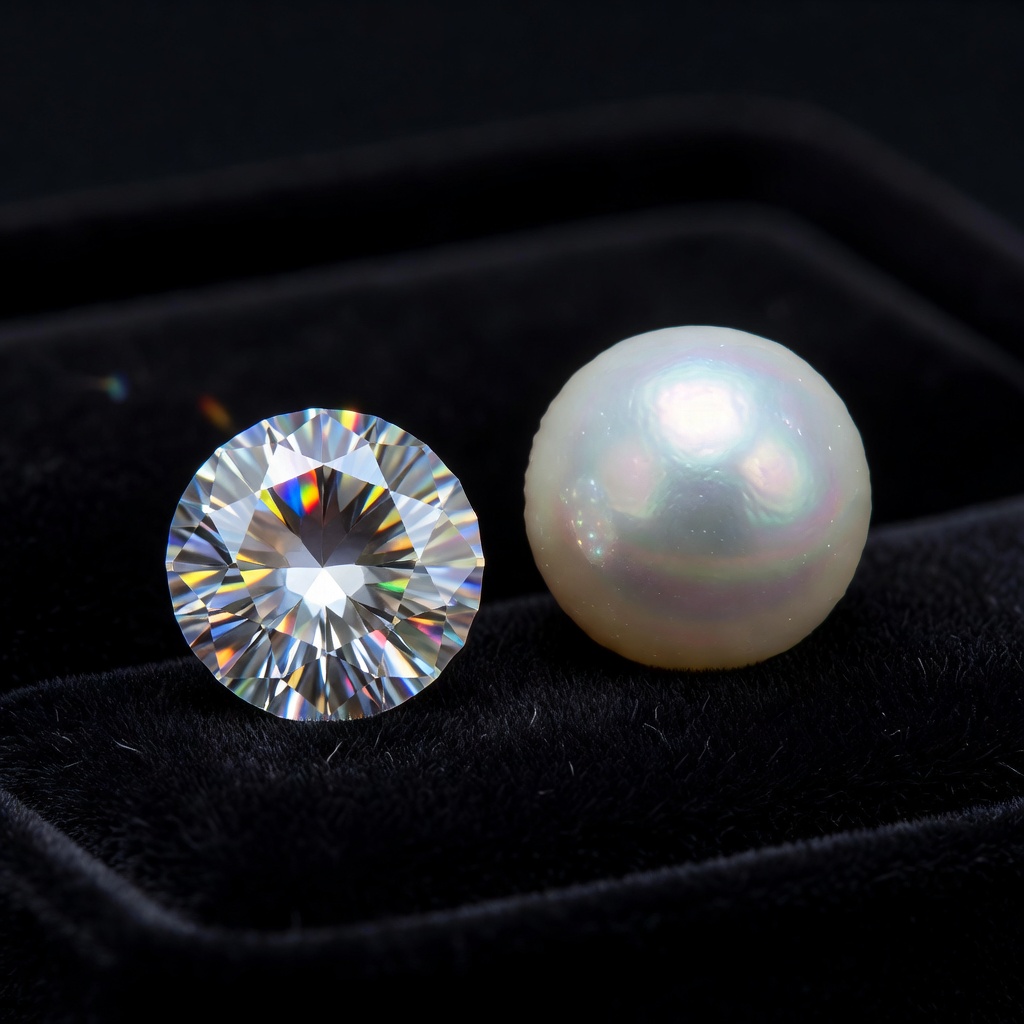
The aesthetic distinction between moissanite brilliance vs pearl luster creates entirely different visual experiences that appeal to diverse style preferences. Moissanite possesses a refractive index of 2.65-2.69, higher than diamonds, combined with a dispersion rating of 0.104 that produces remarkable rainbow fire and spectral color flashes when exposed to light. This gemstone exhibits double refraction, meaning light splits when entering the stone, creating a facet-doubling effect that enhances its sparkling appearance but differs subtly from diamond optics. The result is a brilliant, geometric display of light that commands attention and mimics the most prized characteristics of colorless diamonds at a fraction of the cost.
Pearls offer a completely different optical phenomenon based on luster, orient, and overtones rather than faceted brilliance. Luster refers to the sharpness and intensity of light reflected from the pearl's surface and just below it, with high-quality specimens displaying mirror-like depth that seems to glow from within. Orient describes the iridescent rainbow sheen that appears to float over the surface of fine pearls, caused by the interference of light passing through layers of nacre. Color variations expand the palette for both gemstones, with moissanite available primarily in colorless (D-E-F range), near-colorless, and fancy yellow or green tints, while pearls span natural white, cream, pink, lavender, black Tahitian, and golden South Sea varieties, each offering unique overtone combinations that shift with movement and lighting.
Jewelry Applications: Best Settings and Styles
When considering pearl jewelry vs moissanite rings for specific applications, durability constraints largely dictate appropriate settings and wearing occasions. Moissanite excels in engagement rings, wedding bands, and daily wear earrings due to its robust nature, allowing for delicate prong settings, bezel mounts, and intricate designs without risking stone damage during regular activities. This synthetic gemstone pairs beautifully with platinum, white gold, yellow gold, and rose gold settings, offering versatility for modern, vintage, or avant-garde designs that withstand the rigors of manual labor, gym workouts, and household chores without protective measures.
Pearls traditionally dominate necklace strands, stud earrings, brooches, and formal occasion jewelry where their delicate nature can be protected from physical stress and chemical exposure. Jewelry designers must incorporate protective settings for pearls, including substantial bezels, glue mounts rather than prongs, and backing plates that prevent the soft nacre from contacting hard surfaces or abrasive materials. Metal pairings for pearls typically favor yellow gold, which complements the warm overtones of cream and golden pearls, or white gold and platinum for cooler white and silver-blue varieties. Practical styling tips include reserving pearl rings for cocktail events rather than daily wear, choosing shorter necklace lengths that avoid swinging against clothing hardware, and selecting stud earrings over dangling styles that might knock against objects during wear.
Comprehensive Comparison Table
| Characteristic | Moissanite | Pearl |
|---|---|---|
| Origin | Laboratory-created silicon carbide; rare natural occurrence in meteorites | Organic formation within oysters and mussels; natural or cultured |
| Mohs Hardness | 9.25 (Extremely hard, second only to diamond) | 2.5-4.5 (Soft, similar to fingernails or copper) |
| Durability | Excellent scratch resistance; suitable for daily wear and manual labor | Poor scratch resistance; vulnerable to acids, cosmetics, and impact |
| Visual Appearance | Brilliant sparkle with rainbow fire; faceted geometric cuts; double refraction | Soft luster with orient iridescence; smooth organic surface; glow from within |
| Price Range (Quality) | $300-$600 per carat; consistent pricing due to lab production | Highly variable: $50-$10,000+ depending on type, size, and origin |
| Best Jewelry Use | Engagement rings, daily wear earrings, statement pieces, wedding bands | Necklaces, formal earrings, brooches, occasional wear rings |
| Maintenance Level | Low maintenance; safe for ultrasonic and steam cleaners | High maintenance; requires gentle wiping, chemical avoidance, regular restringing |
| Value Retention | Depreciates after purchase; unlimited supply affects investment potential | Natural pearls appreciate; cultured pearls hold moderate value |
| Symbolism | Modern ethics, space origins, innovation, accessible luxury | Purity, wisdom, wealth, June birthstone, traditional elegance |
Price Comparison and Investment Value
Analyzing moissanite vs pearl price structures reveals distinct market dynamics that affect purchasing decisions and long-term value retention. Moissanite typically costs between $300 to $600 per carat for high-quality colorless stones, with pricing remaining remarkably consistent due to controlled laboratory production methods that eliminate the variability associated with natural resource extraction. This predictable pricing allows consumers to budget accurately for larger carat weights or elaborate settings without encountering the exponential price jumps common in natural gemstone markets. The affordability of moissanite makes it accessible for statement pieces, stackable rings, and fashion jewelry that might be prohibitively expensive with diamonds or rare pearls.
Pearl pricing operates on a complex matrix of quality factors including size, shape perfection, luster intensity, surface cleanliness, and origin variety. Cultured freshwater pearls might range from $50 to $500 per strand depending on quality, while fine Akoya pearls command $300 to $10,000, and exceptional South Sea or natural wild pearls can reach tens of thousands of dollars for single specimens. Investment potential diverges significantly between these options, as high-quality natural pearls historically appreciate in value and attract collectors, whereas lab-created moissanite depreciates after purchase similar to other manufactured technological products. Cultured pearls occupy a middle ground, offering moderate value retention for fine specimens but lacking the investment grade status of their natural counterparts or the durability for generational transfer without significant wear.
Care and Maintenance Requirements
Proper pearl care vs moissanite maintenance protocols reflect their divergent hardness levels and chemical sensitivities, requiring distinctly different approaches to preservation. Moissanite cleaning methods offer remarkable convenience, as this hard gemstone safely tolerates ultrasonic cleaners, steam cleaning, boiling water, and commercial jewelry solutions without risk of damage, etching, or color change. Home maintenance involves simply soaking moissanite pieces in warm soapy water, gently brushing with a soft toothbrush to remove accumulated lotions and oils, and rinsing thoroughly to restore maximum brilliance. This low-maintenance requirement makes moissanite ideal for busy professionals who desire sparkling jewelry without frequent professional servicing or elaborate cleaning rituals.
Pearl maintenance demands meticulous attention to chemical avoidance, proper storage, and gentle handling to prevent the irreversible damage that acids and abrasives inflict on nacre surfaces. Owners must apply pearls after cosmetics, perfumes, and hair products have dried, wipe them with a soft damp cloth after each wearing to remove skin oils and perspiration, and store them flat in soft pouches separate from other jewelry to prevent scratching. Professional care for pearl strands requires restringing every one to two years if worn regularly, using silk thread knotted between each pearl to prevent loss if the strand breaks, and never hanging pearl necklaces as this stretches and weakens the silk. Long-term preservation strategies include maintaining stable humidity levels to prevent nacre drying and cracking, avoiding sealed plastic bags that trap moisture, and periodically wearing pearls to benefit from natural skin oils that help maintain luster.
Symbolism and Cultural Significance
The cultural narratives surrounding pearl symbolism vs moissanite meaning offer rich traditions and contemporary associations that influence gifting decisions and personal connections. Pearls carry millennia of historical significance across civilizations, symbolizing purity, wisdom, and wealth in ancient Rome, China, and India, and serving as the traditional thirtieth wedding anniversary gift and June birthstone in modern Western culture. These organic gems appear in religious texts, royal regalia, and coming-of-age ceremonies, embodying feminine elegance and natural perfection through their association with the moon and water elements. Victorian mourning jewelry often incorporated pearls to represent tears, while Asian cultures value them as symbols of immortality and spiritual transformation.
Moissanite represents a distinctly modern symbolic language rooted in scientific achievement, ethical consumption, and cosmic wonder due to its original discovery in meteorites and current laboratory creation. This gemstone appeals to environmentally conscious consumers seeking conflict-free luxury without the mining concerns associated with diamonds and colored stones, embodying values of innovation, sustainability, and accessible elegance. While lacking traditional birthstone status or ancient folklore, moissanite has rapidly acquired associations with contemporary romance, space-age origins, and intelligent consumerism, making it popular for engagement rings among couples prioritizing ethical sourcing and budget consciousness. Cultural perceptions position pearls as heritage pieces connecting wearers to tradition and natural history, while moissanite signals forward-thinking sophistication and technological mastery.
Final Verdict: Choosing Your Perfect Gemstone
Choosing between moissanite and pearl ultimately requires honest assessment of lifestyle realities, aesthetic preferences, and long-term ownership expectations rather than simply comparing objective quality metrics. Active individuals, healthcare workers, or those seeking daily-wear engagement jewelry should prioritize moissanite for its durability, while those desiring special-occasion statement pieces, vintage-inspired aesthetics, or connections to natural history will find pearls more fulfilling despite their fragility. Budget considerations extend beyond initial purchase price to include maintenance costs, insurance requirements, and replacement likelihood, with moissanite offering lower total cost of ownership for daily wear and high-quality natural pearls potentially serving as appreciating assets for collectors.
Personal style alignment plays a crucial role, as moissanite suits modern, minimalist, or glamorous aesthetics that embrace brilliant sparkle and geometric precision, while pearls complement romantic, classic, or bohemian styles that favor organic forms and subtle iridescence. For wedding jewelry, consider moissanite for engagement rings and wedding bands that withstand daily activities, reserving pearls for bridal necklaces, earrings, or anniversary gifts worn during protected occasions. Mixed gemstone wardrobes can successfully incorporate both materials by following proper storage protocols and selecting appropriate settings that protect pearls while showcasing moissanite's durability. Ultimately, neither gemstone supersedes the other; instead, they serve complementary roles in a comprehensive jewelry collection that balances practicality with poetry.
Frequently Asked Questions
Is Moissanite More Durable Than Pearl?
Yes, significantly. Moissanite ranks 9.25 on the Mohs hardness scale, making it extremely scratch-resistant and suitable for daily wear, while pearls range from 2.5-4.5, making them soft, easily scratched, and vulnerable to damage from chemicals and impact.
Can You Wear Pearls Every Day Like Moissanite?
No, pearls are not recommended for daily wear like moissanite. Pearls are soft, porous, and susceptible to damage from perfumes, cosmetics, sweat, and physical impact. They require careful handling and are best reserved for special occasions, while moissanite can withstand daily activities including manual labor.
Which Is More Expensive, Moissanite or Pearl?
It depends on quality. High-quality natural pearls, especially South Sea or natural wild pearls, can cost significantly more than moissanite. However, cultured freshwater pearls are generally less expensive than moissanite. Lab-created moissanite has consistent pricing, while pearl prices vary widely based on size, luster, shape, and rarity.
Do Moissanite and Pearl Look Similar?
No, they have distinctly different appearances. Moissanite exhibits brilliant sparkle, rainbow fire (dispersion), and a faceted, geometric look similar to diamonds. Pearls display soft, deep luster, iridescence (orient), and a smooth, organic glow without sharp facets or fiery sparkles.
Is Moissanite a Good Alternative to Pearl for Engagement Rings?
Moissanite is actually superior to pearl for engagement rings due to durability requirements. Pearls are too soft for daily ring wear and will scratch and deteriorate quickly. Moissanite offers diamond-like durability and brilliance at a fraction of the cost, making it ideal for everyday jewelry like engagement rings.
How Do I Clean Moissanite vs Pearl Jewelry?
Clean moissanite using warm soapy water, commercial jewelry cleaner, or ultrasonic cleaners safely. For pearls, use only a damp soft cloth with mild soapy water, never submerge fully, avoid all chemicals and ultrasonic cleaners, and lay flat to dry—never hang pearls as this stretches the silk thread.
Can Moissanite and Pearl Be Worn Together in Jewelry?
Yes, but with caution. In combination pieces, ensure pearls are protected from rubbing against harder moissanite settings. Avoid designs where the hard moissanite metal setting could scratch the soft pearl surface. Store separately to prevent the moissanite from scratching the pearl's nacre.
Which Gemstone Holds Its Value Better Over Time?
High-quality natural pearls (especially vintage or rare varieties) often appreciate in value and hold resale value better than moissanite. Moissanite, being lab-created with unlimited supply, depreciates after purchase similar to other manufactured goods. Cultured pearls fall somewhere in between but generally don't appreciate like natural pearls.