Moissanite vs Opal in Modern Jewelry
The landscape of fine jewelry has shifted dramatically as couples and collectors increasingly seek alternative engagement ring stones that reflect individual personality rather than traditional expectations. When examining moissanite vs opal, buyers encounter two radically different paths: one offers space-age durability with diamond-like brilliance, while the other provides nature's artistic mastery with ethereal color play. This comprehensive comparison explores how lab-created moissanite and natural opal stones serve distinct purposes in contemporary jewelry collections, helping you navigate the decision based on your daily activities, aesthetic preferences, and long-term wear expectations. Understanding these fundamental differences ensures your investment aligns with both your lifestyle and the symbolic meaning you wish to capture in your jewelry piece.
Understanding Moissanite: Origins and Optical Properties
Henri Moissan's 1893 discovery of microscopic silicon carbide crystals in an Arizona meteor crater initially puzzled scientists, as these gemstones literally fell from the stars before modern technology made them accessible on Earth. Today, lab-created moissanite replicates this extraterrestrial mineral through advanced thermal growing processes that produce gem-quality crystals in controlled laboratory environments, ensuring ethical sourcing and consistent quality. The resulting gemstone boasts a refractive index of 2.65, surpassing even diamonds in its ability to bend light and create spectacular brilliance that dances with rainbow dispersion when moved.
Modern moissanite properties include exceptional thermal conductivity and optical characteristics that make it virtually indistinguishable from diamond to the untrained eye, though gemologists appreciate its unique double refraction that creates a distinctive "fuzzy" facet pattern under magnification. Jewelry designers particularly value moissanite for its versatility in various cuts, from classic round brilliants to modern cushion shapes, knowing that the material's hardness allows for precise faceting that maximizes light return. When selecting moissanite engagement rings, consumers benefit from knowing that every stone represents sustainable luxury, requiring no mining while delivering consistent clarity and color grades that natural stones cannot guarantee.
The Mystique of Opal: Formation and Visual Characteristics
Unlike their laboratory-born counterparts, natural opal stones emerge from the slow geological ballet of silica-rich water seeping into rock crevices over millions of years, eventually solidifying into hydrated silica gel with water content ranging from three to twenty-one percent. The mesmerizing opal play of color phenomenon occurs when light diffracts through microscopic silica spheres arranged in precise grid-like patterns, creating spectral flashes that shift and morph as the stone moves beneath your gaze. Australian black opals from Lightning Ridge command the highest premiums, displaying intense red flashes against dark body tones, while Ethiopian Welo opals offer translucent honey bases with vibrant neon fire, and Mexican fire opals burn with solid orange, red, or yellow body color without the typical color play.
Collectors often describe high-quality precious opal as "living art" because no two stones ever display identical patterns, with varieties ranging from the ironstone-backed boulder opals of Queensland to the milky, cloud-like white opals from Coober Pedy. When evaluating opal for jewelry, consider that the stone's body tone—the background darkness against which the colors flash—dramatically affects both value and visual impact, with darker backgrounds generally providing better contrast for the spectral display. Jewelry artisans working with opal must account for the stone's sensitivity to dehydration and impact, often choosing protective bezel settings that cradle the gem while allowing light to enter from the crown to activate those hypnotic color patterns.
Durability and Hardness: Can They Handle Daily Wear?
Any gemstone hardness comparison between these two materials reveals a stark reality that directly impacts their suitability for different jewelry applications, with moissanite ranking 9.25 on the Mohs scale while opal struggles between 5.5 and 6.5. This significant difference means that moissanite resists scratching from virtually any daily encounter except contact with diamonds or other moissanite stones, maintaining its polish through years of dishwashing, gardening, and office work without showing wear. Conversely, opal's relative softness means that dust particles (which often contain quartz at 7 hardness) can gradually abrade the surface, while sudden impacts against hard surfaces create risk for catastrophic cracking or "crazing"—the development of internal fracture lines that destroy value.
Beyond simple hardness ratings, moissanite durability extends to its toughness, the measure of resistance to chipping and breaking, where the crystalline structure withstands sharp blows that would shatter more brittle gemstones. Opal presents unique challenges because its water content creates internal stress; when exposed to extreme temperature changes or dry environments, the gem can crack as moisture evaporates unevenly from the silica structure. For active professionals such as nurses, chefs, or construction workers, moissanite engagement rings provide peace of mind during rigorous daily tasks, while opal jewelry demands careful consideration of setting protection and activity level, making it ideal for retirees, office workers, or those willing to remove their rings during physical activities.
Case Study: The Yoga Instructor's Dilemma
Consider Sarah, a yoga instructor who initially chose a beautiful Australian crystal opal for her engagement ring, captivated by its oceanic blue flashes, only to discover that six months of handstands and weight-bearing poses on yoga mats caused microscopic surface scratches that dulled the stone's polish. After consulting with a gemologist, she switched to a lab-created moissanite solitaire that maintained its fire through constant hand washing between classes, demonstrating how profession and hobby compatibility should drive gemstone selection more than initial aesthetic appeal alone.
Visual Appeal: Fire, Brilliance, and Body Color
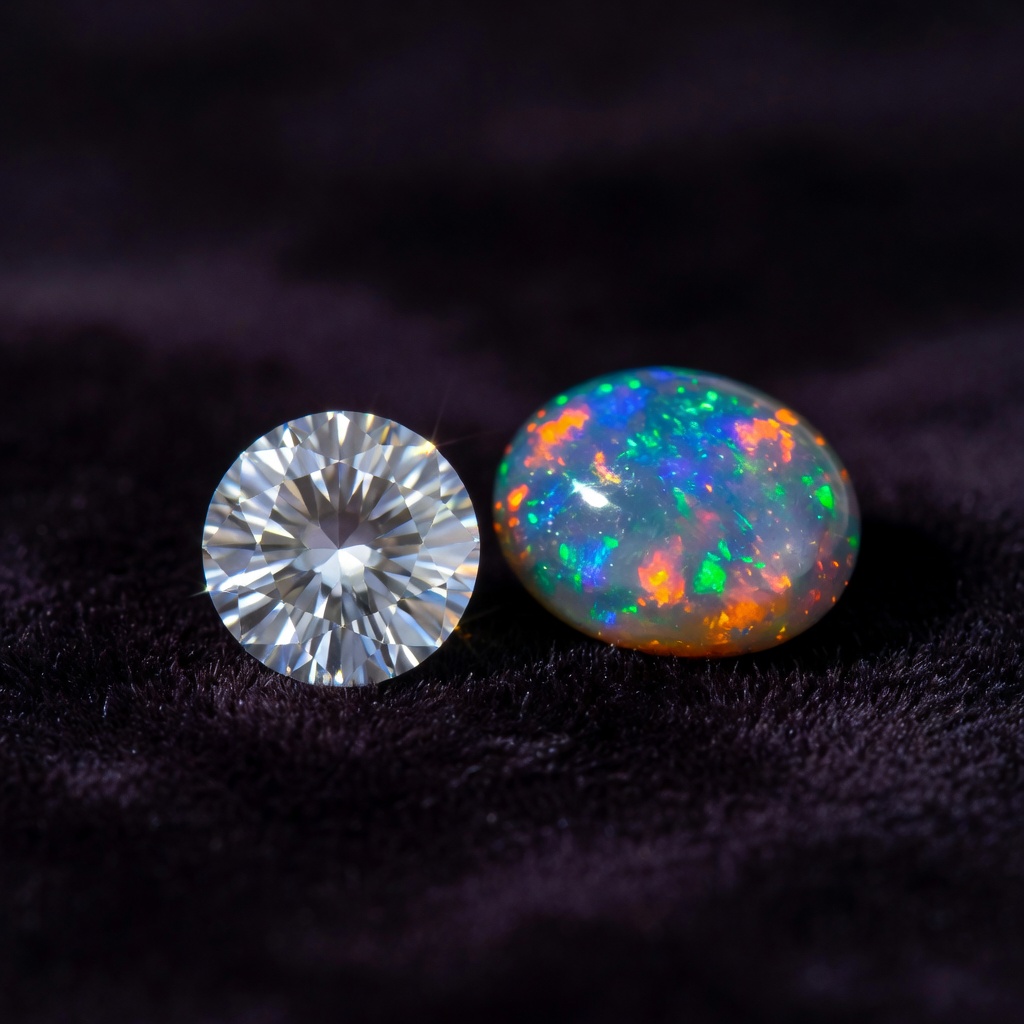
Moissanite brilliance derives from its faceted precision and high refractive index, creating a disco-ball effect of white light return punctuated by rainbow dispersion that splits light into spectral colors with greater intensity than diamond. This "fire" manifests as geometric flashes of red, green, and blue that emanate from the table and facets in predictable patterns, appealing to those who appreciate the structured sparkle of traditional precious gems. Under direct sunlight, moissanite practically ignites with brilliance, though some wearers find the intensity overwhelming in fluorescent office lighting where the stone can appear almost too perfect or "plastic-like" to certain eyes.
Opal fire patterns operate on entirely different optical principles, displaying broad sheets or pinpricks of color that seem to float within the stone's depths, shifting from blue-green to orange-red as you tilt the gem under light sources. Unlike moissanite's consistent sparkle, opal responds dynamically to lighting conditions, often appearing milky or subdued under fluorescent tubes while exploding with color near incandescent bulbs or natural sunlight, rewarding patient observers who take time to appreciate its changing moods. The visual experience of wearing opal resembles carrying a miniature aurora borealis, with the body color providing a canvas—whether jet black, translucent crystal, or ironstone brown—against which the spectral display performs its endless dance.
Practical Lighting Test
Before purchasing either gemstone, conduct a simple lighting experiment: examine the stone under the harsh fluorescent lighting typical of office environments, then move to natural window light, and finally check its appearance under warm incandescent bulbs or candlelight. Moissanite maintains relatively consistent brilliance across all environments, while opal may disappoint in dim restaurants only to astonish at sunset, helping you determine whether you prefer reliable sparkle or theatrical color surprises.
Price Analysis and Value Retention
When evaluating moissanite price points, buyers encounter remarkable consistency, with high-quality stones averaging between $400 and $600 per carat regardless of color grade, though fancy colored moissanite (such as gray or green tints) may command slight premiums. This predictable pricing structure stems from the controlled laboratory environment where production scales meet demand without the geological scarcity factors that drive natural gemstone markets, making moissanite an affordable gemstone option for budget-conscious couples seeking substantial carat weights without compromising ethical standards. The resale market for moissanite remains limited, as laboratory-created stones typically depreciate similarly to other manufactured luxury goods, though the initial savings often offset this consideration for buyers prioritizing immediate sparkle over investment potential.
Opal value spans an astronomical range from $50 per carat for common white opal with subdued fire to over $10,000 per carat for museum-quality Australian black opal displaying full red spectral flashes against a dark body tone. Pricing factors include origin (Australian stones generally command premiums over Ethiopian due to historical prestige and stability), pattern intensity (harlequin or ribbon patterns fetching more than pinfire), and body tone darkness, with N1-N4 rated black opals representing the pinnacle of the market. Unlike moissanite, high-grade opal can appreciate as a collectible asset, particularly rare specimens from depleted mines, though the market requires specialized knowledge to navigate authenticity and treatment disclosures such as sugar or smoke treatments that artificially darken stones.
Budget Optimization Strategy
For couples with $2,000 to spend, choosing a one-carat moissanite center stone leaves room in the budget for elaborate platinum settings or diamond accent stones, while the same investment might secure a modest half-carat crystal opal with decent fire or a smaller but intense black opal requiring significant setting protection. Consider allocating opal purchases toward earrings or pendants where impact risk decreases, allowing you to enjoy both gemstones in your collection without compromising the durability needs of daily-wear rings.
Best Applications: Rings, Pendants, and Lifestyle Matching
Moissanite engagement rings dominate the alternative bridal market because the material's hardness supports the exposed, elevated settings—such as classic six-prong solitaires or tension settings—that showcase maximum light return without risking structural integrity. The stone performs admirably in wedding bands that endure daily hand-washing, gym workouts, and household chores, requiring only occasional cleaning to maintain their factory-fresh appearance decade after decade. For professionals in medical fields, food service, or active trades, moissanite provides the worry-free durability necessary for continuous wear, eliminating the anxiety of damaging an irreplaceable natural treasure during routine activities.
Opal jewelry truly shines in applications that minimize impact risk while maximizing viewing pleasure, making pendants and earrings ideal canvases for these organic gems where they receive protection from surrounding metal and encounter fewer hard surfaces than rings. When set in rings, opals demand protective bezel settings that wrap the girdle in metal, low-profile designs that sit close to the finger, or "occasion wear" pieces reserved for dinners and celebrations rather than daily desk work. Nurses, teachers, and parents of young children might reserve opal rings for weekend wear while choosing moissanite or sapphire for weekday durability, effectively building a jewelry wardrobe that matches specific stones to appropriate activities.
Occupation-Based Selection Guide
Office workers and creative professionals handling paperwork and keyboards can successfully wear either gemstone, though those typing eight hours daily should consider low-profile opal settings to prevent the stone from contacting desk surfaces. Conversely, healthcare workers, athletes, and mechanics should avoid opal rings entirely, opting instead for moissanite's resilience or moving opal to earring form where it remains safe from impact while still displaying its characteristic color play near the face.
Maintenance Requirements and Care Guidelines
Moissanite care requires minimal effort thanks to the stone's chemical inertness and hardness, allowing owners to clean their jewelry using ultrasonic cleaners, steam machines, or simple warm soapy water without fear of damage to the gem itself. The material's resistance to heat means that jewelers can resize rings or repair prongs without removing the stone, while its non-porous surface prevents the buildup of lotions and oils that might temporarily dull its sparkle, though regular cleaning maintains optimal brilliance. Unlike porous gems, moissanite withstands exposure to household chemicals, chlorinated pools, and cosmetics, making it ideal for those who prefer "set it and forget it" jewelry maintenance routines.
Learning how to clean opal properly becomes essential for preservation, as these hydrated gems require gentle handling with damp soft cloths or mild soapy water applied carefully, never soaking, and absolutely avoiding ultrasonic or steam cleaning that can cause cracking from rapid temperature changes or vibration. Solid opals tolerate brief water contact during cleaning, but doublet or triplet opals—composite stones with glue layers—must never touch water, as moisture penetration destroys the adhesive and causes delamination. Store opal jewelry separately in padded compartments away from harder gemstones, and consider placing a small dish of water in your jewelry box to maintain ambient humidity, preventing dehydration that leads to "crazing" or cracking in dry climates or heated winter homes.
Seasonal Care Calendar
Establish a maintenance routine where moissanite receives quarterly deep cleaning in ultrasonic baths while opal gets monthly gentle wiping with a barely damp microfiber cloth followed by immediate drying with a soft towel. During winter months when heating systems reduce indoor humidity, store opal pieces with silica gel packs (in sealed containers, not touching the gems) to regulate moisture levels, and never leave opal jewelry in hot cars where temperatures can exceed safe thresholds rapidly.
Pros and Cons Summary Table
The following comparison table provides a side-by-side analysis of critical factors to consider when evaluating opal vs moissanite pros cons for your specific jewelry needs:
| Aspect | Moissanite | Opal |
|---|---|---|
| Durability (Mohs Hardness) | 9.25 - Extremely scratch resistant, suitable for daily wear | 5.5-6.5 - Soft and brittle, prone to scratching and cracking |
| Visual Characteristics | Diamond-like brilliance with intense rainbow fire and geometric sparkle | Organic play-of-color with floating spectral flashes, unique patterns |
| Price Range (Per Carat) | $400-$600 consistently priced, predictable market | $50-$10,000+ highly variable based on origin, pattern, and body tone |
| Maintenance Requirements | Ultrasonic and steam safe, chemical resistant, minimal care needed | Requires gentle wiping only, humidity control, protection from temperature shocks |
| Best Jewelry Applications | Engagement rings, wedding bands, daily wear pieces | Pendants, earrings, occasion rings with protective settings |
| Origin and Ethics | Lab-created, zero mining impact, sustainable and conflict-free | Natural formation, mining environmental impact, rare premium specimens |
Final Verdict: Which Gemstone Should You Choose?
Choosing between moissanite and opal ultimately requires honest assessment of your daily activity level, professional demands, and emotional connection to the stone's origin story rather than simply comparing aesthetic appeal. If your lifestyle involves manual labor, frequent hand washing, sports participation, or parenting young children, moissanite offers the only practical solution for engagement rings that will look as pristine on your twentieth anniversary as on your wedding day. However, if you work in creative fields, lead a relatively protected lifestyle, or specifically seek a unique artistic expression that no one else possesses, opal provides an irreplaceable connection to geological history and natural artistry that manufactured stones cannot replicate.
Consider adopting both gemstones into your collection strategically: select moissanite engagement rings for the symbolism of enduring love and daily practicality, while acquiring opal pendants or earrings to satisfy your appreciation for organic beauty without exposing the fragile stone to ring-specific risks. Budget-conscious buyers might start with moissanite for primary bridal jewelry, then anniversary-gift themselves opal pieces as lifestyle circumstances evolve toward gentler activities or retirement. Whatever your choice, prioritize purchasing from reputable dealers who provide certification for moissanite (confirming silicon carbide composition) or origin documentation for opal (verifying natural vs. treated status), ensuring your investment reflects both your values and your vision.
Frequently Asked Questions
Which is better for an engagement ring, moissanite or opal?
Moissanite is generally better for engagement rings due to its 9.25 Mohs hardness rating, making it suitable for daily wear. Opal (5.5-6.5 hardness) requires protective settings and is better for occasional wear or alternative ring styles.
Can opal be worn every day like moissanite?
Opal is not recommended for daily wear like moissanite because it is relatively soft and brittle. Daily activities can cause scratching, chipping, or cracking. If worn daily, opals require protective bezel settings and gentle handling.
Why is high-quality opal sometimes more expensive than moissanite?
Rare Australian black opals or stones with intense red fire patterns command premium prices due to scarcity and mining difficulties. Moissanite is lab-created, making supply consistent and pricing predictable regardless of quality grade.
Does moissanite look like a diamond or an opal?
Moissanite resembles a diamond with its high brilliance and fire, though it displays more rainbow dispersion. It looks nothing like opal, which has a milky or transparent body with floating color flashes rather than geometric sparkle.
Can you combine moissanite and opal in the same jewelry piece?
Yes, many designers create halo settings with moissanite surrounding a central opal, or accent bands mixing both stones. This combination offers durability from moissanite with opal's unique color play, though the opal still requires careful maintenance.
Which gemstone shows more color, moissanite or opal?
While moissanite displays rainbow dispersion (fire), opal exhibits true body color with broad spectral flashes including red, green, blue, and gold. High-quality precious opal typically shows more varied and intense color patterns than moissanite.
Is moissanite or opal better for someone with sensitive skin?
Both gemstones are hypoallergenic and safe for sensitive skin. However, ensure the metal setting (gold, platinum, or sterling silver) is also hypoallergenic, as reactions usually stem from metal alloys rather than the gemstones themselves.
How do I clean moissanite vs opal jewelry?
Clean moissanite with warm soapy water, ultrasonic cleaners, or steam. Clean opal only with a damp soft cloth or mild soapy water, avoiding ultrasonic, steam, and harsh chemicals. Never soak solid opals, and avoid water entirely for doublet or triplet opals.