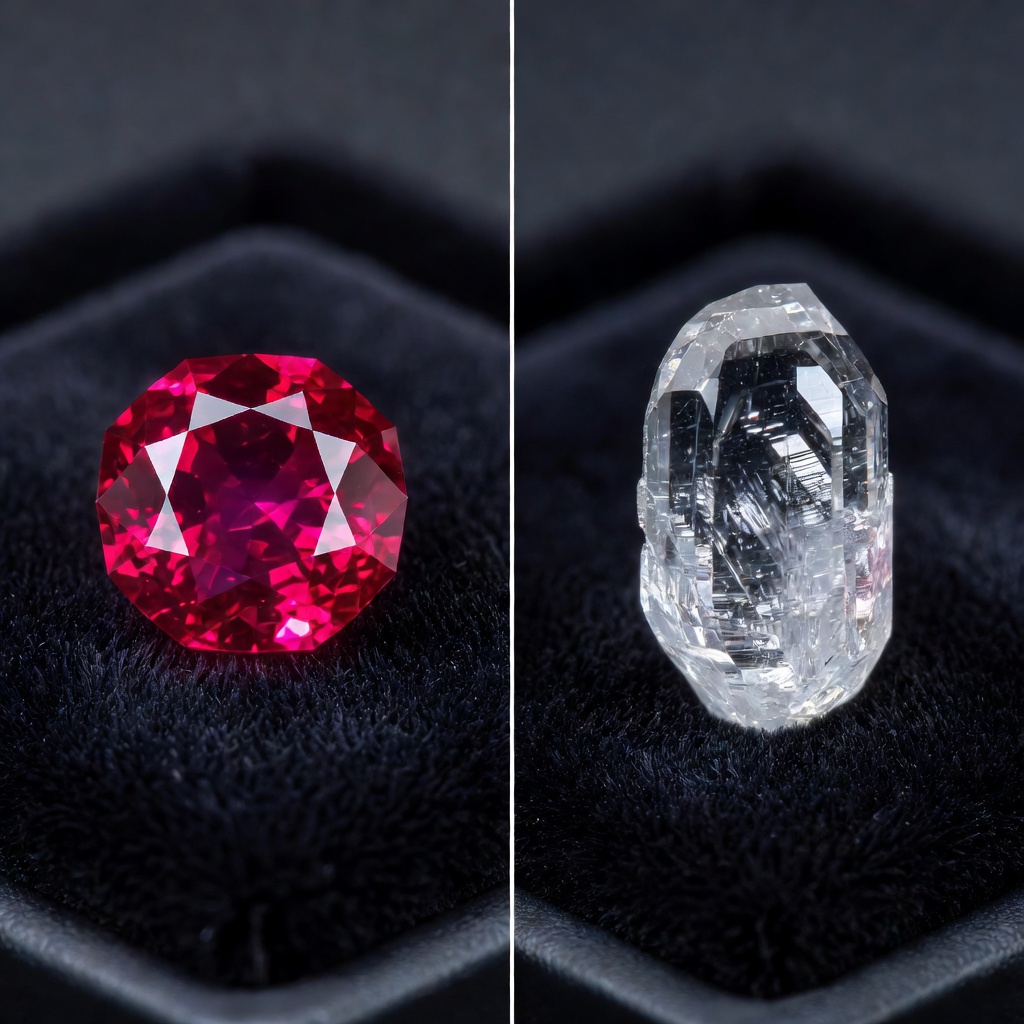
Understanding Two Distinct Gemstone Worlds
When exploring the fascinating landscape of precious gemstones, few comparisons seem as intriguing yet contrasting as Moissanite vs Jade (Jadeite). These two stones occupy entirely different realms of the jewelry universe—one representing the pinnacle of modern laboratory innovation and optical performance, while the other embodies millennia of geological formation and profound cultural heritage. Moissanite, a silicon carbide gemstone discovered in a meteor crater and now primarily created in laboratories, dazzles with diamond-like brilliance at a fraction of the cost. Conversely, jadeite, the rarer and more precious of the two jade minerals belonging to the pyroxene group, captivates with its subtle, waxy luster and deep historical significance, particularly within East Asian cultures.
Consumers often find themselves comparing these stones not because they serve identical purposes, but because they represent two philosophical approaches to jewelry ownership: the modern desire for sustainable sparkle versus the timeless appreciation for natural rarity and cultural symbolism. While moissanite engagement rings have surged in popularity among ethically-minded millennials seeking maximum brilliance, green jade jewelry continues to command reverence among collectors and spiritual practitioners who value the stone's connection to ancient traditions. This comprehensive gemstone comparison will navigate the technical specifications, practical applications, and emotional resonance of both stones, helping you determine which gem aligns with your personal values, lifestyle needs, and aesthetic preferences.
Origins and Composition: Laboratory Creation vs Natural Formation
The Silicon Carbide Revolution
Moissanite's journey from cosmic rarity to jewelry staple represents one of gemology's most remarkable technological achievements. Naturally occurring moissanite was first discovered in 1893 by Nobel Prize-winning chemist Henri Moissan within the Diablo Canyon meteorite in Arizona, where microscopic quantities of silicon carbide had formed under intense heat and pressure in space. However, natural moissanite crystals are so exceptionally rare that they exist in insufficient quantities for commercial jewelry use, making modern moissanite a triumph of laboratory engineering. Today's gem-quality moissanite is grown through advanced thermal growing processes that replicate the conditions of stellar formation, creating crystals with the same chemical composition as their meteoric cousins—silicon carbide (SiC)—but with the consistency and clarity required for fine jewelry.
This laboratory origin offers significant ethical advantages for environmentally conscious consumers. Unlike mined gemstones that disturb ecosystems and potentially exploit labor, lab-created moissanite requires no mining, leaves minimal carbon footprint, and guarantees conflict-free origins. The production process involves placing a silicon carbide seed crystal in a high-temperature furnace where carbon and silicon atoms deposit layer by layer over several months, resulting in a gemstone that is chemically, physically, and optically identical to its natural counterpart but available at a fraction of the environmental cost.
Jadeite's Geological Rarity
Jadeite represents the antithesis of laboratory creation—a testament to the slow, violent geological processes that span millions of years. Formed under extreme pressure and relatively low temperatures in metamorphic rocks associated with subduction zones, jadeite (NaAlSi₂O₆) is a pyroxene mineral that crystallizes in the earth's mantle before being thrust upward through tectonic activity. Unlike moissanite's controlled laboratory environment, natural jadeite formation occurs only in specific geological locations, with Myanmar (formerly Burma) producing approximately 70% of the world's high-quality imperial jadeite. The Kachin State's Mogok Stone Tract remains the premier source for the vivid emerald-green "Imperial Jade" that commands astronomical prices at international auctions.
The extreme rarity of gem-quality jadeite stems from the highly specific conditions required for its formation—specific pressure-temperature gradients that occur only where oceanic plates dive beneath continental margins. This geological specificity means that while nephrite jade (the other true jade mineral) occurs in numerous global locations, true jadeite deposits remain geographically limited and increasingly depleted. Ethical sourcing for jadeite presents complex challenges, as Myanmar's jade trade has historically faced scrutiny regarding environmental degradation and labor practices, making certification and provenance verification crucial for responsible collectors seeking stones from certified ethical mines or established estate collections.
Visual Characteristics: Brilliance Against Subtle Elegance
Moissanite's Optical Fire
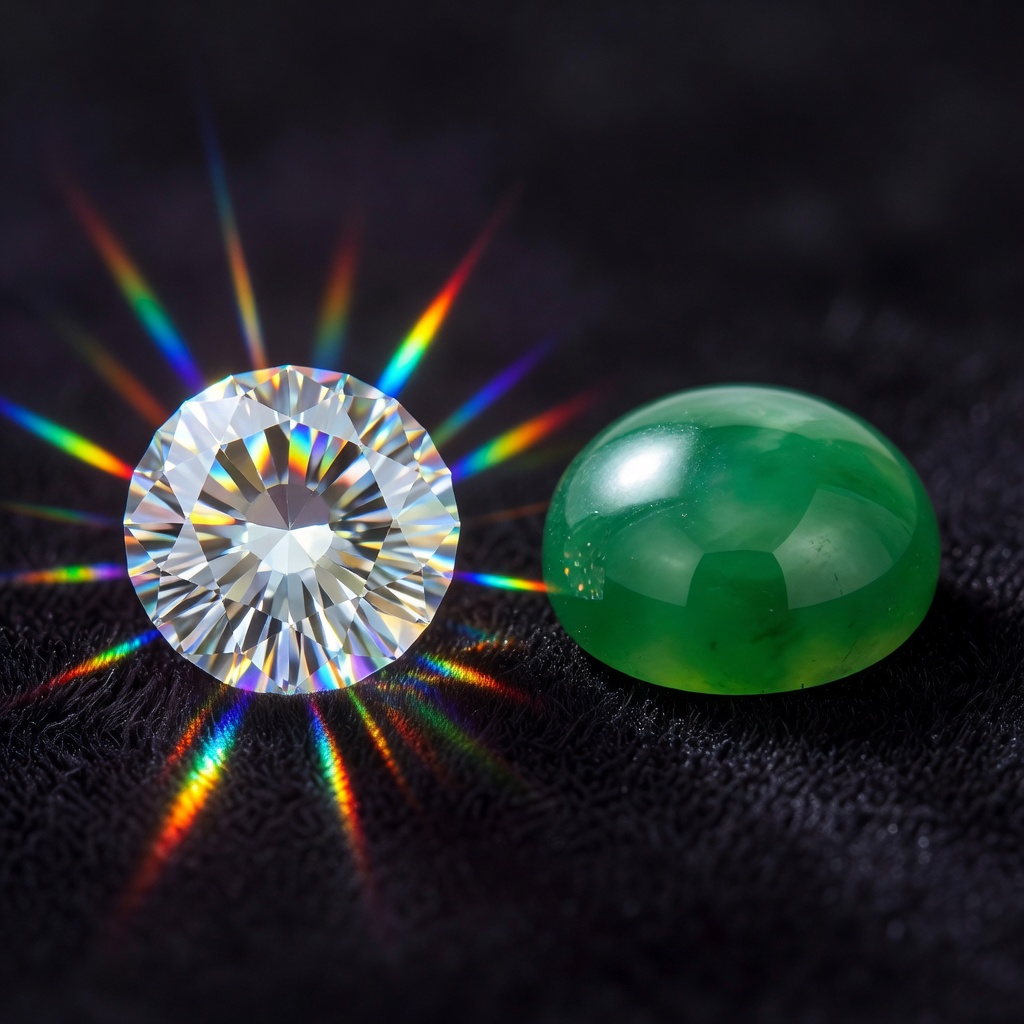
The visual distinction between these gemstones begins with their fundamentally different relationships with light. Moissanite brilliance ranks among the highest of any gemstone, surpassing even diamond in its ability to bend and reflect light. With a refractive index ranging from 2.65 to 2.69 (compared to diamond's 2.42), moissanite exhibits exceptional "life"—the flashes of white light returned to the eye. More dramatically, moissanite's dispersion rate of 0.104 exceeds diamond's 0.044, meaning it breaks white light into spectral colors with twice the intensity, creating the rainbow "fire" that makes moissanite engagement rings so visually arresting under sunlight or spotlight.
When examining a well-cut moissanite, observers notice a distinctive "disco ball" effect of colored light flashes, particularly noticeable in larger stones exceeding one carat. Modern cutting techniques have evolved to minimize this excessive fire for consumers seeking a more diamond-like appearance, with brilliant round cuts and crushed ice modifications offering different optical experiences. Colorless moissanite (graded D-E-F) provides a icy white appearance, while near-colorless varieties (G-H-I) offer slightly warmer tones that some prefer for vintage-style settings. Unlike diamonds, moissanite maintains its clarity and brilliance indefinitely, as the silicon carbide structure resists clouding or dulling over decades of wear.
Jadeite's Depth and Translucency
Jadeite captivates through an entirely different optical language—one of depth, texture, and subtle luminosity rather than surface brilliance. Quality imperial jadeite color exhibits a distinctive "glowing" quality often described as "watery" or "glassy," where light penetrates the stone's interior and reflects back with soft, diffused radiance. Unlike the faceted cuts necessary for moissanite's performance, jadeite is traditionally fashioned into cabochons (domed, unfaceted shapes), bangles, or intricate carvings that showcase the material's translucency and texture. The finest specimens display "imperial green"—a vivid, saturated emerald hue with slight blue undertones that appears to illuminate from within.
Jadeite grading evaluates translucency on a spectrum from opaque to "glass-like" (冰种 or "icy" quality in Chinese terminology), with the most valuable pieces offering that perfect balance where light travels through the stone while maintaining rich color saturation. Beyond the coveted imperial green, imperial jadeite value extends to rare lavender hues (caused by manganese), "honey" yellows, and even translucent whites. The stone's distinctive waxy to vitreous luster creates a soft, approachable glow compared to moissanite's sharp brilliance, appealing to connoisseurs who appreciate understatement and tactile warmth over flashy reflectivity.
Durability and Hardness: Everyday Wear Practicality
Gemstone Hardness Comparison
Understanding the gemstone hardness comparison between moissanite and jadeite proves essential when selecting jewelry for daily wear, particularly for pieces like engagement rings that face constant exposure to potential damage. On the Mohs scale of mineral hardness, moissanite scores an impressive 9.25, positioning it between diamond (10) and corundum varieties like sapphire and ruby (9). This exceptional hardness means that only diamond can scratch moissanite, making it remarkably resistant to the dust and debris encountered in everyday environments. For active individuals or those working with their hands, moissanite durability offers peace of mind that the stone will maintain its polish and facet integrity despite decades of continuous wear.
Jadeite, while significantly softer at 6.5 to 7 on the Mohs scale, presents a more nuanced durability profile that surprises many gem enthusiasts. While it can be scratched by harder materials including quartz (7), which is prevalent in household dust, jadeite possesses something that moissanite lacks: exceptional toughness. Toughness in gemology refers to a stone's resistance to breaking, chipping, or fracturing under impact—a property distinct from hardness. Jadeite's interlocking fibrous crystal structure, composed of microscopic interwoven grains, creates a material that is actually tougher than diamond, resisting cleavage and shattering despite its relative softness.
Practical Wear Considerations
For consumers leading active lifestyles or seeking engagement jewelry, these durability differences carry significant implications. A moissanite engagement ring withstands the abrasion of daily activities—gardening, cooking, gym workouts—without showing surface scratches that would cloud softer stones. However, moissanite's hardness comes with brittleness; while it resists scratching, a sharp blow at the wrong angle could potentially chip a moissanite's delicate girdle or pointed corners in fancy cuts like princess or marquise shapes.
Jadeite's superior toughness makes it surprisingly resilient against breaking, which explains its traditional use in carved bangles and intricate pendants that might survive impacts that would shatter more brittle gems. However, the softer surface requires protective settings and mindful wearing; jadeite rings should be removed during activities involving concrete, sand, or abrasive materials. When storing these gemstones together, always separate them—moissanite's hardness means it will easily scratch jadeite if the pieces rub against each other in a jewelry box, potentially damaging valuable carved surfaces or cabochon finishes.
Value and Investment: Affordability vs Rarity
Moissanite's Accessible Luxury
The economics of moissanite price per carat positioning makes this gemstone one of the most democratic options in fine jewelry, offering diamond-level aesthetics without the premium pricing associated with geological rarity. A one-carat colorless moissanite typically ranges from $300 to $600, compared to $4,000 to $6,000 for a comparable diamond, and significantly less than even modest jadeite specimens. This affordability allows consumers to prioritize size and setting quality without budget compromise, choosing elaborate halo designs or substantial center stones that would be financially prohibitive with diamond or high-grade jadeite. However, moissanite functions primarily as a consumable luxury rather than an investment vehicle; as laboratory production technology improves and scales, resale values remain minimal, with most moissanite jewelry depreciating similarly to other manufactured goods.
Imperial Jadeite as Wealth Storage
Conversely, imperial jadeite value operates within an entirely different economic paradigm, one driven by extreme scarcity, cultural demand, and historical precedent. Top-grade imperial jadeite can command prices exceeding $3 million per carat at major auction houses like Christie's and Sotheby's, with single bangles or cabochons selling for tens of millions of dollars to collectors in Hong Kong, Beijing, and Taipei. Unlike moissanite's consistent manufacturing costs, jadeite pricing follows a steep exponential curve based on color saturation, translucency, and freedom from inclusions. A slight increase in the intensity of green hue or transparency can multiply a jadeite piece's value tenfold, creating a market where certificates of origin and laboratory reports from GIA or Hong Kong Jade & Stone Laboratory significantly impact liquidity.
For investment-minded collectors, untreated "Type A" jadeite—natural jadeite with no polymer enhancement—represents a portable store of wealth with centuries of cultural backing, particularly in Chinese markets where jade ownership signifies status and financial stability. While moissanite offers immediate gratification and budget flexibility, high-quality jadeite requires substantial capital but potentially offers appreciation, heirloom status, and liquidity among serious collectors. The resale market for jadeite remains robust among specialized dealers and auction houses, whereas moissanite typically holds sentimental rather than monetary value for future generations.
Cultural Significance and Symbolism
Jadeite's Seven Millennia of Meaning
Jadeite's value transcends material worth, embedding itself deeply in the spiritual and philosophical traditions of East Asian civilizations for over 7,000 years. In ancient China, jadeite symbolism encompassed the Confucian virtues of benevolence (ren), righteousness (yi), wisdom (zhi), courage (yong), and purity (jie), with the stone serving as a metaphor for the perfected human character. Imperial dynasties reserved the finest translucent green jadeite exclusively for emperors and high-ranking officials, with the Qianlong Emperor of the Qing Dynasty amassing one of history's greatest jade collections, believing the stone conferred immortality and protection against spiritual harm. This historical association with imperial authority continues today, where gifting jadeite bangles to daughters or daughters-in-law remains a traditional transfer of family blessing and protection across generations.
Beyond Chinese culture, Mesoamerican civilizations including the Maya and Aztec revered jadeite as the "stone of the wind," using it in burial masks, ceremonial knives, and symbolic representations of maize deities. In contemporary crystal healing practices, practitioners attribute jadeite with properties of emotional balance, physical healing (particularly for kidney and adrenal functions, reflected in the English term "nephrite" derived from Greek nephros), and energetic protection. The stone's cool, smooth texture makes it ideal for meditation malas and worry stones, continuing its millennia-long role as a spiritual tool.
Moissanite's Modern Ethical Narrative
Moissanite lacks the ancient pedigree of jadeite but compensates with a compelling contemporary narrative centered on technological achievement and ethical consumption. Discovered in a meteorite and now created through human ingenuity, moissanite represents the democratization of beauty—making exceptional brilliance accessible without the environmental and human costs associated with mining. For modern couples, moissanite meaning often aligns with values of sustainability, scientific progress, and conscious consumption, symbolizing a forward-looking partnership that prioritizes environmental responsibility over traditional status markers.
The moissanite meaning in relationship contexts emphasizes enduring brilliance and resilience, mirroring the stone's physical properties. As a relatively recent addition to the fine jewelry canon (commercial production began in the late 1990s), moissanite carries no baggage of colonial exploitation or conflict funding, appealing to younger consumers who view their jewelry choices as extensions of their political and environmental values. While it cannot claim the ancestral spiritual properties attributed to jadeite, moissanite has developed its own metaphysical following among crystal practitioners who associate silicon carbide with enhanced clarity of thought, technological advancement, and cosmic connection due to its extraterrestrial origins.
Jewelry Applications: Best Uses for Each Gemstone
Moissanite's Dominance in Bridal Jewelry
The optical properties and durability of moissanite make it ideally suited for moissanite engagement rings and bridal jewelry designed for daily wear and maximum visual impact. The stone's brilliance performs exceptionally well in modern setting styles that emphasize light return—think solitaire prong settings that elevate the stone, halo designs that amplify the center stone's sparkle, or pavé bands that create continuous scintillation. For brides seeking the "white diamond" aesthetic without the ethical concerns or budget constraints of mined diamonds, moissanite offers versatility in cuts ranging from classic round brilliants to sophisticated emerald cuts and romantic ovals.
Metal selection significantly impacts moissanite's presentation. White metals—platinum, palladium, or white gold—enhance the stone's colorless appearance and maximize its icy brilliance, while rose gold settings create warm, romantic contrasts that complement near-colorless moissanite grades. Because moissanite's hardness resists scratching, it performs well in tension settings and delicate micro-prong arrangements that might risk damage with softer stones. However, jewelers recommend avoiding overly shallow cuts or extremely thin girdles in moissanite, as despite its hardness, the material's double refraction can create visible doubling of facet junctions in certain cuts if not properly proportioned.
Jadeite's Traditional and Avant-Garde Expressions
Green jade jewelry traditionally favors forms that maximize the material's unique properties—cabochon rings that showcase translucency, hololith bangles (carved from a single piece of rough), bead necklaces, and intricate carved pendants depicting gourds, Buddha figures, or floral motifs. Unlike moissanite, which requires faceting to perform optically, jadeite's beauty emerges from its texture and depth, making smooth, polished surfaces the preferred finish. The stone's cultural associations make it particularly appropriate for spiritual jewelry—prayer beads, meditation pendants, and protective amulets that carry personal or familial significance.
Contemporary designers have begun incorporating jadeite into modern, minimalist settings that bridge Eastern tradition and Western aesthetics. Bezel settings in 22-karat yellow gold beautifully complement imperial green jadeite, the warm metal enhancing the stone's cool green tones while providing protective borders against chipping. Jadeite also appears increasingly in mixed-media designs alongside diamonds or colored gemstones, though care must be taken to protect the softer jadeite from harder accent stones. For earrings and pendants, where impact risk is minimal, jadeite offers safe daily wear options, while rings should feature protective settings and be reserved for occasions or worn with awareness of the stone's relative softness.
Authentication and Quality Grading
Understanding Jadeite Certification
Navigating the jadeite grading system requires understanding both gemological standards and market terminology. The Gemological Institute of America (GIA) and Hong Kong laboratories grade jadeite based on three primary criteria: color (hue, tone, and saturation), translucency (ranging from opaque to transparent), and texture (the fineness of crystal aggregation, described as "fine," "medium," or "coarse"). The most valuable specimens exhibit vivid, slightly bluish-green color (imperial green), high translucency approaching "glassy" quality, and fine texture where individual crystals remain invisible to the naked eye. Additionally, jadeite classification includes treatment disclosure: Type A indicates natural, untreated jadeite; Type B denotes polymer-impregnated jadeite (bleached and filled); and Type C refers to dyed jadeite, with value decreasing dramatically from Type A to Type C.
Moissanite Quality Standards
Certified moissanite typically follows color grading scales similar to diamonds, ranging from D-E-F (colorless) through G-H-I (near-colorless) to J-K-L (faint color). Leading manufacturers like Charles & Colvard and Forever One provide certificates of authenticity verifying that the stone is laboratory-created silicon carbide rather than simulant or imitation. When purchasing moissanite, consumers should verify that the stone comes with a warranty against clouding or color change, as quality varies between manufacturers. Unlike jadeite, where natural inclusions often prove authenticity, moissanite should appear eye-clean, with any visible inclusions indicating lower quality control during the growing process.
Care and Maintenance Requirements
Maintaining Moissanite's Sparkle
One of moissanite's practical advantages lies in its low-maintenance nature. Unlike diamonds, which can attract grease and oil due to carbon's chemical properties, silicon carbide's surface resists oil adhesion, meaning moissanite cleaning requires less frequent intervention to maintain brilliance. Standard maintenance involves warm water, mild dish soap, and a soft toothbrush to remove accumulated lotions or soaps, though moissanite's durability also permits ultrasonic cleaning and steam cleaning without risk of damage. The stone's hardness prevents scratching that could harbor dirt, ensuring that with basic care, moissanite retains its showroom sparkle indefinitely.
Preserving Jadeite's Integrity
Jadeite care demands more nuanced attention due to the stone's porosity and chemical sensitivity. Natural jadeite contains microscopic fractures and intergranular spaces that can absorb liquids, meaning exposure to harsh chemicals, acids, or even prolonged contact with pigmented cosmetics can potentially stain or damage the stone. Clean jadeite using only lukewarm water and mild soap, avoiding ultrasonic cleaners (which can exacerbate existing fractures) and steam cleaning (which thermal shock might damage). After cleaning, pat dry with a soft cloth rather than air-drying to prevent water spots on the polished surface.
Storage practices differ significantly between these stones. While moissanite can be stored in standard jewelry boxes with other hard gemstones, jadeite requires individual soft pouches or compartmentalized storage to prevent contact with harder stones like diamonds, sapphires, or moissanite itself. When traveling, wrap jadeite pieces in soft cloth and cushion them to prevent impacts that could chip the stone's edges. Traditional jadeite collectors often store their pieces with a light coating of mineral oil to maintain the stone's luster, though modern treatments mean this is generally unnecessary for Type A jadeite and potentially problematic for polymer-impregnated Type B specimens.
Final Decision Guide: Lifestyle and Budget Matching
Selecting between Moissanite vs Jade (Jadeite) ultimately requires honest assessment of your lifestyle, aesthetic preferences, and long-term intentions for the piece. For active professionals, athletes, or individuals seeking daily-wear engagement jewelry that withstands rigorous activity without budget anxiety, moissanite offers unbeatable practicality. Its moissanite brilliance satisfies those who love sparkle and fire, while its ethical creation process appeals to environmentally conscious consumers. Consider moissanite if you prioritize low maintenance, modern aesthetics, and the freedom to choose elaborate settings or larger stones without financial strain.
Conversely, choose jadeite if you value cultural heritage, investment potential, and subtle luxury over ostentatious sparkle. High-grade jadeite suits collectors who view jewelry as portable wealth and intergenerational legacy, or individuals drawn to the stone's spiritual significance and historical depth. The imperial jadeite value proposition requires substantial initial investment but offers the potential for appreciation and the satisfaction of owning a piece of geological history. Jadeite particularly suits those who appreciate tactile, smooth jewelry with depth and color variation rather than brilliant faceting.
| Characteristic | Moissanite | Jadeite |
|---|---|---|
| Chemical Composition | Silicon Carbide (SiC) | Sodium Aluminum Silicate (NaAlSi₂O₆) |
| Mohs Hardness | 9.25 (Excellent scratch resistance) | 6.5-7 (Moderate scratch resistance) |
| Refractive Index | 2.65-2.69 (Extremely brilliant) | 1.66-1.68 (Subtle glow) |
| Origin | Laboratory-created (sustainable) | Natural metamorphic formation (Myanmar primary source) |
| Typical Price Range (1 carat) | $300-$600 | $500-$3,000,000+ (depending on quality) |
| Best Jewelry Application | Engagement rings, sparkle-heavy designs | Cabochon rings, bangles, carvings, spiritual pendants |
| Daily Wear Suitability | Excellent (hardness prevents scratching) | Moderate (requires protection from impact/abrasion) |
| Investment Potential | Low (depreciating manufactured good) | High (Type A imperial jade appreciates over time) |
| Maintenance Level | Low (ultrasonic safe, oil-resistant) | Moderate (avoid chemicals, clean gently) |
| Cultural Significance | Modern (ethical consumption, cosmic origins) | Ancient (7,000+ years Chinese imperial history) |
Decision Checklist
Before finalizing your selection, review this practical checklist: Do you require a stone for daily wear in active conditions? Choose moissanite. Are you building a collection for long-term investment or cultural legacy? Prioritize Type A jadeite. Does your aesthetic favor rainbow fire and brilliant scintillation? Moissanite satisfies. Do you prefer subtle, glowing color with historical depth? Jadeite excels. Is your budget under $1,000 for a substantial stone? Moissanite offers better value. Are you prepared to spend $10,000+ for museum-quality material? Jadeite provides entry into collectible luxury.
Frequently Asked Questions
Is moissanite more valuable than jadeite?
No, high-quality imperial jadeite is significantly more valuable and rarer than moissanite. While moissanite is an affordable, lab-created gemstone, top-grade jadeite can command prices exceeding $3 million per carat at auction due to its extreme rarity and cultural significance. Moissanite functions as an accessible luxury item with minimal resale value, whereas untreated Type A imperial jadeite represents a tangible asset class with historical appreciation trajectories and liquidity among serious collectors, particularly in Asian markets where it serves as a store of wealth and status symbol.
Can you wear jadeite every day like moissanite?
While jadeite can be worn daily, it requires more careful handling than moissanite. With a Mohs hardness of 6.5-7, jadeite is susceptible to scratching from everyday encounters with quartz dust and harder materials, whereas moissanite (9.25 Mohs) is ideal for daily wear rings and withstands active lifestyles better. However, jadeite's superior toughness means it resists breaking or chipping better than many harder stones, making it suitable for daily wear in protected settings like pendants or earrings, though rings should be removed during manual labor or abrasive activities to preserve their polished surfaces.
Which gemstone sparkles more, moissanite or jadeite?
Moissanite sparkles significantly more than jadeite. Moissanite has a higher refractive index (2.65-2.69) and dispersion (0.104) than diamond, creating intense fire and brilliance. Jadeite possesses a subtle, waxy to vitreous luster prized for its depth and translucency rather than sparkle. While moissanite produces rainbow flashes and brilliant white light return through faceted cuts, jadeite exhibits a soft, internal glow that appears to illuminate from within the stone, particularly in high-translucency specimens. These fundamentally different optical properties attract different aesthetic preferences—moissanite for those seeking dazzling brilliance, jadeite for connoisseurs appreciating subdued luminosity.
Is moissanite a good alternative to jadeite?
They serve entirely different purposes and aesthetics. Moissanite functions as a diamond alternative prized for sparkle, while jadeite is valued for its color, texture, and cultural significance. You wouldn't typically substitute one for the other unless specifically seeking a green-colored stone, as moissanite is usually colorless. Consumers considering moissanite as a "substitute" for jadeite would likely be disappointed, as moissanite cannot replicate jadeite's distinctive greasy luster, translucency, or deep cultural associations. Conversely, someone wanting a brilliant, faceted engagement ring would find jadeite an unsuitable alternative to moissanite's optical performance.
Does jadeite come in colors similar to moissanite?
Jadeite occasionally occurs in white or near-colorless varieties, but these lack moissanite's brilliance. Moissanite is predominantly colorless or near-colorless, while jadeite is famous for its green (imperial jade), lavender, yellow, and black varieties. Both can be found in green hues, though the optical properties differ dramatically. White jadeite (known as "mutton fat" jade when nephrite, or simply white jadeite) exhibits a milky, translucent appearance quite distinct from moissanite's water-clear brilliance. Green moissanite exists through color treatment but remains rare, while green jadeite represents the most valuable and culturally significant color variety of that stone.
Which is better for an engagement ring: moissanite or jadeite?
Moissanite is generally the superior choice for engagement rings due to its exceptional hardness (9.25 Mohs), brilliance, and durability for daily wear. Jadeite's softer nature (6.5-7 Mohs) makes it better suited for pendants, earrings, or occasional-wear rings rather than everyday engagement jewelry. Engagement rings face constant exposure to hard surfaces, cleaning chemicals, and physical impacts that could scratch or damage jadeite over time. Additionally, the traditional expectation of brilliant sparkle in engagement jewelry aligns better with moissanite's optical properties than with jadeite's subtle glow, though culturally Chinese engagement customs sometimes favor jadeite bangles or rings as symbols of commitment and family blessing.
Can you wear moissanite and jadeite jewelry together?
Yes, they create striking contrast combinations in jewelry designs, but they should be stored separately. Moissanite's hardness can scratch jadeite over time if the pieces rub against each other in a jewelry box. When worn together, ensure settings prevent the stones from contacting each other. Fashion-forward wearers increasingly pair moissanite stud earrings with jadeite pendants, or stack moissanite bands with jadeite bangles, creating textural and visual contrast between icy brilliance and warm, glowing color. However, when storing these pieces, always wrap jadeite items individually in soft cloth and keep them in separate compartments from moissanite jewelry to prevent accidental abrasion that could mar jadeite's polished surface.
How can I tell the difference between moissanite and jadeite?
Moissanite is doubly refractive (showing facet doubling when viewed through the crown) and exhibits intense rainbow fire. Jadeite is singly refractive with a distinctive greasy or waxy luster and often shows a fibrous or granular texture under magnification. A gemologist can easily distinguish them using refractive index testing. Visual inspection provides immediate clues: moissanite appears faceted and brilliant, while jadeite is typically cabochon-cut or carved with a smooth, domed surface. Weight differences also help—moissanite is lighter than diamond but denser than jadeite, though specific gravity testing provides definitive identification. Under magnification, jadeite may show "snowflake" patterns or fibrous structures, while moissanite displays doubling of back facet lines due to its birefringence.