Introduction: Why Compare These Popular Diamond Alternatives?
The modern jewelry market has witnessed a dramatic shift toward lab created diamond alternatives as couples and fashion enthusiasts seek brilliance without the traditional diamond price tag. Among the most frequently debated options in this growing sector are moissanite and cubic zirconia, two distinct gemstones that offer sparkle at significantly different price points and quality levels. Understanding the nuanced differences between these simulated gemstones comparison candidates has become essential for anyone considering a significant jewelry purchase, whether for an engagement ring or a statement fashion piece. This comprehensive guide examines Moissanite vs Cubic Zirconia across critical factors including optical performance, structural integrity, and long-term value to help you make an informed decision aligned with your lifestyle and budget.
What is Moissanite? Origins and Scientific Composition
Moissanite represents one of the most fascinating stories in gemstone history, beginning with Nobel Prize-winning chemist Dr. Henri Moissan's 1893 discovery of microscopic silicon carbide crystals in an Arizona meteor crater. Initially mistaken for diamonds due to their exceptional brilliance, these natural specimens proved so rare that today virtually all moissanite jewelry features lab-created silicon carbide gemstones produced through advanced thermal growing processes. The resulting crystal structure features strong covalent bonds between silicon and carbon atoms, creating a material with remarkable thermal conductivity that actually exceeds that of diamonds, making moissanite properties unique among diamond simulants. Modern laboratory techniques can produce colorless to near-colorless moissanite crystals up to several carats, though the growing process requires intense heat and precise conditions that contribute to the stone's higher market value compared to other simulants.
For jewelry shoppers seeking moissanite durability, the material's origins in stardust—literally born from meteoric material—translate into exceptional wear resistance suitable for daily use. Unlike diamond alternatives that merely mimic appearance, moissanite possesses distinct thermal and electrical properties that require specialized testing equipment to differentiate from natural diamonds. When selecting moissanite for engagement ring stones, consumers benefit from a gemstone that maintains its optical properties indefinitely while offering a fascinating geological backstory that often sparks conversation.
What is Cubic Zirconia? Understanding the Synthetic Stone
Cubic zirconia emerged from Soviet scientific laboratories in the 1970s when researchers at the Lebedev Physical Institute developed a method to stabilize zirconium dioxide using yttrium oxide, creating the first commercially viable diamond simulant. Unlike moissanite, which exists in microscopic natural quantities, cubic zirconia composition represents a purely synthetic creation that cannot form naturally under any terrestrial conditions due to the required stabilizing agents and controlled cooling processes. The resulting isometric crystal system produces perfectly formed cubic crystals that, while visually appealing, lack the subtle imperfections and depth that characterize natural gemstones and higher-end simulants.
The manufacturing process for these synthetic gemstones involves melting zirconium dioxide powder at approximately 2,750°C (4,982°F) using a skull crucible technique, where the outer shell remains solid while the interior liquefies. This method allows for rapid production of large, flawless crystals at a fraction of the cost of moissanite, making cubic zirconia price points accessible for virtually any budget. However, jewelry experts note that while CZ offers immediate visual impact, the cubic zirconia clarity that appears perfect upon purchase often deteriorates faster than consumers expect, particularly when exposed to daily wear and environmental factors.
Visual Battle: Brilliance, Fire, and Color Grades
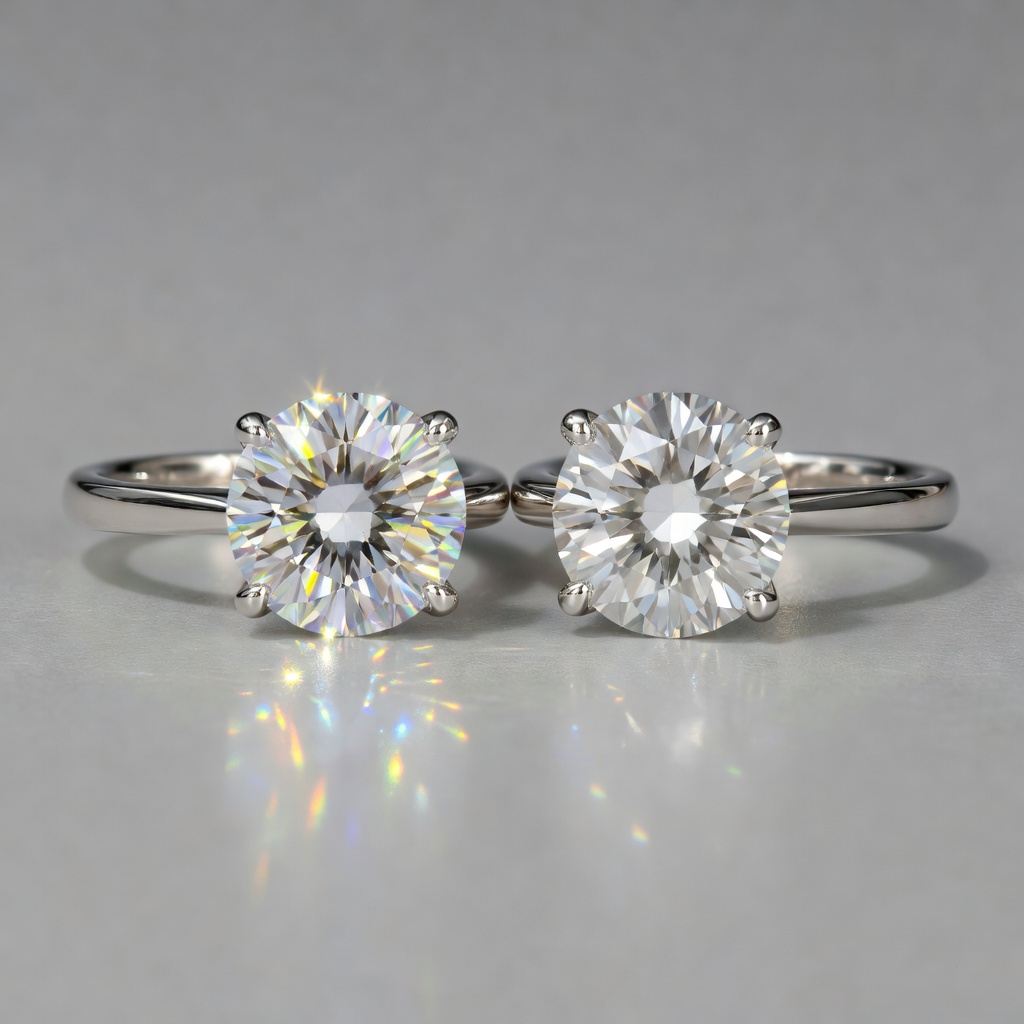
When examining Moissanite vs CZ side by side, the optical performance differences become immediately apparent even to untrained observers, particularly under natural lighting conditions. Moissanite boasts a refractive index ranging from 2.65 to 2.69, significantly higher than cubic zirconia's 2.15 to 2.18, meaning moissanite bends light more aggressively to create that coveted sparkle associated with high-end gemstones. This superior light performance manifests in what gemologists call "fire"—the dispersion of light into spectral colors—with moissanite displaying dispersion values of 0.104 compared to CZ's 0.058-0.066, creating the characteristic "disco ball" effect that some find captivating while others consider excessive.
Color stability presents another crucial distinction for engagement ring stones, as both materials are available in colorless grades equivalent to D-F on the diamond scale, though moissanite occasionally exhibits subtle green or yellow undertones in certain lighting, particularly in older cuts. Cubic zirconia tends toward a more "glassy" or artificial appearance under natural light, lacking the depth and complexity that moissanite brilliance provides, though high-quality CZ can initially appear quite diamond-like to casual observers. For collectors seeking the most diamond-like appearance, moissanite generally offers superior performance, though personal preference regarding fire intensity varies significantly among buyers.
Durability Test: Mohs Hardness and Daily Wear Resistance
The Mohs scale hardness ratings reveal a substantial gap between these diamond alternatives that directly impacts their suitability for everyday jewelry applications. Moissanite registers an impressive 9.25 on the Mohs scale, positioning it between sapphire (9) and diamond (10) and making it remarkably resistant to scratching from daily activities, household dust, and accidental impacts. Conversely, cubic zirconia typically measures between 8 and 8.5 on the same scale, comparable to topaz or emerald, meaning it can be scratched by harder materials including moissanite itself, sapphire, and certainly diamond.
Beyond surface hardness, moissanite durability extends to its fracture toughness—the resistance to chipping and breaking under impact—which exceeds that of diamond due to its unique crystal structure. While moissanite possesses cleavage planes that theoretically allow splitting under precise force vectors, the material's toughness makes such fractures rare in jewelry settings. Cubic zirconia, despite lacking cleavage planes, exhibits brittleness that makes it more susceptible to chipping along edges and corners, particularly in princess or emerald cuts worn daily. For active individuals or those working with their hands, this durability differential suggests moissanite engagement rings will maintain their structural integrity far longer than CZ alternatives, potentially saving replacement costs within just a few years of regular wear.
Price Analysis: Cost Per Carat and Long-Term Value
Understanding the economic reality of simulated gemstones comparison requires examining both upfront acquisition costs and the concept of cost-per-wear over the jewelry's lifetime. Current market pricing places high-quality moissanite between $300 and $600 per carat, depending on color grade and cut quality, while premium cubic zirconia typically ranges from $20 to $50 per carat, with some fashion-quality stones costing mere dollars. This substantial price differential—roughly ten to twenty times higher for moissanite—reflects not only manufacturing complexity but also the genuine durability and optical superiority that justify the investment for permanent jewelry pieces.
However, the cubic zirconia price advantage diminishes when calculating long-term value, as CZ jewelry often requires replacement every 2-5 years when worn daily due to scratching and clouding, whereas moissanite maintains its appearance indefinitely with basic care. Neither stone offers investment value or resale potential comparable to diamonds or precious gemstones, but moissanite value manifests through longevity and sustained beauty. Consider the case of a 1-carat engagement ring: while the CZ version might cost $50 initially, replacing it three times over a decade totals $150, whereas a $500 moissanite ring requires no replacement and offers superior daily enjoyment, effectively costing less per year of wear despite the higher initial outlay.
| Characteristic | Moissanite | Cubic Zirconia |
|---|---|---|
| Mohs Hardness | 9.25 (Excellent) | 8-8.5 (Good) |
| Refractive Index | 2.65-2.69 (Very High) | 2.15-2.18 (Moderate) |
| Dispersion (Fire) | 0.104 (High/Rainbow) | 0.058-0.066 (Low) |
| Price Per Carat | $300-$600 | $20-$50 |
| Durability | Lifetime wear with minimal maintenance | Requires replacement every 2-5 years with daily wear |
| Best Application | Engagement rings, heirlooms, daily wear | Fashion jewelry, travel rings, temporary pieces |
| Maintenance Needs | Standard cleaning; resistant to oils | Frequent cleaning; prone to clouding |
Maintenance Reality: Cleaning, Clouding, and Care
The maintenance profiles of these lab created diamond alternatives diverge significantly regarding long-term optical clarity and cleaning requirements. Cubic zirconia's Achilles heel lies in its porous surface structure, which gradually accumulates skin oils, soap residue, and environmental contaminants that create a characteristic cloudy or hazy appearance, typically noticeable within 6 to 24 months of regular wear. This clouding occurs because CZ jewelry care requires more aggressive maintenance routines, and even with diligent cleaning, microscopic surface scratches from daily abrasion eventually diffuse light rather than reflecting it clearly.
Moissanite maintenance follows a more forgiving trajectory due to the stone's non-porous nature and superior hardness, resisting oil attraction and maintaining its sparkle with simple cleaning routines. While both stones benefit from regular cleaning with mild dish soap and warm water using a soft toothbrush, moissanite engagement rings can safely undergo ultrasonic cleaning and steam treatments that might accelerate deterioration in cubic zirconia. For travelers or those with active lifestyles, moissanite's resistance to environmental factors means it can withstand exposure to sunscreen, chlorine, and household chemicals better than CZ, which may show permanent damage from such encounters. Practical tip: store CZ pieces separately in soft cloth pouches to prevent scratching, while moissanite can withstand standard jewelry box storage alongside other pieces without significant risk of damage.
Best Applications: Engagement Rings vs Fashion Pieces
Selecting between Moissanite vs Cubic Zirconia requires honest assessment of intended use cases, as each material excels in different jewelry contexts. Moissanite engagement ring choices dominate the bridal market for couples seeking permanent symbols of commitment without diamond prices, offering sufficient durability to withstand decades of daily wear including household chores, exercise, and professional activities. The stone's thermal stability also makes it suitable for various setting styles, including tension settings and intricate pavé work that might stress softer materials, while its brilliance ensures the ring photographs beautifully for important life events.
Conversely, CZ fashion jewelry fills an essential niche in the accessory market, providing trend-focused consumers with affordable options to experiment with large stone sizes, fancy colors, or risky settings without financial anxiety. Travel rings featuring cubic zirconia offer security-conscious travelers peace of mind when visiting destinations where displaying valuable jewelry might attract unwanted attention. When selecting settings, moissanite pairs excellently with platinum, palladium, and high-karat golds that match its longevity, while CZ works best in sterling silver or gold-plated settings where the metal wear timeline aligns with the stone's expected lifespan. For statement cocktail rings worn occasionally or fashion-forward earring trends that may change seasonally, cubic zirconia provides cost-effective versatility impossible to achieve with pricier alternatives.
Ethical and Environmental Impact Considerations
Both moissanite and cubic zirconia offer compelling ethical advantages over mined diamonds, providing consumers with guaranteed conflict-free options that eliminate concerns about funding regional conflicts or exploitative labor practices. The lab created stones industry generally operates with smaller environmental footprints than traditional mining, though the manufacturing processes differ in energy intensity and chemical usage between the two materials. Moissanite production requires extremely high temperatures and extended growing periods, consuming significant electrical energy, while cubic zirconia manufacturing, though also energy-intensive, typically involves shorter production cycles and slightly lower carbon emissions per carat.
From a sustainability perspective, neither gemstone represents a "zero impact" choice, yet both offer substantial improvements over earth-mined alternatives regarding habitat disruption and water usage. Ethical gemstones consumers should inquire about specific manufacturers' environmental policies, as some moissanite producers utilize renewable energy sources and carbon offset programs to mitigate their footprint. Additionally, the longevity factor favors moissanite from an environmental standpoint: a stone that lasts a lifetime generates less waste than multiple replacements of shorter-lived alternatives. For the environmentally conscious buyer prioritizing maximum sustainability within the simulated gemstone category, seeking recycled metal settings paired with high-quality moissanite creates the most responsible long-term jewelry solution.
Final Verdict: Making Your Decision Based on Lifestyle
Navigating the Moissanite vs Cubic Zirconia buying guide ultimately requires balancing budget constraints against longevity expectations and intended usage patterns. For milestone purchases like engagement rings, anniversary bands, or heirloom-quality pieces intended for daily wear across decades, moissanite's superior hardness, brilliance, and resistance to degradation justify the higher initial investment through decades of maintenance-free enjoyment. The decision matrix favors CZ for trend-conscious shoppers who enjoy rotating jewelry styles frequently, those needing temporary travel replacements, or individuals seeking large statement pieces for occasional wear without the accompanying large price tags.
Consider your daily activities honestly: if your hands regularly contact hard surfaces, cleaning chemicals, or mechanical equipment, moissanite durability provides necessary resilience, whereas CZ will likely require replacement within two years under such conditions. Budget-first buyers should calculate the five-year cost of ownership rather than focusing solely on sticker price, recognizing that multiple CZ replacements may eventually exceed a single moissanite purchase. Whichever path you choose, both ethical gemstones offer responsible alternatives to mined diamonds, allowing you to prioritize either maximum affordability or optimal longevity without compromising your values or aesthetic goals.
Frequently Asked Questions
Can you tell the difference between moissanite and cubic zirconia with the naked eye?
Yes, moissanite displays significantly more brilliance and rainbow fire (dispersion) than cubic zirconia. Moissanite has a higher refractive index (2.65) compared to CZ (2.15), giving it more sparkle. Additionally, CZ tends to look more 'glassy' or artificial under natural light, while moissanite closely mimics diamond brilliance.
Does cubic zirconia get cloudy over time while moissanite stays clear?
Yes, cubic zirconia is porous and can develop a cloudy or hazy appearance after months or years of wear due to surface scratches and accumulation of oils. Moissanite is non-porous with superior hardness (9.25 vs 8-8.5 Mohs) and maintains its optical clarity and sparkle indefinitely with basic cleaning.
Is moissanite more expensive than cubic zirconia, and is it worth the extra cost?
Moissanite typically costs $300-600 per carat while high-quality cubic zirconia costs $20-50 per carat. The price difference reflects moissanite's superior durability, brilliance, and longevity. For daily-wear items like engagement rings, moissanite offers better long-term value despite the higher initial investment.
Which stone is better for an engagement ring that will be worn daily?
Moissanite is the superior choice for daily-wear engagement rings due to its 9.25 Mohs hardness rating, making it highly resistant to scratching and chipping. Cubic zirconia's 8-8.5 hardness makes it vulnerable to surface damage from daily activities, making it better suited for occasional wear fashion jewelry.
Do moissanite and cubic zirconia test as diamonds on standard diamond testers?
Moissanite typically passes standard thermal diamond testers because it conducts heat similarly to diamonds, which is why specialized moissanite testers exist. Cubic zirconia does not pass diamond testers as it has different thermal conductivity properties. Electronic testers can distinguish between all three materials.
Can cubic zirconia cut glass like moissanite and diamonds can?
While cubic zirconia (hardness 8-8.5) can scratch glass (hardness 5.5), it is significantly softer than moissanite (9.25) and diamonds (10). CZ will show wear, surface scratches, and dulling much faster than moissanite when subjected to daily wear and tear.
Which gemstone looks more like a real diamond?
Moissanite looks more diamond-like than cubic zirconia due to its similar refractive index and brilliance. While CZ can appear too perfect and glassy, moissanite has the 'depth' and fire similar to diamonds. However, both are distinguishable from diamonds upon close inspection by gemologists or with magnification.
Do these stones require special care or cleaning solutions?
Moissanite requires standard jewelry cleaning with mild soap and water or commercial jewelry cleaner. Cubic zirconia needs more frequent cleaning to prevent clouding and should avoid harsh chemicals and ultrasonic cleaners, which can accelerate deterioration. Warm soapy water and a soft brush work best for both.