Understanding the Basics: Composition and Origins
When examining Moissanite vs Amethyst from a geological perspective, their fundamental compositions reveal distinctly different origins and formation processes. Moissanite is a rare silicon carbide gemstone with the chemical formula SiC, originally discovered in 1893 by Henri Moissan within the fragments of the Diablo Canyon meteorite in Arizona. Natural moissanite occurs almost exclusively in meteor craters and upper mantle rocks, making it extraordinarily scarce in nature; consequently, virtually all moissanite available in jewelry today is laboratory-created using advanced thermal growing processes that replicate the intense heat and pressure of stellar environments. This synthetic origin allows for the creation of large, flawless crystals that maintain the same hexagonal crystal structure as their celestial counterparts, featuring six-sided prismatic formations that contribute to their unique optical properties.
Amethyst, conversely, represents one of nature's most abundant precious gems as a purple variety of quartz composed of silicon dioxide (SiO₂). This purple quartz jewelry favorite forms within the gas bubbles (vesicles) of volcanic rocks or the cavities of geodes over millions of years as silica-rich solutions deposit crystals layer by layer. Unlike moissanite's hexagonal system, amethyst crystallizes in a trigonal crystal system, typically presenting as six-sided pyramids with alternating long and short prism faces. Practical gem hunters often identify amethyst deposits by locating basalt formations or volcanic geodes, particularly in regions like Brazil, Uruguay, and Zambia, where hydrothermal veins allow iron impurities to integrate with the quartz lattice, creating the signature violet hues that define this February birthstone.
Visual Characteristics: Fire vs Color Depth
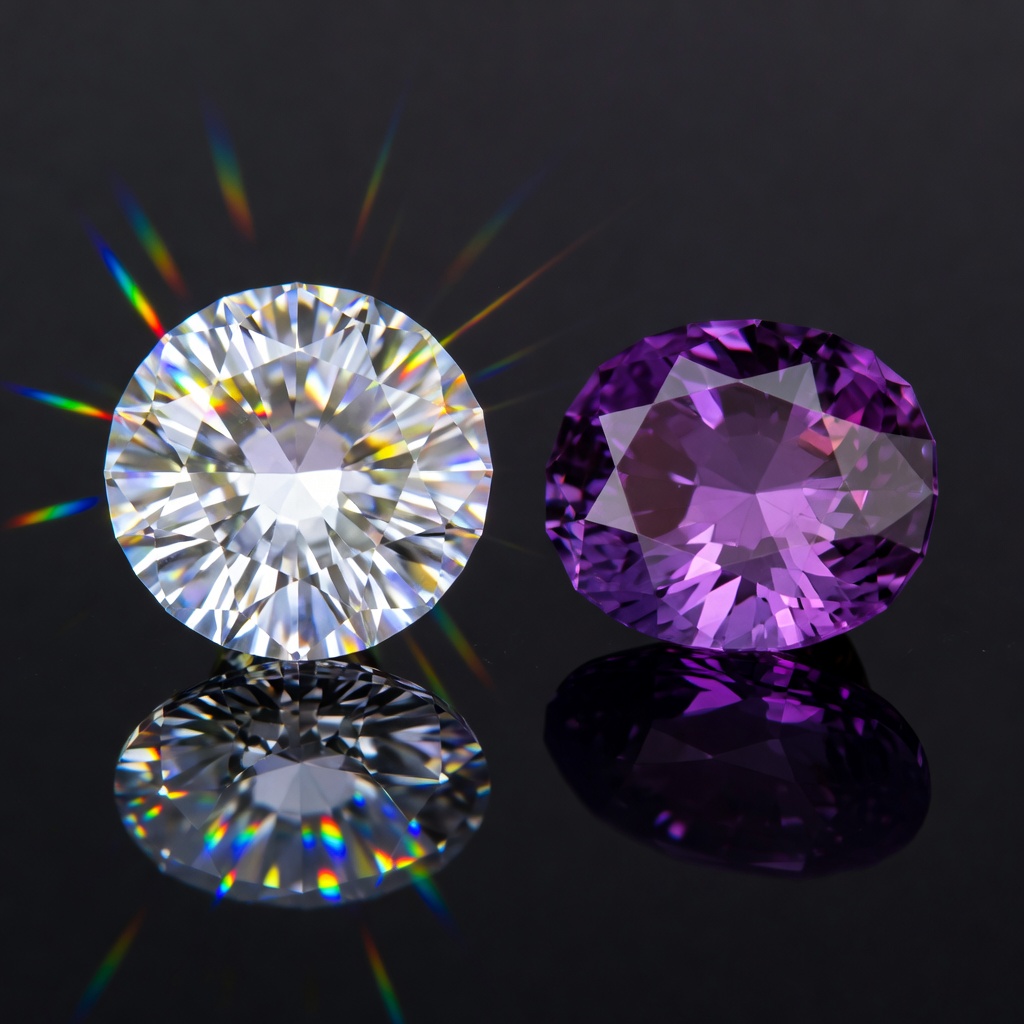
The optical performance of these gemstones diverges dramatically when observed under light, creating distinctly different aesthetic experiences for the wearer. Moissanite exhibits exceptional brilliance with a refractive index of 2.65-2.69, significantly higher than diamond (2.42), which results in intense moissanite fire—the rainbow-like dispersion of light into spectral colors. This double refraction property, where light splits into two rays as it passes through the crystal, creates a doubled facet pattern visible under magnification and produces a lively, almost kaleidoscopic sparkle that some jewelry enthusiasts find even more captivating than diamond. When shopping for engagement jewelry, consider viewing both stones under natural daylight and incandescent lighting to appreciate how moissanite's fire creates colorful flashes compared to amethyst's more subdued luminosity.
Amethyst captivates through depth of color rather than explosive brilliance, displaying amethyst purple color variations ranging from delicate pale lavender to intense deep "Siberian" purple with red and blue flashes. Unlike moissanite's double refraction, amethyst demonstrates single refraction with a refractive index of 1.544-1.553, resulting in subtle internal reflections that emphasize clarity and color zoning over rainbow dispersion. The purple saturation derives from iron impurities (Fe³⁺) within the quartz structure combined with natural irradiation during formation, creating color concentrations often visible as phantoms or bands within larger crystals. When selecting high-quality amethyst for jewelry, examine the stone face-up to check for consistent color distribution without visible windowing (light leakage through the center), as this ensures the gem displays its characteristic velvety depth rather than appearing washed out.
Hardness and Durability for Daily Wear
Durability represents a critical factor when choosing between these gemstones, particularly for jewelry intended for everyday use such as engagement rings or bracelets. Moissanite ranks 9.25 on the Mohs hardness scale, placing it second only to diamond (10) and making it extraordinarily resistant to scratching, chipping, or abrasion during daily activities. This exceptional gemstone hardness comparison winner maintains its polish and facet edges indefinitely, even when subjected to the inevitable bumps and scrapes of office work, household chores, or active lifestyles. For example, a moissanite engagement ring worn daily for five years will typically show no surface wear under 10x magnification, whereas softer stones begin showing scratches within months of regular use.
Amethyst measures 7 on the Mohs scale, which, while suitable for jewelry, presents significant limitations for high-impact pieces like rings worn on dominant hands. This amethyst durability concern stems not only from surface scratching—amethyst can be scratched by common materials like household dust (which contains quartz particles)—but also from its perfect cleavage in one direction, meaning the stone can split or chip when struck against hard surfaces. Case studies from jewelry repair shops indicate that amethyst rings require repolishing or recutting approximately every 3-5 years under normal wear conditions, while prongs holding amethyst stones may loosen more frequently due to the stone's brittleness compared to moissanite. If choosing amethyst for daily wear, consider protective settings like bezels or halos that absorb impact, and remove the jewelry during activities involving hard impacts or abrasive materials.
Color Options and Enhancement Treatments
Both gemstones offer diverse color palettes, though their coloring processes and availability differ substantially. Colored moissanite now extends far beyond the traditional colorless options, with laboratories producing near-colorless (G-H-I), colorless (D-E-F), and fancy colors including vivid purple, teal, green, blue, and even black variants through controlled doping during the crystal growth process. These laboratory-created hues remain stable indefinitely, resistant to fading from light exposure or heat, providing consumers with predictable, consistent color matching for bridal sets or fashion pieces. When selecting fancy colored moissanite, request certification verifying the color is permanent rather than surface-coated, as some lower-quality vendors apply temporary color enhancements that may wear off over time.
Natural amethyst presents a spectrum of purple intensities determined primarily by geographic origin, with Brazilian deposits typically yielding lighter lavender tones while Uruguayan and Siberian mines produce the coveted deep purple specimens with red flash. Treated amethyst commonly undergoes heat treatment (400-500°C) to lighten overly dark stones or remove brownish tints, transforming them into more marketable "Rose de France" pinkish-lavender varieties or even converting them into prasiolite (green quartz). Unlike moissanite's permanent laboratory colors, heat-treated amethyst may show slightly different care requirements, though the color remains stable under normal wearing conditions. When purchasing amethyst, ask your jeweler about origin and treatment disclosure; untreated deep Siberian purple amethyst commands premium pricing, while treated stones offer affordable alternatives for fashion jewelry without sacrificing visual appeal.
Price Comparison and Value Analysis
The economic distinction between these gemstones reflects their availability, creation costs, and market positioning within the jewelry industry. Moissanite price vs amethyst comparisons reveal that moissanite typically commands $300-$600 per carat depending on color grade, cut quality, and whether the stone is premium grade (colorless) or slightly included with tint. This pricing positions moissanite as a luxury alternative to diamond, offering similar durability and superior fire at approximately one-tenth the cost of natural diamonds. The higher price reflects the energy-intensive laboratory creation process, requiring temperatures exceeding 2,000°C to grow silicon carbide crystals over weeks or months, alongside the expertise needed to cut the doubly refractive material without optical distortion.
Amethyst remains one of the most affordable gemstones available, with fine quality specimens ranging from $20-$50 per carat, making it accessible for large statement pieces that would be prohibitively expensive with moissanite or diamond. This dramatic price differential allows jewelry designers to create bold cocktail rings, dramatic pendants, or multi-stone bracelets featuring substantial carat weights without budget constraints. However, value retention differs significantly between the materials; moissanite maintains relatively stable resale pricing due to consistent manufacturing costs and growing consumer recognition, while amethyst values fluctuate based on mining yields and fashion trends, with investment-grade deep Siberian specimens occasionally appreciating while commercial-grade material remains inexpensive. For budget-conscious consumers seeking maximum visual impact, a 5-carat amethyst ring might cost $100-200 compared to $1,500-3,000 for equivalent-sized moissanite, though the latter offers superior longevity.
Side-by-Side Gemstone Comparison
| Characteristic | Moissanite | Amethyst |
|---|---|---|
| Chemical Composition | Silicon Carbide (SiC) | Silicon Dioxide (SiO₂) with iron impurities |
| Mohs Hardness | 9.25 (Excellent for daily wear) | 7.0 (Requires protective settings) |
| Refractive Index | 2.65-2.69 (High brilliance, double refraction) | 1.544-1.553 (Single refraction, subtle sparkle) |
| Primary Colors | Colorless, near-colorless, fancy colors (purple, green, blue) | Pale lavender to deep Siberian purple |
| Price Range (per carat) | $300 - $600 | $20 - $50 |
| Origin Type | Lab-created (rare natural occurrences in meteorites) | Natural volcanic geode formations |
| Best Jewelry Applications | Engagement rings, wedding bands, daily wear pieces | Earrings, pendants, cocktail rings, occasional wear |
| Cleaning Methods | Ultrasonic, steam, professional cleaning safe | Mild soap and water only; avoid ultrasonic/heat |
| Durability Concerns | Resistant to scratching, chipping, and heat | Susceptible to scratches, cleavage planes, color fading in sunlight |
| Symbolism | Eternal love, innovation, sustainable luxury | February birthstone, sobriety, tranquility, spiritual clarity |
Ideal Jewelry Applications and Settings
Selecting appropriate jewelry designs for each gemstone requires balancing their physical properties with aesthetic goals and lifestyle considerations. Moissanite engagement rings dominate the bridal market due to the stone's diamond-like durability and extraordinary brilliance, performing excellently in delicate prong settings, tension mounts, and intricate vintage-inspired designs that might compromise softer stones. The material's toughness allows for ultra-thin band widths and exposed culet designs that maximize light return, making it ideal for active professionals who desire low-maintenance luxury. When designing custom moissanite pieces, jewelers can employ sharp facet angles and thin girdles that would be risky with more brittle materials, resulting in elegant, airy settings that appear to float the stone above the finger.
Amethyst fashion jewelry excels in applications where impact risk remains minimal, such as earrings, pendants, brooches, and special-occasion cocktail rings. The gemstone's relative affordability permits bold, oversized designs featuring 10-carat center stones or elaborate beadwork that would be financially impossible with moissanite. However, protective setting strategies become essential for amethyst rings; bezels that wrap the girdle with metal provide superior protection compared to exposed prong settings, while halo designs buffer the center stone from direct impact. For example, a bezel-set amethyst ring worn occasionally for evening events can remain pristine for decades, whereas the same stone in a high-profile prong setting might chip within weeks of daily grocery shopping or gym visits. Consider amethyst for statement pieces reserved for weekly wear rather than 24/7 lifestyle jewelry.
Care, Cleaning, and Maintenance Requirements
Proper maintenance protocols differ significantly between these stones due to their varying responses to heat, chemicals, and mechanical cleaning methods. Cleaning moissanite jewelry offers remarkable flexibility, as the stone's hardness and thermal stability allow for ultrasonic cleaners, steam cleaning, and ammonia-based solutions without risk of damage, cracking, or color alteration. This resilience makes moissanite ideal for busy professionals who can drop their rings off at jewelers for quick ultrasonic cleaning during lunch breaks, or who wish to use home ultrasonic units for weekly maintenance. The stone's resistance to oil and dirt accumulation also means it maintains its sparkle longer between cleanings compared to diamond, requiring only occasional polishing to remove surface films.
Gemstone care for amethyst demands significantly more caution and specific protocols to preserve both structural integrity and color stability. Clean amethyst using only warm water, mild dish soap, and a soft-bristled brush (like a baby toothbrush), avoiding ultrasonic cleaners entirely due to the risk of exacerbating internal fractures or loosening inclusions that could lead to cleavage. Heat represents a particular enemy of amethyst; never expose the stone to steam cleaning or hot water, as temperatures above 200°C can alter the iron oxidation states responsible for the purple color, potentially fading deep Siberian specimens to pale lavender. Storage requires equal attention—keep amethyst pieces in fabric-lined compartments away from direct sunlight, as prolonged UV exposure can permanently bleach the color, and store separately from harder gemstones like diamonds, rubies, or sapphires that could scratch the quartz surface. For heirloom amethyst pieces, consider wearing them only during evening events to minimize light exposure and impact risks.
Symbolism, Meaning, and Birthstone Significance
Beyond their physical properties, these gemstones carry distinct cultural narratives and emotional resonances that influence consumer selection for commemorative jewelry. Moissanite represents modern innovation and sustainable luxury, symbolizing eternal love through its celestial origins and indestructible nature, while appealing to environmentally conscious couples seeking lab created vs natural gems alternatives that avoid mining impacts. The stone's discovery in meteorites imbues it with cosmic significance, suggesting that love, like stars, transcends earthly limitations and time—a powerful metaphor for marriage in contemporary ceremony. Jewelry designers increasingly market moissanite as the "gemstone of the future," appealing to tech-forward consumers who value scientific achievement and ethical sourcing over traditional geological rarity.
Amethyst carries millennia of historical gemstone symbolism, serving as February's birthstone and maintaining associations with sobriety, clarity, and spiritual protection dating back to ancient Greek mythology (the name derives from "amethystos," meaning "not intoxicated"). The amethyst meaning extends across cultures from Egyptian pharaohs to Catholic bishops, who valued the stone for promoting calmness, mental clarity, and divine connection. In crystal healing practices, amethyst is believed to activate the crown chakra, enhancing meditation and reducing anxiety—a significance that drives sales in wellness-oriented markets regardless of scientific validation. When gifting amethyst, consider pairing it with birthstone significance for February birthdays, sobriety anniversary celebrations, or as a "calming stone" for individuals navigating stressful life transitions, whereas moissanite better suits proposals, technological achievement celebrations, or eco-conscious milestones.
Authentication and Quality Assessment
Distinguishing between these gemstones requires specific gemological knowledge and testing equipment, particularly as high-quality simulants become increasingly sophisticated. To identify moissanite, professionals utilize diamond testers that detect electrical conductivity—moissanite conducts electricity while diamond and amethyst do not—providing immediate differentiation. Visual inspection through a jeweler's loupe reveals moissanite's double refraction, where the back facets appear doubled or fuzzy compared to the crisp, singly refractive appearance of amethyst; this test requires rotating the stone to observe the culet through the table facet. For consumers purchasing pre-owned jewelry, request certification from recognized laboratories (GIA, IGI, or AGS) that confirm moissanite's silicon carbide composition and synthetic origin, ensuring you haven't purchased colorless sapphire or cubic zirconia misrepresented as moissanite.
Amethyst quality grades evaluate different criteria than moissanite, focusing primarily on color saturation, clarity, and cut rather than synthetic growth characteristics. Premium amethyst displays deep purple color (AAA grade) with red or blue secondary flashes visible in daylight, free from visible inclusions to the unaided eye, and well-cut to maximize color depth without windowing. Lower grades (A or commercial quality) show pale color, visible zoning, or inclusions that appear as reddish "tiger stripes" or veils within the stone. When assessing value, examine amethyst under diffused daylight rather than jewelry store spotlights, as intense lighting can mask color zoning or washed-out centers. Natural versus synthetic amethyst identification requires microscopic examination of growth patterns—natural stones show color zoning and fluid inclusions, while synthetic hydrothermal amethyst displays seed plates and chevron-like growth patterns visible under magnification.
Frequently Asked Questions
Is moissanite harder than amethyst?
Yes, moissanite ranks 9.25 on the Mohs hardness scale compared to amethyst's 7. This makes moissanite significantly more scratch-resistant and suitable for daily wear, while amethyst requires more careful handling to prevent surface damage. The difference means moissanite can withstand impacts from household materials and daily activities that would scratch or chip amethyst, making it the superior choice for rings worn during active work or exercise.
Can I use amethyst for an engagement ring?
While amethyst can be used for engagement rings, it requires protective settings like bezels or halos due to its 7 Mohs hardness rating. For active lifestyles, moissanite is the better choice as it withstands daily impacts and maintains its polish longer than amethyst. If selecting amethyst for an engagement ring, consider reserving it for occasional wear or choosing a pendant or earring design that minimizes impact exposure.
Does moissanite come in purple like amethyst?
Yes, fancy colored moissanite including purple varieties is available, though colorless and near-colorless options remain most popular. However, natural amethyst displays a unique violet depth and saturation that differs from purple moissanite's appearance. The purple in moissanite tends toward a cool, electric violet with high dispersion, while amethyst offers warmer, deeper royal purple tones with subtle red flashes in high-quality specimens.
Why is moissanite more expensive than amethyst?
Moissanite costs more due to the complex laboratory creation process that replicates natural silicon carbide formation, plus its diamond-like optical properties. Amethyst is abundant in nature and easier to mine and cut, making it more affordable despite being a natural gemstone. The energy-intensive thermal growth process for moissanite, requiring weeks of controlled high-temperature synthesis, contributes significantly to the price differential compared to amethyst's relatively straightforward mining and processing.
How can I tell moissanite and amethyst apart?
Use a jeweler's loupe to check for double refraction—moissanite will show doubled back facets while amethyst appears singly refractive. Additionally, moissanite displays more rainbow fire (colorful flashes) compared to amethyst's deeper, more subdued purple body color. A simple breath test can also help: moissanite resists fogging longer than amethyst due to its different thermal conductivity, though professional gemological testing provides definitive identification.
Which gemstone is better for daily wear?
Moissanite is superior for daily wear due to its exceptional hardness (9.25 Mohs) and resistance to scratching, chipping, and heat. Amethyst is better suited for occasional wear or pieces like earrings and pendants that don't face constant impact. For professions involving manual labor, frequent handwashing, or active outdoor activities, moissanite engagement rings or bands will maintain their appearance indefinitely while amethyst will show wear patterns within months of such rigorous use.
Can I clean both gemstones the same way?
No, they require different care. Moissanite can be cleaned with ultrasonic cleaners and steam, while amethyst should only be cleaned with mild soap, warm water, and a soft brush. Avoid harsh chemicals and extreme heat with amethyst to prevent color damage. Additionally, never expose amethyst to ultrasonic cleaning, as the vibrations can expand existing fractures or create new cleavage planes within the crystal structure, potentially breaking the stone.
Is moissanite a natural gemstone like amethyst?
Natural moissanite is extremely rare (found in meteorites), so nearly all moissanite jewelry uses lab-created stones. Amethyst is a naturally occurring quartz variety, though both natural and lab-grown amethyst exist in the market. When purchasing, request disclosure of origin for both stones—moissanite should be labeled as laboratory-created, while amethyst may be natural or synthetic, with natural specimens typically commanding higher prices for deep-colored, inclusion-free material.