Emerald vs Mystic Topaz: Understanding Two Distinct Gemstones
When exploring the fascinating world of colored gemstones, buyers often encounter the striking contrast between emerald and mystic topaz, two stones that occupy vastly different positions in the jewelry hierarchy. Emerald stands as one of the "big three" precious gemstones, belonging to the beryl family and prized for its natural green hue derived from chromium and vanadium content deep within the earth's crust. In contrast, mystic topaz represents the innovative intersection of natural materials and modern technology, beginning as colorless natural topaz before undergoing a sophisticated thin-film deposition process that creates its signature rainbow iridescence. Understanding these fundamental differences in origin, classification, and intrinsic value is essential for making informed purchasing decisions, whether you seek a timeless investment piece or a fashionable accessory for occasional wear.
The distinction between these stones extends beyond mere aesthetics to encompass geological rarity, market valuation, and long-term durability considerations that significantly impact buyer satisfaction. While emerald has captivated civilizations for millennia with its natural beauty and scarcity, mystic topaz emerged in the late 1990s as an affordable alternative that democratizes access to vivid, eye-catching jewelry. When comparing emerald vs mystic topaz, prospective owners must weigh the prestige and heirloom potential of natural precious gemstones against the accessible price point and contemporary appeal of treated semi-precious alternatives. This comprehensive analysis will guide you through the critical factors distinguishing these gemstones, from their geological formation to their practical applications in fine jewelry design.
Natural Origins: How Emeralds and Mystic Topaz Are Formed
The journey of an emerald begins deep within the earth's hydrothermal veins, where beryllium-rich fluids interact with chromium-bearing rocks under intense pressure and temperature over millions of years. This rare geological coincidence occurs primarily in Colombia's Muzo and Chivor mines, Zambia's Kagem deposits, and Brazil's historic mining regions, creating crystals that collectors and gemologists covet for their unique fingerprint-like inclusions called "jardin." The formation process requires specific hexavalent chromium or trivalent vanadium substitutions within the beryl crystal structure, making natural emeralds thousands of times rarer than diamonds and explaining their premium positioning in the precious vs semi-precious gemstones market.
Mystic topaz, conversely, begins its existence as abundant natural colorless topaz crystals found in igneous rocks across Brazil, Nigeria, and Sri Lanka, formed through magmatic processes and pegmatite deposits. While the base material is genuinely natural, the transformation into "mystic" variety occurs through a high-tech chemical vapor deposition (CVD) process in specialized laboratories, where technicians apply a microscopic titanium-based film to the pavilion facets of cut stones. This thin-film deposition creates interference patterns that produce the stone's characteristic rainbow effect, a treatment that distinguishes mystic topaz as an enhanced rather than natural color gemstone. The abundance of raw topaz material before treatment means that supply constraints rarely affect pricing, unlike the limited availability of high-quality emerald rough that drives the emerald value and price spectrum.
Environmental and ethical sourcing considerations further differentiate these gemstones, as emerald mining often involves artisanal operations in remote South American and African regions with varying labor standards. Responsible buyers increasingly demand provenance documentation and fair-trade certifications when purchasing emeralds, particularly from Colombian mines with historical significance. Mystic topaz treatment facilities, typically located in major cutting centers like India and Thailand, present different ethical considerations regarding chemical handling and worker safety during the coating process, though the environmental impact remains lower than large-scale mining operations.
Color and Appearance: Natural Green vs Iridescent Rainbow
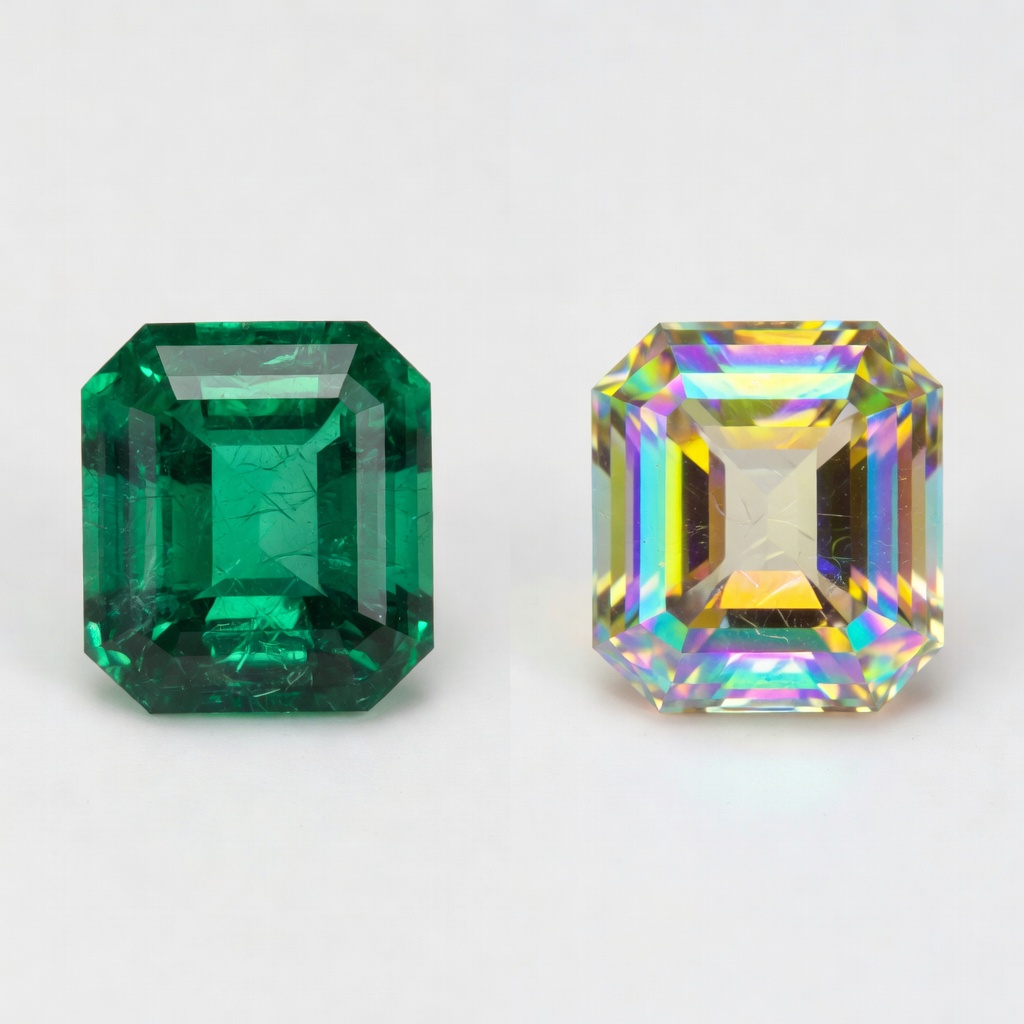
The mesmerizing green of natural emeralds results from trace elements permanently embedded within the crystal lattice during formation, creating a depth of color that remains stable for centuries under proper care. Gemologists evaluate emerald color using three criteria: hue (the basic green shade), tone (lightness to darkness), and saturation (intensity), with the most valuable stones displaying a vivid, slightly bluish-green known in the trade as "emerald green" or "grass green" without being too dark. Unlike many gemstones where clarity dominates pricing, emeralds often contain characteristic inclusions that prove their natural origin while slightly affecting transparency, creating a velvety appearance prized by connoisseurs seeking authentic beryl family gemstones.
Mystic topaz presents an entirely different optical experience, displaying an artificial rainbow iridescence that shifts between violet, blue, green, yellow, and pink depending on viewing angle and lighting conditions. This phenomenon, called thin-film interference, occurs when light waves reflect between the titanium coating and the topaz surface, creating psychedelic color play that appeals to fashion-forward jewelry enthusiasts. However, this coating sits on the surface rather than within the crystal structure, meaning that unlike the permanent color of emeralds, the rainbow effect on mystic topaz depends entirely on the integrity of the artificial layer. Professional jewelers note that while the effect is immediately striking, it lacks the subtle sophistication and natural variation that characterize precious vs semi-precious gemstones with intrinsic coloration.
Light performance differs significantly between these stones, with high-quality emeralds exhibiting depth and "life" through internal reflection and scattering, while mystic topaz creates surface dispersion effects that maximize brilliance at the expense of subtlety. When selecting between these options, consider that emerald's color remains consistent under various lighting conditions, from daylight to incandescent bulbs, whereas mystic topaz's appearance varies dramatically based on the angle of illumination and can appear muted in diffused lighting. Practical tip: Always examine emerald candidates under different light sources to verify color stability, while viewing mystic topaz under direct bright light to assess coating uniformity and avoid stones with visible scratches or thin spots in the iridescent layer.
Durability Test: Which Gemstone Stands the Test of Time?
When evaluating gemstones for jewelry applications, understanding the difference between hardness and durability becomes crucial for long-term satisfaction. On the Mohs hardness scale, emeralds rate 7.5 to 8, while the topaz base material of mystic topaz scores 8, suggesting similar resistance to scratching from daily dust and debris. However, hardness measures only scratch resistance, not toughness or stability, and this is where the comparison reveals significant disparities affecting coated gemstone durability and natural stone longevity. Emeralds typically contain numerous internal inclusions and fractures that create stress points, making them brittle and susceptible to chipping or breaking upon impact, despite their respectable hardness rating.
The primary durability concern for mystic topaz lies not in the base material but in the vulnerable titanium coating that creates its distinctive appearance. This microscopic film, applied to the pavilion (bottom) facets of the stone, can scratch, wear thin, or peel away with normal wear, particularly at facet junctions where the coating experiences maximum abrasion. Chemical exposure poses additional risks, as household cleaners, chlorine, and even skin oils can gradually degrade the adhesion between coating and crystal, leading to patchy color loss that requires professional recoating services. Historical data from jewelry repair shops indicates that while emeralds maintain their beauty for centuries with proper care—witness the preserved stones in museum collections dating to ancient Egypt—mystic topaz typically shows coating degradation within 5 to 10 years of regular wear.
Both stones exhibit perfect basal cleavage, meaning they can split along specific crystallographic planes when struck with sufficient force, requiring careful consideration during the cutting process and setting procedures. For emerald rings, jewelers recommend protective settings that shield the girdle edges from direct impact, while mystic topaz requires settings that minimize contact between the coated pavilion and skin or clothing to preserve the iridescent finish. Case study analysis of insurance claims reveals that emerald damage typically occurs from single traumatic impacts, while mystic topaz degradation happens gradually through cumulative abrasion, suggesting different replacement timelines and care strategies for owners.
| Characteristic | Emerald | Mystic Topaz |
|---|---|---|
| Geological Origin | Natural hydrothermal formation over millions of years | Natural topaz base with artificial CVD coating |
| Mohs Hardness | 7.5 - 8 | 8 (base material) |
| Color Source | Chromium/vanadium within crystal structure (permanent) | Titanium thin-film coating (surface application) |
| Price Range per Carat | $500 - $15,000+ | $10 - $100 |
| Investment Potential | High appreciation potential, strong resale market | Minimal resale value, fashion/trend based |
| Durability Concerns | Brittleness from inclusions, chip-prone | Coating scratches and wears, chemical sensitivity |
| Classification | Precious gemstone (beryl family) | Semi-precious enhanced gemstone |
| Maintenance Requirements | Re-oiling every few years, gentle cleaning only | Avoid abrasives/chemicals, potential recoating needed |
Price Point Analysis: Investment Value Compared
The financial distinction between emerald and mystic topaz represents one of the most dramatic price differentials in the gemstone market, reflecting fundamental supply and demand economics alongside quality assessment criteria. Fine natural emeralds command prices ranging from $500 per carat for commercial quality to $15,000 or more per carat for exceptional Colombian stones with vivid saturation and minimal eye-visible inclusions. Pricing follows the traditional 4Cs framework (Color, Clarity, Cut, and Carat weight) with additional premiums awarded for prestigious origins like Colombia's Muzo mine or rare size categories above 3 carats where crystal availability drops exponentially. Unlike many commodities, high-quality emeralds have historically appreciated in value during economic downturns, serving as portable wealth stores similar to gold for sophisticated collectors.
Mystic topaz occupies the accessible end of the jewelry spectrum, typically retailing between $10 and $100 per carat depending on the quality of the base topaz and the uniformity of the coating application. This affordability stems from the abundant supply of colorless topaz rough and the efficiency of modern chemical vapor deposition technologies that can treat hundreds of stones simultaneously. While mystic topaz enables fashion-conscious consumers to own large, impressive-looking gemstones without significant financial outlay, the secondary market remains virtually nonexistent, with resale values often dropping to 10-20% of retail prices immediately after purchase. Investment-minded buyers should recognize that while emerald value and price trends upward over decades due to depleting mines and increasing global wealth, mystic topaz functions purely as a consumable fashion item with depreciation similar to costume jewelry.
When calculating price-to-carat ratios, consider that a 2-carat fine emerald might cost $10,000 while a comparable-sized mystic topaz retails for $50, yet the lifetime cost of ownership differs significantly due to maintenance and replacement cycles. Budget allocation strategies suggest reserving emerald purchases for milestone events or investment portfolios, while mystic topaz suits trend-driven acquisitions where seasonal style changes justify lower durability expectations. Practical example: A collector purchasing a $5,000 emerald ring should view it as a 30-year asset requiring $200 periodic maintenance, whereas a $100 mystic topaz piece functions as a 2-3 year fashion accessory with no residual value, affecting how buyers should approach insurance, appraisal, and estate planning considerations.
Treatment Transparency: Natural vs Enhanced Processes
The gemstone industry maintains strict disclosure requirements regarding treatments, as these processes significantly affect value, durability, and care requirements that consumers must understand before purchase. Virtually all emeralds on the market receive some form of clarity enhancement, traditionally involving the introduction of colorless oil or modern synthetic resins into surface-reaching fractures to improve apparent transparency. This treatment, while industry-standard and accepted, requires explicit disclosure under Federal Trade Commission guidelines, with designations ranging from "insignificant" to "significant" indicating the extent of filler material present. Untreated emeralds with good clarity command premiums of 50% or more above treated equivalents, making laboratory certification essential for high-value purchases to verify the degree of enhancement.
Mystic topaz represents a different category of treatment where the enhancement creates the gem's essential identity rather than merely improving natural characteristics. The topaz enhancement methods involve placing colorless topaz rough into vacuum chambers where technicians introduce titanium and other metal oxides that bond to the stone's surface at the molecular level through chemical vapor deposition. Unlike temporary coatings such as dyeing or foil backing, this process creates a permanent molecular bond, though the thin film remains vulnerable to physical abrasion in ways that diffused or irradiated color treatments are not. Reputable sellers must disclose that mystic topaz is a treated gemstone, though the treatment is generally considered permanent under normal wear conditions if protected from scratching.
Ethical marketing considerations require jewelers to explain these treatment differences clearly, as consumer protection laws mandate that material facts affecting value must be disclosed prior to sale. For emeralds, buyers should receive documentation indicating the type of filling material (natural oil versus polymer resin) and the degree of clarity enhancement, as oil treatments may dry out over time requiring professional re-oiling. Mystic topaz purchases should include care instructions specifically noting the coated nature of the stone and warranty information regarding potential recoating services. Practical tip: When reviewing certification reports from laboratories like GIA or AGL, look for specific treatment comments in the "Comments" section rather than assuming untreated status, and request written guarantees from retailers regarding the stability of mystic topaz coatings for at least two years post-purchase.
Symbolism and Birthstone Significance
Emerald carries millennia of cultural significance as the official birthstone for May and the traditional gift for 20th and 35th wedding anniversaries, representing renewal, growth, and enduring love across civilizations. Ancient Egyptians mined emeralds from Cleopatra's legendary mines as early as 330 BCE, while the Inca Empire treasured Colombian emeralds as sacred stones representing the earth's fertility and power. Royal collections throughout Europe, from the Crown Jewels of the United Kingdom to the imperial treasuries of Russia, feature spectacular emeralds that have passed through generations as symbols of wealth and divine favor. As the green variety of beryl family gemstones, emerald shares mineralogical relationships with aquamarine and morganite but stands alone in its cultural primacy among green gems.
Mystic topaz lacks the historical pedigree and traditional birthstone status of its natural counterpart, having been developed in the late 20th century specifically for the fashion jewelry market. However, modern crystal healing practitioners and New Age metaphysical communities have adopted mystic topaz as a stone of creativity, inspiration, and artistic expression, attributing its rainbow colors to chakra alignment and energetic versatility. While these associations lack the archaeological and literary foundations of emerald symbolism, they resonate with contemporary consumers seeking personal meaning in jewelry without traditional constraints. The stone's technological origins also appeal to those who value human innovation and the marriage of natural materials with scientific advancement.
When selecting between these stones based on symbolic meaning, consider the message conveyed by each choice: emerald speaks to timeless elegance, natural beauty, and geological rarity, while mystic topaz suggests modernity, playfulness, and accessible luxury. Gift-givers choosing emerald for May birthdays or anniversary milestones communicate deep respect and significant investment in the relationship, whereas mystic topaz suits creative individuals or those celebrating unconventional achievements. Case study: A groom selecting an emerald engagement ring for a May-born fiancée honors both her birth month and the stone's historical associations with faithful love, while choosing mystic topaz for an artist's graduation gift acknowledges her creative spirit through the stone's rainbow palette and contemporary aesthetic.
Best Uses in Jewelry Design
The physical characteristics of emerald and mystic topaz dictate distinct design approaches that maximize beauty while minimizing durability risks for each material. Emeralds require protective settings that shield their vulnerable girdles and corners from direct impact, making bezels, halo settings, and thick prongs essential for ring designs intended for regular wear. Jewelry designers often place emeralds in pendants and earrings where they face less mechanical stress than finger rings, or create "cocktail rings" specifically for occasional wear rather than daily use. The classic elegance of emeralds complements vintage-inspired designs, Art Deco geometry, and sophisticated platinum or yellow gold settings that enhance the green color through complementary metal choices.
Mystic topaz performs best in jewelry applications where the coated pavilion facets remain protected from abrasion and chemical exposure, making pendants and earrings ideal choices while rings require specific design considerations. When set in rings, mystic topaz benefits from high bezel walls or protective galleries that prevent the bottom of the stone from contacting skin, clothing, or surfaces during wear. The iridescent rainbow effect pairs well with modern, contemporary designs featuring white gold or silver settings that provide neutral backgrounds for the color display, though some designers contrast the rainbow hues with black rhodium plating for dramatic effect. Fashion jewelry trends favor mystic topaz in statement pieces where the large size and vivid color create immediate visual impact at accessible price points.
Setting considerations extend beyond aesthetics to practical engineering, as emeralds need gentle prongs that won't exert pressure on included areas while mystic topaz requires settings that avoid scratching the coating during cleaning or wear. For active lifestyles, emerald owners should consider protective "basket" settings with full bezel surrounds or worn primarily as necklaces, while mystic topaz enthusiasts should reserve their pieces for evening wear or special occasions rather than office or gym environments. Style versatility differs significantly: emerald transitions seamlessly from boardroom to black-tie events with timeless sophistication, while mystic topaz makes bold contemporary statements best suited for casual or creative professional environments. Practical example: A three-stone emerald ring requires a substantial mounting with v-prongs protecting the pointed ends, whereas a mystic topaz solitaire pendant allows the stone to spin freely, displaying its rainbow colors while keeping the coated surface away from contact points.
Care Guide: Cleaning and Maintenance Requirements
Proper maintenance protocols differ substantially between these gemstones due to their distinct vulnerabilities and treatment histories, requiring owners to adopt species-specific care routines to preserve beauty and value. Emeralds demand gentle cleaning using only warm soapy water and a soft brush, as ultrasonic cleaners and steam systems can remove oil treatments or cause thermal shock to included stones, leading to catastrophic fractures. Owners should avoid exposing emeralds to harsh chemicals, extreme temperature changes, or prolonged sunlight, and should plan for professional re-oiling every few years as natural oils dry out or modern polymer treatments degrade. Storage requires separate soft pouches or compartmentalized jewelry boxes to prevent harder stones like diamonds or sapphires from scratching the emerald surface.
Mystic topaz requires even more restrictive care protocols focused entirely on preserving the integrity of the titanium coating that creates its value. Cleaning should involve only lukewarm water with mild dish soap and a soft cotton cloth, avoiding any abrasive materials including jewelry polishing cloths that contain rouge or other compounds that could scratch the thin film. Owners must avoid contact with cosmetics, perfumes, hairsprays, and household cleaners, applying these products before putting on jewelry and removing mystic topaz pieces before swimming in chlorinated pools or using hot tubs where chemical exposure accelerates coating degradation. The coated gemstone durability concerns mean that even wiping the stone with a paper towel or tissue can cause microscopic scratches that dull the rainbow effect over time.
Professional maintenance schedules vary significantly: emerald owners should budget for periodic professional inspection and potential re-oiling by qualified gemologists every 3-5 years, while mystic topaz owners should consider recoating services when the iridescence fades, typically costing $50-$150 depending on stone size. Storage best practices recommend keeping mystic topaz in individual soft cloth bags away from other jewelry, as contact with harder stones will scratch the coating, while emeralds should be stored away from extreme humidity fluctuations that could affect filler materials. Case study: An emerald ring worn weekly for five years requires one professional cleaning and re-oiling session costing approximately $150 to restore optimal clarity, whereas a mystic topaz pendant worn with similar frequency typically shows coating wear after three years, requiring recoating or replacement depending on sentimental value versus restoration cost.
Making Your Choice: Which Gemstone Is Right for You?
Selecting between emerald and mystic topaz ultimately depends on aligning your purchasing priorities with the inherent characteristics of each stone, considering budget constraints, lifestyle factors, and long-term ownership expectations. If your goal involves acquiring an investment-grade asset with heirloom potential that appreciates over generations, emerald represents the definitive choice despite requiring careful handling and higher initial expenditure. Budget-conscious fashion enthusiasts who prioritize current style trends and large stone sizes over longevity will find mystic topaz offers satisfying visual impact without financial strain, accepting that replacement will eventually become necessary as the coating degrades.
Lifestyle considerations should heavily influence this decision, as active individuals who work with their hands, engage in sports, or prefer low-maintenance jewelry will face challenges with both stones—emeralds risk chipping while mystic topaz risks coating damage—but may find emeralds more suitable for occasional wear pieces while selecting harder untreated stones like sapphires for daily wear. Personal style preferences also guide selection: those drawn to classic elegance, historical significance, and natural beauty gravitate toward emerald's subtle sophistication, while individuals expressing contemporary, artistic, or eclectic tastes may prefer mystic topaz's bold, modern aesthetic. Long-term value calculations suggest that a $3,000 emerald maintained over 20 years costs approximately $150 annually when accounting for maintenance, while three $100 mystic topaz replacements over the same period cost $15 annually but lack residual value.
When finalizing your emerald vs mystic topaz decision, consult with reputable jewelers who provide certification for emeralds detailing treatments and origin, and who offer warranties for mystic topaz coatings against premature failure. Consider commissioning custom designs that specifically address each stone's vulnerabilities—protective settings for emeralds, covered pavilion designs for mystic topaz—to maximize enjoyment regardless of your choice. Remember that neither stone suits every application, and many collectors wisely own both: emeralds for significant occasions and investment purposes, mystic topaz for fashion-forward casual wear where the rainbow effect complements contemporary wardrobes without financial risk.
Frequently Asked Questions
What is the main difference between emerald and mystic topaz?
The primary difference is that emerald is a naturally occurring precious gemstone from the beryl family, valued for its intrinsic green color from chromium/vanadium content. Mystic topaz is a semi-precious gemstone that starts as natural colorless topaz but receives an artificial titanium coating to create rainbow iridescence. Emeralds are rare and expensive, while mystic topaz is affordable and treated.
Is mystic topaz a real gemstone or synthetic?
Mystic topaz is a real, natural gemstone that has undergone enhancement. The base material is genuine colorless topaz (silicate mineral), but it receives a permanent thin-film coating through chemical vapor deposition to create its signature rainbow effect. It's not synthetic or imitation, but it is considered a 'treated' or 'enhanced' gemstone, which significantly affects its value and classification.
Which is more valuable: emerald or mystic topaz?
Emeralds are substantially more valuable, ranging from $500 to $15,000+ per carat for fine quality stones, and can appreciate over time. Mystic topaz typically costs $10-$100 per carat and is considered a fashion gemstone with minimal investment value. An emerald's worth comes from natural rarity, while mystic topaz's value is limited by its treatment and abundant raw material.
Can the coating on mystic topaz wear off over time?
Yes, the iridescent coating on mystic topaz can wear off, scratch, or fade over time, especially on exposed pavilion facets. The titanium-based film is vulnerable to abrasion, harsh chemicals, and ultrasonic cleaning. With proper care (avoiding contact with skin oils, storing separately, gentle cleaning), the coating can last several years, but it's not permanent like an emerald's natural color. Recoating services are available but costly.
Is emerald durable enough for daily wear in rings?
Emeralds require careful consideration for daily wear. While they rate 7.5-8 on the Mohs scale, they typically contain natural inclusions (jardin) that create internal stress and brittleness. For daily wear, choose emeralds with fewer inclusions, protective settings like bezels or halos, and avoid impact activities. Many jewelers recommend emeralds for occasional wear rings or alternative stones like pendants for daily use.
Are treated gemstones like mystic topaz less desirable?
Treatment affects desirability based on purpose and transparency. Mystic topaz's treatment is essential to its beauty but places it in the fashion jewelry category. Emerald treatments (oil/resin) are industry-standard and expected, but heavily treated stones are less valuable. The key is proper disclosure: treated stones are desirable for budget-conscious buyers seeking beauty, while untreated natural gems command premium prices for collectors and investors.
Which gemstone is better for an engagement ring?
For engagement rings, emeralds are the traditional choice symbolizing love and rebirth, but require protective settings and careful wear. Mystic topaz is not recommended for engagement rings due to its vulnerable coating and lack of heirloom value. Consider your lifestyle: active wearers might prefer diamonds or sapphires, while those wanting a classic precious gem with proper care should choose emerald. Mystic topaz works better for occasional-wear rings or right-hand fashion pieces.
How can I identify a natural emerald from a synthetic imitation?
Natural emeralds show characteristic inclusions (jardin), slight color zoning, and natural growth patterns under magnification. They also have specific refractive indices and specific gravity. Synthetic emeralds (flux-grown, hydrothermal) appear too perfect with uniform color. Professional gemological testing with a loupe, microscope, or spectroscope is essential. Always purchase emeralds with certificates from reputable labs like GIA, AGL, or SSEF that disclose treatments and origin.