Understanding Emerald and London Blue Topaz
When selecting a colored gemstone for fine jewelry, the comparison between emerald and London Blue Topaz represents one of the most striking contrasts in the gemological world. Emerald stands as one of the traditional "Big Four" precious gemstones, belonging to the beryl family and celebrated for its lush, velvety green hues that have captivated royalty for millennia. This natural gemstone forms deep within the earth's crust over millions of years, creating crystals that embody the essence of spring and renewal.
London Blue Topaz emerges as a distinctly different proposition within the gemstone market, representing the deepest and most valuable shade within the topaz family. Unlike emeralds, which present their color naturally, London Blue Topaz begins its journey as colorless or lightly tinted natural topaz before undergoing sophisticated irradiation and heat treatment processes to achieve its signature inky blue-gray appearance. This distinction places it firmly in the semi-precious category, though its visual impact rivals stones commanding exponentially higher prices.
The fundamental differences between these gemstones extend beyond their chemical compositions to encompass their market positioning, wearability, and investment potential. While both stones offer remarkable beauty, understanding their distinct characteristics regarding durability, value retention, symbolic meaning, and practical wearability will guide collectors and jewelry enthusiasts toward the optimal choice for their specific needs and lifestyle requirements.
Geological Origins: Natural vs Enhanced
The geological formation of emeralds represents one of nature's most intricate crystallization processes, occurring exclusively in hydrothermal veins where hot, mineral-rich fluids interact with specific host rocks under precise temperature and pressure conditions. These precious green crystals require millions of years to develop, with primary deposits located in Colombia's legendary Muzo and Chivor mines, Zambia's Kagem mine, and various locations throughout Brazil. The scarcity of suitable geological conditions combined with the specific chemical requirements involving chromium and vanadium substitutions makes natural emerald deposits exceedingly rare and geographically limited.
London Blue Topaz follows an entirely different path to market prominence, beginning as abundant colorless topaz crystals found in pegmatite deposits across Brazil, Nigeria, and Sri Lanka. Through controlled exposure to high-energy irradiation followed by carefully monitored heat treatment, gemologists transform these otherwise ordinary crystals into gems displaying the coveted deep steel-blue coloration. This enhancement process, governed by strict Nuclear Regulatory Commission guidelines in the United States, creates a stable color center within the crystal lattice that permanently locks in the distinctive hue without recurring treatments.
The environmental and ethical implications of these divergent origins present important considerations for conscious consumers. Emerald mining frequently involves challenging extraction methods in remote locations, raising concerns regarding habitat disruption, water usage, and labor practices that necessitate verification through Fairmined certification or GIA origin reports. Conversely, London Blue Topaz production relies primarily on existing topaz stocks with minimal ongoing mining impact, though buyers should seek dealers who transparently disclose treatment methods and adhere to safety protocols regarding irradiation processes.
Color Showdown: Green Elegance vs Deep Blue Sophistication
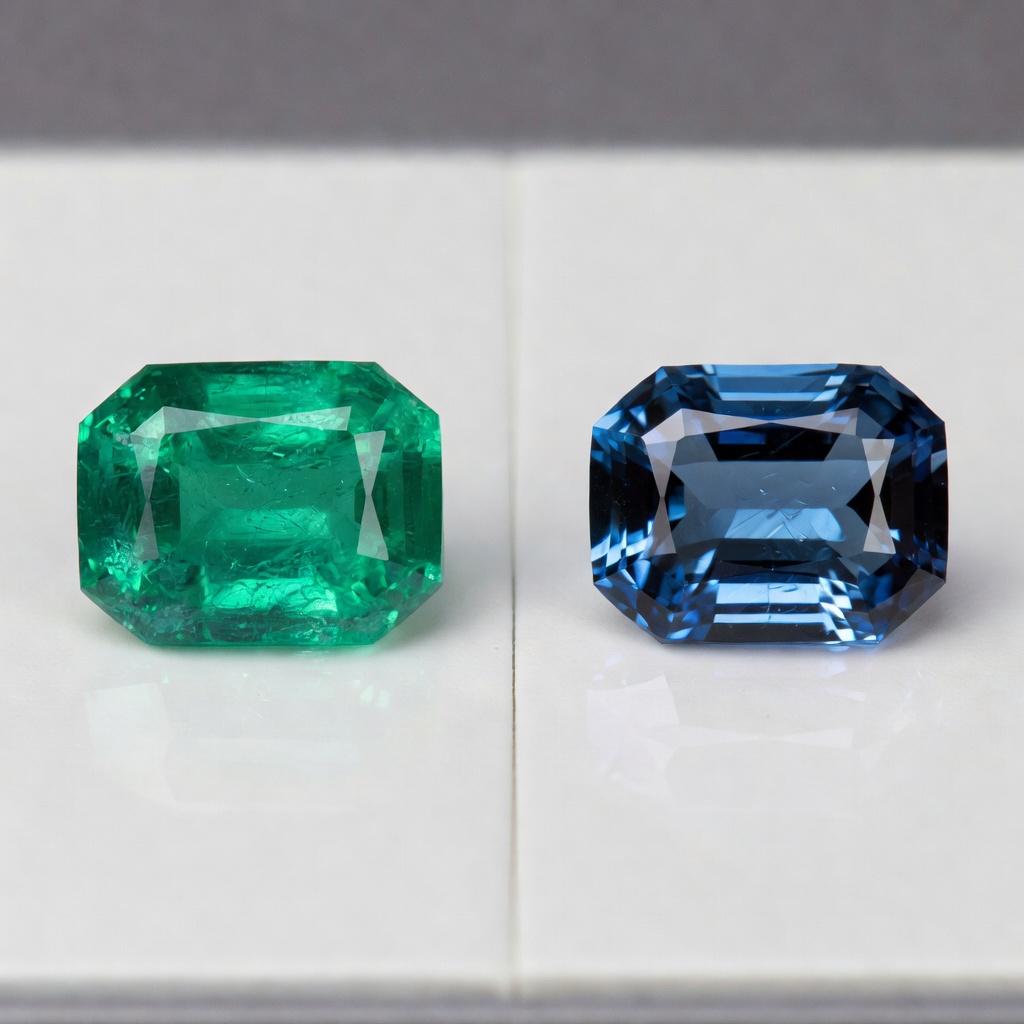
The chromatic identity of emeralds centers on a narrow spectrum ranging from bluish-green to pure green, with the most prized specimens displaying vivid saturation and medium-dark tone often described as "grass green" or "Colombian green." This coloration results from trace amounts of chromium and vanadium replacing aluminum in the beryl crystal structure, creating a unique absorption spectrum that produces the stone's characteristic verdant glow. Unlike many gemstones that achieve uniformity, fine emeralds often exhibit subtle color zoning and a distinctive velvety appearance caused by microscopic inclusions known as "jardin" (French for garden), which paradoxically enhance rather than detract from the stone's desirability when moderate.
London Blue Topaz distinguishes itself through an exceptionally uniform inky blue-gray tone that offers steely saturation unmatched by other blue gemstones in its price range. The treatment process specifically targets the creation of this deep, slightly grayish-blue color that appears almost ink-like in large carat sizes, contrasting sharply with the lighter Swiss Blue or pale Sky Blue topaz varieties. This remarkable clarity and absence of visible inclusions allow London Blue Topaz to display brilliant transparency and exceptional light return, creating a glass-like appearance that maximizes the stone's reflective properties.
Color stability represents a crucial practical consideration for both gemstones, though their behaviors differ significantly. Emerald's natural color remains permanent under normal wearing conditions, though prolonged exposure to intense heat or ultrasonic cleaning can damage the stone through existing fractures. London Blue Topaz presents equally stable coloration, with the irradiation-induced color centers remaining permanent under standard jewelry wear; however, extreme heat exposure above 500 degrees Fahrenheit or prolonged direct sunlight might theoretically affect color, though such occurrences remain exceedingly rare in everyday use.
Durability Face-Off: Mohs Scale and Daily Wear
Evaluating the physical resilience of these gemstones requires looking beyond simple hardness measurements to understand the complex interplay between hardness, toughness, and cleavage characteristics. On the Mohs hardness scale, emeralds rate between 7.5 and 8, while London Blue Topaz registers a solid 8, suggesting comparable resistance to surface scratching and abrasion. However, this numerical similarity belies significant differences in structural integrity that dramatically impact their suitability for various jewelry applications and wearing conditions.
The toughness factor reveals emerald's primary vulnerability despite its respectable hardness rating. The same inclusions that create the stone's desirable jardin effect create internal stress points and fracture networks throughout the crystal, rendering emeralds notably brittle and susceptible to chipping, cracking, or breaking upon impact. This characteristic necessitates protective settings and cautious handling, particularly for emerald rings worn during daily activities. Historical examples include numerous antique emerald pieces in museum collections displaying chips along facet junctions or girdle edges resulting from centuries of careful but occasional impact.
London Blue Topaz presents the opposite challenge through its perfect basal cleavage, meaning the crystal structure contains distinct planes of weakness that allow the stone to split cleanly if struck at specific angles. While the stone resists scratching effectively, a sharp blow to the crown or pavilion can cause catastrophic cleavage failure, splitting the gem into two pieces. Additionally, emeralds demonstrate particular sensitivity to thermal shock and ultrasonic vibrations, which can expand existing fractures or cause "sweating" of filling oils used to improve clarity appearance.
Investment Reality: Price Points and Value Retention
The economic disparity between these gemstones reflects their fundamental categorization as precious versus semi-precious materials, with price differentials spanning two to three orders of magnitude. Fine quality emeralds command prices ranging from $2,000 to well over $50,000 per carat for exceptional specimens, with record-breaking stones from renowned Colombian mines fetching significantly higher premiums at international auctions. This valuation stems from genuine rarity, with high-clarity emeralds over three carats representing extreme geological anomalies that appreciate consistently as mining yields decline.
London Blue Topaz maintains accessible price points typically between $20 and $200 per carat, depending on size, cut quality, and depth of color, positioning it as an attainable luxury for fashion-forward consumers rather than serious investors. The treatment process enables the creation of large, visually impressive stones without the exponential price scaling associated with size increases in precious gems. While this affordability democratizes access to striking blue jewelry, it simultaneously eliminates investment potential, as treated topaz lacks the rarity and collector demand necessary for secondary market appreciation.
Value determination for emeralds follows complex parameters including color intensity (with pure green commanding premiums over bluish-green), clarity levels (eye-clean stones being exceptionally rare and valuable), geographic origin (Colombian material traditionally outperforming Zambian or Brazilian in per-carat pricing), and treatment extent (minor oiling accepted, while significant resin filling dramatically reduces value). London Blue Topaz pricing depends primarily on color saturation depth, with the deepest London Blue shades commanding modest premiums over lighter treated blues, though cut quality and carat weight play secondary roles in valuation.
| Characteristic | Emerald | London Blue Topaz |
|---|---|---|
| Chemical Composition | Beryllium aluminum silicate (Beryl family) | Aluminum fluorosilicate (Topaz family) |
| Color Origin | Natural (Chromium/Vanadium) | Enhanced (Irradiation and Heat Treatment) |
| Mohs Hardness | 7.5 - 8 | 8 |
| Toughness | Poor to Fair (Brittle due to inclusions) | Poor (Perfect cleavage vulnerability) |
| Typical Clarity | Heavily Included (Jardin common) | Eye Clean to Flawless |
| Price Range (Per Carat) | $2,000 - $50,000+ | $20 - $200 |
| Classification | Precious Gemstone | Semi-Precious Gemstone |
| Origin Rarity | Extremely Rare (Specific geological conditions) | Abundant (Colorless rough widely available) |
| Investment Potential | High (Appreciating asset) | Low (Fashion/Consumption item) |
| Primary Care Concern | Avoid impact, heat, and ultrasonic cleaning | Avoid sharp blows along cleavage planes |
| Best Jewelry Application | Occasional wear, protective settings | Earrings, pendants, protected rings |
Meaning and Lore: From Royalty to Modern Style
The historical significance of emeralds spans civilizations and millennia, with ancient Egyptian pharaohs including Cleopatra famously adorning themselves with these green gems to symbolize eternal youth and fertility. Roman mythology associated emeralds with Venus, the goddess of love and beauty, while Spanish conquistadors valued Colombian emeralds above gold during their New World campaigns. This rich pedigree establishes emeralds as symbols of rebirth, wisdom, and prophecy, with medieval lore suggesting the stone could reveal truth and protect against evil spells when worn close to the skin.
London Blue Topaz carries more contemporary associations, having gained prominence primarily in the late twentieth century as treatment technologies advanced to produce its distinctive deep color. As a modern December birthstone (alongside turquoise, tanzanite, and zircon), it represents calm communication, mental clarity, and inner strength rather than ancient mystical properties. The stone's cool, sophisticated hue aligns with contemporary fashion sensibilities, making it popular among professionals seeking gemstone jewelry appropriate for corporate environments without the ostentation associated with high-value precious stones.
Metaphysical practitioners attribute distinct energetic properties to each stone, with emeralds traditionally associated with the heart chakra and emotional healing, believed to foster unconditional love, compassion, and harmony in relationships. London Blue Topaz connects to the throat chakra in crystal healing practices, purportedly enhancing articulate communication, calming anxiety, and strengthening personal resolve during challenging negotiations or public speaking engagements. While scientific evidence does not support these healing claims, the psychological impact of wearing stones with such symbolic associations influences buyer preferences and gift-giving decisions.
Best Jewelry Styles for Each Gemstone
Successful jewelry design for emeralds requires protective architecture that shields the stone from direct impact while showcasing its color. Bezel settings, where metal surrounds the girdle completely, provide optimal protection for emerald rings intended for regular wear, while halo designs featuring diamond surrounds offer both physical buffering and visual enhancement of the green center stone. Prong-set emerald solitaires, though aesthetically striking, present significant risks for daily wear and are better reserved for cocktail rings or special occasion pieces worn occasionally. Vintage-inspired designs featuring milgrain details and filigree work complement emerald's classic associations, while Art Deco geometric settings highlight the stone's crystalline structure.
London Blue Topaz offers greater versatility in jewelry applications due to its superior clarity and availability in large, clean rough crystals. Tension settings, which suspend the stone between two metal arms, showcase the gem's transparency and modern appeal, though they require careful engineering to avoid pressure points along cleavage planes. The stone excels in earring designs where impact risk remains minimal, allowing for dramatic drops and chandelier styles that maximize light return through the blue crystal. Pendant necklaces position the stone safely away from hard surfaces, making them ideal for showcasing large carat weights that would be prohibitively expensive in precious gemstones.
Metal selection significantly impacts the visual presentation of both stones. Yellow gold enhances the warm undertones in Colombian emeralds, creating a classic, regal appearance that references historical royal jewelry, while rose gold offers a contemporary twist that softens the contrast between metal and gem. London Blue Topaz achieves maximum impact when set in white metals such as platinum or white gold, which accentuate the stone's cool steel-blue tones and prevent color dulling that can occur against yellow metal backdrops. Two-tone designs featuring both white and yellow gold elements can bridge these preferences for collectors seeking versatile pieces.
Care and Maintenance Guide
Maintaining emerald jewelry requires specialized knowledge to preserve both the stone and any treatments it may have received. Cleaning should be limited to lukewarm water with mild soap using a soft brush, followed by immediate drying with a lint-free cloth. Ultrasonic cleaners and steam cleaning devices pose severe risks to emeralds, as vibrations can expand existing fractures while heat may cause temporary or permanent damage to clarity-enhancing oils or resins. Many emeralds undergo periodic re-oiling treatments performed by professional gemologists to improve appearance and fill surface-reaching fractures, a maintenance requirement unique to this gemstone.
London Blue Topaz maintenance focuses primarily on preventing thermal shock and avoiding exposure to conditions that might stress its cleavage planes. While the color remains stable, sudden temperature changes—such as moving from a hot sauna to cold outdoor air—can create internal stress fractures. Prolonged exposure to direct sunlight or tanning beds should be avoided as a precautionary measure, though normal daily wear presents minimal fading risk. Storage in individual soft pouches prevents scratching from harder materials like diamonds or sapphires, while keeping topaz separate from emeralds prevents the harder topaz from abrading the softer emerald surfaces.
Professional inspections prove essential for both gemstones, with annual checkups recommended to ensure prongs remain tight and protective settings intact. Emerald settings tend to loosen more frequently than other gemstones due to the brittleness of the material and the wear patterns on protective bezels. For London Blue Topaz, jewelers should examine tension settings and prongs for signs of metal fatigue that might allow the stone to shift or fall out. Both stones benefit from removal during activities involving household chemicals, extreme temperatures, or potential impact risks such as sports, gardening, or heavy lifting.
Sustainability and Ethical Sourcing
The emerald trade faces significant sustainability challenges, with artisanal mining operations in Colombia and Zambia sometimes contributing to deforestation, water pollution from processing chemicals, and complex labor issues requiring careful due diligence from buyers. Responsible sourcing initiatives including Fairmined certification and the Gemfields responsible mining program in Zambia aim to improve traceability and community benefits, though such stones command price premiums. The Gemological Institute of America (GIA) offers origin reports that verify geographic source, allowing consumers to avoid stones from conflict zones or environmentally devastated regions.
London Blue Topaz presents a more straightforward ethical profile, as the treatment process occurs in regulated facilities following strict safety protocols for radiation handling and worker protection. The Gemological Institute of America and other major laboratories provide standard reports confirming the topaz variety and disclosing treatment, ensuring buyers understand they are purchasing enhanced rather than naturally colored material. Unlike emeralds, which face issues with undisclosed oiling or resin filling, London Blue Topaz treatments are universally expected and accepted when properly disclosed.
Lab-grown alternatives exist for emeralds, with hydrothermally created stones offering identical chemical and optical properties at reduced prices, though they lack the investment value and romantic appeal of natural specimens. No synthetic equivalent exists for London Blue Topaz because the treatment process applies to natural rough; however, simulants such as blue spinel or glass may be passed off as topaz by unscrupulous vendors. Certification from reputable laboratories remains the most reliable method for verifying authenticity and treatment disclosure for both gemstones, with AGL (American Gemological Laboratories) reports particularly valued for emeralds due to their detailed treatment and origin analysis.
Which Gemstone Should You Choose?
Selecting between emerald and London Blue Topaz ultimately depends on aligning your priorities regarding budget, lifestyle, aesthetic preferences, and intended use. For significant life events such as milestone anniversaries, major celebrations, or heirloom creation, emeralds justify their premium pricing through timeless prestige, natural rarity, and potential for value appreciation. Collectors seeking a wearable investment that transcends fashion trends will find emerald's historical significance and enduring demand align with their goals, provided they accept the responsibility of delicate handling and protective settings.
Active individuals or those seeking daily-wear statement pieces may find London Blue Topaz more suitable despite its cleavage concerns, particularly when set in protective earring or pendant designs that minimize impact risk. The stone's affordability allows for larger carat weights and bolder designs without financial anxiety about loss or damage, making it ideal for fashion-forward consumers who update their jewelry collections regularly. December birthdays or those drawn to cool, contemporary aesthetics will appreciate the stone's modern symbolism and versatile blue palette.
Consider your wearing habits honestly when making this decision. If you rarely remove jewelry and engage in hands-on activities, neither stone may suit daily ring wear, though London Blue Topaz in protected settings offers greater resilience than emerald. For occasional wear at social events where the jewelry serves as conversation and status symbols, emerald's prestige and rich green color provide unmatched impact. Budget-conscious buyers seeking the largest possible visual presence should consider that a five-carat London Blue Topaz costs less than a high-quality one-carat emerald, allowing for dramatic cocktail rings or statement necklaces that would be impossible with precious stones.
Frequently Asked Questions
Which is more expensive, emerald or London Blue Topaz?
Emeralds are significantly more expensive, ranging from $2,000 to $50,000+ per carat for fine quality, while London Blue Topaz costs only $20-$200 per carat. Emeralds are rare precious gemstones formed under specific geological conditions over millions of years; London Blue Topaz is an affordable, treated semi-precious stone created from abundant colorless topaz rough. This dramatic price difference reflects fundamental scarcity versus treatment-enabled availability in the gemstone market.
Can London Blue Topaz be worn daily like emerald?
London Blue Topaz is actually more suitable for daily wear than emerald despite both having similar hardness ratings on the Mohs scale. While topaz registers slightly harder at 8 compared to emerald's 7.5-8, emerald's numerous inclusions make it brittle and prone to chipping or cracking upon impact. However, topaz requires protective settings due to its perfect cleavage planes, which can cause the stone to split if struck at specific angles, necessitating bezel or halo designs for ring applications.
Is London Blue Topaz a real gemstone or just treated?
London Blue Topaz is a 100% real topaz gemstone that undergoes legitimate radiation and heat treatment to achieve its deep blue color. The treatment process is permanent and stable, creating a genuine gemstone from naturally occurring colorless topaz rough that would otherwise have minimal commercial value. This enhancement follows strict regulatory guidelines and is universally accepted in the jewelry industry when properly disclosed, distinguishing it from synthetic imitations or simulants.
What is the main difference in durability between emerald vs London Blue Topaz?
While both rate 7.5-8 on the Mohs hardness scale, emerald's numerous inclusions create brittleness, making it susceptible to cracking and chipping despite its scratch resistance. London Blue Topaz is harder (8) but possesses perfect basal cleavage, meaning it can split cleanly if struck along specific crystal planes. Emeralds require protection from general impact and thermal shock; topaz needs protection from sharp blows along its cleavage planes and sudden temperature changes.
Which gemstone is better for an engagement ring?
London Blue Topaz is more practical for engagement rings due to superior toughness and affordability, allowing couples to allocate budget toward setting quality or wedding bands. However, emerald remains the prestige choice for those prioritizing tradition, investment value, and symbolic meaning associated with eternal love. If choosing emerald for an engagement ring, a protective bezel or halo setting is essential for longevity, and the wearer should understand the stone requires gentler handling than diamond or sapphire alternatives.
Do emeralds and London Blue Topaz have similar metaphysical properties?
No, they have distinct metaphysical associations rooted in different historical and cultural traditions. Emeralds are linked to the heart chakra, love, wisdom, and rebirth, serving as ancient symbols of fertility and emotional healing used by civilizations from Egypt to Rome. London Blue Topaz aligns with the throat chakra in modern crystal healing practices, promoting communication, calm strength, and mental clarity. Both are considered positive energy stones but serve different spiritual purposes and energetic intentions.
How can I tell if my emerald or London Blue Topaz is real?
For emeralds, look for natural inclusions known as jardin that resemble garden foliage, request AGL or GIA certification verifying origin and treatment, and check for oil treatment disclosure which is standard for natural stones. For London Blue Topaz, verify the deep uniform blue color with characteristic grayish undertones, obtain a gemological report confirming natural topaz with irradiation treatment, and purchase from reputable dealers who disclose enhancement. Professional appraisal remains the definitive method for authentication of both gemstones.
Does London Blue Topaz fade over time?
No, London Blue Topaz's color is permanently stable and will not fade under normal wear conditions. The irradiation and heat treatment creates a stable color center within the crystal lattice that remains permanent throughout the stone's lifetime. However, prolonged exposure to intense UV light or high heat above 500 degrees Fahrenheit should be avoided as a precautionary measure, similar to care recommendations for most colored gemstones including emerald.