Introduction: Understanding These Regal Gemstones
When comparing Emerald vs Imperial Topaz, collectors encounter two distinctly different expressions of geological artistry that have captivated royalty and connoisseurs for millennia. Emerald, a precious variety of the beryl mineral family, derives its mesmerizing green from trace elements of chromium and vanadium trapped within its hexagonal crystal structure during formation deep within the earth's crust under specific temperature and pressure conditions. Imperial Topaz represents the rarest and most coveted variety of topaz, displaying an unmistakable sherry-orange to pinkish-orange hue that distinguishes it from common blue or colorless specimens found in commercial jewelry markets, with true imperial material representing less than one percent of total topaz production worldwide. Historically, these stones have adorned the world's most powerful figures, from Cleopatra's legendary emerald collection that symbolized her divine authority and economic power to the imperial crown jewels of Russia, where topaz from the Ural Mountains signified imperial protection and aristocratic taste during the Romanov dynasty. Understanding the fundamental differences between these regal gemstones requires examining their physical properties, market dynamics, clarity characteristics, and aesthetic qualities that determine their suitability for different jewelry applications, investment portfolios, and personal collections.
Color Spectrum: Emerald Green vs Imperial Sunset
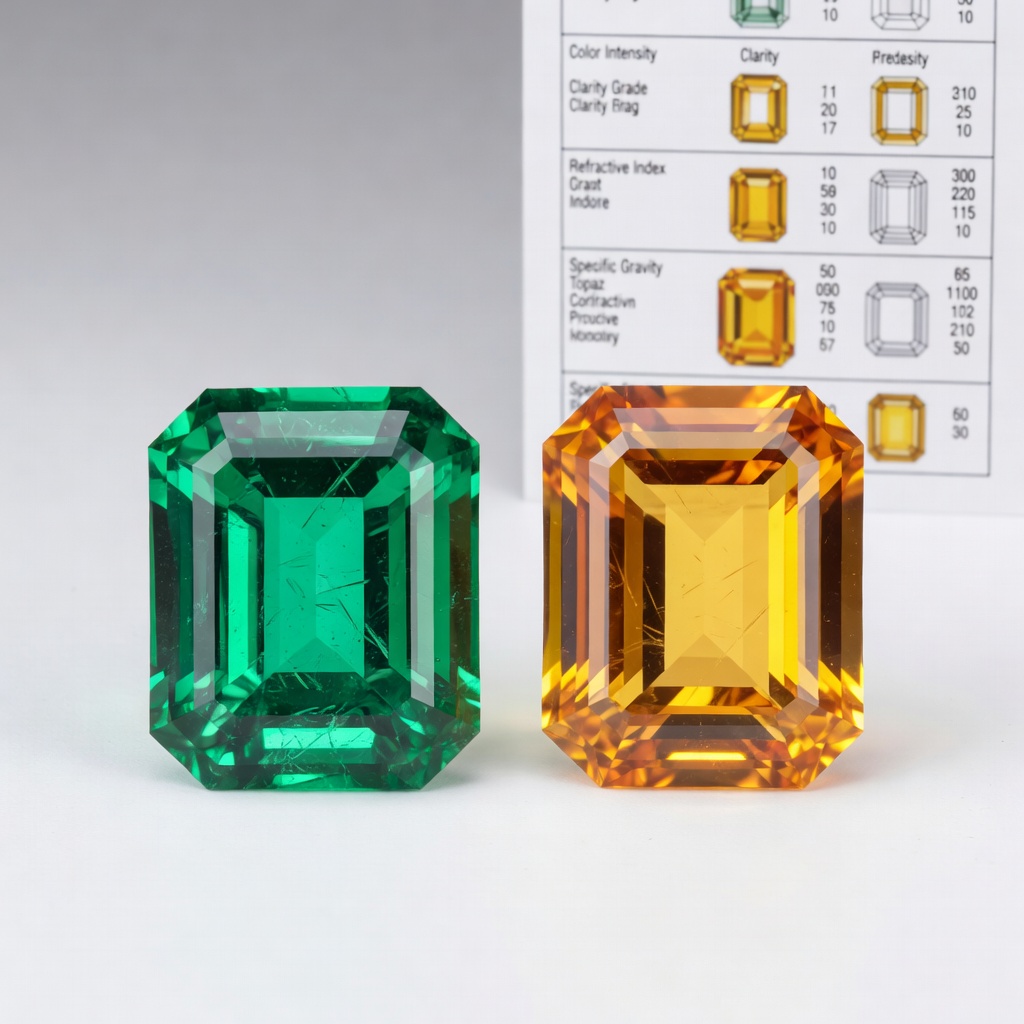
The visual distinction between these gemstones begins with their fundamentally different chromatic chemistry and optical behaviors that create immediately recognizable appearances. Emerald's coveted green spans from bluish-green to pure grass-green, with the most valuable stones exhibiting vivid saturation and medium tone without appearing too dark or yellowish, a color profile largely determined by the specific ratio of chromium to vanadium present during crystallization in beryllium-rich geological environments. Imperial Topaz presents a unique color spectrum ranging from deep sherry-orange to delicate pinkish-orange, sometimes displaying salmon or peach undertones, resulting from natural irradiation processes that create color centers within the crystal lattice over millions of years of geological time. When evaluating imperial topaz value through professional topaz color grading systems, gemologists prioritize stones showing strong saturation without brownish secondary tones or grayish modifiers, whereas emerald valuation focuses on the intensity and purity of the green hue under various lighting conditions including daylight equivalent and incandescent sources.
Unlike emerald, which maintains relatively consistent color under different light sources due to its chromium-based coloring, high-quality imperial topaz displays distinct pleochroism, showing different colors—often orange, yellow, or pink—when viewed from different crystallographic angles, a characteristic that master cutters must carefully manage to maximize face-up color while minimizing undesirable zoning that can reduce the stone's commercial appeal. Practical examination tips include viewing stones under daylight-equivalent lighting to assess true body color, rotating imperial topaz specimens to observe pleochroic effects that confirm natural origin, and avoiding emeralds that appear blackish or excessively dark in indoor lighting, as these indicate poor transparency that significantly reduces value regardless of saturation levels.
Hardness & Durability for Daily Wear
Durability considerations reveal critical differences that impact how these gemstones perform in various jewelry settings despite their similar positions on the Mohs hardness scale, requiring careful assessment beyond simple numerical ratings. Emerald registers between 7.5 and 8 on the Mohs scale, while Imperial Topaz achieves a solid 8 rating, placing both in the realm of relatively hard gemstones suitable for jewelry, though neither approaches the durability of sapphire or diamond for high-impact daily wear scenarios. However, gemstone hardness comparison alone fails to tell the complete story of wearability, as emerald gemstone properties include notorious brittleness resulting from internal stress fractures and characteristic jardin inclusions that create structural weakness throughout the crystal matrix, making them susceptible to chipping and cracking under normal wear conditions. Imperial Topaz, despite its superior hardness rating, possesses perfect cleavage in one direction, meaning a sharp impact against a hard surface can cause the stone to split cleanly along specific atomic planes, creating vulnerability that requires protective mounting considerations and cautious wearing habits.
For daily wear applications, neither stone ideally suits high-impact positions in rings or bracelets without significant protective measures; instead, both perform excellently in pendants and earrings where they avoid direct blows and mechanical stresses. Case studies from jewelry repair specialists indicate that emerald rings require professional attention three to four times more frequently than sapphire or ruby rings due to surface-reaching fracture propagation, while imperial topaz rings show catastrophic cleavage failures when subjected to sharp impacts against granite countertops or metal door handles. Practical recommendations suggest choosing protective bezel or halo settings that shield the girdle edges for both stones, removing jewelry during household chores, exercise, and manual labor, and scheduling annual inspections with qualified jewelers to check for loose prongs or developing fractures before they result in stone loss.
Clarity Characteristics & Enhancement Treatments
Examining internal characteristics and enhancement practices reveals why transparency standards differ dramatically between these two varieties and why disclosure requirements remain essential for ethical trading. Emeralds virtually always contain jardin, a French term describing the mossy, garden-like inclusions consisting of fluid-filled cavities, fractures, and crystal growth patterns that serve as fingerprints of natural origin, with completely clean emeralds so rare that suspicion of synthetic manufacture or extensive oiling immediately arises when inclusions appear absent under ten-power magnification. Standard emerald clarity treatments include traditional oiling with cedar oil or modern resin filling techniques that reduce the visibility of surface-reaching fractures, practices so ubiquitous in the trade that untreated emeralds command significant premiums of thirty to fifty percent and require specific disclosure under FTC guidelines and GIA certification protocols to maintain market transparency. Imperial Topaz typically presents exceptional clarity with few visible inclusions, a characteristic that enhances its brilliance and fire, though buyers must remain vigilant regarding irradiation treatments used to enhance or create color in lower-grade material, with natural-color specimens from Brazil's Ouro Preto mines commanding substantially higher prices than treated stones or material heated from pale yellow rough.
Detection methods for treatments include examining emeralds under dark-field illumination to reveal filled fractures showing flash effects or different luster than the surrounding crystal, while untreated stones show natural jardin without artificial filling substances. For imperial topaz, gemological laboratories use spectroscopic analysis to distinguish between natural radiation-induced color centers and artificial irradiation treatments, with GIA certification providing essential verification of natural origin. When distinguishing precious vs semi-precious stones in contemporary markets, these treatment disclosures become crucial, as untreated Colombian emeralds and naturally colored Imperial Topaz represent genuine rarities that justify their classification alongside ruby and sapphire in the pantheon of elite colored gemstones, while heavily treated specimens fall into more accessible commercial categories despite their beauty.
Value & Pricing: What Your Budget Buys
Market pricing structures reflect the dramatic disparity in rarity, demand, and historical prestige between these two beautiful but differently valued gemstones across various quality tiers. Fine emeralds, particularly those exhibiting vivid color with minimal treatment, typically command between $1,000 and $15,000 per carat, with exceptional untreated Colombian stones occasionally exceeding $50,000 per carat at international auction, establishing them among the most valuable colored gemstones available to collectors and investors. Imperial topaz value remains more accessible to serious collectors, with commercial-quality specimens ranging from $100 to $500 per carat and top-tier natural-color stones from renowned Brazilian localities reaching $800 to $1,000 per carat, though prices rarely approach emerald levels due to limited collector market depth, lower overall brand recognition, and historically recent entry into high jewelry compared to emerald's ancient pedigree. Origin premiums significantly influence pricing structures, with Colombian emeralds, particularly those from the Muzo and Chivor mines, commanding substantial premiums over Zambian or Ethiopian material due to historical cachet and specific color profiles, while Imperial Topaz derives its entire value premium from specific Brazilian localities, particularly Ouro Preto, where unique geological conditions create characteristic sherry-orange hues impossible to replicate elsewhere in the world.
When developing a gemstone investment guide strategy, collectors should note that emerald prices escalate exponentially with size, particularly for stones exceeding three carats with fine color and minimal treatment, whereas Imperial Topaz maintains more linear pricing curves, making larger specimens relatively more accessible though potentially less liquid in secondary markets due to narrower collector interest and less established auction track records. Practical budgeting examples indicate that $5,000 might acquire a one-carat fine Colombian emerald with minor oiling or a five-carat exceptional Imperial Topaz with natural color, presenting distinct choices between intense color rarity in a smaller package versus impressive size and unique hue in the topaz option.
Origins, Rarity & Market Availability
Geological origins and production volumes ultimately determine the scarcity profiles that drive long-term value appreciation and ethical sourcing considerations for both varieties in modern markets. Primary emerald sources include Colombia's famous Muzo and Chivor mines, Zambia's Kagem deposits, Brazil's Belmont mine, and newer Ethiopian production from the Shakiso region, each locality producing distinct color profiles and clarity characteristics based on specific host rock compositions and formation conditions involving beryllium-rich pegmatites interacting with chromium-bearing host rocks under hydrothermal conditions. True Imperial Topaz exhibits extreme geographical exclusivity, with gem-quality specimens displaying the characteristic orange-pink coloration occurring only in the Ouro Preto region of Minas Gerais, Brazil, specifically within the Vermelhao and Capao do Lana mines, making it one of the most geographically restricted gem varieties in commercial trade and explaining its designation as "imperial" reflecting both its color and its association with Brazilian imperial history. Annual production figures reveal that fine emeralds, particularly untreated stones over two carats with vivid color, remain significantly rarer than Imperial Topaz in absolute terms, though the latter's restricted single-source supply creates vulnerability to production disruptions that could theoretically drive future price increases if mining difficulties escalate or deposits deplete faster than new discoveries.
Ethical sourcing considerations increasingly influence November birthstone alternatives and precious stone purchasing decisions, with both gemstones now subject to traceability initiatives and responsible mining certifications. Colombian emerald mining presents complex social and environmental challenges including informal mining operations and landscape disruption, though major producers like Muzo Emerald Company have implemented comprehensive sustainability programs, while Imperial Topaz mining typically involves smaller-scale, artisanal operations in Brazil where many maintain fair-trade certifications and community-supported extraction practices that provide stable employment in the Ouro Preto region. Buyers seeking ethical assurance should request documentation from suppliers participating in the Responsible Jewellery Council or similar organizations, ensuring their acquisition supports sustainable practices regardless of which gemstone they ultimately select.
Jewelry Applications & Design Considerations
Successful jewelry design requires accommodating the distinct physical limitations and optical properties of each gemstone through strategic setting choices, cut selection, and metal pairing that maximize beauty while minimizing damage risk. Given emerald gemstone properties that include brittleness and fracture susceptibility, these stones perform best in protective settings such as bezels or halo designs that shield girdle edges from impact, while Imperial Topaz, despite its cleavage vulnerability, tolerates prong settings provided the wearer avoids activities risking sharp blows to the stone's table or crown facets. Cut selection significantly impacts both durability and beauty, with emeralds traditionally receiving the step-cut "emerald cut" that minimizes pressure during cutting while maximizing color display and weight retention, whereas Imperial Topaz often features mixed cuts or modified brilliant cuts that maximize light return and fire, taking advantage of the material's typically high clarity and strong pleochroism to create lively, scintillating appearances. Metal pairing recommendations follow color theory and protection needs, with yellow gold enhancing the warm sherry tones of Imperial Topaz while providing a durable, malleable setting that absorbs impact energy, and platinum or white gold complementing emerald's cool green tones while offering superior strength for the protective settings necessary to safeguard these more fragile stones from daily wear stresses.
For imperial topaz value optimization in finished jewelry, designers often favor pendant and earring designs that showcase the stone's impressive size and distinctive color while avoiding the mechanical stresses inherent in bracelet and ring applications, though protective bezel-set rings remain viable for careful wearers seeking to display these rare orange gems in more visible positions. Case studies from high jewelry houses demonstrate that emerald necklaces and brooches from the Art Deco period frequently survive in pristine condition ninety years later due to protected placement, while period emerald rings often show significant abrasion and chipping, reinforcing the importance of matching stone selection to intended use and lifestyle factors.
Investment Potential & Collectibility
Long-term value retention and appreciation potential differ significantly between these stones, requiring distinct investment approaches, holding period expectations, and liquidity management strategies for serious collectors. Historical data from major auction houses including Christie's and Sotheby's demonstrates that fine untreated Colombian emeralds have appreciated approximately five to eight percent annually over the past two decades, with exceptional stones showing double-digit growth during periods of strong Asian market demand, establishing them as legitimate alternative assets within diversified portfolios alongside fine art and rare wines. Imperial Topaz, while objectively rare, demonstrates less price transparency and market liquidity, with auction appearances relatively infrequent compared to emeralds, though high-quality untreated specimens from documented Ouro Preto origins have shown steady appreciation in specialized collector circles focused on rare gem varieties, particularly for stones exceeding ten carats with strong orange-pink coloration. Collector market demand increasingly emphasizes untreated stones for both varieties, with GIA-certified untreated emeralds and naturally colored Imperial Topaz commanding premiums of thirty to fifty percent over treated material, a trend driven by sophisticated buyers seeking gemstones whose value derives entirely from natural geological processes rather than artificial enhancement or modification.
When considering precious vs semi-precious stones for investment purposes, liquidity challenges clearly favor emeralds, which benefit from established international dealer networks, consistent auction demand across multiple global centers, and recognized grading standards that facilitate resale, whereas Imperial Topaz requires longer holding periods and specialized marketing to realize full value, making it more suitable for passionate collectors with specific interest in rare topaz varieties than for pure financial speculators seeking quick turnover. Storage considerations also differ, with emeralds requiring periodic professional cleaning and oiling maintenance to preserve appearance, while Imperial Topaz remains chemically stable but requires protection from sudden temperature changes that might stress cleavage planes, factors that influence insurance costs and long-term ownership logistics for investment-grade specimens.
Symbolic Meaning & Metaphysical Properties
Cultural significance and metaphysical associations add intangible value dimensions that influence gifting decisions, personal collection development, and emotional connections beyond purely aesthetic or financial considerations. Emerald carries profound symbolic weight as the traditional birthstone for May and the zodiac stone for Cancer, historically associated with Venus, the goddess of love, representing rebirth, wisdom, foresight, and eternal youth across ancient Egyptian, Incan, and European royal traditions, making it an ideal gift for significant anniversaries, particularly the twentieth and thirty-fifth wedding milestones, and spiritual practices focused on heart chakra healing. Imperial Topaz serves as one of the primary November birthstone alternatives alongside citrine, specifically associated with Sagittarius and Scorpio in different astrological traditions, and carries metaphysical properties related to confidence, manifestation, personal willpower, and abundance attraction, with its warm solar energy believed to counteract depression, enhance creativity, and promote generosity of spirit in modern crystal healing practices. Cultural significance varies by civilization, with emeralds holding particular spiritual importance in Colombian indigenous cultures where they were considered sacred gifts from the gods and used in religious ceremonies, while Imperial Topaz featured prominently in Russian imperial regalia and Brazilian colonial jewelry, representing the intersection of European aristocratic taste and New World mineral wealth during the eighteenth and nineteenth centuries.
Modern gifting occasions favor emeralds for significant life transitions such as graduations, births, or major career achievements, symbolizing growth, renewal, and new beginnings, while Imperial Topaz suits occasions requiring confidence, creativity, and personal power, such as job promotions, artistic debuts, or entrepreneurial ventures, offering a distinctive alternative to more common November birthstone choices like citrine or yellow sapphire. Practical gift-giving tips include presenting emeralds in contexts emphasizing eternal love or wisdom, such as milestone anniversaries or retirement celebrations, while Imperial Topaz makes an excellent "push present" for November births or congratulatory gifts for creative professionals seeking inspiration and self-assurance in their work.
Final Verdict: Which Gemstone Should You Choose?
Selecting between these magnificent gemstones ultimately requires balancing practical considerations against personal aesthetic preferences, lifestyle factors, and intended use cases to ensure lasting satisfaction with your acquisition. When evaluating Emerald vs Imperial Topaz for acquisition, create a decision matrix weighing your budget constraints against durability requirements and color preferences, recognizing that emeralds suit those seeking heritage pieces with established investment potential who can accommodate necessary maintenance and protective settings, while Imperial Topaz appeals to collectors desiring unique statement jewelry with distinctive coloration at more accessible price points without sacrificing rarity or natural beauty. Best use cases clearly differentiate these stones: choose emerald for engagement rings only if selecting protective bezel settings and accepting the need for periodic professional re-oiling or maintenance, whereas Imperial Topaz works beautifully for cocktail rings, pendants, and earrings where its remarkable color receives admiration without sustaining the daily mechanical stresses that threaten its cleavage planes or the constant wear that degrades emerald clarity over time.
Red flags demanding immediate avoidance include emeralds showing obvious surface-reaching fractures without treatment disclosure, stones appearing too clean without certification suggesting possible synthesis or glass filling, and Imperial Topaz priced suspiciously low indicating potential citrine substitution, heated amethyst, or undisclosed irradiation treatments that artificially create color. Your expert buying checklist should insist upon GIA or AGS certification verifying natural origin and treatment status for any significant purchase, examination of stones under various lighting conditions including daylight equivalent and incandescent sources to assess color stability and pleochroism, and purchase from dealers offering robust return policies, lifetime trade-up options, and complete transparency regarding mining origins and ethical sourcing practices. By applying these gemstone investment guide principles and understanding the unique properties of each stone, you will secure a treasure that provides lasting beauty, personal significance, and appropriate value retention for your specific collecting goals and wearing requirements.
Emerald vs Imperial Topaz: Detailed Comparison
| Characteristic | Emerald | Imperial Topaz |
|---|---|---|
| Chemical Composition | Beryllium aluminum silicate (Be₃Al₂Si₆O₁₈) | Aluminum silicate fluoride hydroxide (Al₂SiO₄(F,OH)₂) |
| Mohs Hardness | 7.5 - 8 | 8 |
| Primary Color Range | Bluish-green to pure green | Sherry-orange to pinkish-orange |
| Color Cause | Chromium and Vanadium traces | Natural irradiation creating color centers |
| Typical Clarity | Included (Jardin inclusions common) | Eye-clean to slightly included |
| Common Treatments | Oiling, resin filling (standard) | Heat treatment (occasional) |
| Price per Carat (Fine Quality) | $5,000 - $15,000+ | $200 - $1,000 |
| Primary Sources | Colombia, Zambia, Brazil, Ethiopia | Brazil (Ouro Preto region exclusively) |
| Best Jewelry Applications | Pendants, earrings, protected rings | Pendants, earrings, occasional rings |
| Investment Liquidity | High (established auction market) | Moderate (specialized collector market) |
| Durability Concerns | Brittleness, surface-reaching fractures | Perfect cleavage, impact sensitivity |
| Birthstone Significance | May birthstone | November birthstone (primary) |
Frequently Asked Questions
Which is more valuable: emerald or imperial topaz?
Fine quality emeralds are significantly more valuable, often commanding $5,000-$15,000+ per carat, while top-quality imperial topaz ranges from $200-$1,000 per carat. Colombian emeralds with minimal treatment are particularly prized, whereas imperial topaz, despite being rare, remains more accessible to collectors.
Can imperial topaz be worn daily in an engagement ring?
Imperial topaz's 8 Mohs hardness is suitable for daily wear, but its perfect cleavage makes it vulnerable to sharp impacts. Protective settings like bezels or halos are essential. Emeralds are less suitable for daily rings due to brittleness; both require more care than sapphire or diamond.
Are all imperial topaz stones treated with radiation?
Naturally colored imperial topaz from Brazil's Ouro Preto region forms through natural irradiation over millions of years. However, some commercial 'imperial' topaz is heat-treated from yellow material. Reputable dealers disclose treatments, and GIA certification verifies natural origin.
What causes emerald's green color versus imperial topaz's orange?
Emerald's green comes from trace chromium and/or vanadium replacing aluminum in the beryl crystal structure. Imperial topaz's distinctive orange-pink hue results from natural radiation displacing atoms in the crystal lattice, creating color centers that produce the sherry-orange shades.
Which stone holds its value better over time?
Fine, untreated Colombian emeralds have historically appreciated 5-8% annually and perform well at auction. Imperial topaz, while rare, has a smaller collector market and less price transparency. For investment, high-grade emeralds demonstrate superior long-term value retention.
How can I identify a fake emerald or imperial topaz?
Common emerald simulants include green glass and synthetic spinel; look for natural jardin inclusions under magnification. Imperial topaz fakes are often citrine or heated amethyst; true imperial topaz shows pleochroism (color change when rotated). Always purchase with GIA or AGS certification.
Is imperial topaz a good alternative to citrine for November birthdays?
Absolutely. Imperial topaz is the traditional November birthstone, offering far greater rarity, brilliance, and durability than common citrine. Its warm orange-pink tones provide a luxurious, distinctive option that stands out from mass-market birthstone jewelry while maintaining astrological significance.