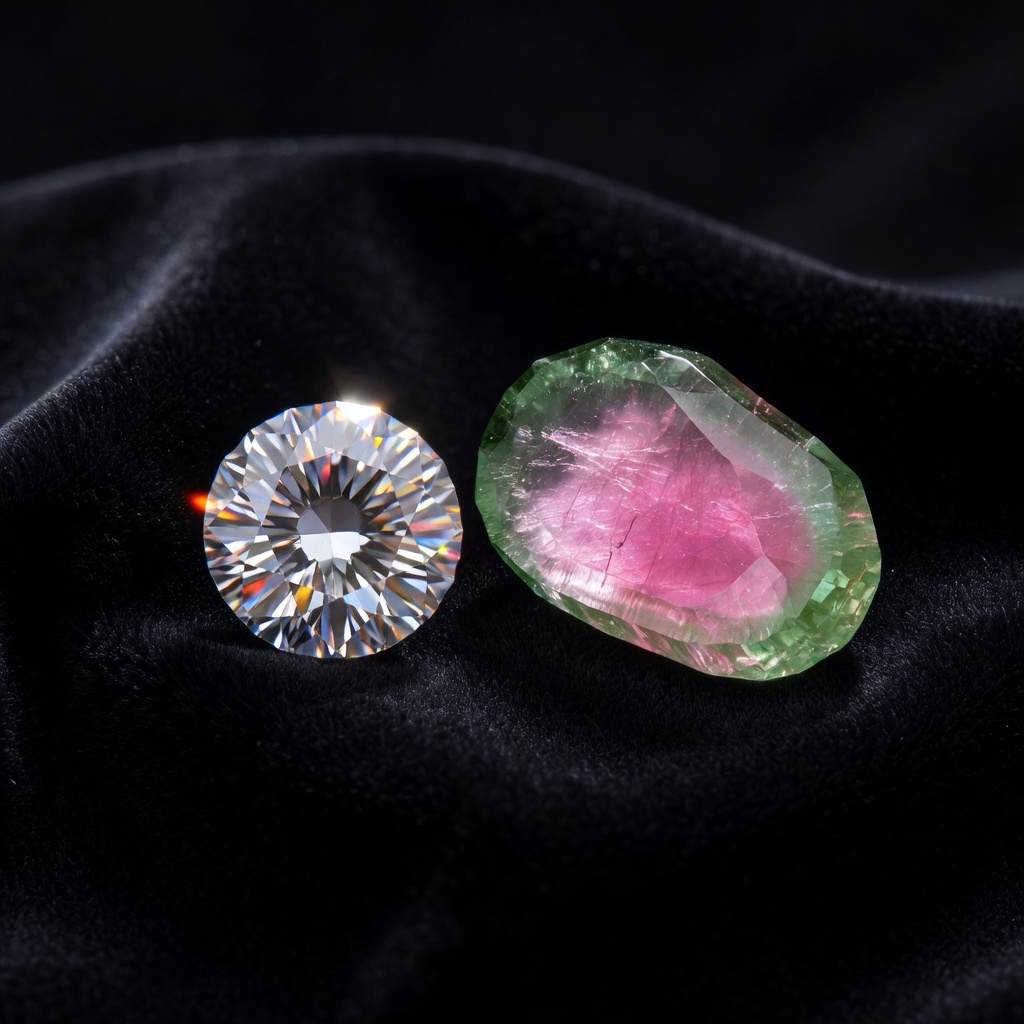
Understanding Diamond vs Watermelon Tourmaline
When selecting a centerpiece gemstone for fine jewelry, discerning collectors increasingly find themselves weighing the timeless prestige of diamonds against the captivating artistry of watermelon tourmaline. While diamonds have dominated the luxury market for centuries as the standard for engagement rings and investment pieces, watermelon tourmaline offers a compelling alternative for those seeking something genuinely unique in the Diamond vs Watermelon Tourmaline debate. These two gemstones represent fundamentally different approaches to beauty: one offering unmatched brilliance and durability, the other presenting nature's own abstract art through dramatic color zoning. Modern jewelry buyers, particularly millennials and Gen Z consumers, are driving demand for personalized pieces that reflect individual style rather than traditional expectations, making this comparison more relevant than ever in today's diverse marketplace.
The distinction between these stones extends far beyond mere aesthetics into practical considerations of daily wear, long-term value, and symbolic meaning. Diamonds command attention through their fiery dispersion and geometric precision, while watermelon tourmaline draws the eye with its organic, gradient transitions from deep pink cores to verdant green rims. Understanding these differences requires examining not just surface appearance but geological formation, structural integrity, and how each stone interacts with light and setting materials. Whether you are commissioning a custom engagement ring or adding to a curated jewelry collection, recognizing the distinct personalities of these gemstones ensures your selection aligns with both your lifestyle and aesthetic values.
Physical Properties and Durability Comparison
Mohs Hardness and Daily Wear Resistance
The most significant practical difference when evaluating Diamond durability Mohs scale ratings versus watermelon tourmaline lies in their fundamental mineral composition and resistance to scratching. Diamonds score a perfect 10 on the Mohs hardness scale, making them the hardest known natural material capable of scratching any other substance while remaining virtually impervious to damage from daily contact. Conversely, tourmaline hardness registers between 7 and 7.5, positioning it softer than sapphires and rubies but harder than quartz, meaning it can withstand normal wear but will eventually show abrasions from decades of contact with harder materials like dust particles containing silica.
For active individuals or those in hands-on professions, this hardness differential translates to markedly different maintenance schedules and longevity expectations. A diamond engagement ring worn daily for fifty years might require only occasional cleaning to maintain its pristine facet edges, whereas a watermelon tourmaline subjected to the same treatment would likely develop a network of microscopic scratches on its table surface, gradually diminishing its luster. However, hardness alone does not tell the complete durability story, as the toughness—the resistance to breaking and chipping—varies significantly based on each stone's crystalline structure and natural inclusions.
Structural Integrity and Cleavage Concerns
Despite their supreme hardness, diamonds possess perfect cleavage in four directions, meaning they can split cleanly along specific crystallographic planes if struck with sufficient force at the correct angle. This characteristic makes them vulnerable to damage from sharp impacts against hard surfaces, particularly along the girdle edge where many setting styles leave the stone exposed. Professional jewelers often encounter diamonds that have chipped or cleaved during normal activities like closing car doors or carrying groceries, incidents that require costly recutting or replacement.
Watermelon tourmaline, belonging to the elbaite variety, exhibits conchoidal fracture patterns rather than cleavage, meaning it breaks with curved, shell-like surfaces rather than clean splits. While this makes tourmaline less likely to suffer catastrophic cleavage failures, its moderate hardness renders it more susceptible to gradual wear and facet junction rounding over time. The bi-color nature of watermelon tourmaline can also mask internal fractures that might compromise structural integrity, requiring careful examination under magnification before setting. For heirloom jewelry intended to last multiple generations, these durability factors suggest diamonds maintain structural superiority, though protective settings can significantly mitigate tourmaline's vulnerabilities.
Color Characteristics and Visual Appeal
Diamond Color Grading and Light Performance
The bi-color gemstone comparison between diamonds and watermelon tourmaline begins with understanding how each stone produces its visual impact through entirely different optical mechanisms. Diamonds are graded on the D-Z color scale, with D representing completely colorless stones that allow maximum light transmission and Z indicating light yellow or brown tints. Fancy colored diamonds exist outside this scale in vivid blues, pinks, and yellows, but these command extreme premiums and represent a tiny fraction of the market. The typical diamond's beauty derives primarily from its refractive index of 2.42 and dispersion rate of 0.044, creating the characteristic fire and brilliance that results from light being split into spectral colors and reflected back to the eye with maximum efficiency.
Professional lighting design in jewelry showcases demonstrates how diamonds perform optimally under controlled spot lighting that emphasizes their scintillation, whereas natural daylight reveals their true body color and clarity characteristics. When selecting a diamond, buyers must balance color grade against cut quality, as a well-cut J-color diamond may appear whiter than a poorly cut F-color stone due to superior light return. This technical precision in diamond grading contrasts sharply with the organic, variable nature of watermelon tourmaline evaluation, where color distribution rather than absence of color determines value.
Watermelon Tourmaline's Distinctive Bi-Color Zoning
Watermelon tourmaline meaning in gemological terms refers specifically to elbaite tourmaline displaying concentric zoning with pink to red cores surrounded by green outer rims, visually resembling the cross-section of the fruit that gives it its name. This phenomenon occurs due to changing chemical conditions during crystal formation: manganese concentrates in the center creating pink hues, while iron and chromium dominate the outer growth zones producing green colors. Unlike treated or assembled doublet stones, natural watermelon tourmaline displays gradual transitions between colors rather than sharp boundaries, with the most valuable specimens showing vivid, saturated tones in both zones with clear delineation.
The optical phenomenon of pleochroism adds another dimension to watermelon tourmaline's visual complexity, as the stone displays different colors when viewed from different crystallographic directions. A skilled lapidary must orient the rough crystal carefully to ensure both pink and green zones appear simultaneously when the stone is face-up, maximizing the characteristic bi-color effect. This stands in stark contrast to diamond's isometric crystal system, which appears identical from all angles and relies solely on cut precision for its visual impact. While diamonds offer consistency and predictability, watermelon tourmaline provides a canvas of natural artistry where no two stones ever display identical color patterns, appealing to collectors who value uniqueness over uniformity.
Rarity, Sourcing, and Ethical Considerations
Geographic Origins and Formation Processes
The geological journeys that create these gemstones differ as dramatically as their appearances, with diamonds forming under extreme pressure 90-150 miles beneath Earth's crust in kimberlite and lamproite pipes, while watermelon tourmaline crystallizes in lithium-rich pegmatites much closer to the surface. Primary diamond production concentrates in Botswana, Russia, Canada, and Australia, with these nations controlling approximately 75% of global rough diamond output through large-scale industrial mining operations. Watermelon tourmaline sources remain more dispersed and artisanal, with significant deposits in Brazil's Minas Gerais region, Nigeria's Oyo State, and Madagascar's Sahatany Valley, where small-scale miners often extract crystals by hand from weathered pegmatite outcrops.
Formation conditions explain why large, inclusion-free diamonds remain exceptionally rare compared to tourmaline specimens. Diamonds require billion-year residence times in the mantle before volcanic eruptions rapidly transport them to the surface, preserving their high-pressure crystal structure. Watermelon tourmaline forms through hydrothermal processes in cooling granite melts, allowing for larger crystal sizes—some exceeding 50 carats in finished gems—but often incorporating fluid inclusions and growth tubes that affect clarity. This difference in formation chemistry means that while flawless diamonds command astronomical prices, collectors of watermelon tourmaline often accept minor inclusions as evidence of natural origin and acceptable trade-offs for remarkable coloration.
Ethical Sourcing and Environmental Impact
The Kimberley Process Certification Scheme, established in 2003, addresses conflict diamond concerns by requiring documentation proving rough diamonds fund neither rebel movements nor civil wars, though critics note loopholes regarding human rights abuses and environmental destruction in sanctioned government mining. Canadian diamonds with provenance certificates from the Northwest Territories offer the most transparent ethical alternative, featuring laser-inscribed polar bear or maple leaf logos tracing stones from mine to market. These ethical premiums typically add 10-15% to base diamond prices but provide peace of mind for socially conscious consumers.
Watermelon tourmaline mining generally occurs through smaller-scale operations with less mechanized environmental disruption, though artisanal mining presents its own challenges regarding fair wages and safety standards. Brazilian pegmatite mining often involves family-run operations using hand tools rather than heavy machinery, resulting in smaller carbon footprints but less regulatory oversight. Both gemstones require energy-intensive cutting and polishing processes, typically concentrated in India, Thailand, and China, where labor practices vary significantly between facilities. Responsible buyers should request chain-of-custody documentation regardless of stone type, as ethical considerations now influence purchasing decisions across the entire gemstone spectrum.
Pricing Analysis and Investment Potential
Market Valuation and Price Per Carat Analysis
Understanding Diamond clarity and color grades proves essential for navigating the vast price differentials in the diamond market, where a one-carat D-flawless round brilliant might retail for $20,000 while a similar-sized I1-J color stone sells for $3,000. The standardized grading system creates liquid markets where diamonds function as near-currency, easily resold through established dealer networks and auction houses. Tourmaline investment value operates differently, with pricing based primarily on color saturation, zoning clarity, and size, typically ranging from $200 per carat for commercial quality to $3,000 per carat for museum-grade specimens with vivid, well-separated colors.
The following comparison table illustrates key differentiators between these gemstones across multiple value factors:
| Characteristic | Diamond | Watermelon Tourmaline |
|---|---|---|
| Mohs Hardness | 10 (Highest) | 7-7.5 (Moderate) |
| Price Per Carat (High Quality) | $5,000-$50,000+ | $500-$3,000 |
| Color Source | Crystal lattice impurities or structural defects | Manganese (pink) and Iron/Chromium (green) |
| Rarity Factor | Controlled supply, high demand | Limited deposits, collector-driven |
| Brilliance (Refractive Index) | 2.42 (Very High) | 1.62-1.64 (Moderate) |
| Investment Liquidity | High (Global standardized market) | Low (Niche collector market) |
| Enhancement Commonality | Occasionally laser-drilled or fracture-filled | Rarely heat-treated; dyeing is concern |
| Optical Phenomena | Fire and Scintillation | Pleochroism and Color Zoning |
Long-Term Investment Considerations
Diamonds historically maintained value stability due to De Beers' historical supply control and massive marketing investments establishing cultural norms around diamond engagement rings. However, laboratory-grown diamonds now disrupt traditional pricing models, causing natural diamond resale values to soften in certain categories, particularly smaller commercial qualities. Investment-grade diamonds—those exceeding two carats with D-F color and IF-VVS clarity—continue appreciating at 3-5% annually, outperforming inflation while providing portable wealth concentration.
Watermelon tourmaline presents a speculative investment profile with higher volatility but potential for significant appreciation among rare specimens. The closure of historic mines, particularly in California's Pala District where American watermelon tourmaline was first discovered, has created scarcity for vintage material. Unlike diamonds, tourmaline lacks standardized grading, making valuation subjective and dependent on expert opinion. For investors, diamonds offer stability and liquidity, while watermelon tourmaline suits collectors with high risk tolerance and appreciation for geological art, particularly those acquiring exceptional crystals with documented provenance from depleted mines.
Jewelry Design Applications and Setting Recommendations
Protective Settings for Watermelon Tourmaline
Given watermelon tourmaline's moderate hardness, gemstone engagement rings featuring this material require thoughtful protective settings that minimize exposure to impact while maximizing color display. Bezel settings, where metal completely encircles the stone's girdle, provide optimal protection against chips and scratches while creating a modern, architectural aesthetic that complements tourmaline's organic color patterns. Halo designs featuring diamond accents not only protect the tourmaline's vulnerable edges but also create dramatic contrast, making the central stone's pink and green zoning appear more vivid by comparison.
Prong settings, while maximizing light entry and color visibility, expose watermelon tourmaline to greater damage risk and should be reserved for occasional wear pieces rather than daily-wear engagement rings. When selecting prong styles, six-prong configurations distribute pressure more evenly than four-prong settings, reducing stress concentrations that might exacerbate natural inclusions. Metal selection significantly impacts appearance: rose gold enhances the pink core of watermelon tourmaline through color harmonization, while yellow gold complements the green outer rim. White metals provide neutral backgrounds that allow the stone's natural colors to dominate without temperature bias.
Versatile Designs for Diamond Brilliance
Diamonds accommodate virtually any setting style due to their hardness, allowing designers to prioritize optical performance through open prong settings, tension mounts, or delicate pavé work impossible with softer gemstones. The classic Tiffany six-prong setting elevates the stone to maximize light return from all angles, while channel settings protect side stones in wedding bands. For colored diamonds or fancy shapes, designers often employ intricate gallery work under the stone to add structural interest without compromising brilliance.
Case studies from bespoke jewelry houses demonstrate successful integration of both gemstones in single pieces, such as cocktail rings featuring watermelon tourmaline centers surrounded by diamond halos, combining protection with prestige. One notable design from a New York atelier featured a 4-carat watermelon tourmaline in a Art Deco-inspired bezel setting with calibre-cut emeralds matching the tourmaline's outer rim, creating a cohesive color story while protecting the softer center stone. Such designs illustrate how understanding material properties enables creative solutions that honor both gemstones' unique characteristics.
Symbolism, Meaning, and Metaphysical Properties
Diamond Symbolism and Cultural Significance
Throughout history, diamonds have symbolized invincibility and eternal love, deriving their name from the Greek "adamas" meaning unconquerable. Ancient Romans believed diamonds were splinters of fallen stars, while Hindu traditions associated them with the planet Venus and divine lightning bolts. This mythology translated into modern Western culture through De Beers' 1947 "A Diamond Is Forever" campaign, cementing the association between diamond engagement rings and marital permanence. Beyond romantic contexts, diamonds represent clarity of purpose, strength of character, and the ability to refract complex situations into understandable components—metaphors drawn directly from the stone's optical properties.
In esoteric traditions, clear diamonds activate the crown chakra, facilitating connection to higher consciousness and spiritual truth. Fancy colored diamonds carry additional associations: yellow stones link to solar plexus energy and personal power, while blue diamonds align with throat chakra communication and angelic realms. These attributions make diamonds popular among business leaders seeking stones that symbolize unbreakable resolve and transparent dealing, regardless of whether the wearer subscribes to crystal healing philosophies or simply appreciates the psychological boost of wearing symbols of permanence.
Watermelon Tourmaline Healing Properties
The watermelon tourmaline meaning in crystal healing circles centers on heart chakra activation and emotional integration, with the pink core representing love and compassion while the green outer layer symbolizes vitality and physical healing. Practitioners believe this bi-color configuration creates a super-positioned energy field that simultaneously addresses emotional and physical heart health, making it particularly sought after by those recovering from grief or trauma. Unlike the singular, focused energy attributed to diamonds, watermelon tourmaline is described as having a gentler, nurturing vibration that encourages self-love and the release of emotional patterns stored in the heart center.
Metaphysical practitioners often recommend placing watermelon tourmaline over the heart during meditation to facilitate the integration of opposing forces—masculine and feminine energies, logic and intuition, giving and receiving. Some crystal therapists use elongated watermelon tourmaline crystals as wands for energy work, directing the pointed end to draw out negative energy while the pink base infuses the area with loving vibrations. While these properties lack scientific validation, the psychological comfort and intention-setting aspects of working with watermelon tourmaline contribute to its popularity among wellness-focused consumers seeking jewelry with deeper personal significance than mere adornment.
Maintenance Requirements and Care Instructions
Proper maintenance protocols differ significantly between these gemstones due to their hardness and chemical sensitivities. Diamonds tolerate ultrasonic cleaning and steam treatment, methods that effectively remove accumulated oils and dirt from behind stones where brushes cannot reach. However, these aggressive cleaning methods risk damaging watermelon tourmaline, which may contain liquid-filled inclusions that expand under heat or vibrations that worsen existing fractures. Instead, watermelon tourmaline requires gentle cleaning using warm water, mild dish soap, and soft brushes, followed by immediate drying with lint-free cloths to prevent water spots.
Storage practices also vary: diamonds can be stored together without risk of mutual scratching, though they will scratch any softer gemstones stored alongside them. Watermelon tourmaline demands separate storage in soft pouches or individual compartments to prevent contact with harder jewelry pieces. Both stones should avoid exposure to harsh household chemicals, particularly chlorine and hydrofluoric acid, which can etch tourmaline's surface and damage metal settings. Professional inspections every six months help identify loose prongs on diamond settings or developing chips in tourmaline before catastrophic loss occurs.
Decision Framework: Which Gemstone Is Right for You?
Selecting between these gemstones requires honest assessment of lifestyle factors, aesthetic preferences, and long-term expectations. Active individuals who work with their hands, engage in sports, or lead bustling daily lives should prioritize diamonds for engagement rings or daily-wear pieces, as the Diamond durability Mohs scale rating ensures decades of wear without degradation. Those with sedentary professions or who view jewelry as special-occasion adornment may find watermelon tourmaline perfectly suitable, particularly if they appreciate the stone's artistic coloration and don't mind occasional professional repolishing to address surface scratches.
Budget optimization strategies suggest allocating funds toward cut quality in diamonds rather than color or clarity upgrades, as brilliance masks slight color tints and inclusions. For watermelon tourmaline, prioritize color zoning over clarity, as the bi-color effect provides the primary value proposition. When consulting gemologists, request comparative viewing under different lighting conditions—daylight equivalent, incandescent, and spot lighting—to observe how each stone performs in environments matching your typical wear situations. Ultimately, the choice between diamond and watermelon tourmaline reflects a decision between timeless tradition and natural artistry, between geological endurance and chromatic expression, with neither choice being inherently superior—only more aligned with individual values and practical needs.
Frequently Asked Questions
Is watermelon tourmaline durable enough for daily wear compared to diamond?
No, watermelon tourmaline ranks 7-7.5 on the Mohs hardness scale, significantly softer than diamond's perfect 10. While suitable for jewelry, it requires protective settings like bezels and more careful handling to prevent scratches, chips, and abrasion damage during daily activities.
Which costs more per carat: high-quality diamond or premium watermelon tourmaline?
High-quality diamonds typically command $5,000-$50,000+ per carat depending on the 4Cs, while exceptional watermelon tourmalines with vivid color separation usually range $500-$3,000 per carat. However, museum-quality watermelon tourmaline crystals with perfect zoning can occasionally exceed lower-grade diamond prices.
Can I use watermelon tourmaline in an engagement ring instead of diamond?
Yes, but with important caveats. Due to moderate hardness, watermelon tourmaline is best set in protective halos or bezel settings rather than exposed prongs. It's ideal for engagement rings worn occasionally or by those with careful lifestyles, whereas diamonds better suit heavy daily wear and active lifestyles.
What creates the distinctive pink and green colors in watermelon tourmaline?
The bi-color zoning results from changing chemical conditions during crystal formation. Manganese produces the pink-to-red core, while iron and chromium create the green outer rim. This natural gradient differs fundamentally from uniformly colored gemstones or treated stones with artificial color layers.
Do diamonds or watermelon tourmalines hold their value better over time?
Diamonds generally maintain value better due to established global markets, standardized grading, and consistent demand. Watermelon tourmaline values fluctuate with collector trends and fashion cycles, making diamonds the more stable investment, though rare tourmaline specimens can appreciate significantly among niche collectors.
How can I verify if a watermelon tourmaline is natural versus treated or synthetic?
Natural watermelon tourmaline displays gradual color transitions and natural inclusions visible under magnification. Request certification from reputable laboratories like GIA, AGL, or GRS to confirm natural origin and detect any heat treatment or dyeing. Synthetic tourmaline exists but is rare; color enhancement treatments are more common concerns.
Which gemstone offers better brilliance and sparkle in jewelry settings?
Diamonds exhibit superior brilliance with a refractive index of 2.42 and high dispersion (0.044), creating intense fire and scintillation. Watermelon tourmaline has a lower refractive index (1.62-1.64) and offers subdued brilliance, but compensates with unique aesthetic appeal through color zoning and pleochroism (showing different colors when viewed from different angles).
Are there ethical concerns specific to diamond mining that don't apply to watermelon tourmaline?
Diamonds have historically faced 'conflict diamond' issues tied to funding civil wars, though Kimberley Process certification now addresses this. Watermelon tourmaline mining generally involves smaller-scale operations with fewer conflict concerns, though environmental impact and fair labor practices remain important considerations for both gemstones.