Understanding Diamond vs Unakite
When selecting the perfect gemstone for jewelry or collection, the comparison between Diamond vs Unakite represents one of the most striking contrasts in the mineral world. Diamond stands as the undisputed king of precious stones, commanding attention as the hardest natural substance known to humanity and serving as the traditional benchmark for luxury and eternal commitment. In contrast, Unakite emerges as a fascinating semi-precious alternative, offering distinctive aesthetic appeal through its unique mottled patterns of sage green and salmon pink at a fraction of the cost.
Consumers frequently evaluate these stones side by side when navigating budget constraints versus investment priorities. While Diamond appeals to those seeking heirloom-quality pieces and status symbols, Unakite attracts collectors drawn to organic beauty, metaphysical properties, and accessible price points. Understanding the fundamental differences between these gemstones enables informed decisions whether you are shopping for an engagement ring, building a crystal collection, or seeking the perfect accent piece for your personal style.
Geological Origins and Composition
The Birth of Diamonds: Carbon Under Pressure
Diamonds form through an extraordinary geological process occurring approximately 90 to 120 miles beneath Earth's surface, where carbon atoms crystallize under intense pressure exceeding 725,000 pounds per square inch and temperatures soaring above 2,000 degrees Fahrenheit. These precious stones travel to the surface through rare volcanic eruptions that create kimberlite pipes, narrow vertical columns of igneous rock that serve as the primary source for diamond mining operations worldwide.
The chemical composition of Diamond remains remarkably pure, consisting of carbon atoms arranged in an isometric crystal structure that creates its legendary hardness and optical properties. Major mining operations in Botswana, Russia, and Canada extract these stones from ancient kimberlite formations, with each location producing diamonds exhibiting slightly different characteristics based on the specific geological conditions of their formation. The rarity of these volcanic delivery systems contributes significantly to Diamond's status as a precious stone commanding premium market prices.
Unakite Formation: Metamorphic Mountain Building
Unakite represents a completely different geological story, forming during the metamorphic alteration of granite as tectonic forces reshape mountain ranges over millions of years. This process fuses green epidote, pink orthoclase feldspar, and clear quartz into a distinctive speckled pattern that gemstone enthusiasts recognize immediately. Unlike Diamond's single-element composition, Unakite properties include a complex mixture of calcium aluminum iron sorosilicate (epidote) and potassium aluminum silicate (feldspar), creating its characteristic color palette.
First discovered in the Unaka Mountains along the Tennessee-North Carolina border in the United States, Unakite now sources primarily from the Blue Ridge Mountains region, South Africa, and parts of Brazil. The stone forms during the mountain-building process known as orogeny, where existing granite undergoes regional metamorphism, causing the original minerals to recrystallize into the patches of color that define this ornamental stone. This abundant geological occurrence places Unakite firmly in the semi-precious category, ensuring consistent availability for jewelry makers and collectors.
Physical Properties: Hardness and Durability
The physical disparity between these gemstones becomes immediately apparent when examining their performance characteristics and structural integrity. Understanding these differences proves crucial for selecting appropriate jewelry applications and setting realistic expectations for longevity and wear resistance.
| Characteristic | Diamond | Unakite |
|---|---|---|
| Mohs Hardness | 10 (Maximum) | 6-6.5 |
| Chemical Composition | Pure Carbon (C) | Silicate Mixture (Epidote + Feldspar + Quartz) |
| Transparency | Transparent to Translucent | Opaque |
| Price Range (Per Carat) | $2,000-$25,000+ | $2-$20 |
| Best Applications | Daily Wear, Engagement Rings | Pendants, Beads, Occasional Wear |
| Maintenance Level | Low (Chemical Resistant) | Moderate (Avoid Acids/Sun) |
Diamond Hardness and Structural Integrity
Diamond hardness rates a perfect 10 on the Mohs scale, making it the reference standard against which all other minerals measure their scratch resistance. This exceptional durability stems from the strong covalent bonding between carbon atoms, creating a three-dimensional lattice that resists deformation and scratching under virtually all circumstances. However, Diamond possesses perfect cleavage in four directions, meaning that while it resists scratching impeccably, a sharp blow at the correct angle can cause the stone to split along its crystal planes.
Jewelry designers leverage this hardness by creating intricate faceted cuts that maintain their polish and sharp edges indefinitely, even after decades of daily wear. For active individuals or those seeking heirloom pieces intended for generational transfer, Diamond offers unmatched security against the abrasions and impacts encountered during normal activities. Professional gemologists recommend inspecting Diamond settings every six months to ensure prongs remain secure, though the stone itself requires minimal protective consideration.
Unakite Durability and Wear Considerations
Unakite presents a more modest Mohs hardness rating of 6 to 6.5, placing it in the same category as orthoclase feldspar and titanium. While sufficiently hard to resist scratching from common household dust (which typically contains quartz at hardness 7), Unakite remains vulnerable to abrasion from harder materials and can develop surface wear when subjected to constant friction. The stone exhibits conchoidal to uneven fracture patterns rather than cleavage, meaning it breaks with curved, shell-like surfaces when subjected to significant impact.
Practical examples demonstrate that Unakite beads worn daily against skin or clothing show visible surface pitting and loss of polish within two to three years, whereas Diamond maintains its original luster indefinitely. For this reason, jewelry artisans typically recommend bezel settings or protective mountings for Unakite cabochons, shielding the edges from direct impact. Collectors should reserve Unakite jewelry for occasions rather than continuous wear, particularly avoiding exposure during physical activities, gardening, or household cleaning where contact with harder surfaces might occur.
Visual Characteristics and Aesthetic Appeal
The Brilliant Optical Performance of Diamond
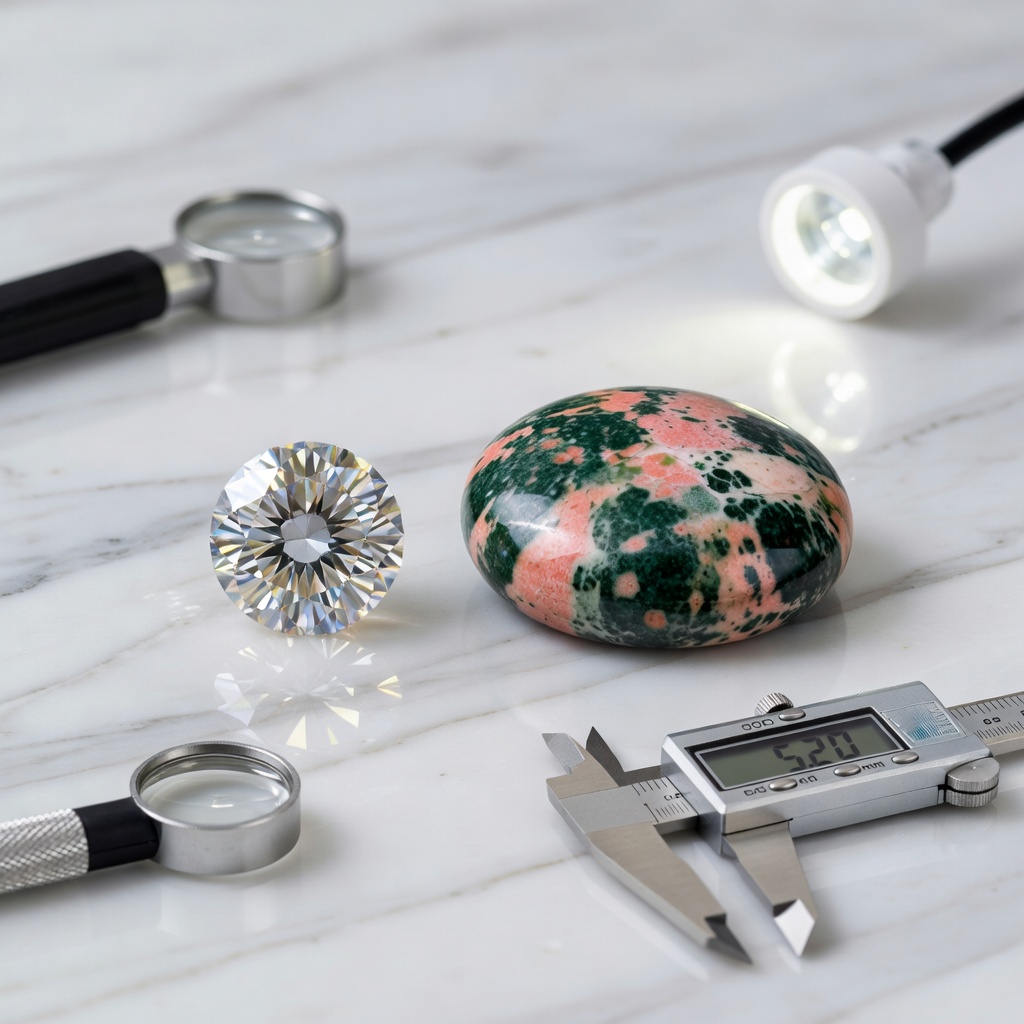
Diamond captivates viewers through its extraordinary interaction with light, displaying three distinct optical phenomena: brilliance (white light reflection), fire (spectral color dispersion), and scintillation (flashing sparkles when moved). These effects result from Diamond's high refractive index of 2.42 and its ability to slow light significantly as it passes through the crystal structure, bending and separating white light into spectral colors. Master cutters optimize these properties through precise facet arrangements, calculating angles to maximize light return while minimizing leakage through the pavilion.
Clarity grades significantly impact Diamond's visual appeal, with stones ranging from Flawless (no inclusions visible under 10x magnification) to Included (imperfections visible to the naked eye). Color preferences vary by market, with the traditional colorless grades (D-F) commanding premium prices, though fancy colored diamonds in vivid yellows, blues, and pinks achieve even higher valuations due to their extreme rarity. When set in white gold or platinum, colorless Diamonds appear to float with an icy brilliance that defines luxury jewelry aesthetics.
Unakite Color and Textural Beauty
Unakite offers a completely different visual experience, trading brilliance for organic, earthy charm through its distinctive mottled patterns. The stone consistently displays patches of pistachio green epidote interspersed with salmon pink or brick red orthoclase feldspar, occasionally accented by veins of clear quartz that appear as white or colorless inclusions. Unlike Diamond's transparency, Unakite remains entirely opaque, absorbing rather than transmitting light to create a soft, waxy luster reminiscent of natural ceramic glazes.
Artisans typically fashion Unakite into cabochons, beads, and carved objects rather than faceted gems, as the opacity prevents light performance and the unique color patterns prove more interesting when displayed in smooth, polished surfaces. Each piece of Unakite presents a unique landscape of color distribution, ensuring that no two jewelry items appear identical. When paired with copper or bronze settings, the warm metallic tones enhance Unakite's earthy palette, creating bohemian and nature-inspired designs that appeal to those seeking alternatives to traditional sparkling gemstones.
Value, Rarity, and Investment Analysis
Diamond Pricing and Investment Potential
The valuation of Diamonds follows a complex system known as the Four Cs: Cut, Color, Clarity, and Carat weight. Each factor significantly influences price, with a one-carat round brilliant Diamond ranging from $2,000 for commercial quality to over $25,000 for D-color, Internally Flawless specimens. Certification from recognized laboratories like GIA or AGS provides essential documentation of these characteristics, ensuring authenticity and supporting resale values. As portable wealth, Diamonds historically maintain value during economic fluctuations, though retail markups often mean immediate resale yields 20-60% of purchase price depending on market conditions.
Investment-grade Diamonds typically require weights exceeding one carat with exceptional color and clarity grades, requiring substantial capital outlay. The emergence of laboratory-grown Diamonds has introduced price pressure on natural stones, though earth-mined Diamonds continue commanding premiums for significant purchases. When considering gemstones as alternative investments, natural Diamonds with exceptional characteristics and proper documentation offer liquidity unavailable in most other collectible stones, though they should constitute part of a diversified portfolio rather than a primary investment vehicle.
Unakite Affordability and Market Position
Unakite occupies the opposite end of the value spectrum, with rough material available for pennies per gram and finished cabochons typically retailing between $5 and $50 depending on size and craftsmanship. As a semi-precious vs precious stones comparison, Unakite demonstrates the vast range of geological materials available to consumers, proving that beauty does not correlate directly with price. The abundant supply from numerous global deposits ensures market stability and prevents the speculative pricing sometimes seen in rare gemstones.
While Unakite does not function as an investment vehicle in the traditional sense, high-quality specimens featuring exceptional color contrast and artistic cutting may appreciate modestly over time, particularly among metaphysical collectors. The stone's accessibility allows jewelry enthusiasts to experiment with bold, statement pieces without financial risk, building collections based on aesthetic preference rather than budget constraints. For beginning gemstone collectors, Unakite offers an excellent entry point to study mineral properties, cutting techniques, and jewelry settings before committing to higher-value purchases.
Jewelry Applications and Design Versatility
Diamond Jewelry: Traditional Luxury Applications
Diamond dominates the high-jewelry market through applications designed to showcase its brilliance and durability. Engagement rings represent the primary market, with solitaire settings, halo designs, and three-stone configurations emphasizing the center stone's optical performance. Eternity bands featuring continuous rows of Diamonds serve as wedding bands or anniversary gifts, while tennis bracelets and line necklaces display multiple matched stones in flexible, elegant arrangements. For formal occasions, Diamond drop earrings and statement pendants provide sophisticated sparkle that complements evening wear.
Setting designs for Diamonds emphasize security while maximizing light exposure. Prong settings, particularly four-prong and six-prong configurations, allow maximum light entry from all angles while protecting the girdle from chipping. Bezel settings offer enhanced protection for active wearers, though they slightly reduce light performance. When designing custom pieces, jewelers often incorporate Diamond accents alongside colored gemstones, using the white brilliance to frame and enhance the center stone's color. Platinum and 18k white gold remain preferred metals for colorless Diamonds, as their neutral tones prevent color reflection that might tint the stone.
Unakite Jewelry: Organic and Bohemian Styles
Unakite jewelry embraces the stone's earthy aesthetic through designs that emphasize texture and color over geometric precision. Beaded necklaces featuring graduated Unakite spheres create natural, grounding accessories suitable for casual wear or yoga practice. Cabochon pendants set in sterling silver or copper bezels showcase the stone's unique patterns, often enhanced by wire-wrapping techniques that complement bohemian fashion sensibilities. Earrings featuring Unakite drops or chips provide lightweight, comfortable options for all-day wear.
Practical design considerations require protective settings for Unakite due to its moderate hardness. Bezel settings surrounding the entire girdle prevent edge chipping, while pendant designs that prevent the stone from contacting hard surfaces during movement extend longevity. Unakite pairs exceptionally well with leather cords, macramé techniques, and mixed-metal designs incorporating copper, bronze, or antiqued silver. For unique custom jewelry, designers increasingly combine Unakite beads with small Diamond accents, creating textural contrast between the opaque, patterned Unakite and brilliant Diamond highlights.
Metaphysical Properties and Symbolism
Diamond Symbolism and Spiritual Significance
Throughout history, Diamond has symbolized invincibility, purity, and eternal love across numerous cultures. As the April birthstone, Diamond represents clarity of mind and purpose, believed to amplify the energies of other stones and the intentions of its wearer. Crystal practitioners associate Diamond with the crown chakra, facilitating connection to higher consciousness and spiritual enlightenment. The stone's ability to refract light into rainbow spectrums supports its reputation as a tool for manifestation, helping individuals transform dreams into reality through focused intention.
Ancient texts reference Diamonds as lightning made solid, carrying protective properties that deflect negative energy and psychic attack. Modern metaphysical practitioners use Diamonds during meditation to enhance mental clarity and decision-making capabilities, particularly when facing complex ethical dilemmas or major life transitions. The stone's association with Venus and love deities across cultures reinforces its popularity in engagement rings, symbolizing not just romantic commitment but the multi-faceted nature of partnership itself.
Unakite Meaning and Healing Applications
Unakite carries the moniker "Stone of Vision," valued in crystal healing communities for its ability to balance emotions with spirituality. The combination of green epidote (associated with growth and healing) and pink feldspar (connected to compassion and love) creates a harmonious energy particularly supportive during times of transition. Practitioners recommend Unakite for pregnancy support, placing the stone on the womb to promote healthy fetal development and ease the emotional fluctuations associated with hormonal changes.
Unlike Diamond's association with the crown chakra, Unakite resonates primarily with the heart chakra, encouraging emotional healing and the release of past traumas. Past life regression therapists utilize Unakite to access cellular memories and karmic patterns, while grief counselors recommend the stone for those processing loss or divorce. Physical healing traditions suggest Unakite supports the reproductive system, healthy weight gain during convalescence, and recovery from major illness. For daily spiritual practice, holding Unakite during visualization exercises allegedly enhances psychic vision and dream recall.
Care, Cleaning, and Maintenance Requirements
Maintaining Diamond Brilliance
Diamond care remains relatively straightforward due to the stone's chemical inertness and hardness. Professional jewelers routinely use ultrasonic cleaners and steam cleaning to remove accumulated lotions, oils, and environmental debris from Diamond jewelry without risk of damage. At home, soaking Diamond pieces in warm water with mild dish soap followed by gentle brushing with a soft toothbrush restores sparkle effectively. The stone's resistance to acids and heat means that occasional exposure to household chemicals or sudden temperature changes rarely causes damage, though chlorine bleach should be avoided as it can attack metal settings.
Despite Diamond's durability, regular maintenance ensures longevity of the jewelry piece rather than just the stone itself. Prongs require inspection every six months to prevent stone loss, particularly in rings subjected to daily wear. When storing Diamond jewelry, individual soft pouches prevent scratching of other gemstones and metal surfaces, as Diamond can scratch virtually any other material including other Diamonds. For heirloom pieces, professional repolishing every decade removes microscopic surface abrasions that accumulate despite the stone's hardness.
Cleaning Unakite and Preservation Techniques
Unakite maintenance requires more attentive care due to its composite nature and sensitivity to environmental factors. Clean Unakite using only lukewarm water and mild soap, avoiding ultrasonic cleaners and steam which may cause internal fracturing or loosen epoxy fills sometimes used in lower-quality material. Acids, including household vinegar and lemon juice, can etch the feldspar components, while prolonged exposure to direct sunlight may fade the pink orthoclase to gray, permanently altering the stone's distinctive color balance.
Storage recommendations emphasize isolation from harder gemstones, particularly Diamonds, which will scratch Unakite surfaces if stored together in jewelry boxes. Wrapping Unakite pieces in acid-free tissue or storing in individual cloth pouches prevents abrasion. When wearing Unakite jewelry, apply perfumes, hairsprays, and cosmetics before putting on the piece, as chemical residues can dull the polish over time. Unlike Diamond, Unakite benefits from occasional oiling with mineral oil to enhance its luster, particularly for carved pieces or beads that may dry out with age.
Making Your Decision: Which Gemstone to Choose
Selecting between Diamond and Unakite ultimately depends on aligning gemstone characteristics with personal priorities, lifestyle requirements, and budget parameters. This gemstone buying guide recommends evaluating several key factors before making your final selection.
For budget-conscious consumers seeking aesthetic impact without financial strain, Unakite offers exceptional value, allowing the purchase of large, visually striking pieces for under $100. Conversely, those preparing for milestone events such as engagements or significant anniversaries should consider Diamond for its durability, cultural significance, and ability to withstand daily wear for decades. Active individuals with physically demanding lifestyles or professions involving manual labor will find Diamond's hardness essential, while those seeking spiritual tools or occasional statement pieces may find Unakite's metaphysical properties and unique appearance more aligned with their needs.
Consider combining both stones in custom designs to leverage their complementary properties. A pendant featuring a central Unakite cabochon surrounded by Diamond melee creates textural interest while providing the durability of Diamond in high-contact areas. Alternatively, Unakite beads paired with Diamond rondelles in a bracelet offer the grounding energy of Unakite with the protective amplification of Diamond accents. Whether choosing the eternal brilliance of Diamond or the earthy vision of Unakite, understanding these distinct gemstones ensures satisfaction with your jewelry investment for years to come.
Frequently Asked Questions About Diamond vs Unakite
Is Unakite as hard as Diamond?
No, Unakite is significantly softer than Diamond. On the Mohs hardness scale, Diamond ranks at 10 (the hardest natural substance), while Unakite measures 6-6.5. This means Unakite can be scratched by harder materials and requires more careful handling and protective jewelry settings.
Can Unakite be used in engagement rings like Diamond?
While Unakite can be used in engagement rings, it is not recommended for daily wear due to its moderate hardness (6-6.5). Unlike Diamond, which withstands daily wear exceptionally well, Unakite is better suited for occasional wear, pendants, or earrings where it faces less impact and abrasion.
Why is Diamond so much more expensive than Unakite?
Diamond commands higher prices due to its extreme rarity, mining difficulty, cultural significance as a luxury item, and the 4 Cs grading system (Cut, Color, Clarity, Carat). Unakite is abundant, easier to mine and process, and classified as a semi-precious stone, making it accessible at much lower price points.
What are the healing properties of Unakite compared to Diamond?
Unakite is associated with emotional healing, pregnancy support, and grounding energy, specifically linked to the heart chakra. Diamond is associated with clarity, strength, amplification of energy, and spiritual enlightenment, connecting to the crown chakra. While Unakite focuses on emotional balance, Diamond emphasizes mental clarity and protection.
How can I tell the difference between Diamond and Unakite?
Diamond is typically transparent to translucent with brilliant sparkle and fire, often colorless or near-colorless, and feels cold to the touch. Unakite is opaque with distinctive mottled patterns of green and pink, has a waxy luster rather than brilliant sparkle, and shows no dispersion or light-splitting properties like Diamond.
Is Unakite a good alternative to Diamond?
Unakite serves as an affordable aesthetic alternative for those seeking unique color and pattern rather than brilliance. However, it is not a functional alternative for high-wear jewelry like engagement rings due to its lower hardness. It works best as a complementary stone or for different jewelry types like pendants and beads.
Can you wear Diamond and Unakite jewelry together?
Yes, you can wear them together, but store them separately to prevent scratching. Diamond (hardness 10) will easily scratch Unakite (hardness 6-6.5). When combining them in jewelry designs, ensure protective settings separate the stones or use Unakite as accent beads with Diamond focal points.
What colors do Unakite and Diamond come in?
Diamonds are most valued in colorless/white shades but also occur in fancy colors including yellow, blue, pink, and black. Unakite consistently displays a mottled combination of pistachio green (from epidote) and salmon pink or brick red (from orthoclase feldspar), with occasional quartz inclusions appearing as white patches.