Understanding Diamond vs Tektite: A Comprehensive Gemstone Comparison
When exploring the fascinating world of precious materials, the comparison between Diamond vs Tektite represents one of the most intriguing contrasts in gemology. Diamonds, composed of crystalline carbon formed under immense geological pressure, stand as the pinnacle of traditional gemstone value and durability. Tektites, conversely, are natural glasses created by the explosive impact of meteorites striking Earth's surface, transforming terrestrial silica into cosmic-inspired treasures. Collectors and jewelry enthusiasts frequently compare these materials despite their vastly different origins, as both offer unique aesthetic appeal, metaphysical associations, and distinct value propositions that cater to different preferences and budgets.
Origins and Formation: Earthly Pressure vs Cosmic Impact
The genesis of these two materials could not be more different, representing opposite ends of the geological spectrum. Diamonds form approximately 140 to 190 kilometers beneath Earth's surface in the mantle, where temperatures exceed 1,000 degrees Celsius and pressures reach 45,000 atmospheres. This extreme environment, maintained for one to three billion years, allows carbon atoms to crystallize into the isometric crystal system that gives diamonds their legendary hardness and brilliance. Volcanic eruptions then transport these precious crystals to the surface via kimberlite and lamproite pipes, where they are mined in locations such as Botswana, Russia, Canada, and Australia.
Tektite formation represents a dramatically sudden cosmic event rather than a slow geological process. When large meteorites strike silica-rich areas of Earth's crust, the impact generates temperatures exceeding 1,700 degrees Celsius, instantly melting the surrounding rock and soil. This molten material is ejected high into the atmosphere, sometimes reaching the stratosphere, where it cools rapidly while spinning and falling back to Earth. The result is natural impact glass with distinctive aerodynamic shapes, surface textures, and internal flow patterns. Unlike diamonds, which form uniformly deep underground, tektites create scattered "strewn fields" across specific geographic regions, with notable deposits including Moldavite in the Czech Republic, Indochinites across Southeast Asia, and Libyan Desert Glass in Egypt.
Practical tip for collectors: When sourcing tektites, always request provenance documentation indicating the specific strewn field origin, as this significantly affects value and authenticity. For diamond purchases, insist on Kimberley Process certification to ensure ethical sourcing from legitimate mining operations rather than conflict zones.
Physical Properties and Hardness Comparison
Understanding the Tektite vs diamond hardness differential is crucial for anyone considering these materials for jewelry applications. Diamonds rank at the absolute peak of the Mohs hardness scale with a rating of 10, making them the hardest known natural material. This exceptional hardness results from the strong covalent bonding between carbon atoms in a tetrahedral lattice structure, allowing diamonds to resist scratching from any other substance and maintain their polish indefinitely. This property makes diamonds ideal for daily wear items, particularly engagement rings and wedding bands that must withstand decades of constant use without showing signs of abrasion.
Tektites, being natural glasses, possess significantly different physical characteristics with Mohs hardness ratings between 5 and 5.5. This places them in the same hardness range as ordinary window glass and apatite, meaning they can be scratched by materials including steel knives, quartz, and even prolonged contact with harder gemstones. Tektites possess an amorphous structure rather than a crystalline one, lacking the organized atomic arrangement that gives diamonds their durability. Their specific gravity ranges from 2.3 to 2.5, considerably lighter than diamond's 3.52, while their refractive indices (1.48-1.52) fall well below diamond's impressive 2.42, explaining why tektites lack the intense brilliance of their carbon-based counterparts.
Case study: A jewelry repair shop reported that a client brought in a tektite pendant after wearing it daily for six months alongside a diamond tennis bracelet. Examination revealed numerous surface scratches on the tektite where it had contacted the diamonds, while the diamonds remained pristine. This illustrates why understanding gemstone properties prevents damage to softer materials.
Visual Characteristics and Varieties
The optical performance of these gemstones diverges dramatically due to their fundamental structural differences. Diamonds exhibit exceptional dispersion (0.044), splitting white light into spectral colors and creating the "fire" that makes them so desirable in jewelry. This effect, combined with high refractive index and expert faceting, produces the intense brilliance and scintillation that diamonds are famous for. Modern cutting techniques maximize these optical properties, with round brilliant cuts featuring 57 or 58 precisely angled facets designed to return maximum light to the viewer's eye.
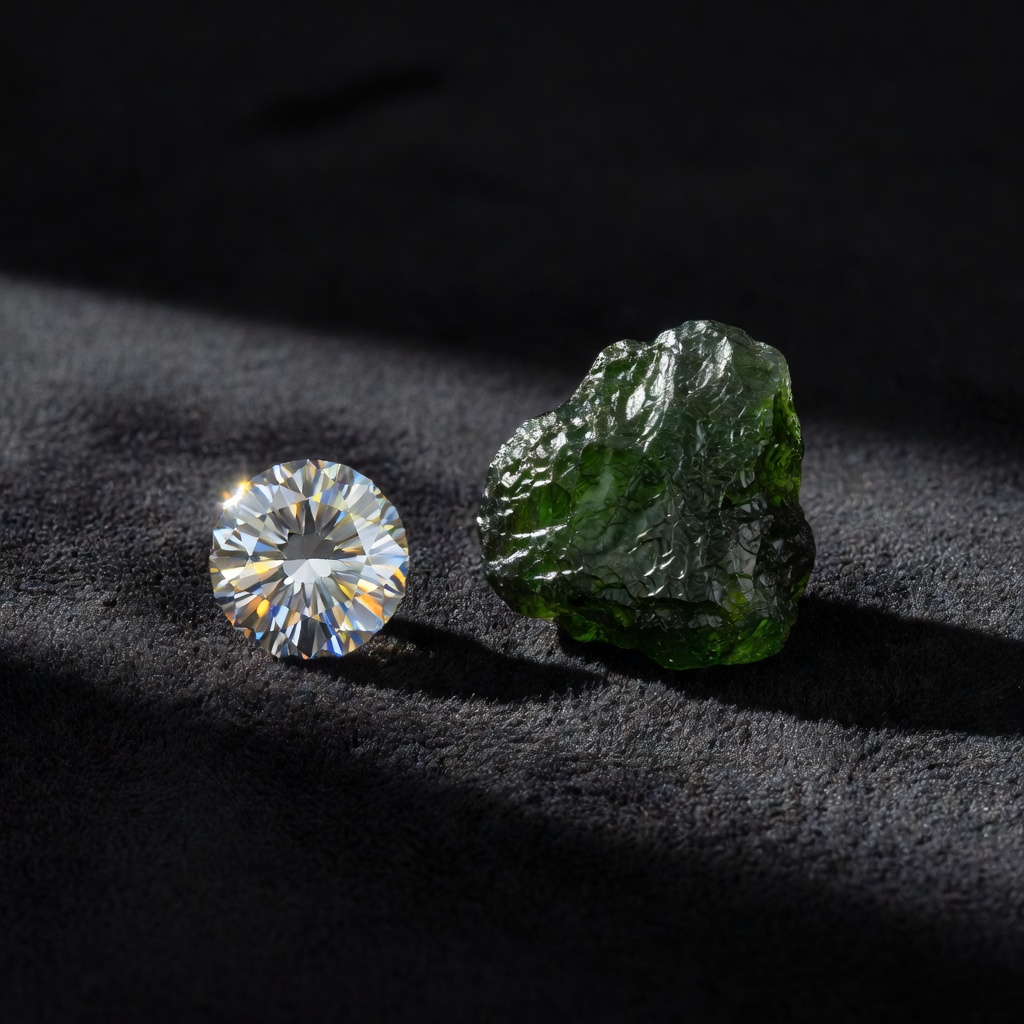
Tektites offer an entirely different aesthetic appeal based on organic textures and cosmic colorations rather than geometric brilliance. Moldavite vs diamond comparisons particularly highlight these differences, as Moldavite displays distinctive mossy green to olive hues with textured surfaces featuring pitting, wrinkling, and grooving caused by atmospheric flight and rapid cooling. High-quality tektites often contain internal swirls, bubbles, and flow lines visible under magnification—characteristics that would be considered flaws in diamonds but are prized as proof of natural origin in tektites. Libyan Desert Glass appears in translucent to transparent yellow shades, while Indochinites and other black tektites range from opaque dark brown to deep black with characteristic conchoidal (shell-like) fractures when broken.
Practical application: When photographing these materials for sale or appraisal, diamonds require controlled lighting to demonstrate fire and brilliance, typically using dark field illumination or spot lighting. Tektites photograph best with diffused natural light that highlights their surface textures and internal characteristics without creating harsh reflections.
Comparative Analysis: Diamond vs Tektite Properties
| Property | Diamond | Tektite |
|---|---|---|
| Chemical Composition | Crystalline Carbon (C) | Silica Glass (SiO₂ with impurities) |
| Mohs Hardness | 10 (Hardest natural material) | 5-5.5 (Similar to glass) |
| Refractive Index | 2.42 (High brilliance) | 1.48-1.52 (Vitreous luster) |
| Formation Process | Mantle crystallization over billions of years | Meteorite impact melting and atmospheric cooling |
| Typical Colors | Colorless to fancy colors (blue, pink, yellow) | Green (Moldavite), Yellow (Libyan), Black (Indochinite) |
| Price Range (per carat) | $2,000-$50,000+ depending on quality | $5-$100+ depending on variety and size |
| Best Jewelry Application | Daily wear rings, bracelets, earrings | Occasional wear pendants, earrings, collector specimens |
| Structure | Crystalline (Isometric system) | Amorphous (Natural glass) |
| Specific Gravity | 3.52 | 2.3-2.5 |
Durability and Jewelry Applications
The disparity in hardness directly dictates how these materials function in jewelry settings. Diamond engagement rings dominate the bridal market specifically because diamonds withstand the mechanical stresses of daily activities including household cleaning, gardening, office work, and exercise without sustaining damage. Their scratch resistance ensures that facets remain sharp and polished surfaces retain their luster through decades of wear. Prong settings, which expose maximum surface area to light, work excellently for diamonds because the stone's hardness prevents the edges from chipping during normal wear, though sharp blows can still cause cleavage along diamond's perfect octahedral planes.
Meteorite glass jewelry requires significantly more careful consideration regarding setting and wear patterns. Tektite's brittleness and moderate hardness make it susceptible to chipping at the edges, surface scratching from contact with harder materials, and thermal shock from rapid temperature changes. Jewelry designers typically recommend bezel settings that wrap the metal entirely around the stone's edge, providing physical protection against impacts. Tektites perform best in pendants and earrings, which experience less mechanical stress than rings or bracelets. For rings, tektites should be reserved for occasional wear or cocktail rings rather than daily wear bands, and owners should remove them during activities involving manual labor, sports, or exposure to abrasive materials.
Maintenance tip: Clean diamond jewelry using ultrasonic cleaners or steam cleaning without risk of damage. For tektite pieces, use only mild soap and lukewarm water with a soft brush, as ultrasonic vibrations can exacerbate internal fractures or surface-reaching inclusions in glass materials.
Market Value and Investment Considerations
The economic profiles of these gemstones reflect their relative rarity, durability, and cultural demand. The diamond market operates on a complex pricing structure based on the Four Cs (Carat, Cut, Color, Clarity), with investment-grade stones starting around $5,000 per carat for high-quality one-carat specimens and escalating rapidly for larger, flawless, or fancy colored varieties. Blue diamonds and pink diamonds from the Argyle mine have achieved auction prices exceeding $1 million per carat. The diamond industry's controlled supply chain, marketing history, and established resale markets provide liquidity that appeals to investors seeking portable wealth storage.
Tektite value operates on entirely different metrics based on variety, provenance, and specimen quality rather than standardized grading systems. Common black Indochinites might cost $5-$20 per gram, while high-quality Moldavite with characteristic surface sculpture and translucent green color commands $50-$200 per gram or more for museum-grade pieces. Libyan Desert Glass, particularly specimens with dark inclusions or larger sizes, occupies a middle price tier. While tektites represent affordable entry points for collectors interested in natural glass gemstones, they lack the standardized resale markets and liquidity of diamonds. However, as tektite deposits are finite and non-renewable—once the known strewn fields are collected, no new natural tektites will form—certain varieties may appreciate as geological collectibles rather than traditional jewelry investments.
Investment advice: Purchase diamonds certified by GIA or AGS with detailed grading reports if seeking investment potential. For tektites, prioritize documented specimens from depleted or restricted sources, such as Moldavite from specific Bohemian localities where mining is now limited, as these show stronger value retention than common black tektites.
Metaphysical Properties and Symbolism
Beyond their physical characteristics, both materials carry significant cultural and metaphysical associations that influence purchasing decisions. Diamonds have served as symbols of eternal love and invincibility since ancient times, with the Greek word "adamas" meaning unconquerable. As the April birthstone, diamonds represent clarity of mind, purity, and strength. In crystal healing practices, diamonds activate the crown chakra, facilitating connection to higher consciousness and amplifying the energies of other stones. Their indestructible nature makes them popular talismans for protection and endurance, while their clarity symbolizes truth and commitment in romantic contexts.
Tektite meaning centers on transformation, cosmic connection, and extraterrestrial energy. Because they literally originate from the collision of celestial and terrestrial bodies, tektites are believed to bridge earthly and cosmic realms. Crystal healers attribute various properties to different tektite varieties: Moldavite is renowned for rapid spiritual evolution and heart chakra activation, often described as having an intense "buzzing" energy that facilitates transformation. Black tektites are associated with grounding and protection during astral travel or meditation. Practitioners use tektites for the third eye chakra to enhance psychic abilities, intuition, and communication with higher realms. Unlike diamonds, which emphasize permanence and stability, tektites represent change, adaptation, and the powerful forces of creation through destruction.
Practical example: A holistic jewelry designer reported combining diamonds and Moldavite in a custom pendant for a client undergoing major life transitions. The diamond provided grounding and clarity during decision-making, while the Moldavite supported emotional release and openness to new opportunities, demonstrating how these contrasting energies can complement each other in intentional jewelry design.
Authentication and Avoiding Imitations
The high value of diamonds and increasing popularity of tektites have created thriving markets for imitations that require careful identification. Diamond simulants include cubic zirconia (CZ), which lacks diamond's dispersion and thermal conductivity, and moissanite, which actually exceeds diamond in fire and brilliance but has different optical doubling properties. Synthetic diamonds (lab-grown) possess identical chemical and physical properties to natural diamonds but different growth patterns visible under magnification. Professional gemological laboratories use spectroscopy, thermal conductivity testers, and examination of inclusions to differentiate natural diamonds from simulants and synthetics.
Fake tektite detection presents different challenges, as counterfeiters often melt bottle glass or industrial slag to mimic natural impact glass. Authentic tektites display conchoidal fractures with distinctive ripple marks, flow lines, and lechatelierite inclusions (fused silica glass) visible under 10x magnification. Manufactured fakes typically lack the complex surface textures of atmospheric flight and may contain bubbles that are round rather than elongated or teardrop-shaped. The specific gravity of natural tektites is remarkably consistent within varieties, while manufactured glass often differs significantly.
Certification remains essential for both categories. Diamonds should accompany reports from recognized laboratories such as GIA (Gemological Institute of America), AGS (American Gem Society), or IGI (International Gemological Institute) detailing the Four Cs and confirming natural origin. For collectible tektites, documentation should include the specific strewn field location, weight, and descriptive characteristics, ideally from reputable mineral dealers or meteoritic research institutions. For Moldavite specifically, beware of "green glass" from China or Indonesia flooding the market; authentic pieces display the characteristic wrinkled surface texture and olive-green color distinct from emerald-green manufactured glass.
Testing tip: Perform a specific gravity test on suspected tektites using the hydrostatic method—suspending the specimen in water to measure displacement. Natural tektites typically measure between 2.3-2.5, while most manufactured glass falls outside this narrow range. For diamonds, use a diamond tester that measures thermal conductivity, though note that moissanite requires electrical conductivity testing for definitive separation.
Making Your Decision: Which Gemstone Fits Your Needs?
Selecting between these materials requires honest assessment of lifestyle, budget, and aesthetic preferences. Active individuals who work with their hands, engage in sports, or prefer low-maintenance jewelry will find diamonds the practical choice despite higher initial costs. The durability of diamonds justifies the investment for heirloom pieces intended to last generations without requiring replacement or extensive repairs. Those seeking traditional bridal jewelry, investment portability, or the specific optical brilliance that only crystalline carbon provides should prioritize diamonds regardless of higher price points.
Budget-conscious buyers or those drawn to alternative aesthetics may find tektites ideal diamond alternatives that offer cosmic provenance and organic beauty at accessible price points. Collectors interested in geological oddities, metaphysical properties, or conversation-starting jewelry pieces appreciate tektites for their extraterrestrial origins and unique textures. Tektites suit individuals who view jewelry as artistic expression rather than financial investment, and who are willing to handle pieces with appropriate care. When choosing tektites, prioritize protected settings and occasional wear scenarios to maximize longevity.
Decision framework: Create a priority list ranking durability, budget, symbolism, and visual preference. If durability and daily wear rank highest, choose diamond. If cosmic significance, unique appearance, and affordability matter most, select tektite. Many collectors ultimately choose both, using diamonds for engagement rings and wedding bands while reserving tektites for spiritual pendants, earrings, or display specimens that showcase these remarkable natural glasses without risking damage through daily wear.
Frequently Asked Questions
Is tektite as hard as diamond?
No, tektite is significantly softer than diamond. While diamonds rank 10 on the Mohs hardness scale (the hardest known natural material), tektites typically measure 5 to 5.5, similar to ordinary glass. This means tektites can be scratched by many common materials including steel, while diamonds can only be scratched by other diamonds.
Can tektite be used in engagement rings like diamond?
Tektite is generally not recommended for engagement rings due to its relatively low hardness (5-5.5 Mohs) and brittleness. Unlike diamonds, which withstand daily wear and resist scratching, tektites are prone to chipping, surface scratches, and damage from impacts. Tektites are better suited for pendants, earrings, or occasional wear rings with protective bezel settings.
Which is more valuable, diamond or tektite?
High-quality diamonds are significantly more valuable than tektites. While rare tektite varieties like Moldavite command premium prices ($20-$200+ per gram), they remain far more affordable than diamonds, which can cost thousands to tens of thousands per carat depending on the 4Cs. However, exceptionally large or historically significant tektite specimens can be valuable to collectors.
How can I tell the difference between black tektite and black diamond?
Black diamonds possess metallic adamantine luster, sharp faceting capabilities, and superior hardness (will scratch glass easily). Black tektites (like Indochinites) display conchoidal fractures, surface pitting, a more vitreous (glassy) luster, and visible flow lines or bubbles when examined with magnification. Tektites also feel warmer to the touch and lighter than diamonds of similar size.
Is Moldavite a type of diamond?
No, Moldavite is not a type of diamond. Moldavite is a specific variety of tektite—natural glass formed from a meteorite impact in the Czech Republic approximately 15 million years ago. While both are valued gemstones, they have completely different chemical compositions (silica glass vs crystalline carbon) and physical properties.
Do tektites have the same sparkle as diamonds?
No, tektites do not exhibit the same brilliance or fire as diamonds. Diamonds have a high refractive index (2.42) and strong dispersion that creates rainbow flashes and intense sparkle. Tektites, being natural glass, have lower refractive indices (approximately 1.48-1.52) and typically display a more subdued, waxy or vitreous luster without the intense light performance of faceted diamonds.
Are both diamond and tektite considered birthstones?
Only diamond is recognized as an official birthstone (April). Tektite is not traditionally classified as a birthstone in standard gemological charts. However, some alternative crystal healing systems associate tektites with various zodiac signs, particularly Scorpio and Cancer, due to their transformative and cosmic energy associations.
Can tektite scratch glass like diamond can?
Tektites and glass have similar hardness levels (both around 5-5.5 on the Mohs scale), meaning tektite cannot reliably scratch glass and may actually scratch itself against glass surfaces. Diamonds, being hardness 10, easily scratch glass and virtually any other material. This scratch test is one way to distinguish between these gemstones.