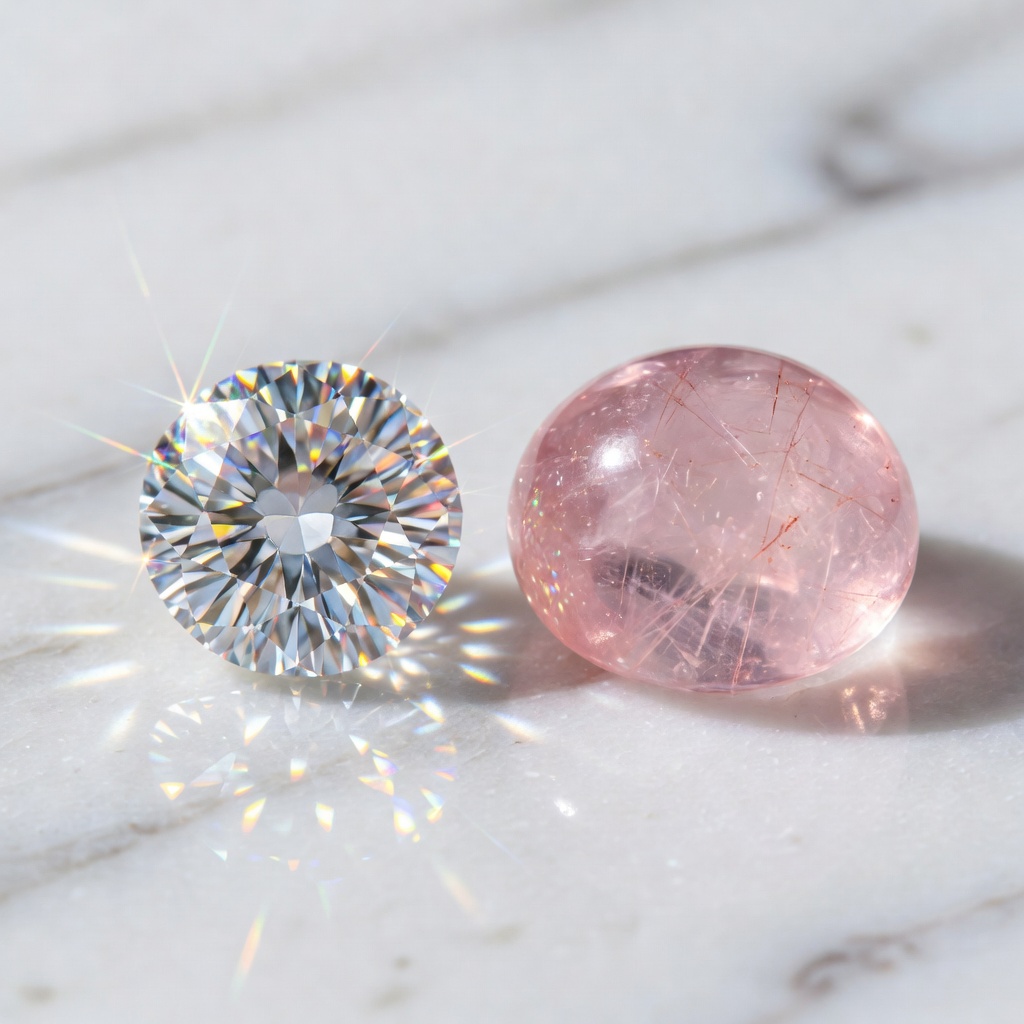
Introduction: Understanding Diamond vs Strawberry Quartz
When selecting the perfect gemstone for fine jewelry, modern consumers increasingly find themselves weighing the timeless prestige of diamonds against the romantic allure of strawberry quartz. Diamond represents the pinnacle of geological achievement as the hardest natural substance known to humanity, while strawberry quartz emerges as a captivating alternative engagement ring option for those seeking organic beauty with metaphysical significance. This comprehensive guide examines the critical differences between these distinct gemstones, from their molecular structures and durability characteristics to their spiritual symbolism and investment potential. Whether you are selecting a milestone anniversary gift or exploring pink crystal properties for daily wear, understanding the nuances of diamond vs strawberry quartz will empower you to make an informed decision aligned with your lifestyle, budget, and aesthetic preferences.
Chemical Composition and Geological Formation
The fundamental differences between diamond and strawberry quartz begin at the molecular level, where distinct chemical compositions create vastly different physical properties and formation timelines. These geological processes not only determine each stone's durability and appearance but also influence their rarity and market value in the gemstone industry.
Diamond's Pure Carbon Structure and Mantle Origins
Diamonds form approximately 140 to 190 kilometers beneath Earth's surface in the upper mantle, where extreme pressure exceeding 45,000 atmospheres and temperatures ranging from 900 to 1,300 degrees Celsius transform carbon atoms into isometric crystal structures. This remarkable diamond structure consists of pure carbon atoms arranged in a tetrahedral lattice, with each carbon atom covalently bonded to four others, creating the strongest natural material known to science. The formation process requires between one to three billion years, with diamonds traveling to the surface via rare volcanic eruptions through kimberlite pipes. Major mining operations in Botswana, Russia, Canada, and Australia extract these ancient stones, with each location producing diamonds exhibiting slightly different trace element signatures that can affect color and clarity.
Strawberry Quartz Silicon Dioxide Formation
Strawberry quartz properties derive from its silicon dioxide (SiO2) foundation identical to clear quartz, but with distinctive iron oxide and goethite inclusions that create its signature pink coloration and speckled appearance. Unlike diamonds formed deep within the mantle, strawberry quartz crystallizes in hydrothermal veins and pegmatite formations much closer to Earth's surface, typically forming over millions rather than billions of years. The iron oxide inclusions appear as delicate red to pink platelets, needles, or clouds within the quartz matrix, creating the strawberry-like visual effect that gives this stone its name. Significant deposits occur in Mexico, Kazakhstan, and various African nations, where geological conditions allow for the slow cooling necessary for these unique inclusions to develop without fracturing the host crystal.
Mohs Hardness and Durability Comparison
Understanding gemstone hardness comparison is essential when selecting jewelry intended for daily wear versus occasional use, as these ratings directly impact a stone's resistance to scratching, chipping, and overall longevity. The Mohs scale of mineral hardness provides a standardized framework for comparing these materials, though hardness alone does not tell the complete story of a gemstone's durability.
Extreme Hardness vs Moderate Durability
Diamond ranks supreme at 10 on the Mohs hardness scale, meaning it can scratch any other natural material and maintains its polish indefinitely even under rigorous daily wear conditions. Strawberry quartz registers 7 on the same scale, which while suitable for jewelry, renders it susceptible to scratching from everyday substances including household dust (which contains quartz particles), steel files, and harder gemstones. This three-point difference translates to a significant gap in practical durability; while diamonds require deliberate effort to damage, strawberry quartz can accumulate surface scratches from activities as mundane as gardening, rock climbing, or even aggressive hand washing. For consumers seeking alternative engagement rings, this hardness differential becomes particularly relevant when considering whether the ring will withstand decades of continuous wear.
Impact Resistance and Fracture Considerations
Despite diamond's unparalleled hardness, it possesses perfect cleavage in four directions, meaning a sharp blow at the correct angle can split a diamond along its crystal planes, though such occurrences remain rare in well-protected settings. Strawberry quartz, while softer, actually demonstrates better resistance to direct impact shattering due to its cryptocrystalline structure in some varieties, though its lower hardness makes surface abrasion the primary concern for long-term aesthetics. When evaluating these stones for heirloom potential, diamonds maintain their brilliance indefinitely with proper care, whereas strawberry quartz typically requires re-polishing every 10-15 years if worn daily to remove accumulated surface scratches. Jewelry designers often recommend bezel or halo settings for strawberry quartz to protect vulnerable edges, while diamonds thrive in elevated prong settings that maximize light exposure without compromising security.
Side-by-Side Comparison: Key Characteristics
| Characteristic | Diamond | Strawberry Quartz |
|---|---|---|
| Mohs Hardness | 10 (Highest) | 7 (Moderate) |
| Chemical Formula | C (Pure Carbon) | SiO₂ with Fe₂O₃ inclusions |
| Refractive Index | 2.42 (Exceptional brilliance) | 1.54 (Gentle glow) |
| Price per Carat | $2,000 - $25,000+ | $10 - $50 |
| Durability Rating | Excellent for daily wear | Good for occasional wear |
| Typical Clarity | FL to I3 (graded system) | Included by nature |
| Best Jewelry Applications | Engagement rings, all settings | Pendants, earrings, protected rings |
| Metaphysical Association | Crown chakra, mental clarity | Heart chakra, emotional healing |
Visual Characteristics: Brilliance vs Organic Beauty
The optical properties of these gemstones create distinctly different aesthetic experiences, appealing to divergent preferences for either mathematical precision or natural artistry. Understanding these visual differences helps collectors and jewelry enthusiasts appreciate what makes each stone unique while setting realistic expectations for performance in various lighting conditions.
Diamond's Exceptional Light Performance
Diamonds possess a refractive index of 2.42 and a dispersion rate of 0.044, enabling them to bend light dramatically and separate white light into spectral colors, creating the famous "fire" and brilliance that defines luxury jewelry. Diamond clarity grades range from Flawless (FL) to Included (I3), with professional gemologists evaluating stones under 10x magnification for internal inclusions and external blemishes that affect light transmission. The Gemological Institute of America (GIA) color scale grades diamonds from D (colorless) to Z (light yellow or brown), with colorless stones commanding premium prices due to their ability to maximize light return. When set in white gold or platinum, high-quality diamonds exhibit a distinctive "crushed ice" or "splintery" brilliance that remains visible even in dim lighting conditions, making them ideal for statement pieces designed to capture attention.
Strawberry Quartz's Distinctive Appearance
Strawberry quartz appearance embraces a softer, more subdued aesthetic characterized by milky translucency and distinctive red-to-pink speckled inclusions that resemble strawberry seeds suspended within the crystal. Unlike the crystalline clarity sought in diamonds, strawberry quartz derives its value and charm from these very inclusions, which create depth and interest when viewed from different angles under natural light. The stone typically exhibits a vitreous to waxy luster rather than adamantine brilliance, offering a gentle glow that complements rose gold settings and vintage-inspired jewelry designs. While strawberry quartz lacks the fire and scintillation of diamond, its unique color variations—from pale pink to deep rose with crimson flecks—provide an organic warmth that appeals to those seeking gemstone jewelry with personality and natural character rather than uniform perfection.
Price, Value, and Investment Potential
The economic considerations surrounding strawberry quartz vs diamond value extend far beyond initial purchase price, encompassing long-term investment potential, insurance costs, and resale market dynamics. These financial factors often serve as primary determinants for consumers deciding between these stones for significant purchases such as engagement rings or anniversary gifts.
Market Value and Rarity Factors
Natural diamonds command prices ranging from approximately $2,000 to over $25,000 per carat depending on the four Cs (cut, color, clarity, and carat weight), with fancy colored pink diamonds fetching even higher premiums due to extreme rarity. In stark contrast, strawberry quartz remains an accessible semi-precious stone typically retailing between $10 and $50 per carat for high-quality specimens, making it an attractive option for budget-conscious consumers seeking substantial carat weights. The price differential reflects fundamental supply constraints; while diamonds require specific billion-year-old geological conditions and limited mining locations, quartz represents one of Earth's most abundant minerals, with strawberry varieties occurring frequently enough to maintain affordable price points. However, exceptional strawberry quartz specimens with intense color saturation and distinct goethite patterns from specific localities like Kazakhstan can command premium prices among crystal collectors, though these rarely exceed a few hundred dollars even for large cabochons.
Investment and Resale Considerations
Diamonds traditionally maintain resale value better than most gemstones, with certified stones from reputable laboratories retaining 50-70% of retail value in secondary markets, though jewelry settings typically depreciate significantly regardless of the center stone. Strawberry quartz possesses minimal investment potential, functioning primarily as a consumable fashion accessory or spiritual tool rather than a store of value, with resale markets limited to collector communities and metaphysical practitioners. For consumers prioritizing financial liquidity, diamonds offer established appraisal standards and international markets, while strawberry quartz purchases should be viewed as expenditures for personal enjoyment rather than assets. When budgeting for alternative engagement rings, couples might consider allocating savings from choosing strawberry quartz toward higher quality wedding bands or future investments, rather than expecting the center stone to appreciate in monetary value.
Metaphysical Properties and Symbolism
Beyond physical attributes, many collectors evaluate gemstones through the lens of energetic properties and spiritual symbolism, with both diamond and strawberry quartz offering distinct vibrational signatures for meditation, healing work, and personal talismans. These metaphysical associations often influence purchasing decisions as strongly as aesthetic considerations, particularly among those seeking meaningful connections with their jewelry.
Diamond's High-Frequency Energy
Diamonds resonate with the crown chakra and are traditionally associated with invincibility, purity, and the amplification of spiritual energy, making them popular among those seeking mental clarity and protection from negative influences. Ancient Sanskrit texts referred to diamonds as "vajra" or thunderbolts, believing they carried the power of lightning to dispel illusion and enhance inner vision, a tradition that continues in modern crystal healing practices. As the April birthstone and associated with the Aries zodiac sign, diamonds are thought to strengthen relationships, promote courage, and support the manifestation of abundance through focused intention. Practitioners often use diamonds in meditation grids to amplify the properties of surrounding crystals, leveraging their high-frequency vibration to clear energetic blockages and enhance spiritual connection.
Strawberry Quartz Meaning and Heart-Centered Healing
Strawberry quartz meaning centers predominantly on heart chakra activation, emotional healing, and the cultivation of universal love, offering a gentler energetic signature compared to the intense amplification of diamond. The iron oxide inclusions within strawberry quartz are believed to ground spiritual energy into the physical body, making this stone particularly effective for healing past emotional traumas and fostering self-love and acceptance. Unlike the clarity and mental focus associated with diamond, strawberry quartz supports emotional intelligence, empathy, and the ability to give and receive love without fear or reservation. Crystal healers often recommend strawberry quartz for those recovering from heartbreak or seeking to attract new romantic partnerships, as its nurturing vibration is said to soothe anxiety while opening the heart to joy and connection.
Jewelry Applications and Setting Requirements
The practical application of these gemstones in jewelry design requires careful consideration of their physical properties, with each stone demanding specific setting styles and metal pairings to maximize beauty while ensuring longevity. Professional jewelers approach these materials with distinct techniques tailored to their hardness and durability characteristics.
Versatile Settings for Diamond
Diamond's exceptional hardness allows for virtually unlimited design possibilities, from delicate pavé bands to dramatic tension settings that suspend the stone between metal compression points without prongs. The stone's durability permits intricate cutting styles including princess, emerald, and cushion cuts with sharp edges that maintain their polish indefinitely, while its brilliance performs optimally in white metals such as platinum and white gold that reflect light back through the stone. For everyday wear pieces like engagement rings and tennis bracelets, diamonds require minimal protective settings, thriving in elevated four-prong or six-prong mounts that maximize light exposure while securing the stone against loss. Contemporary designers increasingly pair diamonds with alternative engagement rings featuring unconventional center stones, using diamond accents to provide sparkle and protection to softer gems like strawberry quartz through halo or bezel-surround designs.
Protective Design Strategies for Strawberry Quartz
Strawberry quartz demands protective settings that shield its surface from impact and abrasion, with bezel settings, half-bezels, and thick prong mounts providing superior protection compared to exposed tension or floating styles. The warm pink tones of strawberry quartz pair exceptionally well with rose gold settings, which enhance the stone's natural color while providing a vintage aesthetic that complements its organic appearance. Due to its moderate hardness, strawberry quartz performs best in earrings, pendants, and brooches that encounter minimal environmental contact, though it can function in rings intended for occasional wear or as "right-hand rings" rather than daily-wear engagement jewelry. When incorporated into bridal jewelry, strawberry quartz often appears as accent stones or center pieces in bezel-set cocktail rings, surrounded by diamond halos that provide both visual contrast and physical protection against chipping.
Care, Maintenance, and Cleaning Guidelines
Proper maintenance protocols differ significantly between these gemstones, with incorrect cleaning methods potentially damaging strawberry quartz while diamonds tolerate aggressive cleaning techniques that would destroy softer stones. Establishing appropriate care routines ensures both immediate sparkle and long-term preservation of your jewelry investments.
Professional Cleaning Protocols
Diamonds tolerate ultrasonic cleaners and steam cleaning methods that utilize high-frequency sound waves and pressurized vapor to remove accumulated oils and debris from setting crevices, though stones with significant inclusions or fracture-filled treatments require gentler approaches. Strawberry quartz care strictly excludes ultrasonic and steam cleaning, as the heat and vibration can expand existing inclusions or create thermal shock that fractures the crystal structure, potentially causing the stone to shatter or lose its polish. For strawberry quartz, mild soap and lukewarm water applied with a soft microfiber cloth or natural bristle brush provide safe effective cleaning without risking damage to the iron oxide inclusions that create its distinctive color. Professional jewelers recommend annual inspections for diamond jewelry to check for loose prongs, while strawberry quartz pieces benefit from biannual examinations to ensure protective settings remain intact and the stone shows no signs of surface abrasion or chipping.
Storage and Daily Maintenance
When storing diamond and strawberry quartz jewelry together, always separate pieces into individual soft pouches or compartmentalized boxes, as diamonds will readily scratch quartz if they contact each other during drawer movement or travel. Remove strawberry quartz rings before engaging in household cleaning, gardening, or exercise, as exposure to harsh chemicals, abrasive soils, or impact against gym equipment can permanently damage the stone's surface. For diamonds, daily maintenance involves simple wiping with a jewelry cloth to remove skin oils, while strawberry quartz requires more careful handling to prevent cumulative micro-scratches that eventually dull its luster. Consider purchasing a travel jewelry case with padded, separate compartments when bringing strawberry quartz on vacation, as hotel drawers and shared storage spaces present high-risk environments for accidental contact with harder gemstones or metal jewelry.
How to Choose Between Diamond and Strawberry Quartz
Selecting between these gemstones ultimately requires honest assessment of your lifestyle, aesthetic preferences, budget constraints, and the intended symbolic meaning of the jewelry piece. This decision framework helps navigate the choice between diamond vs pink crystal for various occasions and personal circumstances.
Lifestyle and Wear Patterns
Active individuals who work with their hands, engage in outdoor sports, or work in healthcare or food service environments should strongly consider diamond for daily-wear rings due to its resistance to both physical impact and chemical exposure. Strawberry quartz suits those with gentler lifestyles who can remove jewelry during physical activities and who prioritize spiritual significance or unique aesthetic over traditional durability standards. Consider your track record with jewelry maintenance; if you frequently forget to remove rings before showering or sleeping, diamond's forgiving nature proves more practical than strawberry quartz's requirement for careful handling.
Budget and Occasion Appropriateness
For milestone events such as engagements, significant anniversaries, or inheritances intended for future generations, diamonds provide the longevity and traditional recognition that mark such occasions appropriately. Strawberry quartz excels as a self-purchase for spiritual growth, a "push present" celebrating new beginnings, or fashion jewelry allowing experimentation with pink crystal properties without substantial financial commitment. When budget constraints limit diamond options, consider high-quality strawberry quartz set in substantial gold with diamond accents, creating a luxurious appearance at a fraction of the cost of a solitaire diamond ring.
Aesthetic and Energetic Priorities
Choose diamond if you prioritize brilliance, fire, and the prestige associated with traditional luxury gemstones, particularly if you prefer colorless stones that coordinate with any wardrobe choice. Select strawberry quartz if you are drawn to organic, natural beauty with romantic pink hues, or if you seek heart chakra healing and emotional support from your jewelry. Many collectors ultimately choose both, reserving diamonds for formal occasions and daily-wear heirloom pieces while incorporating strawberry quartz into spiritual jewelry collections or casual fashion rotations.
Frequently Asked Questions
Is strawberry quartz as hard as diamond?
No, strawberry quartz ranks 7 on the Mohs hardness scale while diamond ranks 10. This means strawberry quartz can be scratched by harder materials including diamonds, sapphires, and topaz, whereas diamonds can only be scratched by other diamonds. The three-point difference on the Mohs scale represents an exponential increase in hardness, meaning diamond is actually many times harder than strawberry quartz, not just slightly harder. For practical purposes, this means strawberry quartz requires protective settings and careful handling to maintain its polish, while diamonds withstand virtually any daily activity without showing wear.
Can strawberry quartz be used for an engagement ring?
While strawberry quartz can be used for engagement rings, it requires protective settings like bezels due to its moderate hardness. It's best suited for occasional wear or as a center stone in necklaces and earrings rather than daily-wear rings, unlike diamonds which are ideal for everyday engagement jewelry. Couples choosing strawberry quartz for engagement rings should understand that the stone will likely require professional re-polishing after several years of daily wear to remove accumulated surface scratches. Many jewelers recommend reserving strawberry quartz for "right-hand rings" or anniversary gifts rather than traditional engagement rings that are worn continuously for decades.
Which is more expensive, diamond or strawberry quartz?
Diamonds are significantly more expensive, often costing thousands per carat depending on quality, while strawberry quartz is an affordable semi-precious stone typically ranging from $10-$50 per carat. The price difference reflects diamond's rarity, hardness, and cultural prestige compared to abundant quartz varieties. A one-carat diamond of decent quality might cost $3,000-$8,000, while a comparable sized strawberry quartz might cost $20-$40, allowing consumers to purchase much larger strawberry quartz stones for the same investment. However, exceptional strawberry quartz specimens with intense color saturation from specific localities can command higher prices among collectors, though they still remain accessible compared to precious gemstones.
Does strawberry quartz contain real strawberry particles?
No, strawberry quartz doesn't contain fruit. Its pink color and red speckles come from iron oxide and goethite inclusions within the silicon dioxide crystal structure. These mineral inclusions create the strawberry-like appearance that gives the stone its name. The iron oxide forms as microscopic platelets or needles that reflect light to produce the reddish-pink coloration, while goethite inclusions may appear as black or brown needle-like structures within the quartz matrix. Some lower-quality specimens on the market may be dyed to enhance pink coloration, so purchasing from reputable dealers who verify natural color origin is essential for collectors.
How can I tell the difference between a pink diamond and strawberry quartz?
Pink diamonds exhibit brilliant fire and scintillation with high refractive index, while strawberry quartz has a milky, translucent appearance with visible iron oxide inclusions. Diamonds feel cold to the touch and can scratch glass easily, whereas strawberry quartz feels warmer and cannot scratch materials harder than 7 on the Mohs scale. Under magnification, pink diamonds may show internal graining or specific inclusion patterns like pinpoints and crystals, but they maintain transparency and brilliance, while strawberry quartz displays distinctive opaque speckled patterns throughout the stone. Additionally, pink diamonds command prices exceeding $10,000 per carat for faint colors and hundreds of thousands for vivid pinks, making the price point itself a strong indicator of identity.
Which stone has better spiritual properties for love and relationships?
Both stones support love but differently: diamonds symbolize eternal commitment and mental clarity, while strawberry quartz specifically targets heart chakra healing, self-love, and emotional healing. Strawberry quartz is often preferred for attracting new love and healing past emotional wounds, while diamonds represent established, enduring partnerships. Those seeking to mend a broken heart or develop self-compassion might gravitate toward strawberry quartz's gentle, nurturing energy, while couples celebrating decades of marriage might choose diamonds to represent the unbreakable strength of their bond. Many spiritual practitioners actually recommend wearing both stones together, with strawberry quartz positioned near the heart and diamond at the crown or third eye to balance emotional healing with mental clarity.
Can I wear diamond and strawberry quartz together in the same jewelry piece?
Yes, but with caution. Since diamond is harder than strawberry quartz, they should be set so the diamond doesn't touch the quartz, or the quartz may become scratched over time. Many designers create complementary pieces using diamonds as accent stones surrounding a strawberry quartz center, separated by metal barriers. When storing such pieces, ensure the stones don't rub against each other, as even slight movement can cause the diamond to abrade the quartz surface. Some innovative settings use a "halo" of diamonds around strawberry quartz not only for aesthetic contrast but also to provide a protective barrier that absorbs impact before it reaches the softer center stone.
Is strawberry quartz treated or dyed to achieve its pink color?
Natural strawberry quartz obtains its color from iron oxide inclusions, but some market specimens are dyed or heat-treated to enhance pink coloration. High-quality natural strawberry quartz shows distinct goethite needles or plate-like inclusions. Always purchase from reputable dealers who disclose any treatments. Dyed quartz often appears uniformly saturated without the natural variation and speckled patterns characteristic of genuine iron oxide inclusions, and the color may concentrate in fractures or surface-reaching inclusions. Untreated strawberry quartz typically shows color zoning and irregular distribution of pink hues, whereas treated stones might display unnaturally even coloration throughout the crystal.