Understanding Diamond vs Shell in Fine Jewelry
When selecting materials for fine jewelry, the comparison between diamond vs shell represents one of the most fundamental distinctions in gemology: mineral versus organic origins. Diamonds constitute pure crystallized carbon formed under extreme pressure approximately 90 to 150 miles beneath Earth's surface, enduring temperatures exceeding 2,000 degrees Fahrenheit for periods ranging from one to three billion years. In contrast, shell materials—particularly mother-of-pearl and nacre—comprise calcium carbonate-based organic substances secreted by mollusks as protective inner shell layers, creating iridescent surfaces through biological processes rather than geological forces.
Many consumers encounter confusion regarding marketing terms like "shell diamonds" or "diamond dust shells," which often describe imitation diamonds or coated materials rather than genuine comparisons between these distinct categories. Clarifying this terminology remains essential because organic vs mineral gemstones exhibit radically different physical properties, care requirements, and aesthetic characteristics. While diamonds offer eternal durability and brilliance suitable for daily wear across generations, shell materials provide unique organic beauty with iridescent color play that no laboratory or geological process can exactly replicate, appealing to collectors seeking natural artistry over crystalline perfection.
Chemical Composition and Formation Processes
Diamond Crystallization Deep Within the Earth
Diamonds represent nature's ultimate expression of carbon purity, consisting of 99.95% pure carbon arranged in an isometric crystal system where each carbon atom bonds tetrahedrally with four neighboring atoms. This specific atomic arrangement creates the strongest natural substance known to humanity, forged under immense pressure exceeding 725,000 pounds per square inch within Earth's mantle. The gemstone composition of diamond requires specific geological conditions where ancient seabed carbon descends through subduction zones, transforming into rough octahedral crystals before volcanic eruptions transport them rapidly to surface levels through kimberlite and lamproite pipes.
Biological Creation of Shell and Nacre
Shell materials fundamentally differ as biogenic substances created through the metabolic processes of living mollusks including oysters, abalones, and conchs. Nacre structure consists of microscopic aragonite tablets of calcium carbonate (CaCO₃) cemented together by layers of conchiolin, a fibrous protein resembling the keratin found in human hair and nails. This hexagonal crystal system produces the characteristic brick-and-mortar arrangement visible under electron microscopy, where alternating layers of calcium carbonate and organic material create both strength and optical interference responsible for iridescence.
Structural Implications for Jewelry
The atomic uniformity of diamonds allows light to travel through the material at consistent speeds, creating predictable refraction patterns essential for cutting and brilliance optimization. Conversely, the layered nacre structure creates variable optical properties depending on viewing angles and layer thicknesses, producing the phenomenon known as "orient" or pearlescent glow. These structural differences explain why diamonds require faceting to maximize light performance while shell materials achieve their beauty through cabochon cutting or carving that preserves the natural layer orientation.
Hardness, Durability and Wear Resistance
Gemstone Hardness Comparison on the Mohs Scale
The Mohs hardness scale provides the definitive framework for understanding gemstone hardness comparison between these materials, with diamond occupying the apex position at 10—the maximum rating indicating resistance to scratching. Shell materials present significantly softer profiles, ranking between 2.5 and 4.5 depending on specific variety, with mother-of-pearl typically measuring 3.5-4.0 while conch shell registers approximately 3.0. This substantial hardness differential means that diamond can scratch virtually any material including shell, whereas shell can be damaged by common household items such as steel knives (5.5), glass (5.5), or even persistent fingernail contact (2.5).
Toughness and Fracture Resistance
While hardness measures scratch resistance, toughness indicates resistance to breaking or chipping—a category where the comparison becomes more nuanced. Diamonds possess perfect cleavage in four directions, making them vulnerable to splitting if struck at specific angles despite their surface hardness. Shell materials demonstrate superior toughness relative to their hardness due to the nacre durability derived from their layered structure; when impacted, cracks tend to propagate along the organic protein layers rather than shattering the entire piece, similar to the principles used in laminated safety glass.
Practical Wear Recommendations
For daily wear applications, diamonds remain the undisputed choice for rings and bracelets that encounter frequent contact with hard surfaces, doorframes, and workplace equipment. Professional jewelers consistently recommend reserving shell pieces for pendants, earrings, brooches, and occasional-wear rings that minimize physical impact. Case studies from antique jewelry restoration reveal that Victorian-era shell cameos worn as bracelets typically show significant surface wear after 50-100 years, whereas diamond jewelry from the same periods maintains original surface integrity when properly maintained.
Visual Characteristics and Optical Properties
Diamond Optics: Brilliance and Fire
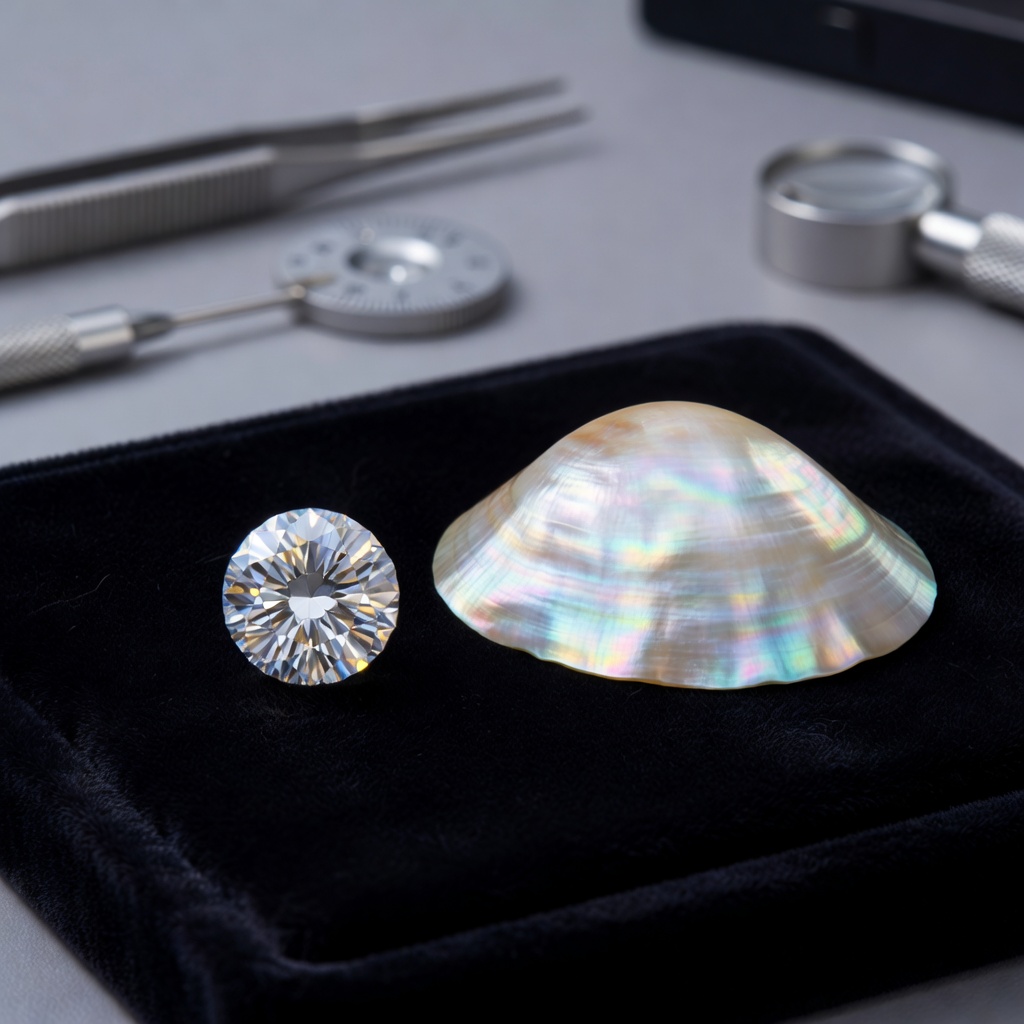
Diamonds exhibit three primary optical characteristics that define their visual appeal: brilliance (white light reflection), fire (spectral color dispersion), and scintillation (sparkle from movement). These properties emerge from diamond's exceptionally high refractive index of 2.42, which bends light dramatically as it enters and exits the stone, combined with a dispersive power of 0.044 that separates white light into rainbow components. The adamantine luster—the highest category of gemstone luster—creates the mirror-like surface reflection that distinguishes diamonds from all other transparent gems.
Shell Aesthetics: Iridescence and Orient
The mother of pearl vs diamond visual comparison reveals entirely different aesthetic philosophies, with shell materials emphasizing subtle color play over brilliant reflection. Nacre produces pearlescent luster characterized by soft, glowing reflections reminiscent of moonlight rather than sunlight, combined with iridescence (orient) caused by interference between light waves reflecting off microscopic calcium carbonate layers. Chatoyancy or the "cat's eye" effect occasionally appears in shell when fibers align parallel to the surface, creating moving bands of light across cabochon-cut specimens.
Color Palettes and Transparency Variations
Diamonds range from absolutely colorless (D grade) through fancy yellows and browns to extremely rare fancy vivid pinks, blues, and reds, with transparency allowing light to pass completely through properly cut stones. Shell materials offer opaque to slightly translucent bodies displaying white, cream, pink, gold, silver, black, and green hues depending on the mollusk species—black lip oyster producing dark Tahitian-style tones while abalone creates vivid blues and greens. Unlike diamonds where color typically reduces value (except fancy colors), shell derives much of its worth from distinctive color patterns and surface iridescence.
Jewelry Applications and Design Versatility
High-Wear Diamond Applications
Diamond engagement rings dominate the bridal market specifically because the stone's hardness accommodates the continuous wear that engagement and wedding bands endure throughout decades of daily activities. Tennis bracelets, eternity bands, and stud earrings constitute additional diamond staples where scratch resistance proves essential for maintaining aesthetic appeal. The gemstone's compatibility with various setting styles—including prong, bezel, channel, and pavé settings—allows designers to create secure mountings that expose maximum surface area to light while protecting against loss.
Artistic Shell Utilization
Shell cameo jewelry represents centuries of artistic tradition, with artisans carving raised relief portraits or scenes into the contrasting colored layers of helmet shells or conch shells, utilizing the white upper layer against pink or brown bases. Inlay work incorporating mother-of-pearl into furniture, musical instruments, and jewelry boxes showcases shell's ability to create continuous decorative surfaces without the cost of solid gemstone coverage. Statement pendants featuring abalone or paua shell capitalize on the material's large surface areas to display maximum iridescence, while vintage buttons and belt buckles demonstrate shell's historical utility in fashion accessories.
Setting Requirements and Metal Compatibility
Diamond settings prioritize security and light exposure, typically employing open-back designs that allow cleaning access and illumination from multiple angles. Shell requires protective closed-back settings that support the material's relative softness and prevent pressure points that could cause cracking. Both materials pair beautifully with precious metals including platinum, white gold, yellow gold, and rose gold, though shell particularly complements yellow gold's warm tones while diamonds often suit white metals that enhance colorless appearances. Jewelers must exercise caution when combining both materials in single pieces, ensuring that diamond edges do not contact shell surfaces during wear.
Market Value, Pricing and Investment Potential
Diamond Valuation Framework
The gemstone value comparison between diamond and shell reveals staggering economic disparities rooted in supply constraints and grading complexity. Diamond pricing follows the standardized 4Cs system (cut, color, clarity, carat weight), with fine one-carat stones ranging from $1,000 for commercial quality to $50,000 or more for D-flawless specimens, while fancy vivid colors can command millions per carat at auction. Investment-grade diamonds offer liquidity through established resale markets, though consumers should recognize that retail markups often range 100-300% above wholesale, complicating short-term investment returns.
Shell Affordability and Rarity Exceptions
Shell materials generally occupy accessible price points between $10 and $500 for standard mother-of-pearl components, making them democratic alternatives for consumers seeking organic elegance without substantial financial commitment. However, specific varieties achieve significant value: natural conch pearls (non-nacreous calcareous concretions from queen conchs) lacking cultured pearl cultivation methods can exceed $20,000 per carat due to extreme rarity, while antique shell cameos by renowned carvers like Elena Pistrucci command collector premiums at specialty auctions.
Long-Term Value Considerations
Diamonds typically appreciate gradually with inflation, serving as portable wealth stores during economic instability, whereas shell jewelry generally depreciates from retail prices unless possessing specific historical provenance or artistic significance. Sustainable jewelry materials like renewable shell appeal to environmentally conscious consumers willing to sacrifice investment potential for ethical alignment, while diamonds increasingly compete with lab-grown alternatives that offer identical physical properties at 60-80% reduced costs, potentially affecting natural diamond investment trajectories.
Care, Cleaning and Maintenance Protocols
Diamond Maintenance Routines
Diamond maintenance requires minimal restrictions due to the material's chemical inertness and hardness. Ultrasonic cleaning machines safely remove accumulated lotions and oils from diamond surfaces and settings, while steam cleaners effectively restore brilliance without risking damage. Household ammonia solutions diluted with water provide effective home cleaning, and diamonds resist damage from chlorine, alcohol, and most acids encountered in daily life. Professional jewelers recommend annual inspections of prongs and settings rather than concern for the stone itself.
Shell Jewelry Care Requirements
Shell jewelry care demands significantly more attention due to calcium carbonate's vulnerability to acids and mechanical abrasion. Owners must avoid exposing shell to perfumes, hairsprays, cosmetics, and household cleaners containing acids or alcohol that can etch surfaces and dissolve binding proteins. Cleaning requires only a soft, damp cloth with mild soap—never ultrasonic or steam cleaning that can cause delamination of nacre layers or thermal shock fractures. Prolonged water exposure, including swimming or bathing, risks water penetration into microscopic cracks causing internal deterioration.
Storage and Professional Servicing
Diamonds can be stored loosely in jewelry boxes without scratching concerns, though separation from other diamonds prevents mutual abrasion. Shell requires individual soft pouches or lined compartments to prevent contact with harder gemstones or metal findings that could scratch the relatively soft surface. Professional repolishing can restore diamond brilliance after decades of wear, whereas shell damage typically proves irreversible—surface scratches cannot be polished out without removing iridescent layers, and cracks usually necessitate complete replacement of the component.
Ethical Sourcing and Environmental Sustainability
Diamond Mining Ethics and Alternatives
The Kimberley Process Certification Scheme attempts to prevent conflict diamonds from entering legitimate markets, though critics note loopholes regarding human rights violations in certain mining regions. Lab-grown diamonds offer ethical jewelry choices with identical physical properties, produced through Chemical Vapor Deposition (CVD) or High Pressure High Temperature (HPHT) methods using significantly less land disruption than open-pit mining. However, diamond mining provides crucial economic infrastructure in developing nations like Botswana, where partnerships between governments and mining companies fund education and healthcare systems.
Sustainable Shell Harvesting Practices
Shell materials generally qualify as sustainable jewelry materials when sourced from responsible aquaculture operations or food industry byproducts. Many mother-of-pearl components derive from pearl farming operations where mollusks are raised primarily for meat consumption, utilizing shells that would otherwise become waste. Marine ecosystem considerations require avoiding endangered species collection and ensuring that harvesting doesn't deplete wild populations essential for reef health, though most commercial shell jewelry utilizes abundant, fast-growing mollusk species.
Carbon Footprint and Environmental Impact
Comparative environmental analysis reveals that shell collection requires minimal energy inputs—primarily manual harvesting and simple cutting—versus diamond mining's heavy machinery, diesel generators, and extensive processing facilities. Shell cultivation can actually improve water quality as mollusks filter and clean surrounding marine environments, whereas diamond extraction involves moving tons of earth per carat recovered. Consumers prioritizing ecological impact often favor shell for occasional jewelry pieces while selecting lab-grown diamonds for permanent high-wear items, balancing sustainability with durability needs.
How to Choose Between Diamond and Shell
Lifestyle and Wear Pattern Assessment
Choosing jewelry materials requires honest evaluation of daily activities and wear patterns. Medical professionals, construction workers, and parents of young children typically benefit from diamond selections for rings and bracelets that withstand accidental impacts against hospital equipment, building materials, or playground fixtures. Conversely, individuals working in office environments or attending frequent social events may find shell pieces perfectly suitable for their gentler usage patterns while offering distinctive conversation pieces that stand out from ubiquitous diamond jewelry.
Budget Optimization Strategies
Intelligent budget allocation often involves combining both materials strategically: selecting diamond accent stones to frame larger shell cameos or inlays creates luxurious appearances at fractions of solid diamond costs. Brides seeking unique engagement rings might choose mother-of-pearl centers with diamond halos, achieving substantial visual impact while allocating budget toward higher-quality accent diamonds rather than large central stones. This approach satisfies desires for both durability (diamonds protecting shell edges) and organic beauty (iridescent central focus).
Aesthetic Preferences and Heirloom Planning
Aesthetic preferences ultimately drive material selection, with some wearers preferring diamonds' timeless crystalline sparkle that complements any outfit or era, while others gravitate toward shell's unique organic patterns ensuring no two pieces appear identical. Heirloom considerations favor diamonds for multi-generational transmission due to their permanent durability, though vintage shell cameos from the Victorian or Art Nouveau periods carry significant collectible value despite requiring more delicate handling. Families might designate diamonds for signature pieces like engagement rings while collecting shell items as artistic expressions reflecting specific periods or travels.
Diamond vs Shell: Comparative Analysis
| Characteristic | Diamond | Shell (Mother of Pearl) |
|---|---|---|
| Chemical Composition | Pure carbon (C), isometric crystal system | Calcium carbonate (aragonite) + conchiolin protein |
| Mohs Hardness | 10 (hardest natural substance) | 2.5-4.5 (varies by species) |
| Formation Process | Geological: 1-3 billion years under mantle pressure | Biological: Secreted by mollusks over months/years |
| Primary Luster | Adamantine (brilliant, mirror-like) | Pearly to iridescent (soft, glowing) |
| Price Range (Retail) | $1,000-$50,000+ per carat | $10-$500 per component (exceptions: conch pearls) |
| Durability | Permanent, scratch-proof under normal conditions | Moderate, susceptible to scratching and acids |
| Best Jewelry Applications | Rings, bracelets, daily wear items | Pendants, earrings, brooches, cameos |
| Cleaning Methods | Ultrasonic, steam, chemical cleaners safe | Damp cloth only; no chemicals, water, or steam |
| Transparency | Transparent to translucent | Opaque to slightly translucent |
| Environmental Impact | High (mining) or Low (lab-grown) | Low (renewable, often food byproduct) |
Frequently Asked Questions
Is shell jewelry durable enough for daily wear compared to diamond?
Shell jewelry (including mother-of-pearl) ranks 2.5-4.5 on the Mohs hardness scale, making it significantly softer than diamond (10). While shell can withstand occasional wear, it's susceptible to scratching from daily activities. Diamonds are ideal for rings and bracelets worn daily, whereas shell is better suited for pendants, earrings, and special occasion pieces that experience less contact with hard surfaces.
What is the difference between mother of pearl and diamond?
Mother of pearl is the iridescent inner layer of mollusk shells, composed of calcium carbonate and organic proteins. It displays a soft, pearly luster with rainbow-like iridescence. Diamond is pure carbon crystallized in an isometric structure, exhibiting brilliant sparkle, fire (spectral colors), and superior hardness. While diamonds are mineral gemstones valued for durability, mother of pearl is an organic gem prized for its unique natural patterns.
Can shell be considered a precious gemstone like diamond?
Shell is classified as an organic gemstone rather than a precious stone in traditional gemology. While high-quality shell varieties like conch pearls and abalone are valuable, they generally don't reach diamond price points. However, antique shell cameos and rare natural pearl shells are highly collectible. Unlike diamonds, shell lacks standardized grading systems and typically serves as an affordable, decorative alternative in jewelry.
Why are diamonds so much more expensive than shell materials?
Diamonds command higher prices due to their extreme rarity in gem quality, complex mining operations, and the 4Cs grading system that evaluates cut, color, clarity, and carat weight. Additionally, diamonds require specialized cutting and polishing. Shell materials are renewable resources harvested more sustainably, require minimal processing, and have abundant supply chains, making them significantly more affordable while still offering natural beauty.
How do I clean shell jewelry without damaging it?
Clean shell jewelry using only a soft, damp cloth with mild soap—never use ultrasonic cleaners, steam, or harsh chemicals that can dissolve the calcium carbonate. Avoid exposing shell to perfumes, hairsprays, or acidic substances. Store shell pieces separately in soft pouches to prevent scratching from harder materials. Unlike diamonds, shell is porous and can be damaged by prolonged water exposure or abrasive cleaning methods.
Are there any shell varieties as rare as high-quality diamonds?
Yes, certain shell varieties achieve exceptional rarity. Conch pearls (from queen conch shells) are non-nacreous, flame-structured gems that occur in only 1 in 10,000 to 15,000 shells, making them rarer than many diamonds. Melo pearls (from melo melo sea snails) and high-quality abalone pearls also command premium prices. However, these remain organic materials with different durability characteristics than diamonds.
Can diamonds and shell be combined in the same jewelry piece?
Absolutely. Combining diamonds and shell creates striking contrast between crystalline brilliance and organic iridescence. Popular designs include diamond halos surrounding shell cameos, mother-of-pearl inlays with diamond accents, and Art Deco style pieces featuring both materials. Jewelers must use protective settings for the shell components while allowing diamonds to be securely prong-set, creating luxurious pieces that leverage both materials' aesthetic strengths.
Is shell jewelry ethical and environmentally friendly?
Shell jewelry is generally considered environmentally friendly when sourced from sustainable aquaculture or food industry byproducts. Unlike diamond mining, shell harvesting doesn't require energy-intensive extraction or cause significant habitat disruption. Many shell materials come from farmed mollusks raised for food, utilizing the entire animal. However, consumers should verify that rare shells aren't harvested from endangered species or vulnerable marine ecosystems.