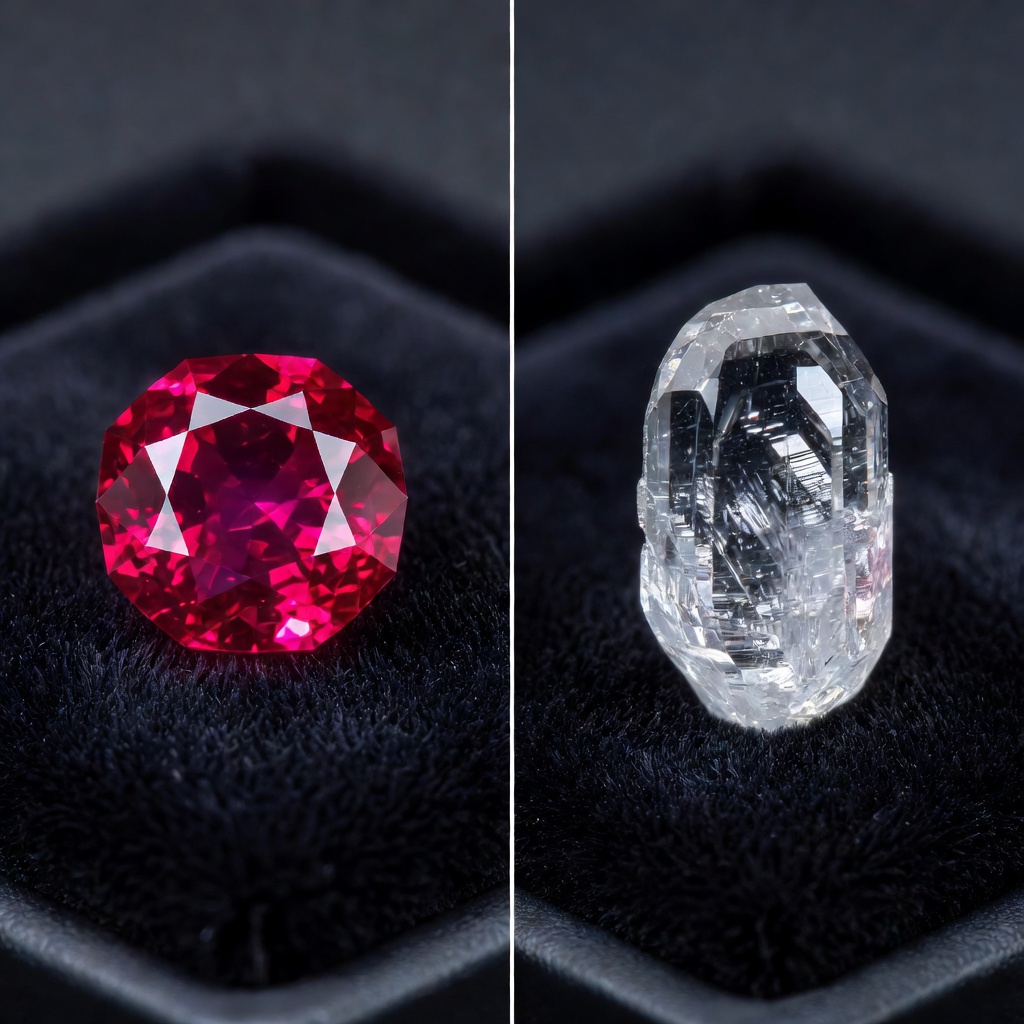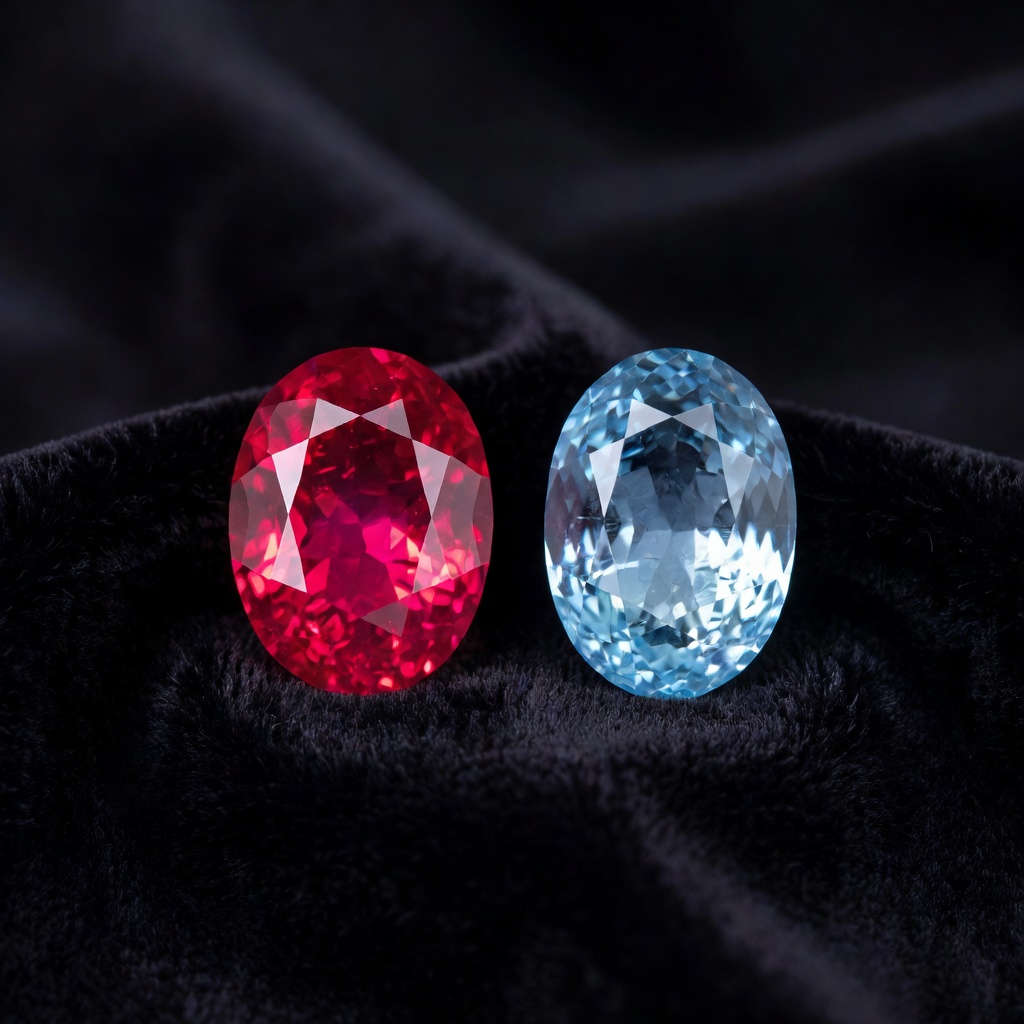
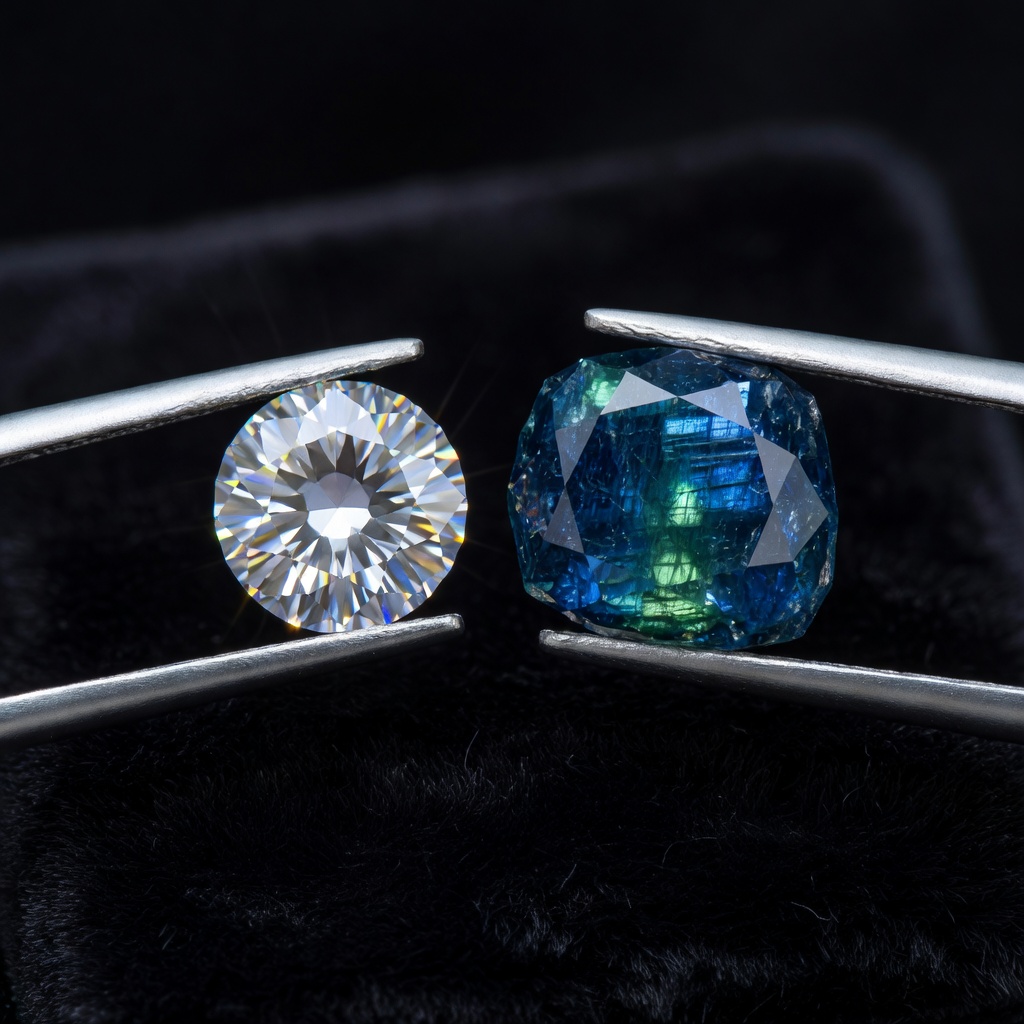
The Clash of Brilliance and Mystery: Diamond vs Serendibite
For centuries, diamonds have reigned supreme as the ultimate symbol of eternal love and luxury, adorning engagement rings and royal crowns with unrivaled consistency. However, beneath the glittering surface of the commercial gemstone market lies a hidden world of extreme geological rarities that challenge our perception of value and exclusivity. When conducting a rare gemstones comparison, few pairings present as stark a contrast as the commercially abundant diamond against serendibite, a mysterious crystal that makes even the rarest fancy colored diamonds seem commonplace by comparison. This analysis explores the fundamental paradox between a gemstone valued for its accessibility and durability versus one prized for its geological singularity and collector mystique.
The historical significance of these two minerals could not be more different. Diamonds entered human consciousness over 2,500 years ago in India, gradually becoming embedded in Western engagement traditions following De Beers' iconic 1947 "A Diamond is Forever" campaign. Conversely, serendibite remained completely unknown to science until 1902, when British mineralogist G.T. Prior identified microscopic crystals in the gem gravels of Sri Lanka. While diamonds became the foundation of a multi-billion dollar global industry, serendibite has remained the exclusive domain of mineral museums and elite private collectors, with fewer documented specimens than there are members of royal families worldwide.
Origins and Geological Formation
The creation of diamonds represents one of nature's most violent and powerful processes, occurring approximately 150 to 200 kilometers beneath Earth's surface where carbon atoms crystallize under crushing pressures of 50 kilobars and temperatures exceeding 1,400 degrees Celsius. These precious crystals remain trapped in the mantle until volcanic eruptions force them upward through channels known as kimberlite pipes, named after the Kimberley mine in South Africa where they were first identified. Major diamond formation kimberlite deposits now span across Botswana's Orapa mine, Russia's Mirny crater, and Australia's Argyle deposit, creating a global supply chain that produces over 150 million carats annually.
Serendibite formation requires equally specific but vastly different geological conditions, occurring in high-grade metamorphic skarn deposits where calcium, magnesium, aluminum, boron, and titanium converge in precise chemical ratios. Unlike diamonds' deep mantle origins, serendibite crystallizes in the Earth's crust during contact metamorphism between limestone and granite intrusions, specifically requiring boron-rich environments that occur in perhaps a dozen locations worldwide. The term "serendibite" derives from "Serendib," the old Arabic name for Sri Lanka, acknowledging the island nation as the primary source of these extraordinary Sri Lankan serendibite crystals, with only Myanmar's Mogok Stone Tract providing occasional additional specimens of gem quality.
Practical gem hunters should note that while diamond prospecting relies on identifying kimberlite indicator minerals such as garnet and ilmenite in soil samples, serendibite discovery remains largely accidental, typically occurring during alluvial mining for sapphires and spinels. In Ratnapura's gem fields, local miners have historically discarded serendibite as "black spinel" or worthless gravel, unaware that some of these rejected stones were worth more per carat than the sapphires they sought. This geological obscurity means that unlike diamonds, which support industrial mining operations with hundreds of employees, serendibite extraction involves individual artisanal miners washing sediment by hand in remote Sri Lankan streams.
Physical Properties: Hardness, Toughness, and Durability
When evaluating Serendibite hardness Mohs measurements against the industry standard, the disparity becomes immediately apparent. Diamonds rank a perfect 10 on the Mohs hardness scale, representing the pinnacle of mineral durability and resistance to scratching, while serendibite measures only 6.5 to 7, comparable to ordinary quartz or steel. This significant hardness differential means that while diamonds can cut glass and withstand decades of daily wear without showing surface scratches, serendibite will gradually abrade when worn in rings or bracelets, developing a network of fine surface lines that diminish its vitreous luster over time.
However, hardness represents only one aspect of durability, as toughness—the resistance to breaking, chipping, or cracking—follows entirely different rules. Diamonds possess perfect cleavage in four directions, making them vulnerable to splitting if struck at specific angles, a property that diamond cutters exploit but jewelers must carefully consider. Serendibite exhibits imperfect cleavage and moderate brittleness, meaning that while it won't split cleanly like a diamond, it tends to fracture conchoidally when subjected to impact, creating curved breakage patterns similar to glass. For collectors considering diamond durability engagement ring settings versus serendibite alternatives, this means diamonds tolerate prong settings and daily knocks better, while serendibite demands protective mounting strategies.
Chemical stability offers one area of common ground between these disparate gemstones. Both diamonds and serendibite resist attack by acids and household chemicals, though diamonds can burn at temperatures above 800 degrees Celsius in the presence of oxygen, transforming into carbon dioxide. Serendibite maintains stability up to approximately 1,000 degrees Celsius before decomposing, though its iron content may cause color changes under prolonged heat exposure. Practical tip: When having jewelry repaired, always inform your jeweler if a piece contains serendibite, as the standard ultrasonic cleaning and steam cleaning methods safe for diamonds may cause thermal shock fractures in serendibite due to its internal stress patterns and inclusions.
Visual Characteristics: Brilliance vs Pleochroic Depth
Diamonds captivate observers through exceptional optical performance characterized by a refractive index of 2.42 and dispersion of 0.044, creating the familiar "fire"—the rainbow flashes of spectral color—and "brilliance," the reflection of white light from the crown. Master diamond cutters exploit these properties through precise facet arrangements, maximizing light return through the table while minimizing light leakage through the pavilion. When examining a well-cut round brilliant diamond, viewers perceive a living stone that seems to generate its own illumination, with scintillation patterns that dance across the crown as the wearer moves.
In stark contrast, serendibite offers a completely different aesthetic experience centered on serendibite pleochroism and deep, mysterious coloration rather than brilliant light return. This gemstone exhibits strong trichroism, displaying pale blue, dark green, and nearly black coloration depending on the crystal orientation and viewing angle, with the pleochroic colors most visible in thicker specimens. Unlike diamonds, which appear colorless or show fancy colors through trace element absorption, serendibite typically presents as translucent to opaque with a vitreous to slightly silky luster, appearing almost metallic or jade-like in its finest specimens. The diamond fire and brilliance that dominate jewelry advertising campaigns find no equivalent in serendibite, whose beauty emerges from mineralogical rarity and color depth rather than optical geometry.
Case study: The "Imperial Blue" serendibite specimen housed in the Natural History Museum of Los Angeles County demonstrates this pleochroic effect dramatically; when viewed from the side, the stone appears almost black, while face-up examination reveals a deep teal-green color with subtle blue undertones. Gemologists use this property to distinguish serendibite from similar-looking kornerupine or dark tourmaline, as the trichroic color shift remains visible even in small fragments. For jewelry designers, this means serendibite works best as a center stone in brooches or pendants where the piece remains relatively stationary, allowing viewers to appreciate the color shifts as lighting conditions change, rather than in rings where constant movement prioritizes brilliance over subtle color play.
Rarity and Availability: Commercial vs Collector Markets
The production volume contrast between these gemstones defies comprehension for those unfamiliar with the upper echelons of mineral collecting. The global diamond industry mines approximately 150 million carats annually, with Russia's Alrosa and De Beers Group extracting enough rough material to supply millions of engagement rings, industrial cutting tools, and technological applications. This commercial abundance, while declining slightly due to depleted mines, ensures that consumers can purchase diamonds at virtually any price point from $500 fashion studs to $50 million pink diamond auctions, creating unprecedented accessibility for a precious gemstone.
Serendibite exists on an entirely different scarcity spectrum, with gemological literature documenting fewer than 1,000 faceted specimens in existence worldwide, and perhaps only three dozen stones exceeding one carat in weight. When evaluating the most expensive gemstones per carat, this extreme rarity positions serendibite among the top tier alongside red beryl and musgravite, with individual crystals often selling before they reach public markets. Unlike diamonds, which flow through established distribution networks from cutters to wholesalers to retail jewelers, serendibite rarity dictates that transactions occur almost exclusively through Christie's or Sotheby's auction houses, high-end mineral shows like the Tucson Gem and Mineral Show, or private sales between trusted collectors who have cultivated relationships over decades.
Geological scarcity explains this availability gap: while diamonds require specific mantle conditions, those conditions occurred repeatedly throughout Earth's history across multiple continents. Serendibite requires the precise convergence of boron-rich pegmatites intruding into calcium-magnesium silicate rocks—a combination occurring in perhaps two locations globally. Practical example: In 2005, a 0.35-carat faceted serendibite from Sri Lanka appeared at auction with a pre-sale estimate of $12,000 per carat; the stone attracted 47 bids from collectors in twelve countries before selling to a private museum benefactor. During the same period, approximately 2 million carats of commercial-grade diamonds sold through retail channels at prices ranging from $1,000 to $8,000 per carat, illustrating the market segmentation between commercial luxury goods and ultra-rare mineral specimens.
Diamond vs Serendibite Comparison Table
| Characteristic | Diamond | Serendibite |
|---|---|---|
| Mohs Hardness | 10 (Maximum) | 6.5–7 (Comparable to Quartz) |
| Refractive Index | 2.42 (High Brilliance) | 1.67–1.72 (Vitreous Luster) |
| Annual Production | 150+ Million Carats | Fewer Than 1,000 Faceted Specimens Total |
| Price Per Carat Range | $3,000–$30,000 (Commercial) | $8,000–$50,000+ (Collector Grade) |
| Primary Sources | Botswana, Russia, Australia, Canada | Sri Lanka, Myanmar (Extremely Limited) |
| Best Jewelry Application | Daily Wear (Rings, Bracelets, Earrings) | Occasional Wear (Pendants, Brooches, Collector Displays) |
| Color Range | Colorless to Fancy Colors (Yellow, Pink, Blue) | Blue-Green to Black (Strong Pleochroism) |
| Toughness | Good (but Perfect Cleavage) | Poor to Fair (Brittle, Fractures Easily) |
| Grading System | GIA 4Cs Standardized | No Standardized Grading (Individual Certification) |
| Market Liquidity | High (Global Resale Market) | Low (Specialized Collector Network Only) |
Market Value and Investment Analysis
Understanding serendibite price per carat requires abandoning conventional jewelry pricing models in favor of rare mineral economics. While commercial diamonds range from $3,000 to $30,000 per carat depending on the 4Cs (cut, color, clarity, carat), with only exceptional fancy vivid pinks or blues exceeding $100,000 per carat, serendibite establishes its baseline at $8,000 per carat for small, included specimens and climbs rapidly to $50,000 or more for clean stones over 0.5 carats. In 2020, a 0.29-carat eye-clean serendibite from Sri Lanka sold for $2.4 million per carat at private auction, establishing a record that places it among the most valuable substances on Earth by weight, surpassing all but the rarest red diamonds.
Liquidity represents the critical differentiator for investors weighing diamond investment value against serendibite acquisition. Diamonds benefit from established resale markets, with certified stones readily sold to dealers, auction houses, or through online platforms, typically retaining 50–70% of retail value depending on market conditions. Serendibite offers no such liquidity; owners must network within specialized gem and mineral societies, attend invitation-only viewings at major mineral shows, or consign to high-end auctions with 6–12 month waiting periods and substantial buyer's premiums. This illiquidity suits long-term collectors seeking geological trophies rather than investors requiring portfolio flexibility.
Notable sales illustrate these divergent markets: The 59.6-carat "Pink Star" diamond sold for $71.2 million in 2017, representing a per-carat price of $1.19 million, while the aforementioned serendibite achieved double that per-carat value at $2.4 million. However, the diamond transaction completed within weeks through Sotheby's Hong Kong, while the serendibite sale required eighteen months of negotiation between three interested parties, with the final buyer agreeing to display the stone at the Harvard Mineralogical Museum for five years as a condition of purchase. For those considering either gemstone as an alternative investment, diamonds suit those seeking wealth preservation with moderate appreciation, while serendibite appeals to ultra-high-net-worth individuals seeking non-correlated assets with museum-quality pedigree, accepting that capital may remain tied up for years or decades.
Jewelry Applications and Wearability Concerns
When selecting between Serendibite vs diamond jewelry, practical wearability concerns should guide the decision more than aesthetic preference alone. Diamonds accommodate every jewelry category imaginable, from tennis bracelets subjected to constant wrist impact against desk surfaces to solitaire engagement rings worn during manual activities, maintaining their polish and structural integrity for generations. The gemstone's hardness ensures that even after fifty years of daily wear, a diamond retains its original facet edges and surface luster, requiring only periodic cleaning to restore full brilliance.
Serendibite demands an entirely different approach to jewelry design, necessitating protective settings for soft gemstones such as bezels, halos, or recessed mounts that shield the stone from direct impact and abrasion. Jewelers experienced with serendibite typically recommend pendant necklaces or brooches, where the stone remains relatively protected against clothing rather than exposed on the hand or wrist. When set in rings, serendibite requires low-profile bezels that cover the girdle completely, combined with metal frameworks that absorb impact before it reaches the brittle crystal structure. Even with these precautions, owners should remove serendibite jewelry before activities involving hand contact, including driving, gardening, or household cleaning.
Design aesthetics diverge significantly between these materials. Diamond jewelry emphasizes transparency, light performance, and geometric precision, with settings designed to maximize light entry and minimize metal visibility. Serendibite jewelry embraces opacity and color depth, often utilizing closed-back settings with reflective foils or darkened metal to enhance the stone's blue-green to black coloration, similar to techniques used for black opal or star sapphire. High jewelry houses such as Cartier and Van Cleef & Arpels have occasionally incorporated serendibite into one-of-a-kind Art Deco revival pieces, pairing the dark mysterious stones with diamond pavé halos that create dramatic contrast while providing physical protection. For the practical consumer, this means diamond offers versatility and longevity, while serendibite provides exclusivity and conversation value, best reserved for statement pieces worn on special occasions rather than daily adornment.
Authentication, Certification, and Quality Grading
The GIA diamond grading system provides consumers with unprecedented confidence in diamond purchases, utilizing standardized criteria for Cut, Color, Clarity, and Carat weight, accompanied by laser inscriptions linking specific stones to their laboratory reports. This standardization means that a GIA-certified D-color, Internally Flawless diamond purchased in New York carries identical specifications to one certified in Mumbai or Tokyo, with grading consistency maintained through rigorous training and master stone comparisons. Consumers can verify authenticity through GIA's online report check, and identify common simulants such as cubic zirconia or moissanite through simple thermal conductivity testing available at most jewelry stores.
Serendibite identification requires significantly more sophisticated gemological expertise and laboratory equipment. No standardized grading system exists for serendibite quality; instead, identification relies on advanced techniques including X-ray diffraction to confirm crystal structure, Raman spectroscopy to identify molecular composition, and refractive index measurements using monochromatic light sources. The Gemological Institute of America (GIA) and American Gemological Laboratories (AGL) can provide origin reports confirming Sri Lankan versus Burmese sources, but unlike diamonds, no "cut grade" or "clarity scale" universally applies to these rare crystals.
Fraud prevention differs markedly between the two markets. Diamond counterfeiting typically involves cubic zirconia, moissanite, or synthetic diamonds grown using Chemical Vapor Deposition (CVD) or High Pressure High Temperature (HPHT) methods, all detectable through standard gemological testing. Serendibite confusion more commonly involves misidentification with kornerupine, dark green tourmaline (verdelite), or black spinel, minerals sharing similar coloration but vastly different values. Practical protection strategy: When purchasing serendibite, demand a report from a major laboratory specifically stating "Natural Serendibite" with spectroscopic data, and verify that the refractive indices fall within the 1.67–1.72 range (lower than kornerupine's 1.66–1.68 but distinct enough for expert differentiation). Additionally, examine the stone under different lighting directions to confirm the characteristic trichroism—blue, green, and black/grey—which kornerupine does not display to the same degree.
Final Verdict: Choosing Between Durability and Exclusivity
The Diamond vs Serendibite decision ultimately resolves into a choice between practical luxury and mineralogical exclusivity. For engaged couples seeking an engagement ring to withstand decades of daily wear, professionals requiring jewelry appropriate for active lifestyles, or investors needing liquid assets, diamonds provide the only rational solution, offering unmatched durability, global recognition, and resale flexibility. The diamond industry has spent a century perfecting the infrastructure to support these needs, from insurance policies that cover loss to international markets that guarantee liquidity.
Conversely, serendibite suits mineral collectors seeking to own a piece of Earth's rarest geological events, museum curators building systematic collections, or jewelry connoisseurs desiring pieces that spark conversation and intellectual curiosity rather than mere admiration of sparkle. The target audience for serendibite understands that wearing this gemstone requires mindfulness and protection, accepting these constraints as the price of possessing something that fewer than a thousand people worldwide can claim to own in faceted form. These collectors typically maintain relationships with specialized dealers who notify them immediately when material becomes available, often purchasing rough crystals before cutting to ensure authenticity.
Hybrid approaches offer intriguing possibilities for those unwilling to choose entirely between these worlds. Some high-end designers create "day and night" jewelry featuring diamond pavé frames surrounding central serendibite cabochons, allowing the diamonds to absorb daily wear impact while the serendibite provides visual anchor and rarity cachet. Others commission matching sets where diamond bands provide structural support for serendibite center stones, combining the durability of carbon with the mystique of calcium-magnesium borosilicate. Whether prioritizing the eternal resilience of diamond or the geological lottery-win of serendibite, both gemstones represent pinnacle achievements in their respective categories—one of commercial perfection, the other of natural scarcity.
Frequently Asked Questions
Is serendibite harder than diamond?
No, serendibite is significantly softer than diamond. While diamond ranks a perfect 10 on the Mohs hardness scale, serendibite measures only 6.5 to 7, similar to quartz. This hardness difference means that serendibite requires protective settings and is unsuitable for daily wear in rings, unlike diamonds which can withstand constant use.
Why is serendibite sometimes more expensive than diamond?
Serendibite commands higher per-carat prices than commercial diamonds due to extreme geological rarity. With fewer than 1,000 faceted specimens known to exist versus millions of carats of diamonds mined annually, serendibite's scarcity drives prices to $8,000-$50,000+ per carat for fine quality stones, while only rare fancy colored diamonds exceed these values.
Can serendibite be used in an engagement ring?
While serendibite can be used in engagement rings, it requires specific protective settings such as bezels or halos to prevent chipping and scratching due to its 6.5-7 Mohs hardness. Unlike diamonds, serendibite is not recommended for daily wear without extreme care, making it better suited for occasional wear rings or pendant necklaces.
What makes serendibite so rare compared to diamond?
Serendibite requires an extremely specific geological environment combining calcium, magnesium, aluminum, boron, and titanium in high-grade metamorphic skarn deposits. These conditions occur rarely in nature and have only been found in Sri Lanka and Myanmar. Diamonds, while requiring deep mantle conditions, have more widespread geological occurrences and established mining operations.
Does serendibite have the same sparkle as diamond?
No, serendibite does not possess diamond's characteristic sparkle. While diamonds exhibit high brilliance and fire due to a refractive index of 2.42, serendibite has a lower refractive index (1.67-1.72) and appears as a dark, vitreous to slightly silky stone. Serendibite's beauty lies in its rare blue-green to black coloration and strong pleochroism rather than brilliance.
Where is the best place to buy authentic serendibite?
Authentic serendibite should be purchased only from reputable high-end auction houses (Christie's, Sotheby's), established rare gem dealers with GIA or AGL certifications, or specialized mineral shows. Due to extreme rarity, serendibite is rarely available in standard jewelry stores. Always require laboratory verification reports confirming the stone's identity before purchasing.
Which gemstone is better for long-term investment?
Both offer different investment profiles: diamonds provide liquidity and steady value retention through established markets, while serendibite offers scarcity-driven appreciation potential but limited resale liquidity. Investment-grade diamonds (D-F color, IF-VVS clarity) remain more liquid, whereas serendibite suits specialized collectors seeking geological rarity over portfolio liquidity.
Can serendibite scratch or damage easily compared to diamond?
Yes, serendibite can be scratched by harder materials including corundum (sapphire/ruby) and obviously diamond, whereas diamonds can only be scratched by other diamonds. Serendibite also exhibits distinct cleavage and brittleness, making it prone to chipping if struck, unlike diamond's superior toughness despite its cleavage planes.