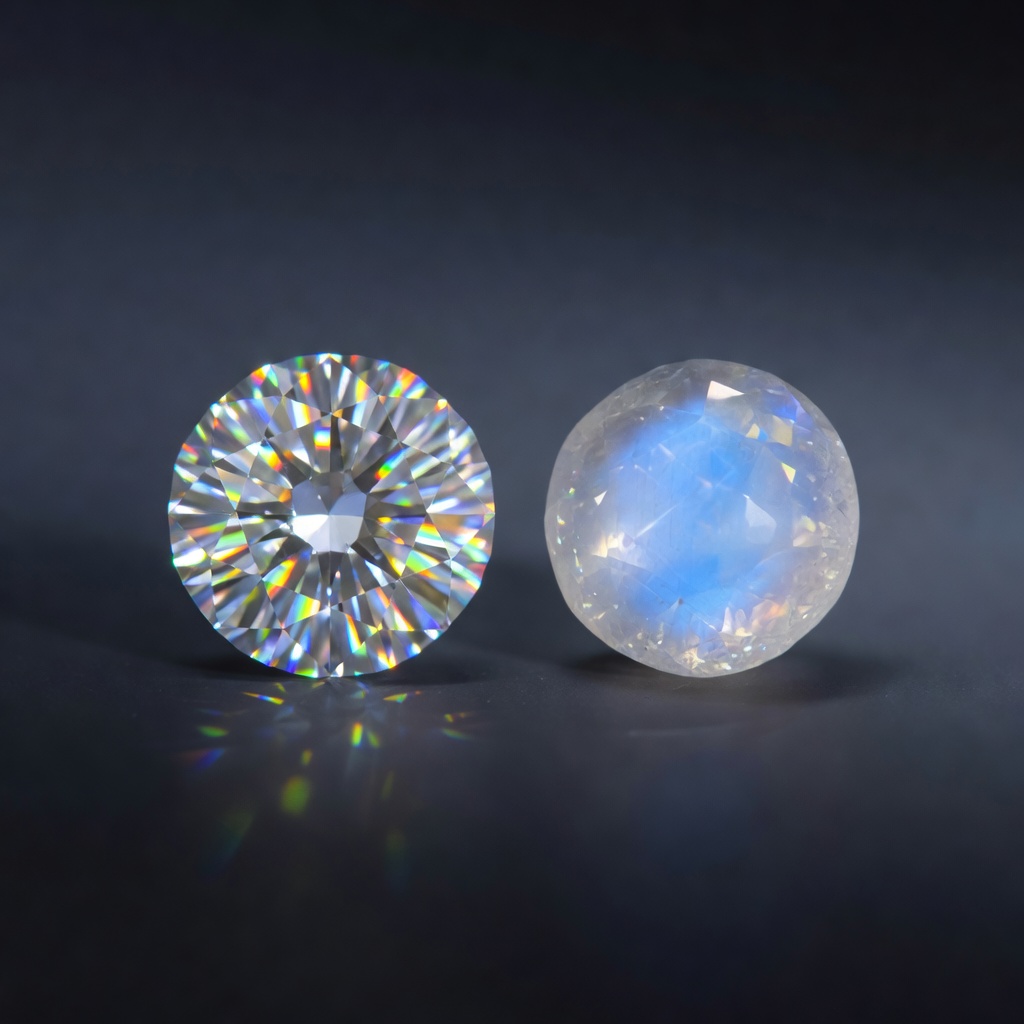
Two Worlds of Gemstone Beauty
When selecting the perfect gemstone for jewelry that captures both the eye and the heart, modern consumers increasingly find themselves weighing the timeless prestige of diamonds against the ethereal allure of rainbow moonstone. This diamond vs rainbow moonstone comparison represents more than a simple choice between precious and semi-precious stones; it embodies a fundamental decision between contemporary luxury and ancient mysticism, between geological perfection and optical enchantment. While diamonds have dominated the fine jewelry market for nearly a century as symbols of eternal commitment and status, rainbow moonstone has experienced a remarkable resurgence among those seeking engagement ring alternatives that carry deeper spiritual significance and distinctive visual character.
Understanding the distinctions between these two gems matters profoundly for today's discerning jewelry buyer who refuses to compromise on either quality or personal meaning. Whether you are selecting a center stone for a daily-wear engagement ring, commissioning a statement pendant, or building a collection of meaningful pieces, the differences in durability, optical effects, pricing structures, and symbolic value will directly impact your long-term satisfaction. This comprehensive gemstone comparison guide examines every facet of these remarkable stones, from their ancient geological origins to their practical maintenance requirements, empowering you to make an informed decision that aligns with your lifestyle, budget, and aesthetic desires.
Origins and Mineral Composition
The story of every gemstone begins deep within the Earth, and the geological journeys of diamonds and rainbow moonstones could not be more divergent. Diamonds form from pure carbon subjected to immense pressure—approximately 725,000 pounds per square inch—and temperatures exceeding 2,000 degrees Fahrenheit, conditions found exclusively 90 to 150 miles beneath the Earth's surface in the upper mantle. These crystals develop over billions of years, with some specimens dating back 1 to 3.3 billion years, making them among the oldest objects you can own. Volcanic eruptions then transport these treasures rapidly to the surface through kimberlite and lamproite pipes, preserving their cubic crystal structure against all odds.
Conversely, rainbow moonstone belongs to the feldspar mineral family, specifically a complex intergrowth of orthoclase and albite layers that form through much more recent geological processes. Unlike diamonds' deep-earth origins, moonstone crystallizes within cooling igneous rocks, particularly granitic pegmatites, at relatively shallow crustal levels over millions rather than billions of years. The distinctive rainbow moonstone properties emerge from these alternating microscopic layers of different feldspar compositions that separated as the mineral cooled. While diamonds represent pure elemental carbon in perfect crystal lattice formation, rainbow moonstone showcases the beautiful complexity of mineral interactions, with its adularescence resulting directly from these structural anomalies rather than from chemical purity.
Physical Properties and Durability Face-Off
When evaluating gemstones for jewelry that will endure daily life, understanding diamond hardness and relative durability becomes paramount. Diamond occupies the apex of the Mohs hardness scale with a perfect rating of 10, meaning it can scratch any other material and can only be scratched by another diamond. This exceptional hardness translates to remarkable longevity; a diamond engagement ring worn daily for fifty years will retain its polish and facet edges with minimal wear, resisting the inevitable encounters with household surfaces, metal door handles, and accidental impacts that characterize modern life.
Rainbow moonstone presents a more delicate profile, ranking 6 to 6.5 on the Mohs hardness scale, which places it in a vulnerable position for jewelry subjected to regular wear. At this hardness level, moonstone can be scratched by quartz (7), a mineral common in household dust and sand, as well as by harder gemstones like topaz, sapphire, and of course, diamond. Beyond surface scratching, moonstone exhibits two-directional perfect cleavage, meaning it can split cleanly along specific planes if struck with sufficient force at the correct angle—a property that demands protective setting designs. Diamonds also possess perfect octahedral cleavage, though their extreme hardness generally prevents the type of edge chipping that plagues softer gems.
In practical terms, this durability differential dictates radically different wearing patterns. A marketing executive who wears her diamond solitaire while typing, traveling, and exercising need not remove her ring for most activities, whereas the same lifestyle would rapidly degrade a rainbow moonstone's surface polish and risk structural damage. Thermal conductivity further distinguishes these gems; diamonds conduct heat five times faster than copper, allowing jewelers to test authenticity through heat dispersal, while moonstone's poor thermal conductivity requires careful setting techniques to avoid heat damage during repair work.
Optical Magic: Brilliance vs. Adularescence
The visual distinction between these gemstones stems from fundamentally different interactions with light, creating two equally captivating but utterly dissimilar optical experiences. Diamonds achieve their legendary sparkle through a combination of brilliance (white light reflection), fire (dispersion into spectral colors), and scintillation (flashing effects from movement), all maximized by precise faceting angles that exploit the stone's high refractive index of 2.42. Master diamond cutters calculate facet placement to the nearest degree, ensuring that light entering the crown reflects internally off the pavilion facets before exiting to the viewer's eye, creating that signature "crushed ice" or "hall of mirrors" effect that has defined luxury jewelry for generations.
Rainbow moonstone operates as a completely different type of adularescence gemstone, producing a phenomenon that seems to emanate from within the stone itself rather than reflecting off its surface. When light enters moonstone, it encounters the microscopic layers of orthoclase and albite feldspar—typically 0.5 microns thick—each with slightly different refractive indices (approximately 1.52). These layers scatter light in a phenomenon similar to how clouds produce silver linings, creating a billowy, floating sheen that appears to glide across the stone's surface as it moves. The finest specimens display an intense blue flash reminiscent of moonlight on water, though many exhibit rainbow color shifts including pinks, oranges, and greens.
The refractive index differential significantly impacts cutting styles; diamonds are almost always faceted to maximize light return, while rainbow moonstone is traditionally cut as a cabochon—a smooth, domed shape without facets—to best display its adularescence. A faceted moonstone would scatter the light responsible for its signature glow, while a cabochon-cut diamond would appear lifeless and glassy. This distinction means that moonstone jewelry often carries a vintage, romantic aesthetic compared to diamond's modern geometric precision, appealing to collectors who value organic, mysterious beauty over calculated brilliance.
Visual Appearance and Quality Factors
Evaluating diamond quality follows an internationally standardized system that has governed the trade for decades, creating objective benchmarks for comparison. The Gemological Institute of America (GIA) grades diamond color on a scale from D (completely colorless) to Z (light yellow or brown), with each letter representing a subtle shift in tint visible only to trained graders under controlled lighting. Clarity assessment involves examining the stone under 10x magnification to identify inclusions (internal characteristics) and blemishes (external features), ranging from Flawless (no inclusions visible under magnification) to Included (obvious to the naked eye). These rigorous standards ensure that a VS1 diamond purchased in New York matches the quality of a VS1 diamond sold in Tokyo.
Rainbow moonstone lacks such universal grading standards, making quality assessment more subjective and requiring buyers to evaluate individual specimens based on several key characteristics. The body color should be nearly colorless to white with high transparency, as overly gray or yellow bases diminish the adularescence effect. The intensity and color of the flash determine value, with vivid blue commanding premium prices while white or multicolor sheens offer more affordable options. Typical inclusions in moonstone include "centipedes"—tension cracks resembling the multi-legged insects—and small black tourmaline crystals, which are generally accepted as natural birthmarks provided they do not interfere with the stone's adularescence or structural integrity.
Size availability differs dramatically between these gems. While diamonds are routinely cut in sizes ranging from melee (under 0.15 carats) to spectacular ten-carat center stones, high-quality rainbow moonstone becomes increasingly rare above five carats. Large moonstones often display weaker adularescence or excessive inclusions, meaning that substantial moonstone jewelry typically features smaller stones in cluster or halo arrangements rather than single impressive solitaires. This size limitation influences design possibilities; whereas a five-carat diamond commands attention through sheer presence, a five-carat moonstone might appear milky or lifeless, requiring designers to work within more modest carat weights to preserve optical quality.
Price and Value Analysis
The economics of diamond vs rainbow moonstone purchases reveal a staggering disparity that reflects both geological rarity and market manipulation. Natural diamond pricing operates through the 4Cs system (Cut, Color, Clarity, Carat weight), with certified stones commanding anywhere from $3,000 to $30,000 or more per carat depending on quality. This pricing structure reflects not only extraction costs—mining one carat of gem-quality diamond requires processing approximately 250 tons of rock—but also historical market controls and the stone's permanence as a wearable asset. Investment-grade diamonds, particularly those over two carats with D-F color and VS+ clarity, retain value and liquidity in the secondary market, functioning as portable wealth storage.
Rainbow moonstone occupies the opposite end of the value spectrum, offering accessibility without sacrificing beauty. High-quality specimens typically range from $10 to $100 per carat, with exceptional large stones displaying intense blue adularescence occasionally reaching $200 per carat. This affordability stems from the gem's relative abundance, its classification as semi-precious rather than precious, and the absence of centralized market control. For couples seeking engagement ring alternatives without mortgage-level expenditures, moonstone provides genuine gemstone beauty at a fraction of diamond costs, allowing budget allocation toward intricate settings, wedding experiences, or future investments.
The emergence of laboratory-grown diamonds has complicated this comparison, offering chemically identical stones at 30-50% discounts compared to natural diamonds. These cultured diamonds provide the same hardness and optical properties as mined stones, challenging traditional notions of value and rarity. Conversely, synthetic rainbow moonstone remains rare in the commercial market; most affordable "moonstone" imitations are actually glass or plastic composites lacking genuine adularescence. When considering long-term value, diamonds—whether natural or lab-grown—maintain structural integrity indefinitely, while moonstone's softness limits its lifespan as an heirloom, though both carry emotional value that transcends monetary considerations.
| Characteristic | Diamond | Rainbow Moonstone |
|---|---|---|
| Mohs Hardness | 10 (Highest possible) | 6-6.5 (Moderate softness) |
| Primary Optical Effect | Brilliance, Fire, Scintillation | Adularescence (Blue/Rainbow Sheen) |
| Typical Price Range | $3,000-$30,000+ per carat | $10-$100 per carat |
| Durability for Daily Wear | Excellent - Resists scratches and impacts | Fair - Requires protective settings |
| Ideal Jewelry Applications | Engagement rings, Daily wear pieces | Pendants, Earrings, Occasional rings |
| Care Requirements | Ultrasonic and steam cleaning safe | Gentle soap only; avoid chemicals/ultrasonic |
| Refractive Index | 2.42 (High) | 1.52 (Low) |
| Market Classification | Precious Gemstone | Semi-Precious Gemstone |
Symbolism and Cultural Significance
The meanings ascribed to diamonds and rainbow moonstones reflect broader cultural shifts from material abundance to spiritual seeking. Diamonds acquired their modern association with eternal love and marital commitment largely through De Beers' marketing campaigns beginning in the 1940s, particularly the "A Diamond is Forever" slogan that transformed a luxury item into a social necessity for Western engagements. Beyond marketing, diamonds have historically symbolized invincibility (from the Greek "adamas"), purity, and unbreakable bonds, their clarity and permanence serving as metaphors for idealized romantic love. Royal families cemented this association through spectacular diamond parures and engagement rings, most notably the British Crown Jewels and the legendary Koh-i-Noor diamond.
Rainbow moonstone carries symbolism rooted in millennia rather than decades, with connections to lunar deities across Hindu, Roman, and Greek traditions. The ancient Romans believed moonstone formed from solidified moonbeams, while Hindu mythology associates it with the god Chandra, whose ethereal glow it captures. Metaphysical practitioners value rainbow moonstone for enhancing intuition, emotional balance, and feminine energy, often recommending it for new beginnings, fertility, and spiritual growth. Unlike diamond's association with mental clarity and amplification of energy, moonstone resonates with receptive, introspective qualities—the inward journey complementing diamond's outward declaration.
Historical jewelry applications reveal these symbolic distinctions; diamonds dominated royal regalia as displays of power and wealth, while moonstone adorned spiritual talismans and amulets. Art Nouveau designers like René Lalique favored moonstone for its mysterious, organic beauty, creating pieces that evoked natural forms and mystical themes. Today, choosing between these gems often signals personal values: diamond selections may emphasize traditional success and public commitment, while moonstone choices frequently indicate spiritual awareness, appreciation for vintage aesthetics, or rejection of conventional luxury norms in favor of individualized meaning.
Jewelry Design and Setting Considerations
Successful jewelry design requires matching gemstone properties to appropriate settings and wearing contexts, a principle that fundamentally separates diamond and rainbow moonstone applications. Diamonds excel in high-exposure settings including prong-set solitaire engagement rings, tennis bracelets, and daily wear studs because their hardness withstands the abrasion inevitable in active lifestyles. Jewelry designers can employ minimal metalwork with diamonds, using delicate four-prong settings that maximize light exposure without compromising security, confident that the stone itself will resist damage from environmental contact.
Rainbow moonstone demands protective architecture that acknowledges its vulnerability while showcasing its unique optical properties. Bezel settings, which wrap the stone's circumference in metal, provide essential edge protection against the chipping that threatens moonstone's cleavage planes. Halo settings offer additional security while enhancing the stone's apparent size and reflecting light to intensify adularescence. Designers often position moonstone in pendants and earrings rather than rings, as these locations experience less physical trauma than hands constantly interacting with surfaces, keyboards, and objects.
Metal pairings further distinguish these gems' design languages. Diamonds typically complement white metals—platinum and white gold—which create a seamless colorless canvas that emphasizes the stone's lack of body color and maximizes light return. Rainbow moonstone achieves its most striking effects against warm yellow gold or oxidized silver, metals that contrast with its cool blue flashes and milky translucency. Rose gold offers a contemporary middle ground that flatters both gems, though diamond purists often insist on white metals for colorless stones to avoid color casting.
Maintenance schedules reflect these durability differences; diamond jewelry requires professional inspection annually to check for loose prongs, while moonstone pieces need assessment every six months to evaluate setting integrity and surface condition. Case studies from jewelry repair shops consistently show moonstone rings requiring repolishing or replacement after two to three years of regular wear, whereas diamond rings maintain their original finish for decades with basic cleaning. This practical reality influences design philosophy—moonstone jewelry often embraces a deliberately vintage, worn aesthetic that accommodates patina, while diamond jewelry pursues eternal pristine perfection.
Care and Maintenance Requirements
Proper maintenance protocols diverge sharply between these gemstones based on their hardness and chemical sensitivities. Diamond care remains refreshingly straightforward due to the stone's chemical inertness and extreme hardness. Owners can safely clean diamond jewelry using ultrasonic cleaners that vibrate away accumulated oils and debris, steam cleaners that blast away residues with high-pressure vapor, or simple household methods involving mild detergent and soft brushes. The only caution involves checking setting security before cleaning, as the cleaning process itself cannot damage the diamond, though loose stones might dislodge and be lost down drains.
Rainbow moonstone requires significantly more delicate handling that respects its softer composition and layered internal structure. Owners must avoid ultrasonic cleaners entirely, as the vibrations can exacerbate existing cleavage planes and cause internal cracking. Chemical exposure presents another hazard; household cleaners, chlorine, and even prolonged contact with cosmetics can etch moonstone's surface or degrade its polish. Cleaning should involve only lukewarm water with mild, phosphate-free soap applied with a soft cloth or baby's toothbrush, followed by immediate drying to prevent water spots from affecting luster.
Storage practices prevent accidental damage that occurs when jewelry pieces contact each other. Diamond jewelry should be stored separately from other pieces—not to protect the diamond, but to prevent it from scratching softer gems and metals. Rainbow moonstone requires individual soft pouches or dedicated jewelry box compartments, as contact with harder stones (including diamond, sapphire, or quartz) will inevitably scratch its surface. Temperature shocks also threaten moonstone; removing a moonstone ring before washing hands with hot water prevents thermal expansion stress that could initiate cracks.
Professional maintenance frequencies reflect these care requirements. Diamond settings should be inspected annually by a jeweler who can tighten loose prongs and check for chip damage (rare but possible along cleavage planes if struck correctly). Moonstone jewelry benefits from biannual professional cleaning and setting checks, with repolishing services needed every few years to restore surface luster dulled by micro-scratches. Understanding these maintenance realities helps buyers make informed decisions about which gem suits their willingness to engage in jewelry care routines.
Making Your Final Choice
Selecting between diamond and rainbow moonstone ultimately requires honest assessment of budget constraints, lifestyle demands, aesthetic preferences, and symbolic priorities. Budget allocation represents the most pragmatic consideration; if you view jewelry as a long-term investment and financial asset, diamond's retention of value and liquidity justifies its premium pricing. Conversely, if you prioritize acquiring beautiful adornment without debt or prefer allocating resources toward experiences rather than possessions, rainbow moonstone delivers genuine gemstone appeal at accessible price points, allowing for larger stones or elaborate custom settings within modest budgets.
Lifestyle assessment proves equally critical for long-term satisfaction. Active individuals who climb, weightlift, garden, or work with their hands require diamond's durability to avoid constant anxiety about damage. A yoga instructor or office professional might successfully wear moonstone daily with proper settings and conscious removal during strenuous activities, while a construction worker or medical professional handling equipment daily would rapidly destroy a moonstone ring. Consider your daily routines honestly; if you cannot commit to removing rings during physical tasks or storing jewelry carefully, diamond's resilience becomes a necessity rather than a luxury.
Aesthetic preference separates those drawn to modern geometric precision from those captivated by organic mystery. Diamond appeals to minimalists and those who appreciate engineering perfection, its mathematical brilliance complementing contemporary fashion and architectural styles. Rainbow moonstone attracts romantics, vintage enthusiasts, and spiritual seekers who value the stone's shifting, living quality and the way it seems to hold moonlight within its depths. Neither aesthetic is superior, but mismatching stone to personal style results in jewelry that languishes unworn despite its intrinsic value.
Symbolic importance may ultimately outweigh practical considerations. For those who view engagement rings as public declarations of commitment following centuries of tradition, diamond carries unavoidable cultural weight that moonstone cannot replicate. However, couples prioritizing personal meaning over social expectation may find that moonstone's associations with new beginnings, intuition, and emotional balance better represent their relationship's unique character. Some choose to bridge both worlds, selecting diamond for primary engagement rings while incorporating moonstone into wedding bands or anniversary gifts, honoring both durability requirements and spiritual significance.
Which gemstone is harder, diamond or rainbow moonstone?
Diamond is significantly harder, scoring a perfect 10 on the Mohs scale, while rainbow moonstone ranks 6-6.5. This means diamond can scratch virtually any material, whereas moonstone can be scratched by common substances like quartz (7) and even household dust. For daily wear jewelry, diamond's superior hardness makes it far more durable and resistant to surface damage.
Can rainbow moonstone be used for an engagement ring?
Yes, but with important caveats. Rainbow moonstone requires protective settings like bezels or heavy halos to shield its edges from impacts. Its softer nature (6-6.5 Mohs) means it's vulnerable to scratches and chipping during daily wear. While it offers unique beauty and mystical appeal, it demands more careful wear and frequent maintenance compared to diamond's carefree durability.
What causes the blue flash in rainbow moonstone?
The phenomenon is called adularescence, caused by light scattering between ultra-thin, alternating layers of orthoclase and albite feldspar within the stone. When light enters, it reflects off these microscopic layers, creating a floating, moonlight-like sheen that appears to move across the gem's surface. The finest specimens display vivid blue flashes, while others show rainbow colors.
Why are diamonds so much more expensive than rainbow moonstone?
Diamonds command premium prices due to several factors: De Beers' historical market control and marketing ('A Diamond is Forever'), their extreme rarity in gem quality, unmatched hardness creating permanent wearability, internationally recognized grading standards (4Cs), and strong investment/resale value. Rainbow moonstone is more abundant, softer, lacks standardized grading, and is considered semi-precious, making it 100-1000x less expensive per carat.
How can I easily tell diamond and rainbow moonstone apart?
The visual differences are striking: diamonds are faceted to maximize brilliance and fire, showing sharp sparkle and rainbow flashes from reflected light. Rainbow moonstone is typically cut as a smooth cabochon (domed top) to showcase its internal adularescence—a soft, floating blue or multicolor sheen that appears to move beneath the surface. Diamonds are transparent, while moonstone is translucent to opaque with a milky base.
Which gemstone is better for everyday jewelry?
Diamond is unequivocally superior for everyday wear. Its perfect 10 hardness means it resists scratches from virtually all encounters, maintaining its polish for generations. Rainbow moonstone's 6-6.5 hardness makes it susceptible to scratching from common materials, requiring removal during household chores, exercise, and careful storage. Diamonds need minimal maintenance, while moonstone demands protective settings and conscious care.
Do rainbow moonstones have genuine metaphysical properties?
While not scientifically proven, rainbow moonstone has been revered for centuries in metaphysical traditions. It's associated with lunar energy, feminine intuition, emotional balance, and new beginnings. Many believe it enhances psychic abilities and promotes inner growth. Diamonds are thought to amplify energy and bring clarity. Whether you believe in crystal healing or not, these symbolic meanings add personal significance to jewelry choices.
Are lab-created versions available for both gemstones?
Lab-grown diamonds are widely available and chemically, physically, and optically identical to natural diamonds, typically costing 30-50% less. Synthetic rainbow moonstone exists but is rare in the market—most 'synthetic' moonstone is actually imitation glass. Natural rainbow moonstone remains the standard, and its affordability makes lab creation unnecessary. Always verify authenticity through reputable dealers and gemological testing.