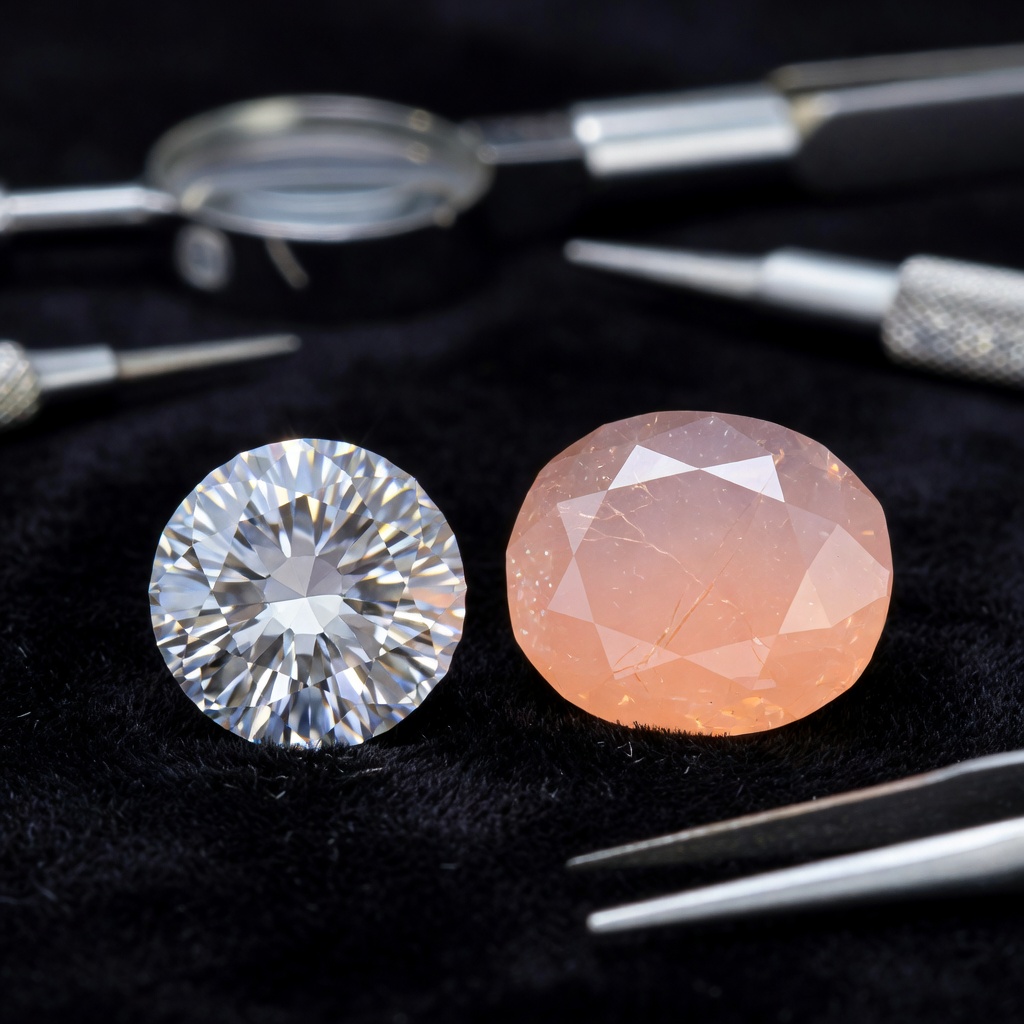
Introduction to Diamond vs Orthoclase
When selecting the perfect gemstone for jewelry, understanding the fundamental differences between precious and semi-precious materials becomes essential for making an informed decision. Diamond represents the pinnacle of mineral hardness, consisting of 99.95% carbon atoms arranged in a cubic crystal system that creates unmatched durability and brilliance. In contrast, orthoclase serves as a potassium feldspar mineral with the chemical formula KAlSi₃O₈, crystallizing in the monoclinic system and commonly recognized as moonstone when displaying the coveted adularescence effect. This comprehensive Diamond vs Orthoclase comparison explores the critical distinctions between these gemstones, weighing ultimate durability against unique optical phenomena while examining the traditional precious versus semi-precious classification systems that influence market perception and value.
Chemical Composition and Crystal Structure
The atomic architecture of these gemstones reveals why they behave so differently under physical stress and light interaction. Diamond forms deep within Earth's mantle under extreme pressure exceeding 725,000 pounds per square inch, creating an isometric crystal structure where each carbon atom bonds tetrahedrally to four neighboring atoms, resulting in extraordinary hardness and thermal conductivity. Orthoclase belongs to the expansive feldspar family, characterized by a framework silicate structure incorporating potassium, aluminum, and silicon in a complex three-dimensional lattice that contributes to its distinct cleavage properties. Understanding these Orthoclase feldspar properties requires examining cleavage planes: diamond exhibits perfect octahedral cleavage along four directions, while orthoclase demonstrates two perfect cleavages intersecting at nearly 90 degrees, making it prone to splitting under impact.
Hardness and Durability Analysis
Durability remains the most significant factor distinguishing these gemstones for practical jewelry applications and long-term wear. Diamond ranks supreme at 10 on the Mohs hardness scale, establishing it as the hardest known natural material capable of resisting scratches from any other substance, making it ideal for daily wear engagement rings and heirloom pieces. Orthoclase measures considerably softer at 6-6.5 on the Mohs hardness scale comparison, rendering it vulnerable to scratching from quartz (7 Mohs), steel files, and everyday environmental dust that contains silica particles. Regarding toughness—a mineral's resistance to breaking or chipping—diamond possesses only moderate toughness due to its perfect cleavage, creating risk of chipping along girdle edges, while orthoclase exhibits poor toughness specifically because of its two perfect cleavage planes that readily propagate fractures under blunt force.
Optical Properties and Visual Characteristics
The visual distinction between these gemstones extends far beyond simple transparency and color, encompassing complex interactions with light that create distinctly different aesthetic experiences. Diamond exhibits superior brilliance, fire (dispersion separating white light into spectral colors), and scintillation (sparkle from light return) due to its exceptionally high refractive index of 2.42 and strategic faceting that maximizes light performance. Moonstone variety orthoclase displays a phenomenon called adularescence—a billowy, moonlight-like sheen that appears to float across the gemstone's surface caused by the interlayering of orthoclase and albite feldspar at microscopic scales, creating interference patterns that no other gemstone precisely replicates. While diamonds span the spectrum from completely colorless (D-grade) to fancy vivid colors including yellow, pink, and blue, orthoclase typically presents in white, cream, pink, or yellow hues with translucent to transparent clarity that emphasizes its soft, ethereal glow rather than sharp brilliance.
Diamond vs Orthoclase: Comparative Analysis
| Characteristic | Diamond | Orthoclase (Moonstone) |
|---|---|---|
| Chemical Composition | Carbon (C) | Potassium Aluminum Silicate (KAlSi₃O₈) |
| Crystal System | Isometric (Cubic) | Monoclinic |
| Mohs Hardness | 10 (Hardest natural material) | 6-6.5 (Vulnerable to scratching) |
| Refractive Index | 2.42 (High brilliance) | 1.518-1.526 (Low brilliance) |
| Optical Phenomenon | Fire and Scintillation | Adularescence (Billowy sheen) |
| Cleavage | Perfect octahedral (4 directions) | Perfect (2 directions at ~90°) |
| Specific Gravity | 3.52 | 2.56 |
| Typical Price Range | $3,000-$30,000+ per carat | $10-$100 per carat |
| Best Jewelry Use | Daily wear, engagement rings | Earrings, pendants, occasional rings |
| Cleaning Methods | Ultrasonic, steam, chemicals safe | Mild soap and water only |
Rarity, Sourcing, and Ethical Considerations
The geological occurrence and extraction methods of these gemstones create vastly different supply chains and environmental footprints that conscious consumers must evaluate. Diamonds originate from ancient kimberlite pipes and alluvial deposits, with major commercial mines operating in Botswana, Russia, Canada, and Australia, requiring significant capital investment and infrastructure to extract ore from extreme depths or sift alluvial gravels. Orthoclase occurs as a common rock-forming mineral in granitic pegmatites and metamorphic rocks globally, making it geologically abundant, though gem-quality specimens exhibiting strong adularescence suitable for jewelry remain relatively scarce and command premium prices within the feldspar category. Gemstone sourcing ethics present stark contrasts: the diamond industry faces intensive scrutiny regarding conflict-free certification through the Kimberley Process and concerns about environmental degradation, while orthoclase mining typically involves smaller-scale operations with lower environmental disruption and reduced social impact, often occurring as byproduct recovery from feldspar mining for industrial ceramics.
Price, Value, and Investment Potential
Market valuation mechanisms create enormous price differentials between these materials, reflecting not just rarity but also marketing infrastructure and cultural significance. Diamond pricing follows the rigorous 4 Cs methodology (carat weight, cut quality, color grade, and clarity), with high-quality stones maintaining exceptional investment liquidity and retained value over decades, often appreciating during economic uncertainty as tangible assets. Orthoclase value comparison reveals remarkable affordability even for large, high-quality specimens displaying prominent adularescence, with premium moonstone varieties rarely exceeding $50-100 per carat, making substantial statement pieces accessible to modest budgets. Market perception fundamentally diverges: diamonds symbolize eternal commitment, social status, and luxury heritage backed by decades of strategic marketing, while orthoclase appeals to sophisticated collectors and designers seeking unique optical effects, esoteric beauty, and distinctive aesthetic signatures that differentiate their creations from mainstream jewelry.
Jewelry Applications and Setting Recommendations
Practical wear considerations dictate dramatically different applications for these gemstones based on their physical properties and vulnerability to damage. Diamonds suit virtually all jewelry types including solitaire engagement rings, tennis bracelets, and daily wear items subjected to constant impact and abrasion, requiring no special precautions beyond standard prong maintenance to ensure stone security. Orthoclase performs best in protective settings such as earrings, pendants, and brooches where impact risk remains minimal; when used in rings, it demands protective bezel settings that wrap the girdle completely, preventing direct blows that could activate cleavage planes. Metal compatibility considerations favor both gemstones with traditional precious metals, though orthoclase pairs particularly beautifully with rose gold to enhance warm body color tones, while diamonds offer versatile pairing with white gold, platinum, or yellow gold depending on color grade and desired contrast.
Care, Cleaning, and Maintenance Requirements
Maintenance protocols vary dramatically between these stones, reflecting their chemical stability and physical resilience to common cleaning methods and environmental exposures. Diamonds tolerate aggressive cleaning techniques including ultrasonic cleaners, steam cleaning systems, and exposure to harsh chemicals without structural damage, though settings may require professional inspection to prevent stone loss. Caring for orthoclase demands meticulous gentle handling using only lukewarm water, mild phosphate-free soap, and a soft-bristled brush to remove accumulated oils and debris; the stone remains vulnerable to acids, excessive heat, and sudden temperature changes that could cause thermal shock or etching. Storage recommendations emphasize separate compartmentalization: diamonds can scratch virtually all other gems including other diamonds, requiring individual soft pouches or lined compartments, while orthoclase needs protection from contact with harder stones (quartz, corundum, diamond) and cushioning against physical impact that might trigger cleavage failure.
Pros and Cons Summary
Evaluating these gemstones side-by-side reveals complementary strengths and weaknesses that suit different consumer priorities and lifestyle requirements. Diamond advantages include ultimate durability suitable for generational transmission, prestigious social recognition, versatile design compatibility, and investment stability that preserves capital; disadvantages encompass substantial upfront costs, ethical sourcing complexities requiring verification, and potential for industrial aesthetic sameness in lower-quality stones. Diamond alternatives like orthoclase offer distinct advantages including mesmerizing adularescence impossible to replicate synthetically, remarkable affordability enabling larger carat weights, distinctive aesthetic character, and lightweight comfort for substantial cabochon cuts; disadvantages involve poor durability for daily wear, limited mainstream recognition affecting resale value, and restricted setting options requiring protective designs. The decision matrix ultimately depends on lifestyle intensity (active versus sedentary), budget constraints (investment-grade versus fashion jewelry), and intended wear frequency (daily heirloom versus occasional statement piece).
Final Verdict: Which Gemstone Should You Choose?
Selecting between these materials requires honest assessment of wear intentions, aesthetic preferences, and practical constraints rather than defaulting to traditional assumptions about value. Choose diamond for engagement rings, family heirlooms, and daily wear jewelry requiring maximum durability, universal recognition, and traditional prestige that appreciates over time while withstanding active lifestyles without special precautions. Choose orthoclase for artistic statement pieces, dedicated moonstone jewelry collections, and budget-conscious designs prioritizing optical uniqueness and ethereal beauty over hardness, particularly when creating vintage-inspired or bohemian aesthetic collections. Consider hybrid approaches that leverage both materials strategically: utilizing diamonds for ring settings subject to impact and abrasion while incorporating orthoclase as protected decorative elements in pendants, earrings, or brooch centers where the adularescence effect can be admired without risk. When choosing diamond or orthoclase, remember that jewelry serves personal expression—select the stone that resonates with your values, lifestyle, and the specific stories you wish your pieces to tell across years of wear.
Frequently Asked Questions
Is Orthoclase Hard Enough for an Engagement Ring?
Orthoclase, measuring 6-6.5 on the Mohs scale, is generally too soft for daily-wear engagement rings. It scratches easily from everyday contact with dust particles containing quartz and can chip along its perfect cleavage planes when struck against hard surfaces. While possible with a protective bezel setting and gentle wear habits reserved for special occasions rather than constant use, diamonds (Mohs 10) remain the superior choice for engagement jewelry durability and long-term structural integrity.
What Makes Orthoclase Different from Regular Moonstone?
Orthoclase is actually the mineral species, while moonstone is a variety of orthoclase feldspar that exhibits adularescence—the billowy, glow-like optical effect resembling moonlight floating across the surface. Not all orthoclase displays adularescence; when it does, gemologists classify it as moonstone within the gem trade. Both terms refer to the same potassium feldspar composition (KAlSi₃O₈), but moonstone specifically denotes gem-quality orthoclase or orthoclase-albite intergrowths showing the characteristic schiller effect.
Can You Tell the Difference Between Diamond and Orthoclase with the Naked Eye?
Yes, several visual cues distinguish them immediately upon inspection. Diamonds exhibit intense brilliance and rainbow-like fire due to high refractive index (2.42), while orthoclase shows a softer, milky adularescence or glassy luster without sharp spectral dispersion. Orthoclase also frequently displays visible cleavage lines, internal inclusions typical of feldspar minerals, and a lower density that makes stones feel lighter than diamonds of comparable size, though definitive identification requires gemological testing with refractometers or polariscopes.
Why Is Diamond Significantly More Expensive Than Orthoclase?
Diamond commands premium prices due to extreme hardness (10 Mohs), sophisticated marketing positioning as luxury status symbols, controlled supply chains managed by major mining conglomerates, and the standardized 4Cs grading system that creates scarcity hierarchies even within abundant production. Orthoclase, while beautiful, is geologically abundant as a common rock-forming mineral, softer and less durable for jewelry, and lacks the same marketing infrastructure, certification costs, and investment demand that drive diamond values into thousands of dollars per carat.
Does Orthoclase Have Any Advantages Over Diamond Besides Price?
Orthoclase offers unique adularescence that diamonds cannot replicate, creating an ethereal, glowing appearance reminiscent of moonlight that appeals to mystical and romantic aesthetics. It is significantly lighter in weight than diamond (specific gravity 2.56 versus 3.52), making large statement cabochons more comfortable to wear in earrings and pendants without causing strain. Additionally, orthoclase mining typically involves less environmental disruption, smaller-scale extraction operations, and fewer ethical concerns regarding conflict funding compared to diamond extraction, appealing to environmentally conscious consumers.
How Should I Clean Orthoclase Jewelry Compared to Diamond Jewelry?
Clean orthoclase using only lukewarm water, mild dish soap without phosphates or abrasives, and a soft-bristled brush like a baby toothbrush, gently scrubbing to remove oils and dirt without applying pressure. Never use ultrasonic cleaners, steamers, ammonia-based solutions, or chemical jewelry dips, as orthoclase is sensitive to heat, acids, and vibration that could cause cleavage failure or surface etching. Diamonds, conversely, tolerate all cleaning methods including ultrasonic cavitation and high-pressure steam cleaning without damage, though settings should be checked periodically for security.
Can Orthoclase Scratch Glass Like Diamond Can?
Orthoclase (6-6.5 Mohs) can technically scratch glass (5.5 Mohs), but with difficulty and significant risk to the stone itself due to its perfect cleavage planes. Diamond (10 Mohs) scratches glass effortlessly and without self-damage. While both are technically harder than glass, orthoclase's structural weakness makes it risky to use for scratch testing, as the pressure required might cause the stone to split along cleavage directions rather than leaving a scratch on the glass surface.
Is Orthoclase Considered a Precious or Semi-Precious Gemstone?
Orthoclase is classified as semi-precious, specifically as a variety of feldspar within the tectosilicate mineral group. When displaying adularescence, it is marketed as moonstone, one of the traditional semi-precious gems recognized in historical birthstone lists and metaphysical crystal healing practices. Unlike diamond, which is considered precious along with ruby, sapphire, and emerald, orthoclase is valued for its unique optical effects and accessibility rather than extreme rarity or exceptional hardness, placing it firmly in the semi-precious category despite its beauty and desirability.