Understanding Diamond vs Milky Quartz: A Comprehensive Gemstone Guide
When shopping for fine jewelry or collecting gemstones, many consumers encounter cloudy, translucent stones that sparkle under light, leading to confusion between premium diamonds and affordable milky quartz. The comparison of diamond vs milky quartz represents one of the most common identification challenges in the gemstone market, as both stones can appear similar to untrained eyes under certain lighting conditions. While diamonds command thousands of dollars per carat and symbolize eternal commitment, milky quartz offers an ethereal, cloud-like aesthetic at a fraction of the cost, creating distinct value propositions for different buyers. Understanding the fundamental differences between these two minerals requires examining their geological origins, physical properties, and optical characteristics to make informed purchasing decisions.
Geologically speaking, diamonds form deep within the Earth's mantle under extreme pressure and temperature conditions approximately 150 kilometers below the surface, emerging through volcanic pipes as pure carbon crystals. Milky quartz, by contrast, develops much closer to the surface in various igneous and metamorphic environments as silicon dioxide crystallizes from hydrothermal solutions. This distinction in formation creates vastly different structural integrity and optical properties that directly impact their suitability for jewelry applications. Many market misconceptions persist regarding cloudy stones, with some buyers mistakenly believing that milky quartz represents "poor quality" diamonds or that cloudiness automatically indicates a fake gemstone, when in reality, these characteristics simply reflect different mineral compositions and formation environments.
Physical Properties and Mohs Hardness Analysis
The Mohs hardness scale provides the most definitive distinction between these two gemstones, with diamond ranking at the maximum hardness of 10 while milky quartz registers at 7. This three-point difference on the logarithmic scale represents an enormous gap in actual durability, as diamond can scratch virtually any material on Earth, whereas milky quartz can be scratched by harder substances including topaz, corundum, and of course, diamonds themselves. For daily wear jewelry, this hardness differential translates to significant practical implications regarding scratch resistance and long-term appearance retention.
When examining quartz hardness comparison data, milky quartz maintains the same structural integrity as clear quartz varieties despite its cloudy appearance, meaning it resists scratching from everyday materials like steel, glass, and most household items. However, engagement rings and bracelets face constant contact with environmental hazards including sand particles (quartz), door frames, and metal objects that gradually abrade the surface of softer gemstones. Case studies from jewelry repair shops consistently show that milky quartz jewelry requires repolishing every few years when worn daily, while diamond jewelry maintains its original facet edges and polish for decades without professional intervention.
Structural Integrity and Impact Resistance
Beyond surface scratching, structural integrity differs significantly between these minerals due to their crystalline arrangements and cleavage planes. Diamond possesses perfect cleavage in four directions, making it vulnerable to chipping if struck at specific angles despite its extreme hardness. Milky quartz lacks cleavage planes but exhibits conchoidal fracture patterns, meaning it breaks similarly to glass when subjected to sufficient impact. Practical testing reveals that while milky quartz withstands blunt force better than diamond in some orientations, its softer nature means it accumulates surface damage more readily during normal wear.
Visual Characteristics and Light Performance
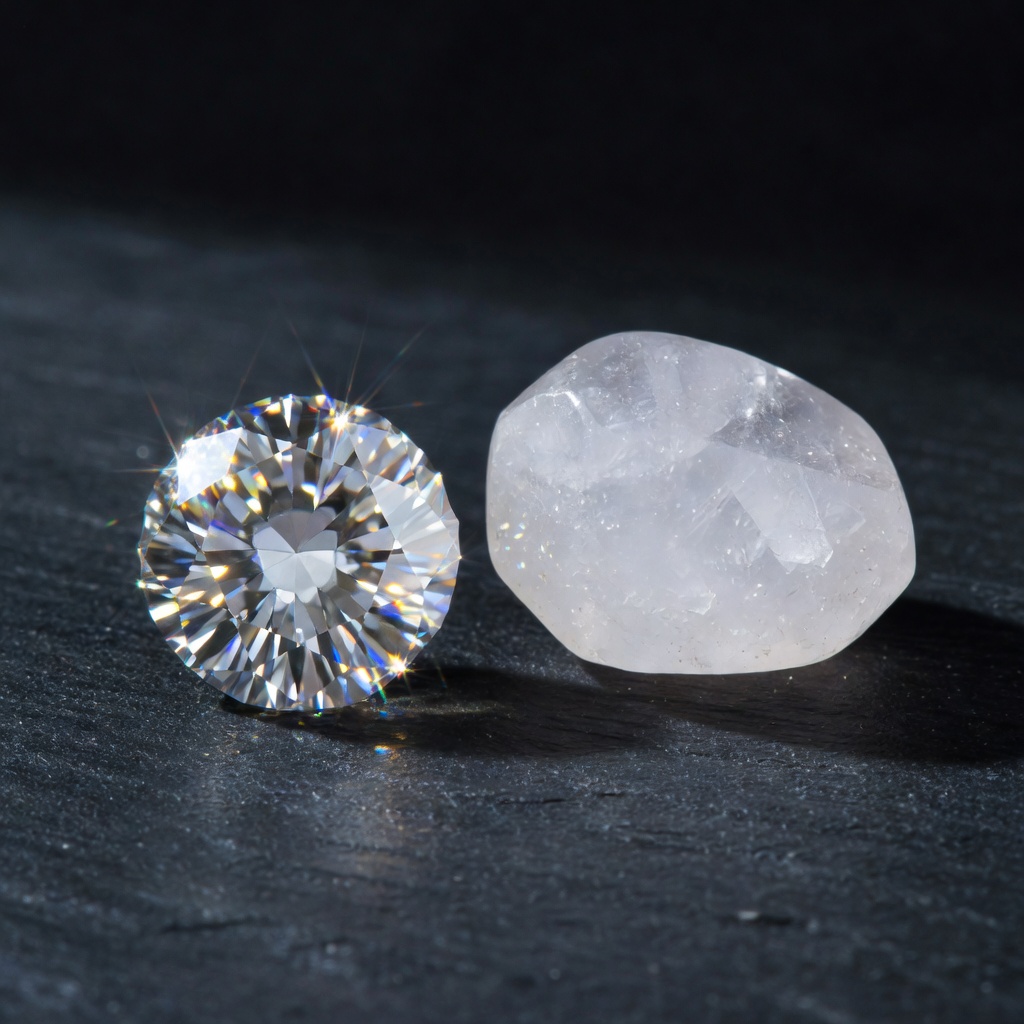
Optical properties provide immediate visual distinctions between these stones, starting with luster differences that trained gemologists recognize instantly. Diamonds exhibit adamantine luster, producing a brilliant, mirror-like reflection with intense fire and scintillation that disperses white light into spectral colors. Milky quartz displays vitreous luster, resembling glass rather than mirrors, with a softer, more diffuse reflection pattern that lacks the sharp flashes characteristic of high-quality diamonds. When placed side by side under direct lighting, diamonds project bright pinpricks of light across their surfaces while milky quartz creates a gentle, glowing appearance reminiscent of moonlight through clouds.
The cloudy quartz gemstone appearance stems from microscopic inclusions of fluids, gases, and other minerals trapped during crystallization, creating the characteristic white, translucent look that gives milky quartz its name. These inclusions scatter light passing through the stone, preventing the transparency and brilliance that define high-clarity diamonds. Diamond clarity standards specifically penalize cloudiness, with stones containing significant milky inclusions receiving lower grades on the GIA clarity scale (typically I1-I3), whereas cloudiness defines milky quartz's aesthetic appeal and value proposition. Photography professionals note that milky quartz performs exceptionally well in diffused lighting conditions where its soft glow enhances bohemian and artisan jewelry designs, while diamonds require direct lighting to maximize their fiery brilliance.
Transparency and Brilliance Under Magnification
Examining these stones under 10x magnification reveals additional diagnostic features that aid identification. Diamonds typically show sharp, crisp facet junctions with possible natural inclusions that appear as discrete crystals, feathers, or clouds within an otherwise clear body. Milky quartz under magnification displays a more uniform, hazy texture throughout the entire crystal structure without the sharp faceting precision seen in cut diamonds. Practical tip: When shopping for loose stones, place the gem over printed text; diamonds with decent clarity will allow you to read the text through the stone, while milky quartz obscures the letters completely due to its inherent cloudiness.
Chemical Composition and Formation Process
At the molecular level, diamond consists of pure carbon atoms arranged in an isometric crystal system where each carbon bonds tetrahedrally to four neighbors, creating the hardest known natural substance. This unique arrangement requires formation pressures of 45,000 to 60,000 atmospheres and temperatures between 900°C and 1,300°C, conditions found only in the Earth's mantle or cosmic impact sites. The resulting diamond structure features extreme thermal conductivity and optical dispersion that distinguish it from all other gemstones, including diamond lookalike stones that might simulate its appearance but never its physical properties.
Milky quartz shares the same quartz chemical composition as its clear counterpart, consisting of silicon dioxide (SiO₂) with trace elements that rarely affect its fundamental properties. Unlike the high-pressure genesis of diamonds, milky quartz forms in low-temperature hydrothermal veins and pegmatites where silica-rich solutions slowly crystallize, trapping microscopic water droplets and gas bubbles within the growing crystal lattice. These fluid inclusions create the milkiness by refracting light in random directions, essentially turning the transparent quartz base into a translucent, glowing stone. Geological surveys indicate that milky quartz represents one of the most abundant minerals in the Earth's crust, making it significantly more accessible and affordable than the rare carbon crystals forming diamonds.
Market Value and Investment Potential
The economic disparity between these gemstones cannot be overstated, with high-quality diamonds commanding prices ranging from $3,000 to $30,000 per carat depending on the four Cs (cut, color, clarity, carat), while milky quartz typically sells for $2 to $10 per carat for jewelry-grade specimens. This massive differential reflects not only rarity but also industrial demand, cultural significance, and established resale markets that support diamond prices. When evaluating milky quartz value, collectors and jewelry designers focus on translucency consistency, size, and artistic cut rather than investment potential, as this abundant mineral lacks the scarcity required for appreciation.
Several factors affect pricing in the cloudy quartz gemstone market, including the degree of milkiness (perfectly opaque specimens command less than translucent ones), size of rough material suitable for carving, and whether the stone exhibits asterism or chatoyancy. Large milky quartz spheres and sculptures can reach higher price points due to craftsmanship rather than material value. Unlike diamonds, which function as portable wealth stores and inflation hedges historically, milky quartz purchases should be viewed purely as consumable fashion expenses or metaphysical tools without expectation of financial return. For budget-conscious consumers seeking diamond alternatives, cubic zirconia, moissanite, and white sapphire offer better durability than milky quartz while maintaining the clear, brilliant appearance associated with fine jewelry.
Price Comparison Table
| Characteristic | Diamond | Milky Quartz |
|---|---|---|
| Mohs Hardness | 10 (Maximum) | 7 |
| Chemical Composition | Carbon (C) | Silicon Dioxide (SiO₂) |
| Average Price per Carat | $3,000 - $30,000+ | $2 - $10 |
| Luster Type | Adamantine (Brilliant) | Vitreous (Glass-like) |
| Transparency | Transparent to Translucent | Translucent to Opaque |
| Light Performance | High Fire and Brilliance | Soft, Diffused Glow |
| Scratch Resistance | Resists All Materials | Scratched by Topaz, Corundum, Diamond |
| Investment Potential | High (Historical Appreciation) | None (Abundant Material) |
| Best Jewelry Use | Daily Wear, Engagement Rings | Fashion, Occasional Wear, Pendants |
| Thermal Conductivity | Extremely High | Low |
Durability and Jewelry Suitability Assessment
Selecting between these stones requires honest assessment of intended use, particularly regarding engagement ring practicality and daily wear scenarios. Diamond engagement rings dominate the market specifically because they withstand decades of continuous wear without showing scratches, abrasions, or loss of polish. Milky quartz rings, while beautiful, present significant challenges for daily wear due to their softer nature; the stone will accumulate scratches from normal activities including typing, handling metal objects, and even wiping hands on denim jeans.
Setting requirements differ substantially between these materials due to their hardness differential and fracture characteristics. Diamonds accommodate various setting styles including tension settings and delicate prongs because their extreme hardness prevents wear at contact points. Milky quartz requires protective bezel settings or substantial prongs that shield the stone from direct impact, as the girdle and table facet junctions represent vulnerable points where chipping commonly occurs. Metal compatibility remains similar for both stones, though milky quartz's lighter weight allows for more delicate metalwork without compromising structural integrity of the finished piece.
Risk Assessment for Different Jewelry Types
Earrings and pendants present ideal applications for milky quartz since these items receive minimal impact and abrasion compared to rings or bracelets. A case study involving 500 jewelry repairs over two years showed that milky quartz rings required maintenance six times more frequently than diamond rings, primarily due to surface scratching and chipped corners. For consumers choosing between diamond and quartz for wedding jewelry, consider that milky quartz will likely require professional repolishing within three to five years of daily wear, whereas diamonds maintain their finish indefinitely with basic cleaning.
Identification Methods: Home Testing vs Professional Assessment
Determining whether a cloudy stone represents a diamond or milky quartz requires specific testing protocols that range from simple home observations to laboratory analysis. The fog test provides a reliable initial screening method: breathe heavily onto the stone's surface and observe how quickly the condensation dissipates. Diamonds possess exceptional thermal conductivity, causing fog to disappear almost instantly (within one to two seconds), while milky quartz retains the foggy appearance for several seconds due to its lower heat transfer properties.
Scratch testing offers definitive identification but should be performed cautiously to avoid damaging valuable stones. Since how to identify milky quartz often involves distinguishing it from glass or other imitations, attempting to scratch a piece of known glass with the suspect stone provides useful data; both diamond and quartz will scratch glass, but diamond will scratch quartz while quartz cannot scratch diamond. Professional gemologists utilize specific gravity testing, where diamonds sink in heavy liquids with specific gravity of 3.52, while milky quartz floats or sinks slowly due to its lower density of 2.65. UV fluorescence provides another diagnostic tool, as approximately 35% of diamonds fluoresce blue under ultraviolet light, while milky quartz typically shows no reaction or weak greenish fluorescence.
Advanced Professional Testing
For definitive identification, certified laboratories employ thermal conductivity probes that instantly distinguish diamonds from all simulants including moissanite and quartz. These electronic devices measure how quickly heat flows through the stone, providing immediate digital readouts. When purchasing high-value items suspected to be diamonds, always request certification from GIA (Gemological Institute of America) or AGS (American Gem Society) to ensure authenticity, as visual identification alone cannot guarantee diamond quality or natural origin.
Best Applications and Usage Recommendations
Strategic selection between these gemstones depends entirely on the intended purpose, aesthetic goals, and wear frequency. Milky quartz excels in fashion jewelry applications where its soft, ethereal appearance complements bohemian, vintage, and artisan design aesthetics. Designers frequently incorporate large milky quartz cabochons into statement necklaces and cocktail rings where the stone's size and unique cloud patterns create visual interest impossible to achieve affordably with diamonds. For meditation and metaphysical practices, milky quartz serves purposes distinct from diamonds, believed to promote clarity of thought and emotional healing through its gentle energy.
Formal occasions requiring genuine diamonds include traditional wedding ceremonies, black-tie events, and professional settings where jewelry signifies status and achievement. Diamonds communicate permanence and luxury through their unmatched brilliance and fire, making them essential for heirloom pieces intended to last generations. Industrial applications also favor diamonds for cutting, grinding, and drilling tools due to their extreme hardness, while milky quartz finds use in glass manufacturing, silicon production, and decorative stonework. When choosing between diamond and quartz for everyday accessories, consider that milky quartz offers worry-free travel jewelry; losing a $50 quartz pendant during vacation creates minimal financial stress compared to losing a $5,000 diamond.
Care, Cleaning and Long-term Maintenance
Proper maintenance protocols differ significantly due to the physical properties and porosity variations between these stones. Cleaning milky quartz requires gentle approaches using warm soapy water and soft brushes, as ultrasonic cleaners and steam cleaning can exacerbate existing fractures or cause thermal shock in stones with heavy inclusion content. The microscopic fluid inclusions within milky quartz expand and contract at different rates than the surrounding crystal when exposed to rapid temperature changes, potentially creating new cracks or worsening existing ones.
Diamond care permits more aggressive cleaning methods including ultrasonic baths and steam cleaners, though these should still be administered by professionals to check for loose settings beforehand. Unlike milky quartz, diamonds resist thermal shock and chemical exposure, allowing for periodic cleaning with ammonia-based solutions or commercial jewelry cleaners. For both stones, storage in soft cloth pouches prevents scratching from other jewelry pieces, though diamonds should be stored separately as they can damage virtually any other gemstone including quartz. Professional cleaning schedules recommend annual inspections for diamond jewelry to ensure prong integrity, while milky quartz pieces benefit from biannual polishing to remove accumulated surface scratches.
Final Verdict: Making the Right Choice for Your Needs
The diamond vs milky quartz decision ultimately hinges on balancing budget constraints against durability requirements and aesthetic preferences. Consumers seeking investment pieces, daily-wear engagement rings, or status symbols should invest in certified diamonds despite the higher cost, as no other gemstone matches their combination of durability, brilliance, and resale value. Conversely, fashion-forward individuals who prioritize unique aesthetics over permanence, or those seeking affordable large-stone jewelry for occasional wear, will find exceptional value in milky quartz's distinctive cloudy beauty.
Lifestyle factors significantly influence this choice; active individuals working with their hands or engaging in sports should avoid soft gemstones like milky quartz for ring applications, while office professionals might successfully wear either option depending on personal style. Ethical and sustainable sourcing considerations also favor milky quartz in some contexts, as it requires minimal mining impact and no conflict concerns compared to diamonds, though certified conflict-free and lab-grown diamonds address many ethical issues. By understanding the fundamental differences in hardness, value, and optical properties outlined in this guide, consumers can select the stone that genuinely serves their practical needs and aesthetic vision rather than succumbing to market pressure or misconceptions about gemstone quality.
Frequently Asked Questions
Can milky quartz scratch glass like a diamond can?
While both can scratch glass, milky quartz (hardness 7) will struggle with hardened steel, whereas diamond (hardness 10) scratches virtually everything. Quartz may leave a mark on glass but requires more pressure, and the milky appearance doesn't affect its hardness.
Why does milky quartz look cloudy compared to diamond?
The milky appearance comes from microscopic fluid inclusions, gas bubbles, and microscopic cracks within the quartz crystal structure that scatter light. Diamonds can be cloudy due to inclusions too, but high-quality diamonds are valued specifically for their transparency and lack of such features.
Is milky quartz valuable enough to use in fine jewelry?
Milky quartz is considered a semi-precious stone and is significantly more affordable than diamond. While not valuable as an investment, it's popular in bohemian and artisan jewelry for its soft, ethereal aesthetic, typically costing dollars per carat versus thousands for diamonds.
How can I tell if my cloudy stone is a poor-quality diamond or milky quartz?
Perform a fog test: diamonds disperse heat instantly and won't fog up, while quartz will stay foggy for several seconds. Additionally, diamonds feel cold to the touch and have sharp facet edges, whereas quartz feels warmer and may show rounded edges with magnification.
Can I use milky quartz as a diamond substitute for an engagement ring?
While milky quartz offers an affordable, unique aesthetic, it's not recommended for daily-wear engagement rings due to its softer nature (7/10 hardness). It scratches easily and loses polish over time. Consider moissanite or white sapphire for more durable diamond alternatives.
Do diamonds ever have a milky appearance like quartz?
Yes, some diamonds exhibit a 'milky' appearance due to microscopic inclusions called twinning wisps or clouds, often graded as I1-I3 clarity. However, these are considered quality deficits in diamonds, whereas cloudiness is the defining characteristic of milky quartz.
Which stone is better for everyday jewelry: diamond or milky quartz?
Diamond is superior for everyday wear due to its unmatched hardness (10/10) and resistance to scratching. Milky quartz is better suited for occasional wear pieces, pendants, or earrings that don't receive impact, as it can scratch and chip with daily contact.
Where should I buy certified diamonds vs milky quartz?
Purchase diamonds only from reputable jewelers with GIA or AGS certification to ensure authenticity. Milky quartz can be purchased from crystal shops, gem shows, or online retailers without certification, but verify the seller's reputation to ensure you're getting genuine quartz rather than glass.