Introduction: Why Compare Diamond vs Lapis Lazuli?
When navigating the world of precious gemstones, few comparisons seem as stark yet fascinating as Diamond vs Lapis Lazuli. One represents the pinnacle of geological pressure and modern luxury, while the other embodies ancient artistry and metaphysical tradition. Diamonds, composed of pure carbon crystallized under immense heat and pressure deep within Earth's mantle, have dominated the jewelry market as the ultimate symbol of eternal commitment and status. In contrast, lapis lazuli, a metamorphic rock featuring deep celestial blue hues peppered with golden pyrite, has adorned royalty and spiritual leaders for over six thousand years, serving as both ornamental stone and artistic pigment.
Consumers increasingly encounter this gemstone comparison guide when exploring birthstone alternatives, budget-conscious jewelry options, or meaningful spiritual talismans. Perhaps you are seeking a September birthstone that diverges from traditional sapphire, or maybe you are weighing the practical durability of an engagement stone against the symbolic depth of an ancient gem. Budget considerations also drive this comparison, as these stones occupy vastly different price brackets while both offering significant aesthetic impact. Additionally, the growing interest in crystal healing and metaphysical properties has renewed attention to lapis lazuli meaning, creating demand for this historic stone alongside traditional diamond selections.
This comprehensive analysis examines every critical factor from geological formation to investment potential, providing actionable insights for collectors, couples, and jewelry enthusiasts. Whether you prioritize the unmatched hardness and brilliance of carbon crystals or the rich cultural heritage and accessibility of Afghanistan's famous blue stone, understanding their distinct characteristics ensures you make an informed decision aligned with your lifestyle, values, and aesthetic preferences.
Origin and Geological Composition
Formation Deep Within the Earth
Diamonds begin their journey approximately 140 to 190 kilometers beneath Earth's surface in the mantle's rigid lithosphere, where temperatures exceed 1,000 degrees Celsius and pressure reaches 50 kilobars. Under these extreme conditions, pure carbon atoms arrange themselves into isometric crystal structures over periods spanning 1 to 3 billion years, making diamonds among the oldest materials you can hold. Volcanic eruptions through kimberlite pipes then transport these crystals rapidly to surface deposits, where miners extract them from ancient volcanic necks or alluvial deposits in riverbeds across Botswana, Russia, Canada, and Australia.
Lapis lazuli forms through an entirely different metamorphic process occurring when limestone undergoes contact metamorphism with igneous intrusions. Unlike diamonds' pure elemental composition, lapis lazuli consists primarily of the mineral lazurite (25-40%), accompanied by calcite (white veins), pyrite (golden flecks), and other silicate minerals. This composite structure creates the stone's distinctive appearance but also determines its physical limitations. The most coveted specimens originate specifically from the Sar-e-Sang mines in Afghanistan's Badakhshan Province, where miners have extracted this material using traditional methods for over 7,000 years, yielding stones with the intense ultramarine blue that Renaissance masters once ground into pigment more valuable than gold.
Mining Location and Extraction Challenges
Modern diamond mining involves sophisticated technology including open-pit excavations, underground tunnels, and marine retrieval from ocean floors, with operations requiring massive capital investment and environmental management protocols. Conversely, Afghan lapis mining remains largely artisanal, with miners using hand tools and pneumatic drills in treacherous mountain conditions at elevations exceeding 3,000 meters. This difference in extraction methods significantly impacts availability, pricing, and ethical sourcing considerations. While diamond production is distributed across multiple continents with established certification schemes like the Kimberley Process, high-quality lapis lazuli relies heavily on a single geographic region, creating supply vulnerabilities but also ensuring the stone's exotic provenance remains a key value factor.
Physical Properties and Durability Metrics
Hardness and Wear Resistance
When evaluating diamond hardness, gemologists reference the Mohs scale, where this carbon crystal achieves a perfect 10—the highest rating possible and the definition of hardness against which all other minerals are measured. This exceptional hardness means diamonds resist scratching from any other material, maintaining their polish and facet edges indefinitely even with daily wear. For consumers, this translates to engagement rings and bracelets that withstand decades of active lifestyles without showing surface damage, provided the stone remains secure in its setting.
Lapis lazuli properties present a dramatically different durability profile, ranking only 5 to 5.5 on the Mohs scale—comparable to window glass or a steel knife blade. This moderate hardness means the stone can scratch from everyday encounters with household dust (which often contains silica particles ranking 7 on the scale), keys, or other jewelry. Practical application requires careful consideration: while diamonds forgive rough handling during gardening or sports activities, lapis lazuli demands protective settings and occasional-wear status to prevent surface dulling and abrasion.
Structural Integrity and Setting Requirements
Despite their extreme hardness, diamonds possess perfect octahedral cleavage, meaning they can split cleanly along specific planes if struck with sufficient force at the correct angle—a vulnerability that requires skilled setting techniques to protect vulnerable points. Lapis lazuli lacks cleavage but features a granular, aggregate structure where individual mineral components (lazurite, calcite, pyrite) respond differently to stress, potentially causing pitting or surface irregularities over time. The specific gravity also differs significantly: diamonds measure 3.52, creating substantial heft for their size, while lapis lazuli ranges from 2.7 to 2.9, resulting in lighter jewelry pieces that may require different design considerations to achieve desirable weight distribution.
| Property | Diamond | Lapis Lazuli |
|---|---|---|
| Mohs Hardness | 10 (Highest) | 5-5.5 (Moderate) |
| Specific Gravity | 3.52 | 2.7-2.9 |
| Chemical Composition | Pure Carbon (C) | Rock Aggregate (Lazurite, Calcite, Pyrite) |
| Cleavage | Perfect Octahedral | None (Granular) |
| Refractive Index | 2.42 (High Brilliance) | 1.50 (Opaque) |
| Wear Suitability | Daily Wear/Rings | Occasional Wear/Pendants |
Visual Appearance and Color Characteristics
Diamond Optics and Light Performance
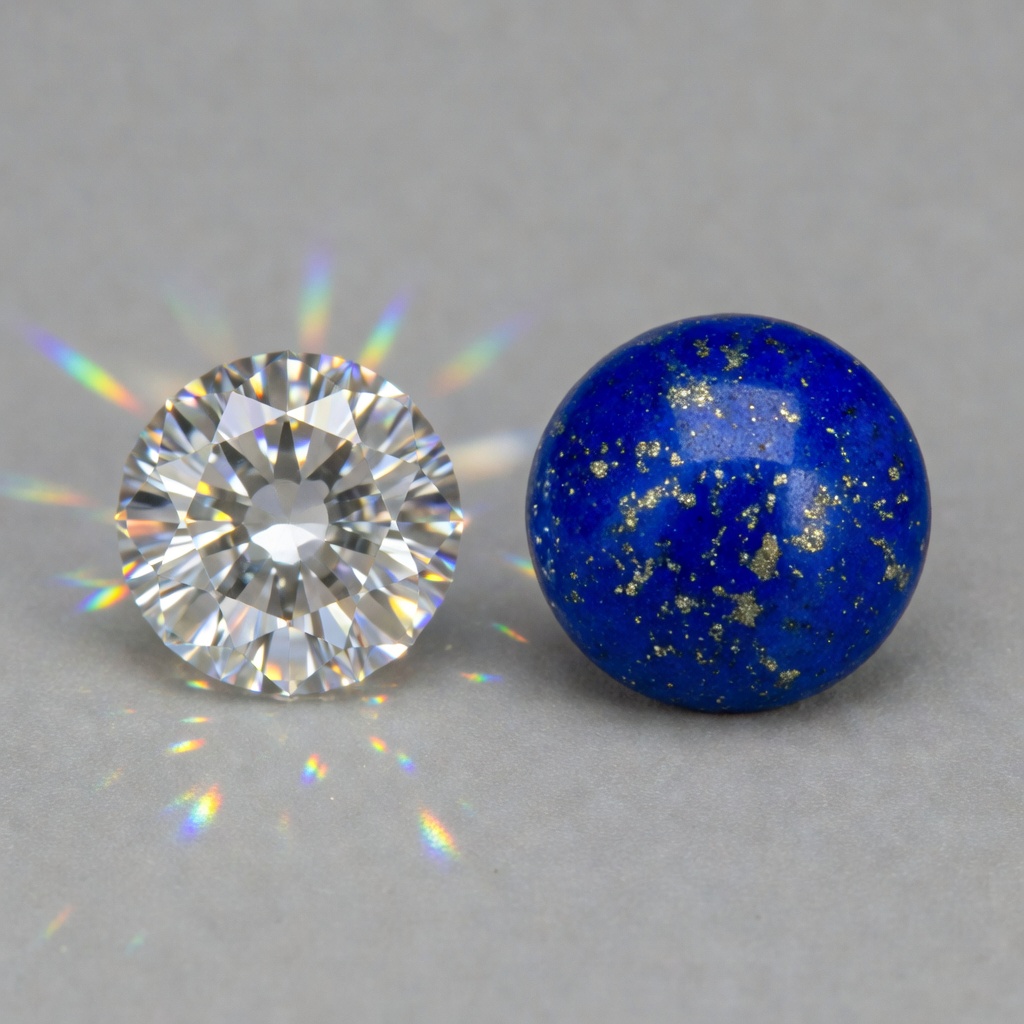
Diamonds captivate through their interaction with light, displaying three distinct optical properties: brilliance (white light reflection), fire (spectral color dispersion), and scintillation (sparkle from movement). Gemological laboratories grade diamond color grades on a D-Z scale, with D representing completely colorless stones commanding premium prices, while Z shows noticeable yellow or brown tinting. Beyond traditional white diamonds, fancy colors including pink, blue, and yellow occur through structural anomalies or trace elements like nitrogen and boron, with intense fancy vivid hues sometimes exceeding colorless stones in value. Clarity assessment examines internal inclusions and external blemishes under 10x magnification, ranging from Flawless (no inclusions visible) to Included (visible to naked eye), with most jewelry-grade stones falling in the VS (Very Slightly Included) to SI (Slightly Included) range where imperfections remain invisible without magnification.
Lapis Lazuli Signature Aesthetic
Unlike diamonds' transparent crystalline structure, lapis lazuli meaning manifests through its opaque, velvety ultramarine to violet-blue base color, historically so prized that Renaissance painters reserved it for the Virgin Mary's robes. The stone's distinctive appearance comes from golden pyrite inclusions—often mistaken for gold but actually iron sulfide creating a "starry night" effect against the deep blue lazurite. White calcite veins occasionally traverse the surface, with premium specimens showing minimal calcite and evenly distributed fine pyrite rather than chunky metallic clusters. While diamonds require precise faceting to maximize light return, lapis lazuli artisans typically employ cabochon cuts (smooth, domed surfaces) or intricate carvings to showcase color consistency and natural patterns, making each piece uniquely organic rather than standardized.
Price, Value Determinants and Market Analysis
Diamond Pricing Structures
The diamond price per carat follows a complex valuation system based on the Four Cs: Cut, Color, Clarity, and Carat weight. A one-carat, GIA-certified diamond with Excellent cut, G color (near-colorless), and VS2 clarity typically ranges from $4,000 to $6,000, while premium D-color, Internally Flawless stones can exceed $20,000 per carat. Pricing increases exponentially with size—a two-carat diamond costs significantly more than double the price of two one-carat stones due to rarity. Certification from reputable laboratories like GIA or AGS provides essential documentation of these characteristics, creating liquidity in the resale market and ensuring consumers receive exactly what they pay for.
Lapis Lazuli Value Factors
Lapis lazuli value operates on an entirely different economic scale, with high-quality Afghan material typically retailing between $1 and $10 per carat for jewelry-grade cabochons. Value determinants focus on color intensity (deep, uniform blue without greenish tint), pyrite distribution (fine, evenly scattered inclusions preferred over dense clusters), and minimal calcite veining. Exceptional specimens exceeding 20 carats with intense color and perfect pyrite patterns might reach $50-$100 per carat, while antique carved pieces or historical artifacts command premium prices based on provenance rather than mineral content. For budget-conscious consumers, this means acquiring a substantial 50-carat lapis lazuli pendant might cost less than a single one-carat diamond of moderate quality, offering dramatic visual impact at accessible price points.
Symbolism, History and Cultural Significance
Diamond: Modern Emblems of Eternity
Diamonds have become synonymous with eternal love and unbreakable commitment largely due to De Beers' 1947 "A Diamond is Forever" advertising campaign, which cemented the tradition of diamond engagement rings in Western culture. As April's official birthstone, diamonds represent clarity, strength, and abundance in metaphysical traditions, believed to amplify energy and provide protection to the wearer. Royal crowns and state regalia historically featured diamonds not merely for beauty but as demonstrations of imperial power and indestructible authority, with stones like the Koh-i-Noor passing between monarchies as symbols of conquest and legitimacy.
Lapis Lazuli: Ancient Wisdom and Spiritual Truth
The lapis lazuli spiritual meaning stretches back to ancient Egypt, where priests ground the stone into cosmetics for Cleopatra and inlaid it into King Tutankhamun's death mask to represent the hair of the gods and protection in the afterlife. Renaissance artists revered lapis as the source of ultramarine pigment, reserving the color for the most sacred subjects in religious paintings due to the material's cost exceeding gold. As a birthstone alternative for September (alongside sapphire), lapis lazuli embodies wisdom, truth, and inner vision, associated with the third eye chakra in crystal healing practices. Unlike diamonds' emphasis on external displays of commitment, lapis traditionally supports introspection, authentic communication, and intellectual clarity, appealing to those seeking jewelry with meditative or creative significance.
Best Jewelry Applications and Design Considerations
Optimal Settings for Diamond Durability
Diamonds excel in high-contact jewelry pieces due to their unmatched hardness, making them ideal for engagement rings, wedding bands, tennis bracelets, and daily-wear earrings. Prong settings, particularly four or six-prong configurations, maximize light exposure while securely holding the stone, though bezel settings offer additional protection for active lifestyles. Because diamonds resist scratching, they withstand the abrasion encountered in professions involving typing, childcare, or outdoor activities without requiring special precautions beyond annual prong inspections.
Strategic Use of Lapis Lazuli Jewelry
Lapis lazuli jewelry requires more strategic application, thriving in statement necklaces, drop earrings, brooches, and cocktail rings designed for occasional wear rather than daily exposure. Jewelers recommend protective bezel or halo settings that shield the stone's edges from impact, while avoiding tension settings that concentrate stress on lapis's relatively soft structure. Bracelets and daily-wear rings present particular risks, as these pieces frequently contact hard surfaces during writing, handwashing, or sports. For those seeking the blue stone's aesthetic in bridal contexts, consider lapis lazuli as accent stones in earrings or pendants rather than center stones in engagement rings, preserving the gem's beauty through limited exposure to harsh conditions.
Care, Cleaning and Maintenance Requirements
Maintaining Diamond Brilliance
Diamond maintenance remains straightforward due to the stone's chemical inertness and hardness. Home cleaning utilizing warm water, mild dish soap, and a soft brush effectively removes accumulated oils and lotions, while ultrasonic cleaners and steam cleaning devices safely restore brilliance without damaging the gem. Professional jewelers recommend annual inspections to check for loose prongs or structural wear in the setting rather than the diamond itself. Unlike softer gems, diamonds tolerate exposure to household chemicals, chlorinated pools, and temperature variations, though removing rings during heavy manual labor prevents potential chipping from hard impacts despite the stone's scratch resistance.
Preserving Lapis Lazuli Integrity
Lapis lazuli cleaning demands meticulous attention due to the stone's composite nature and sensitivity to chemicals. Never immerse lapis in water or cleaning solutions, as porous calcite components can absorb liquids, causing discoloration or structural weakening. Instead, gently wipe the surface with a soft, damp cloth followed by immediate drying with a lint-free towel. Store lapis pieces separately in soft cloth pouches away from harder gemstones (including diamonds) that could scratch the surface. Professional re-polishing every three to five years can restore luster to worn surfaces, but prevention through proper storage and limited chemical exposure remains essential for longevity.
Investment Potential and Resale Market
Diamonds as Financial Assets
For those considering gemstone investment, GIA-certified diamonds exceeding one carat with Excellent cuts and high color/clarity grades offer the most liquid alternative investment vehicle within the colored stone market. These stones maintain transparent pricing through Rapaport Price Lists and auction records, with rare fancy colors (particularly pink and blue) showing appreciation rates exceeding traditional investments during certain market cycles. However, retail buyers should recognize that diamond resale typically realizes 20-40% of original purchase price unless acquired through wholesale channels, with investment-grade stones requiring significant capital ($20,000+) to appreciate meaningfully.
Lapis Lazuli Collectibility vs. Investment
Lapis lazuli presents limited standardized investment potential due to the absence of universal grading systems and certified resale channels. While museum-quality Afghan rough material exceeding 100 carats with intense blue color and minimal calcite may appreciate among specialized collectors, and antique carved pieces (particularly Chinese snuff bottles or Mughal objets d'art) command strong prices at auction, these markets require specialized knowledge and connections. Unlike diamonds, lapis does not serve as an inflation hedge or portable wealth store, though its value remains stable due to restricted supply from traditional Afghan mines and increasing export restrictions. Collectors should purchase lapis for aesthetic and cultural enjoyment rather than financial appreciation, with the understanding that liquidity depends entirely on finding the right private buyer or specialty dealer.
Final Verdict: Which Gemstone Should You Choose?
Selecting between diamond vs lapis lazuli ultimately depends on aligning gemstone characteristics with personal priorities and intended use. Choose diamonds when seeking engagement rings or daily-wear jewelry that must withstand decades of active use without showing wear, when investment liquidity and certification documentation matter, or when traditional symbolism of eternal love and April birthstone significance resonate with your values. The unmatched hardness and brilliance of diamonds justify their premium pricing for pieces intended as lifetime heirlooms.
Opt for lapis lazuli when working within modest budgets while desiring substantial, visually striking jewelry, when drawn to September birthstone alternatives with rich historical significance, or when spiritual practices emphasizing wisdom and truth guide your selection. The stone's distinctive appearance suits statement pieces and artistic expressions rather than utilitarian daily wear. Many collectors ultimately embrace a hybrid approach, maintaining diamond studs or solitaire rings for timeless elegance while incorporating lapis lazuli jewelry as colorful accent pieces that invite conversation about ancient history and artistic tradition. By understanding each stone's unique strengths and limitations, you can build a jewelry collection that balances practical durability with cultural depth.
Frequently Asked Questions
Which is harder, diamond or lapis lazuli?
Diamond is significantly harder, ranking 10 on the Mohs scale (the highest possible), while lapis lazuli ranks only 5-5.5. This means diamond can scratch any material including lapis lazuli, while lapis can be scratched by steel knives, glass, and even hard minerals in household dust. For jewelry, diamonds are suitable for daily wear in rings; lapis lazuli requires protective settings and is better for occasional-wear pieces.
Is lapis lazuli more expensive than diamond?
No, diamonds are substantially more expensive. High-quality diamonds cost $1,500-$15,000+ per carat, while premium Afghan lapis lazuli typically costs $1-$10 per carat. However, museum-quality lapis carvings or historic pieces can command high prices. For a 1-carat stone, expect to pay 100-1000x more for a diamond than lapis lazuli of similar jewelry-grade quality.
Can lapis lazuli be used in engagement rings?
Lapis lazuli is not recommended for traditional daily-wear engagement rings due to its softness (5-5.5 Mohs) and susceptibility to scratching, chipping, and chemical damage. However, it can work in protective bezel settings for occasional wear, or as accent stones. For active lifestyles, diamond (10 Mohs) remains the practical choice. Consider lapis for engagement pendants or earrings instead.
What are the spiritual meanings of diamond versus lapis lazuli?
Diamonds symbolize eternal love, purity, strength, and clarity—making them the traditional engagement gem. They're April's birthstone. Lapis lazuli represents wisdom, truth, royalty, and spiritual enlightenment, used since ancient Egypt. It's associated with the third eye chakra and is a September birthstone alternative. While diamonds represent enduring commitment, lapis embodies inner vision and authentic self-expression.
How do you clean lapis lazuli compared to diamond?
Diamonds can be cleaned with ultrasonic cleaners, steam cleaners, or simple soap and water due to their extreme hardness. Lapis lazuli requires gentle dry cleaning only—use a soft, damp cloth without soaking. Never use chemicals, ultrasonic cleaners, or steam on lapis as it can damage the stone and dissolve calcite veins. Store lapis separately from harder gems to prevent scratches.
Does lapis lazuli have real gold in it?
The golden flecks in lapis lazuli are not gold but pyrite (iron sulfide), often called 'fool's gold.' While pyrite contains iron and sulfur with a metallic luster similar to gold, it has no gold content. These pyrite inclusions are actually desirable in lapis lazuli, creating the signature 'starry night' appearance. Premium lapis has fine, evenly distributed pyrite; too much calcite (white streaks) lowers value.
Which gemstone is better for investment purposes?
Diamonds are superior for investment liquidity, especially GIA-certified stones 1 carat and larger with excellent cut, color, and clarity. They have established resale markets, auction records, and price transparency. Lapis lazuli has limited investment potential—only museum-quality Afghan pieces or significant antique carvings appreciate meaningfully. The market lacks standardized grading and resale channels, making diamonds the safer financial asset.
What birthstone month is lapis lazuli vs diamond?
Diamond is the official birthstone for April, while lapis lazuli serves as a traditional and modern alternative birthstone for September (alongside sapphire). Some alternative birthstone lists also include lapis for December. This makes lapis an excellent option for September-born individuals seeking something unique beyond sapphire, or for those wanting the deep blue symbolism without sapphire's price point.