Introduction to Diamond and Lab-Created Opal
When selecting the perfect gemstone for fine jewelry, modern consumers increasingly find themselves weighing the merits of traditional precious stones against innovative laboratory-grown alternatives. The debate surrounding Diamond vs Lab-Created Opal represents one of the most intriguing comparisons in contemporary gemology, pitting the ultimate symbol of endurance against a vibrant, artistic newcomer. While natural diamonds have served as the cornerstone of luxury jewelry for centuries, formed from pure carbon crystallized under immense pressure deep within Earth's mantle, lab-created opals emerge as sophisticated synthetic hydrated silica gemstones engineered to display mesmerizing play-of-color phenomena.
Despite their vastly different chemical structures and physical properties, shoppers frequently compare these stones when considering engagement rings, anniversary gifts, and statement fashion pieces. This comparison stems from growing interest in ethical lab-created gemstones and the desire for unique aesthetic expressions beyond traditional diamond brilliance. Understanding the fundamental distinctions between these materials requires examining critical decision factors including hardness durability, visual characteristics, price accessibility, and long-term maintenance requirements. Whether you prioritize the timeless resilience of carbon crystals or the kaleidoscopic color patterns of synthesized silica, this comprehensive gemstone comparison guide will equip you with the knowledge necessary to make an informed investment aligned with your lifestyle and values.
Chemical Composition and Formation Process
Understanding the molecular architecture of these gemstones reveals why they behave so differently despite both serving as coveted jewelry centerpieces. Diamonds represent nature's ultimate carbon arrangement, featuring an isometric crystal system where each carbon atom bonds covalently with four neighbors in a tetrahedral structure. Natural diamonds form over billions of years approximately 100 miles beneath Earth's surface, where temperatures exceeding 2,000 degrees Fahrenheit and pressures of 725,000 psi enable carbon atoms to crystallize into the hardest known natural substance. Modern laboratory methods replicate these conditions through High Pressure High Temperature (HPHT) and Chemical Vapor Deposition (CVD) techniques, creating gem-quality diamonds with identical chemical signatures to their mined counterparts.
Lab-created opals, conversely, consist of hydrated silicon dioxide (SiO2·nH2O) with water content ranging from 3% to 21%, structurally mirroring natural precious opal down to the microscopic level. The predominant synthesis method, pioneered by Pierre Gilson in 1974 and refined through modern technology, involves precipitating silica spheres in controlled laboratory environments over periods of months rather than millennia. During this process, technicians arrange silica nanoparticles into uniform hexagonal or cubic close-packed patterns, then fill interstitial spaces with silica gel and water before curing. This precise engineering produces synthetic opal composition that diffracts light identically to natural opal, though without the random inclusions and irregularities found in earth-formed specimens. The fundamental structural difference lies in diamond's rigid crystalline lattice versus opal's amorphous hydrated silica spheres, explaining their divergent hardness and optical behaviors.
Practical Example: Identifying Authenticity
When purchasing fine jewelry, always request certification from recognized laboratories such as GIA (Gemological Institute of America) for diamonds or IGI (International Gemological Institute) for lab-created opals. A certified diamond report will specify whether the stone is natural or laboratory-grown using HPHT or CVD methods, while opal certification should clearly state "synthetic" or "laboratory-created" to ensure transparent disclosure. Reputable jewelers will gladly demonstrate these stones under magnification, showing diamond's characteristic inclusions or opal's ordered silica sphere structure.
Hardness and Durability: The Mohs Scale Reality
The disparity in physical resilience between these gemstones cannot be overstated, fundamentally determining their suitability for various jewelry applications. Diamonds occupy the pinnacle of the Mohs hardness scale at 10, making them the hardest known natural material and resistant to scratching by any other substance except another diamond. This exceptional hardness translates to remarkable longevity, allowing diamond jewelry to withstand decades of daily wear without losing polish or developing surface abrasions. However, diamonds possess perfect cleavage in four directions, meaning they can fracture if struck with sufficient force at specific angles, though this occurs rarely in properly set jewelry.
Lab-created opals present a dramatically different durability profile, ranking 5.5 to 6.5 on the Mohs scale—comparable to glass or porcelain. This relatively soft nature makes opal hardness compared to diamond a study in contrasts, as opals can be scratched by common materials including household dust (which contains quartz particles ranking 7 on the scale), steel files, and even prolonged contact with harder gemstones in shared jewelry boxes. Beyond scratching susceptibility, opals exhibit poor toughness due to their amorphous structure and water content, making them vulnerable to crazing (development of surface cracks), chipping from impact, and damage from rapid temperature changes. For consumers considering active lifestyles or daily wear jewelry, this gemstone durability comparison heavily favors diamonds, while opals demand protective settings and mindful wearing habits.
| Property | Diamond | Lab-Created Opal |
|---|---|---|
| Mohs Hardness | 10 (Hardest natural material) | 5.5-6.5 (Similar to glass) |
| Fracture Toughness | Good (cleavage planes present) | Poor (susceptible to crazing) |
| Chemical Composition | Pure Carbon (C) | Hydrated Silicon Dioxide (SiO2·nH2O) |
| Specific Gravity | 3.51-3.53 | 1.98-2.20 |
| Water Content | 0% | 3%-21% |
| Optical Phenomenon | Brilliance, Fire, Scintillation | Play-of-Color |
| Heat Sensitivity | High (can burn at 1400°F) | Moderate (crazing risk) |
| Chemical Resistance | Resistant to acids/bases | Vulnerable to acids, ammonia |
Case Study: The Active Lifestyle Test
Consider Sarah, a rock climbing instructor who purchased both a diamond solitaire and a lab-created opal pendant. After six months of wearing both pieces during varied activities, her diamond showed no wear despite accidental strikes against granite surfaces, while her opal developed microscopic surface scratches and required professional polishing. This real-world scenario illustrates why jewelers recommend reserving lab-grown opal jewelry for occasions rather than daily wear, whereas diamonds accommodate demanding physical lifestyles without compromise.
Visual Characteristics: Brilliance vs Play-of-Color
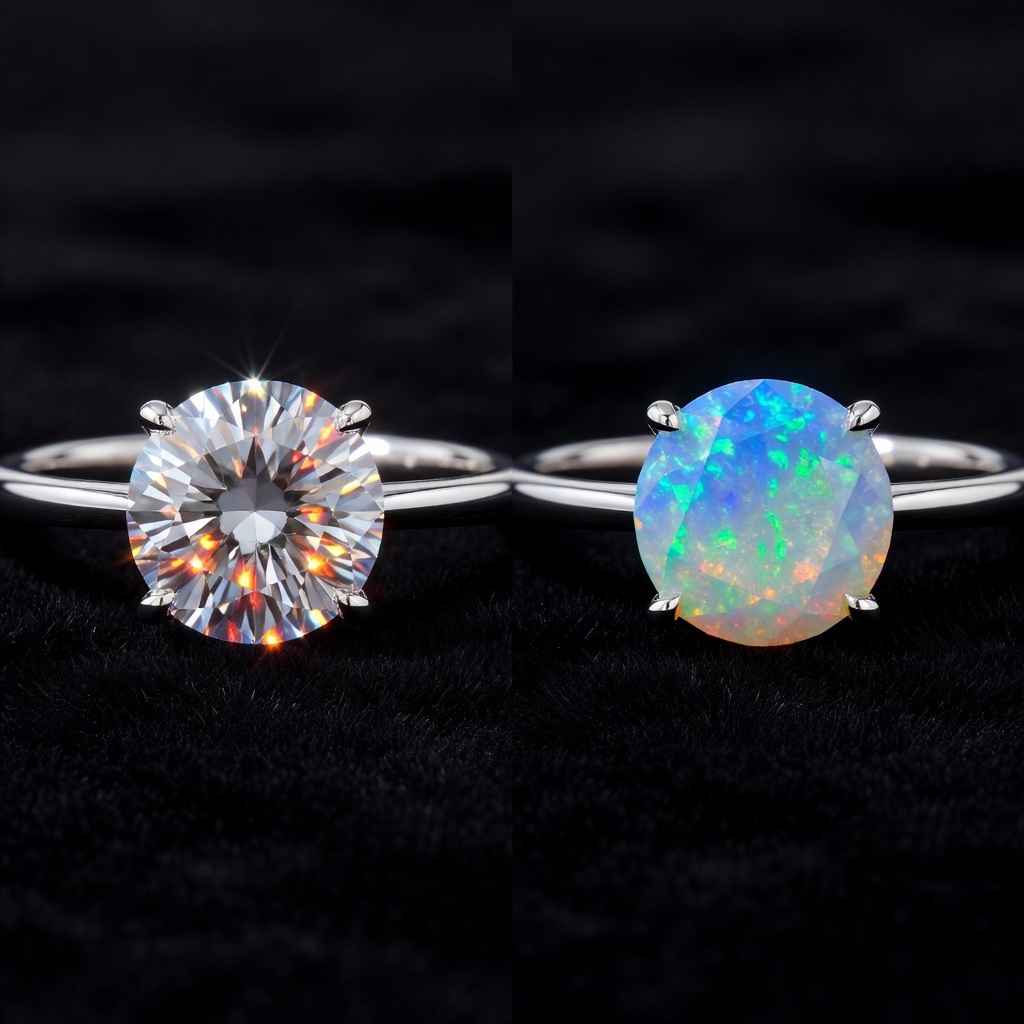
The aesthetic distinction between these gemstones offers perhaps the most subjective decision point for buyers, pitting classical brilliance against artistic chromatic expression. Diamonds captivate through three optical properties: brilliance (white light reflection from the crown), dispersion or "fire" (spectral color separation), and scintillation (sparkle patterns created by light and dark areas). These effects result from diamond's high refractive index (2.42) and expert faceting, creating the iconic glitter associated with engagement rings and formal jewelry. Modern cutting techniques maximize light return, producing stones that appear to generate their own illumination under varied lighting conditions.
Lab-created opals offer an entirely different visual experience centered on play-of-color, an optical phenomenon caused by diffraction as light passes through ordered silica spheres within the stone's structure. Unlike diamond's white sparkle with occasional rainbow flashes, high-quality synthetic opals display rolling patterns of spectral colors—including vivid reds, electric blues, and emerald greens—that shift with viewing angle and lighting conditions. This opal play of color creates an organic, fluid aesthetic impossible to replicate in diamond. Transparency differs significantly as well; diamonds range from completely transparent to translucent, while opals span opaque to translucent with varying body tones from milky white to deep black. For designers and wearers seeking diamond brilliance comparison alternatives, lab-created opals provide unlimited color combinations and pattern variations, from harlequin pinfire to broad flash patterns, enabling truly distinctive jewelry expressions unavailable in the diamond color spectrum.
Design Tip: Maximizing Visual Impact
When designing jewelry featuring lab-grown opal jewelry, consider halo settings that incorporate small diamonds around the opal center stone. This hybrid approach combines diamond sparkle with opal color play, creating dimensional visual interest while the diamond halo provides physical protection for the softer opal. For pure diamond pieces, opt for brilliant or modified brilliant cuts in white gold or platinum settings to maximize light return and scintillation.
Price Analysis and Investment Value
Financial considerations often drive the decision between these gemstones, with dramatic cost differentials making lab-created opals accessible to budget-conscious luxury consumers. Natural and laboratory-grown diamonds command premium prices based on the four Cs—cut, color, clarity, and carat weight—with quality stones ranging from $1,000 to $15,000+ per carat depending on specifications. Even lab-grown diamonds, though 30-40% less expensive than mined stones, maintain significant per-carat costs due to energy-intensive production processes and established market demand. This pricing structure positions diamonds as both luxury purchases and potential stores of value, though retail markup typically exceeds resale value.
Lab-created opal price vs diamond comparisons reveal a different economic reality, with synthetic opals typically costing between $20 and $200 per carat depending on color intensity, pattern complexity, and manufacturing quality. This affordability allows consumers to acquire substantial, visually striking center stones for the price of a modest diamond accent. However, this accessibility comes with investment limitations; unlike diamonds, which retain 20-60% of retail value in secondary markets, lab-created opals possess minimal resale liquidity and should be viewed as consumable fashion accessories rather than financial assets. The value proposition shifts from wealth preservation to aesthetic enjoyment, making synthetic opal vs diamond decisions hinge on whether buyers prioritize long-term asset retention or immediate visual impact per dollar spent.
Budget Strategy: The Carat Equation
For couples with a $3,000 jewelry budget, choosing a 0.5-carat quality diamond versus a 10-carat lab-created opal with intricate pinfire patterning presents distinct advantages. The diamond offers traditional bridal symbolism and durability for daily wear, while the opal provides dramatic size and unique color expression suitable for cocktail rings or pendants. Consider splitting budgets between both materials—perhaps a diamond engagement ring for daily wear and an opal fashion ring for special occasions—to maximize both investment security and aesthetic variety.
Jewelry Applications and Setting Requirements
The physical properties of these gemstones dictate distinct approaches to jewelry design, mounting techniques, and appropriate use cases. Diamonds suit virtually any jewelry application due to their unmatched hardness, making them ideal for engagement rings subjected to daily wear, tennis bracelets experiencing frequent contact with hard surfaces, and earrings requiring minimal maintenance. Their durability supports delicate prong settings that maximize light exposure while maintaining security, allowing designers to create intricate, open designs without compromising stone safety.
Lab-created opal engagement ring selections require careful consideration of setting architecture to compensate for the stone's relative softness and brittleness. Jewelers universally recommend protective bezel settings that encircle the opal with metal rims, shielding edges from impact and preventing chipping. Halo designs offer dual benefits—enhancing visual size while providing structural protection—though prong settings should feature rounded, polished tips to avoid stress points. Metal compatibility favors platinum and gold for both stones, though opal mounting demands gentler techniques without heat application that could cause dehydration or cracking. For opal jewelry, designers typically recommend pendants and earrings over rings, as these applications experience less mechanical stress than hand-worn pieces. When creating synthetic opal vs diamond mixed pieces, ensure harder stones don't contact opals in storage, as diamond accents can scratch opal surfaces during jewelry box storage.
Practical Setting Recommendation
If commissioning a custom lab-created opal ring, specify a "gypsy" or flush bezel setting where the stone sits slightly recessed within the metal band. This configuration protects the opal's crown from direct impact while maintaining a sleek, modern profile. For diamond bands, request shared-prong settings that minimize metal coverage while ensuring stone security, allowing maximum light penetration for optimal brilliance.
Care Requirements and Maintenance Protocols
Maintaining the beauty of fine gemstone jewelry requires species-specific protocols reflecting each stone's unique vulnerabilities and resilience. Diamond maintenance tips emphasize the stone's chemical inertness and hardness, permitting aggressive cleaning methods including ultrasonic cleaners, steam cleaning systems, and boiling water treatments that dissolve accumulated oils and debris. Regular cleaning with mild dish soap and warm water using a soft brush effectively restores diamond brilliance without risk of damage. Annual professional inspections should verify prong integrity and check for loose stones, though diamonds themselves require no special environmental controls during storage.
Understanding how to care for lab-created opal demands opposite approaches reflecting the stone's hydrated, porous nature. Despite being laboratory-grown, these opals retain natural opal's sensitivity to dehydration, requiring occasional light oiling with odorless mineral oil to prevent water loss and subsequent crazing. Owners must avoid ultrasonic cleaners, steam, and chemical exposure including chlorine, ammonia, and harsh detergents that can penetrate the stone's structure causing clouding or color loss. Storage requires humidified environments or sealed bags with damp cotton balls to prevent moisture evaporation, while padded compartments protect against harder jewelry items. Temperature stability proves crucial—removing opal jewelry before showering, swimming, or entering saunas prevents thermal shock that causes cracking. Unlike diamonds, which tolerate daily wear during all activities, opals require removal during physical work, cleaning chores, and handwashing to preserve their play-of-color and structural integrity.
Maintenance Schedule Comparison
Implement a quarterly cleaning routine for diamonds using professional ultrasonic services or at-home steam units, while opals require monthly gentle wiping with a damp microfiber cloth followed by air-drying. Store diamond jewelry in standard felt-lined boxes, but maintain opal pieces in separate fabric pouches with silica gel packets replaced by small pieces of damp sponge to regulate humidity. Professional jewelers should inspect diamond settings annually, while opal jewelry warrants biannual checks to ensure bezel integrity and detect early signs of dehydration or surface damage.
Ethical Sourcing and Environmental Impact
Contemporary consumers increasingly prioritize the provenance and ecological footprint of their luxury purchases, driving interest in ethical lab-created gemstones as alternatives to traditionally mined materials. Lab-created opals offer compelling sustainability advantages, requiring no open-pit mining, habitat displacement, or groundwater contamination associated with natural opal extraction. Laboratory synthesis consumes minimal land area and employs closed-loop water systems, resulting in significantly reduced carbon footprints compared to mining operations. Additionally, synthetic production eliminates the dangers facing artisanal miners, including tunnel collapses and respiratory diseases from silica dust exposure.
The diamond industry has evolved substantially regarding ethical gemstones through initiatives like the Kimberley Process Certification Scheme, which aims to prevent conflict diamonds from entering legitimate markets. While natural diamond mining continues to face scrutiny regarding environmental disruption and community displacement, many modern operations implement land rehabilitation programs and support local economies through employment. Lab-grown diamonds offer middle-ground solutions, though their production requires substantial energy consumption for HPHT and CVD processes. When evaluating lab-created opal sustainability against diamond options, consider that synthetic opal production utilizes lower temperatures and pressures than diamond synthesis, generally resulting in smaller carbon footprints. Ultimately, both lab-created opals and certified conflict-free diamonds offer ethical alternatives to problematic mining practices, though opals provide additional environmental benefits through lower energy requirements and absence of heavy machinery use.
Verification Protocol
Request blockchain certification or origin documentation when purchasing diamonds to verify Kimberley Process compliance and mining location transparency. For lab-created opals, seek suppliers who disclose their manufacturing methods and energy sources—preferring facilities utilizing renewable energy. Consider jewelers who participate in the Responsible Jewellery Council (RJC) certification program, ensuring ethical standards throughout the supply chain for both natural and synthetic gemstones.
Decision Framework: Which Gemstone Should You Choose?
Selecting between these distinct materials requires honest assessment of lifestyle patterns, aesthetic preferences, and long-term intentions for the jewelry piece. Active professionals, healthcare workers, or outdoor enthusiasts should prioritize diamonds for daily wear pieces, accepting higher costs in exchange for durability that withstands mechanical stress, chemical exposure, and physical impact without requiring removal during activities. Conversely, fashion-forward individuals who appreciate artistic expression and rotate jewelry collections frequently may find greater satisfaction with lab-grown opal jewelry, leveraging affordability to acquire multiple pieces showcasing varied color patterns.
Budget optimization strategies favor diamonds for milestone purchases intended as permanent heirlooms, where cost-per-wear calculations justify initial investment through decades of use. Lab-created opals suit trend-responsive purchases, allowing experimentation with non-traditional bridal styles or statement pieces without substantial financial commitment. When evaluating choosing between diamond and opal for specific applications, consider the recipient's maintenance habits—diamonds forgive forgetful owners who shower or clean while wearing jewelry, while opals demand mindful caretakers willing to remove pieces during water exposure and store them properly. For those seeking compromise, consider lab-created opal accents in diamond-centric designs, utilizing harder stones for ring shanks and bands while featuring opals in protected pendant or earring settings where impact risk remains minimal.
Case Study: The Hybrid Approach
Marcus and Elena solved their gemstone dilemma by commissioning a three-stone anniversary ring featuring a central diamond flanked by two lab-created opals. This design provided the durability necessary for Elena's nursing career while incorporating her love for opal's blue-green color play. The diamond protected the overall investment value, while the opals added personalized aesthetic appeal at minimal cost, demonstrating how modern couples need not choose exclusively between these materials.
Final Verdict and Recommendations
The Diamond vs Lab-Created Opal comparison ultimately reveals two exceptional but fundamentally different materials suited to distinct purposes rather than direct competitors. For engagement rings, wedding bands, and daily wear heirloom pieces, diamonds remain the unequivocal choice, offering the hardness, security, and traditional symbolism necessary for lifelong wear without compromise. Their superior durability justifies higher costs through generations of use, while established resale markets provide financial liquidity unavailable with synthetic alternatives.
Lab-created opals excel as artistic expressions in pendants, earrings, brooches, and occasional rings where protective settings and mindful wearing habits can preserve their beauty. These stones reward buyers seeking unique color palettes, ethical manufacturing, and accessible luxury without replicating diamond's visual language. For gemstone purchase recommendations, consider diamonds for "forever" pieces and opals for "right now" fashion statements. Hybrid designs incorporating both materials offer sophisticated solutions, utilizing diamond halos to protect opal centers or alternating diamond and opal stations in necklaces and bracelets. When proceeding with purchases, always verify certification, inspect settings under magnification, and purchase from established jewelers offering maintenance services appropriate to your selected stone's specific requirements.
Frequently Asked Questions
Is lab-created opal as hard and durable as diamond?
No, lab-created opal is significantly softer than diamond. While diamond ranks 10 on the Mohs hardness scale, lab-created opal measures only 5.5-6.5. This means opals can be scratched by everyday materials like dust (which contains quartz at 7 hardness), steel, and even household items. Diamonds can only be scratched by other diamonds, making them far superior for daily wear jewelry like engagement rings.
Which costs more per carat, diamond or lab-created opal?
Diamonds cost significantly more per carat than lab-created opals. Quality diamonds typically range from $1,000 to $15,000+ per carat depending on the 4Cs, while lab-created opals usually cost between $20 to $200 per carat. This dramatic price difference makes lab-created opals an affordable alternative for fashion jewelry, though they don't hold value like diamonds.
Can lab-created opal be used in an engagement ring for daily wear?
While possible, lab-created opal is not recommended for daily wear engagement rings due to its relative softness (5.5-6.5 Mohs) and vulnerability to dehydration, chemicals, and impact. If used for engagement jewelry, opals require protective bezel settings and should be removed during physical activities, cleaning, and showering. Diamonds remain the superior choice for everyday bridal jewelry due to their unmatched durability.
Do lab-created opals look identical to natural opals?
High-quality lab-created opals are chemically and optically identical to natural opals, displaying the same play-of-color phenomenon. Advanced synthesis methods create silica spheres in uniform patterns that can actually produce more consistent and intense color patterns than many natural stones. However, lab opals lack the natural inclusions and irregularities that gemologists use to identify natural stones under magnification.
Which gemstone holds its value better over time?
Diamonds generally hold value significantly better than lab-created opals. Natural diamonds have established resale markets and can retain 20-60% of retail value, while lab-created opals, like most synthetic gemstones, have minimal resale value. Lab-created opals should be purchased for their aesthetic appeal rather than investment potential, whereas high-quality natural diamonds can serve as stores of value.
Is lab-created opal considered a fake or synthetic gemstone?
Lab-created opal is not 'fake'—it is chemically, physically, and optically identical to natural opal, composed of hydrated silicon dioxide. The term 'synthetic' in gemology means it shares the same chemical composition as its natural counterpart, unlike simulants such as plastic or glass imitations. However, lab-created opals must be disclosed as synthetic or laboratory-grown at the point of sale.
Can you shower or swim while wearing lab-created opal jewelry?
No, you should avoid showering or swimming with lab-created opal jewelry. Despite being laboratory-grown, these opals retain natural opal's porosity and sensitivity to sudden temperature changes, chemicals (chlorine, shampoo), and water absorption. Prolonged water exposure can cause crazing (fine cracks), clouding, or color loss. Remove opal jewelry before water activities and clean only with a damp, soft cloth.
Why would someone choose lab-created opal over diamond?
Buyers choose lab-created opal over diamond for several reasons: unique aesthetic appeal with vibrant play-of-color unavailable in diamonds, affordability allowing larger stones for the budget, ethical concerns about mining, desire for distinctive non-traditional jewelry, and the ability to obtain specific color patterns consistently. Opals appeal to those prioritizing artistic expression and color over brilliance, hardness, and traditional status.