Diamond vs Lab-Created Diamond: Understanding the Modern Choice
The jewelry industry has witnessed a seismic shift as lab-created diamonds captured approximately 20% of global diamond sales in 2024, fundamentally altering how consumers approach significant purchases. When comparing diamond vs lab-created diamond options, modern buyers face a more complex decision than previous generations, who simply selected based on cut, color, clarity, and carat weight. This comparison has become critical for engagement ring shoppers and jewelry investors alike, as the choice between these two origins affects not only immediate budgets but long-term value retention and ethical considerations. Before committing to a purchase exceeding $5,000, consumers must understand that while both options sparkle identically to the naked eye, they diverge significantly in terms of pricing structures, resale markets, and environmental footprints.
What Are Natural Diamonds? Formation and Rarity Explained
The Geological Miracle Beneath Our Feet
Natural diamonds represent one of Earth's most extraordinary geological processes, forming between 1 to 3 billion years ago under intense pressure and temperature conditions approximately 150 kilometers deep within the Earth's mantle. These precious crystals journeyed to the surface through rare volcanic eruptions called kimberlite pipes, which occurred millions of years ago and created the deposits we mine today. The extreme conditions required for diamond formation—pressures of 45,000 atmospheres and temperatures exceeding 1,000 degrees Celsius—explain why these gemstones remain among nature's most durable and coveted creations.
Global Mining Operations and Declining Resources
Major diamond mining operations concentrate in specific geological regions, with Russia, Botswana, Canada, and Australia dominating current production, though ore grades continue declining as accessible deposits deplete. The Argyle mine in Australia, which closed in 2020 after producing 90% of the world's pink diamonds, exemplifies the finite nature of these resources and their impact on rarity-driven pricing. Modern mining operations must move increasingly larger volumes of earth to extract fewer carats, with some operations processing 250 tons of rock and soil to recover a single carat of gem-quality rough.
Marketing vs. True Scarcity
While diamonds have historically symbolized eternal love and commitment since De Beers' iconic "A Diamond is Forever" campaign launched in 1947, understanding the difference between marketing-driven scarcity and actual geological rarity helps buyers make informed decisions. Natural diamonds carry cultural weight as traditional engagement centerpieces, with many families passing these stones through generations as heirlooms connecting past and future. However, the controlled release of mined diamonds throughout the 20th century created artificial scarcity that differentiated market prices from actual extraction costs, a dynamic that lab-grown alternatives now challenge.
What Are Lab-Created Diamonds? The Science Behind Synthetic Gems
CVD Technology: Growing Diamonds Layer by Layer
Chemical Vapor Deposition (CVD) represents the most advanced method for creating gem-quality diamonds, utilizing plasma technology to deposit carbon atoms onto a diamond seed crystal within a vacuum chamber over 6 to 10 weeks. This process creates diamonds atom by atom in precisely controlled environments, allowing manufacturers to produce stones with exceptional clarity and specific color characteristics that might occur rarely in nature. CVD diamond vs natural comparisons reveal that while the timeframe differs dramatically—weeks versus billions of years—the resulting crystal structure remains identical down to the atomic level.
HPHT Method: Replicating Earth's Crucible
The High Pressure High Temperature (HPHT) method simulates the natural formation conditions that created diamonds deep within Earth, subjecting carbon to pressures of 1.5 million pounds per square inch and temperatures around 1,500 degrees Celsius using specialized presses. Originally developed for industrial diamond production, HPHT technology now creates gem-quality stones indistinguishable from mined diamonds without specialized detection equipment, representing a true synthetic diamond comparison to geological processes. Leading producers in the United States, India, and China have refined these technologies, with companies like Diamond Foundry and WD Lab Grown Diamonds achieving production scales that challenge traditional mining economics.
Chemical and Optical Identity
Lab-created diamonds possess the exact same chemical composition, physical properties, and optical characteristics as their mined counterparts, consisting of 100% carbon arranged in the isometric crystal system that gives diamonds their legendary hardness and brilliance. Unlike diamond simulants such as cubic zirconia or moissanite, lab-grown diamonds test as genuine diamond on thermal conductivity testers and refract light with the same fire and scintillation that make natural diamonds captivating. This identical nature has prompted the Federal Trade Commission to update its jewelry guides, recognizing that lab-created diamonds are indeed real diamonds, not imitations or synthetic substitutes in the traditional sense.
Physical and Chemical Properties: Are They Truly Identical?
Structural Perfection and Hardness
Both natural and lab-created diamonds register 10 on the Mohs hardness scale, making them the hardest known natural material capable of scratching any other substance while resisting wear themselves. They share identical refractive indexes of 2.42, creating the characteristic brilliance and fire that defines diamond beauty, along with the same specific gravity of 3.52 grams per cubic centimeter. Whether formed over eons or weeks, both varieties consist of carbon atoms arranged in a cubic crystal structure called diamond cubic, creating the tetrahedral bonding that gives these gems their unmatched durability.
Detection Methods and Growth Patterns
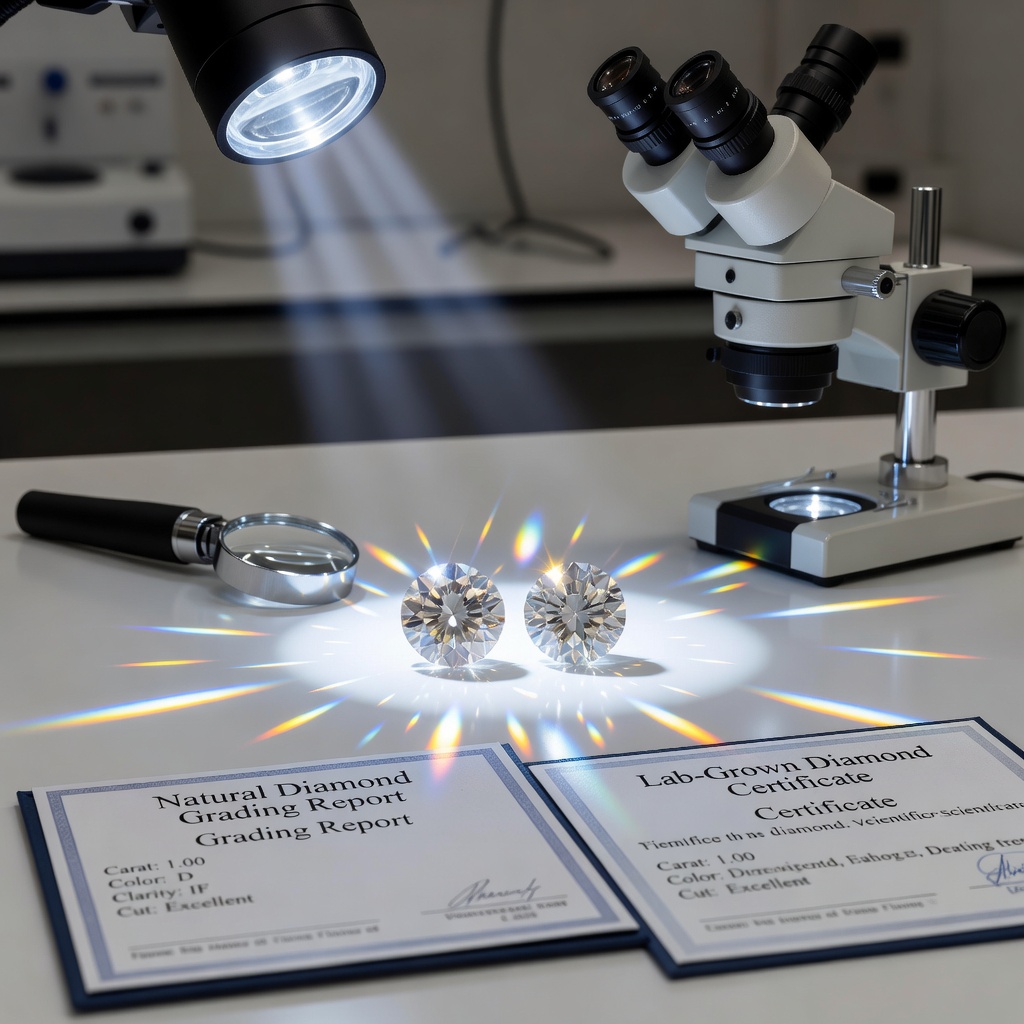
While the naked eye cannot distinguish between lab grown diamond vs real diamond specimens, gemological laboratories employ sophisticated spectroscopy and advanced imaging to identify subtle differences in growth structures and trace elements. Natural diamonds often display strain patterns and inclusions formed during their turbulent journey to Earth's surface, while CVD diamonds may show distinctive layer growth lines and HPHT stones often contain metallic flux inclusions invisible without magnification. Professional detection requires equipment costing upwards of $10,000, including photoluminescence spectroscopy and UV fluorescence imaging, making casual identification impossible for consumers and most jewelers.
Certification and Laser Inscriptions
The Gemological Institute of America (GIA) and other major laboratories laser-inscribe the girdle of every certified lab diamond with "Laboratory-Grown" alongside the report number, providing definitive identification that requires magnification to read. Natural diamonds receive different report formats and lack origin-specific inscriptions unless requested for specific tracking purposes, creating a documentation trail that separates the two categories in the marketplace. These microscopic distinctions matter significantly for insurance purposes and future valuations, as they permanently identify the stone's origin regardless of how many times it changes hands.
Comprehensive Comparison: Natural vs. Lab-Created Diamonds
| Characteristic | Natural Diamond | Lab-Created Diamond |
|---|---|---|
| Formation Time | 1-3 billion years | 6-10 weeks (CVD) or days (HPHT) |
| Chemical Composition | 100% Carbon (C) | 100% Carbon (C) |
| Hardness (Mohs Scale) | 10 | 10 |
| Refractive Index | 2.42 | 2.42 |
| Average Cost per Carat (1ct, G/VS1) | $4,500-$8,000 | $1,200-$3,000 |
| Resale Value Retention | 50-70% of retail | 10-20% of retail |
| Carbon Footprint | 108kg CO2/carat | 6-25kg CO2/carat (CVD) |
| Origin Traceability | Kimberley Process (limited) | Full supply chain transparency |
| Rarity Factor | Geologically finite | Technologically reproducible |
| Inclusion Types | Mineral inclusions, feathers | Metallic flux (HPHT), growth layers (CVD) |
Price Comparison Analysis: Cost Differences in 2024
Current Market Pricing Structures
The most immediate difference consumers encounter when evaluating diamond vs lab-created diamond options involves pricing, with lab-grown stones typically costing 40-70% less than natural diamonds possessing identical 4Cs specifications. A high-quality one-carat natural diamond with G color and VS1 clarity currently ranges from $4,500 to $8,000 depending on cut quality and market conditions, while a laboratory-grown equivalent with identical visual characteristics sells for $1,200 to $3,000. This dramatic price differential enables buyers to either save significantly on their budgets or upgrade to larger stones and higher quality grades that would remain financially out of reach with natural diamonds.
Depreciation Trends and Market Volatility
Lab diamond price comparison data reveals significant depreciation since 2020, with some categories dropping 30% as production technology improved and supply chains expanded, whereas natural diamonds have maintained relatively stable wholesale pricing despite economic fluctuations. This volatility reflects the scalable nature of laboratory production, where technological improvements continuously lower manufacturing costs, unlike finite mining operations where extraction becomes progressively more expensive as deposits deplete. Buyers should view lab diamonds as consumption goods rather than stores of value, similar to purchasing a new vehicle, where immediate depreciation offsets the initial acquisition savings.
Economics of Production and Supply Chains
Lab diamonds achieve lower price points by eliminating the massive infrastructure costs associated with mining operations, which require moving 250 tons of earth per carat, along with the complex international supply chains involving miners, rough dealers, cutters, and wholesalers. Advanced manufacturing facilities in India, China, and the United States can produce gem-quality stones with fewer intermediaries, shorter logistics chains, and greater production consistency than unpredictable geological extraction. However, this efficiency creates an oversupply situation where technological advancement continuously drives prices downward, benefiting initial buyers but challenging long-term value retention compared to the scarcity-maintained pricing of natural stones.
Practical Budget Optimization
For a practical example, consider a couple with a $6,000 engagement ring budget: selecting a natural diamond might yield a 0.8-carat stone with excellent cut and H color, while choosing lab-created allows purchase of a 1.5-carat diamond with D color and flawless clarity, or significant savings redirected toward wedding expenses or investments. Many modern buyers prioritize the immediate visual impact and size advantages, accepting that the 40-70% upfront savings effectively compensates for minimal resale value, particularly when the primary purpose involves wearing and enjoying the jewelry rather than liquidating it later.
Grading Standards: GIA, IGI and Certification Differences
Universal Application of the 4Cs
Gemological laboratories apply identical grading standards for cut, color, clarity, and carat weight to both natural and lab-created diamonds, ensuring that a D-color, Internally Flawless stone meets the same strict criteria regardless of origin. The GIA, recognized as the industry's gold standard for natural diamond certification, now offers specific "Laboratory-Grown Diamond Reports" with blue covers distinct from the gold reports used for mined stones, while maintaining identical grading rigor. This consistency means consumers can compare stones directly using the 4Cs framework, though they must verify that the certification body has appropriate expertise in distinguishing and grading synthetic specimens.
Market Share and Laboratory Specializations
While the GIA dominates natural diamond grading and maintains the highest industry reputation, the International Gemological Institute (IGI) currently certifies approximately 60% of lab-created diamonds globally, having developed specialized expertise in identifying growth methods and characteristics specific to manufactured stones. Other laboratories including GCAL (Gem Certification and Assurance Lab) and HRD Antwerp also provide reputable grading services for lab-grown diamonds, often including detailed growth method identification (CVD vs HPHT) that natural diamond reports do not require. When purchasing, buyers should ensure their lab diamond carries certification from a recognized laboratory rather than an in-house jeweler's appraisal, as third-party verification provides essential authentication and value documentation.
Insurance and Documentation Implications
Certification differences extend beyond grading to documentation standards that affect insurance coverage and future valuations, with lab diamond reports explicitly stating "Laboratory-Grown" to prevent misrepresentation in secondary markets. Insurance companies generally accept both types of certification but require updated appraisals every few years for lab diamonds due to rapid price fluctuations, whereas natural diamond appraisals remain stable longer. The laser inscription mentioned in the certificate provides crucial proof of identity, allowing verification that a submitted stone matches the documented specifications, protecting both buyers and insurers from substitution or fraud.
Quality Consistency in Controlled Environments
Lab-created diamonds often demonstrate fewer inclusions than natural diamonds because they grow in controlled environments without the geological turbulence, temperature fluctuations, and pressure variations that create internal characteristics in mined stones. This consistency means buyers frequently find eye-clean stones at lower clarity grades when choosing lab-created options, whereas natural diamonds require higher clarity grades to achieve the same visual purity. However, some connoisseurs value the unique inclusions in natural diamonds as birthmarks proving geological authenticity, viewing perfect clarity in large natural stones as potentially suspicious without proper documentation.
Resale Value and Investment Reality Check
Secondary Market Dynamics
The lab created diamond resale value currently lags significantly behind natural diamonds, with most jewelers refusing buy-back programs for lab-grown stones or offering only 10-20% of the original purchase price compared to 50-70% retention for natural diamonds. This discrepancy stems from supply dynamics: natural diamonds benefit from controlled scarcity and established secondary markets where estates, auctions, and trade-up programs create liquidity, while lab diamonds face unlimited production potential that underpins price depreciation. A recent case study involved a couple attempting to sell a $4,000 lab-created engagement ring after two years of marriage, receiving offers of $400-$600 from pawn shops and no interest from major retailers, whereas a similar natural diamond purchase might have returned $2,000-$2,800 through consignment or buy-back programs.
Jewelry Industry Buy-Back Policies
Major retailers like Tiffany & Co., Cartier, and Blue Nile generally decline to purchase previously owned lab-created diamonds, focusing their pre-owned acquisitions exclusively on natural stones with verifiable provenance and stable market demand. Some online platforms specializing in lab-grown diamonds have attempted to create secondary markets, but liquidity remains limited and prices continue declining as manufacturing technology improves, creating a situation where yesterday's production costs exceed today's replacement values. Buyers should approach lab diamond purchases with the expectation that the stone represents a sunk cost similar to custom clothing or electronics, valuable for use and enjoyment but not for asset liquidation.
Investment Perspectives and Long-Term Holdings
Neither natural nor lab-created diamonds function as traditional investments like gold or real estate, though natural diamonds possess historical liquidity that lab-grown stones currently lack, particularly for rare colors and large sizes exceeding three carats. Investment-grade natural diamonds—typically D-Flawless stones over 5 carats with excellent cut—maintain value through auction houses like Sotheby's and Christie's, whereas no equivalent market exists for lab-created stones regardless of quality. For 2025-2030 projections, industry analysts predict lab diamonds capturing 30% of the market share, which may stabilize prices somewhat but unlikely to create appreciation given the unlimited scalability of production technology.
Financial Planning Considerations
When evaluating the total cost of ownership, buyers should calculate the effective annual cost by dividing the purchase price by expected years of ownership, recognizing that a $3,000 lab diamond worn for 30 years costs $100 annually while a $6,000 natural diamond with $3,000 resale value costs $100 annually if sold, or provides estate value if kept. This calculation helps frame the decision not as investment versus consumption but as different approaches to value realization: lab diamonds front-load savings while natural diamonds back-load value retention. For those planning to pass jewelry to future generations, natural diamonds currently offer better prospects for maintaining monetary and sentimental value across decades.
Ethical and Environmental Impact Comparison
Mining Operations and Ecological Disruption
Traditional diamond mining operations create significant environmental footprints, requiring the movement of approximately 250 tons of earth and rock to extract a single carat of gem-quality rough, often resulting in deforestation, habitat destruction, and water table disruptions in sensitive ecosystems. The open-pit mines at Argyle in Australia and Orapa in Botswana represent massive geological alterations that, while providing economic benefits to local communities, fundamentally transform landscapes and require decades of rehabilitation after closure. Ethical lab diamonds offer an alternative that bypasses these extraction impacts entirely, though critics note that manufacturing facilities consume substantial electricity and water resources during the growth process.
Carbon Footprint Analysis
Comprehensive lifecycle assessments indicate that natural diamonds generate approximately 108 kilograms of CO2 emissions per carat, primarily from fuel-intensive mining operations, transportation across international supply chains, and processing equipment, whereas CVD lab diamonds produce between 6 to 25 kilograms of CO2 per carat depending on the energy source powering the facility. However, this environmental advantage diminishes significantly if production relies on coal-generated electricity, with some Chinese manufacturing facilities potentially creating larger carbon footprints than responsibly mined Canadian diamonds using renewable energy and strict environmental regulations. The most sustainable choice involves lab diamonds produced using solar, wind, or hydroelectric power, followed by carbon-neutral certified natural diamonds from mines adhering to rigorous environmental standards like those in Canada or Botswana.
Human Rights and Conflict-Free Guarantees
While the Kimberley Process Certification Scheme reduced the flow of conflict diamonds funding civil wars, loopholes allow diamonds from areas with poor labor practices, environmental violations, and human rights concerns to enter legitimate markets as "conflict-free" based on narrow definitions. Lab-created diamonds provide guaranteed traceability from factory to finger, eliminating concerns about artisanal mining conditions, child labor, or exploitation in politically unstable regions, though manufacturing facilities themselves must maintain fair labor practices. Consumers prioritizing ethical sourcing should research specific producers, as some lab diamond manufacturers have faced scrutiny over worker conditions in certain facilities, while others proudly maintain USA-based production with union labor and renewable energy.
Water Usage and Resource Conservation
Diamond mining operations consume approximately 480 liters of water per carat for processing ore and dust suppression, often in regions where water scarcity affects local communities and wildlife, whereas lab diamond production uses significantly less water primarily for cooling systems and cleaning. This resource efficiency, combined with the absence of toxic tailings ponds associated with kimberlite processing, positions lab diamonds as the environmentally preferable option for ecologically conscious consumers. However, the responsible mining sector continues improving water recycling and land rehabilitation, suggesting that the environmental gap between best-practice mining and lab production may narrow as both industries adopt greener technologies.
Which Should You Choose? Decision Framework for Buyers
Budget Optimization and Size Priorities
Buyers prioritizing maximum visual impact for their available funds should strongly consider lab-created diamonds, as the 40-70% cost savings enable purchase of significantly larger stones or higher color and clarity grades that would exceed budgets with natural diamonds. For example, a $5,000 budget might purchase a 0.9-carat natural diamond with H color and SI1 clarity, or a 1.5-carat lab diamond with E color and VVS2 clarity, providing demonstrably superior brilliance and presence on the hand. This approach suits couples who view the engagement ring as a symbol of current commitment rather than a financial asset, preferring to allocate savings toward housing, experiences, or other investments rather than geological rarity.
Heirloom Considerations and Legacy Value
For those intending to pass jewelry through generations as family heirlooms, natural diamonds currently offer superior long-term value retention and traditional significance that resonates with older family members who may view lab-created stones as "not real" despite scientific evidence to the contrary. The natural diamond carries stories of geological time and Earth's history, connecting the wearer to ancient processes spanning billions of years, whereas lab diamonds represent human technological achievement and modern values. Couples should discuss family expectations and legacy intentions before purchasing, as replacing a natural stone later for sentimental reasons costs significantly more than choosing correctly initially.
Balancing Emotional Significance and Values
The decision often reflects deeper values regarding tradition versus innovation, with some wearers appreciating the romance of a stone formed over eons before human existence, while others celebrate human ingenuity and the elimination of mining impacts. A growing trend involves hybrid designs featuring lab-created center stones surrounded by natural diamond accents, compromising between budget and tradition while creating unique aesthetic combinations. Ultimately, the "better" choice depends entirely on personal priorities: choose natural for historical connection and asset retention, or lab for ethical alignment, budget efficiency, and technological appreciation.
Occasion-Specific Recommendations
For engagement rings intended for daily wear over decades, both options perform identically in terms of durability, though natural diamonds suit those who might upgrade later using trade-in programs unavailable for lab stones. Anniversary gifts and right-hand rings provide excellent opportunities for lab diamonds, allowing celebration of milestones with impressive stones without the investment concerns of natural diamonds. Fashion jewelry, earrings, and bracelets particularly suit lab-created diamonds, as these pieces rarely retain significant resale value regardless of stone origin, making the cost savings particularly advantageous for building a versatile jewelry wardrobe.
Final Verdict: Making Your Informed Diamond Decision
When weighing diamond vs lab-created diamond options, the fundamental differences crystallize around three primary factors: acquisition cost, value retention, and ethical sourcing, with no universally superior choice existing for all buyers. Natural diamonds offer geological romance, established secondary markets, and traditional significance that continues resonating with many consumers despite higher price points, while lab-created alternatives provide identical beauty, guaranteed ethical origins, and budget flexibility that democratizes access to high-quality gems. Market projections suggest lab diamonds will capture 30% of global sales by 2027, indicating growing mainstream acceptance that may eventually normalize both categories as simply different sourcing options rather than tiered quality levels.
Your decision should reflect personal values, financial circumstances, and intended use rather than external pressure or traditional expectations. If you prioritize immediate value, maximum size, and ethical certainty, lab-created diamonds offer compelling advantages that extend beyond simple cost savings to include environmental benefits and supply chain transparency. Conversely, if you view jewelry as a long-term asset, cherish geological history, or anticipate passing pieces to future generations, natural diamonds remain the prudent choice despite higher initial investments.
Regardless of your selection, verify certification from reputable laboratories like GIA or IGI, insure your purchase appropriately, and select retailers offering solid return policies and warranty protection. Remember that both varieties will sparkle identically on your hand, endure equally through decades of daily wear, and symbolize the same commitments and celebrations. The perfect diamond is ultimately the one that aligns with your values, fits your budget comfortably, and brings joy every time you glimpse its fire and brilliance.
Frequently Asked Questions
Are lab-created diamonds considered real diamonds?
Yes, lab-created diamonds are chemically, physically, and optically identical to natural diamonds. They consist of pure carbon crystallized in the isometric cubic system, just like mined diamonds. The FTC recognizes them as real diamonds, and they test as diamond on standard thermal conductivity testers. The only difference is their origin: created in a laboratory versus formed in the earth over billions of years.
Can jewelers tell the difference between lab and natural diamonds?
No, jewelers cannot distinguish them with the naked eye or standard jeweler's loupe. Only gemological laboratories using advanced spectroscopy equipment can identify lab-created diamonds through subtle growth patterns and trace element differences. All certified lab diamonds are laser-inscribed with 'Laboratory Grown' on the girdle, which requires magnification to read. Professional detection requires specialized equipment costing $10,000+.
Why do lab-created diamonds cost 40-70% less than natural diamonds?
Lab diamonds bypass expensive mining operations that move 250 tons of earth per carat. The supply chain is dramatically shorter without miners, wholesalers, and multiple middlemen. Production is scalable and repeatable, unlike the finite, geographically limited nature of diamond mines. While the technology is expensive, the per-carat cost decreases with volume, whereas natural diamond prices increase as mines deplete.
Do lab-created diamonds hold their value over time?
Lab diamonds currently have minimal resale value, typically 10-20% of original purchase price, due to abundant supply and retailers' reluctance to buy them back. Unlike natural diamonds with established secondary markets, lab diamonds lack historical price stability and collector demand. However, if purchased primarily for beauty and wear rather than investment, the initial 40-70% savings often outweigh resale considerations for most buyers.
Which is better for an engagement ring: natural or lab-created diamond?
Lab diamonds offer superior value—30-40% larger stone for the same budget—with identical beauty. Natural diamonds carry traditional symbolism and better long-term value retention. The 'better' choice depends on priorities: choose lab for maximum size/quality on a budget, or natural for heirloom value and tradition. Many couples now compromise with lab diamond center stones and natural diamond accents.
Are lab-created diamonds more environmentally friendly than mined diamonds?
Generally yes, but with important caveats. CVD lab diamonds produce 6-25kg CO2 per carat versus 108kg for mined diamonds, and use significantly less water. However, the environmental benefit depends entirely on the energy source—coal-powered labs can have worse carbon footprints than responsibly mined diamonds. The most sustainable choice is lab diamonds using renewable energy, followed by carbon-neutral certified mined diamonds from Canada.
How long do lab-created diamonds last compared to natural diamonds?
Both last forever identically. As the hardest natural substance (10 on Mohs scale), diamonds—whether lab or natural—never scratch, cloud, or deteriorate under normal wear. They can survive house fires up to 1,500°F and remain unchanged for billions of years. The 'forever' marketing applies equally to both types. Your lab diamond will look identical to a natural diamond in 50 years if properly cared for.
Do lab-created diamonds come with GIA certificates like natural diamonds?
Yes, but with different report formats. GIA now grades lab diamonds but uses distinct 'Laboratory-Grown Diamond Report' (blue instead of gold) and always laser-inscribes 'Laboratory-Grown' on the girdle. IGI currently certifies most lab diamonds (60% market share) and is widely accepted. Both labs grade using identical 4Cs standards, but GIA remains the gold standard for natural diamonds while IGI dominates the lab-grown market.