Two Worlds of Gemstone Prestige: Understanding Diamond vs Jade (Jadeite)
When collectors and connoisseurs discuss the pinnacle of gemstone luxury, two names consistently emerge as the ultimate symbols of wealth and refinement: diamonds and jadeite. While both represent the highest echelons of the jewelry world, they occupy distinctly different realms of cultural significance, physical properties, and aesthetic appeal. This comprehensive gemstone comparison explores how these precious materials have captivated civilizations for millennia, yet serve remarkably different purposes in modern jewelry and investment portfolios.
The journey of understanding Diamond vs Jade (Jadeite) requires examining not just their market values, but their fundamental nature as geological specimens. Diamonds have dominated Western markets as the quintessential expression of eternal love and status, while jadeite commands reverence across East Asian cultures as a spiritual talisman and symbol of imperial authority. Whether you are building a collection of investment grade gemstones or selecting a meaningful piece of jewelry, understanding the nuanced differences between these two treasures will inform your decision-making process and ensure you acquire a stone that aligns with your values and lifestyle needs.
Gemological Fundamentals: Composition and Formation
The fundamental distinction between diamond and jadeite begins at the atomic level, where their divergent chemical compositions create vastly different physical and optical properties. Diamonds consist of pure carbon atoms arranged in an isometric cubic crystal structure, formed under extreme pressure and temperature conditions approximately 90 to 120 miles beneath the Earth's surface within kimberlite pipes. These volcanic conduits transport the rough crystals rapidly upward, preventing them from converting into graphite and preserving their legendary hardness. The formation process requires specific geological conditions lasting billions of years, making each natural diamond a relic of ancient Earth history.
Jadeite, conversely, represents a sodium aluminum silicate mineral belonging to the pyroxene group, crystallizing in a monoclinic structure under high-pressure, low-temperature metamorphic conditions at subduction zones. Unlike diamond's singular elemental composition, jadeite forms through complex chemical interactions between oceanic crust and mantle rocks, typically resulting in an interlocking fibrous aggregate structure rather than distinct individual crystals. This unique formation process occurs primarily along tectonic plate boundaries, with the most prized gem-quality material emerging from the serpentine-rich regions of northern Myanmar, specifically the Mogok Stone Tract and Kachin State.
Geographical sourcing significantly impacts jadeite jade value and diamond pricing structures. Major diamond production centers include the Jwaneng and Orapa mines in Botswana, the Udachnaya pipe in Russia, and the Diavik and Ekati mines in Canada's Northwest Territories, where ethical mining practices have attracted conscientious consumers. Jadeite sources remain more limited, with Myanmar (Burma) producing approximately 70% of the world's high-grade material, supplemented by deposits in Guatemala's Motagua Valley and Japan's Itoigawa region. The political instability surrounding Myanmar's jade mines has created supply constraints that directly influence imperial jadeite price fluctuations, whereas diamond markets benefit from more diversified global production.
Physical Properties and Durability Analysis
Understanding gemstone hardness comparison requires looking beyond simple scratch resistance to evaluate how these materials withstand daily wear and potential impacts. The MOHS hardness scale diamond occupies the apex position at 10, representing the hardest known natural substance capable of scratching any other material. This exceptional hardness stems from the strong covalent bonds between carbon atoms, creating a surface that maintains its polish indefinitely under normal conditions. However, diamond durability encompasses more than hardness; the gemstone possesses perfect octahedral cleavage in four directions, meaning that a sharp blow at the correct angle can split even the finest diamond along specific crystallographic planes.
Jadeite ranks between 6.5 and 7 on the Mohs scale, significantly softer than diamond but possessing extraordinary toughness that often surprises gemologists. Rather than forming discrete crystals, jadeite consists of randomly oriented interlocking fibers that create a structure similar to reinforced concrete. This fibrous composition allows jadeite to absorb tremendous impact without fracturing, explaining why ancient civilizations carved intricate bangles and ritual objects that have survived millennia of burial and handling. While a steel knife cannot scratch a diamond, it may leave marks on jadeite; however, dropping a jadeite ring onto concrete might result in no damage, whereas a diamond might chip or cleave under identical circumstances.
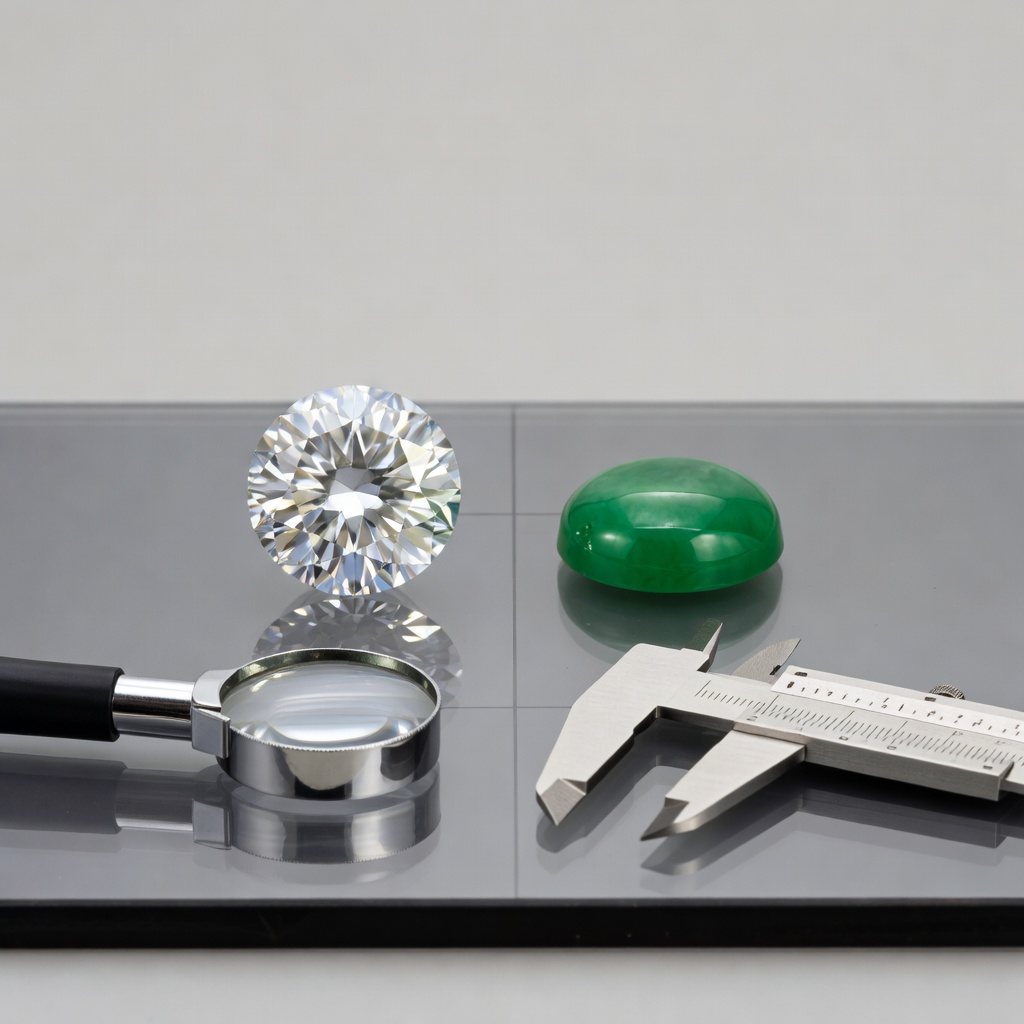
Specific gravity measurements further distinguish these gemstones, with diamonds averaging 3.52 and jadeite ranging from 3.30 to 3.38. Refractive indices also differ significantly: diamonds exhibit a high refractive index of 2.42, creating their characteristic brilliance, while jadeite's lower index of 1.66-1.68 produces a more subtle, waxy to vitreous luster. For collectors evaluating investment grade gemstones, these physical properties determine not only aesthetic appeal but also long-term wearability and maintenance requirements.
Visual Characteristics: Color, Clarity, and Light Performance
The optical behavior of diamonds and jadeite represents perhaps the most striking difference between these precious materials. Diamonds achieve their mesmerizing appearance through precise faceting that maximizes brilliance (white light reflection), fire (spectral color dispersion), and scintillation (sparkle from movement). Master cutters calculate exact angles and proportions to create light performance that seems to emanate from within the stone itself. This interplay with light makes diamonds instantly recognizable and universally coveted, whether set in classic solitaire engagement rings or contemporary avant-garde designs.
Jadeite communicates value through entirely different visual parameters, emphasizing color saturation, translucency, and texture over reflective sparkle. The most coveted variety, known as "imperial jade," displays an intense emerald-green color caused by chromium content, combined with semi-transparent "water" quality that allows light to penetrate and glow from within the stone. Unlike diamonds, where colorlessness typically commands premium prices (except in fancy colored varieties), jadeite achieves maximum value through color intensity. Lavender jadeite derives its hue from manganese, while iron content creates yellow and brown tones, and chromium-rich black jadeite offers an opaque alternative for bold contemporary designs.
Clarity assessment methodologies diverge significantly between these gemstones. The diamond industry relies on the standardized 4Cs system, grading clarity from Flawless to Included based on internal inclusions and external blemishes visible under 10x magnification. Jadeite evaluation proves more complex, requiring examination of texture (the fineness of crystal aggregation), absence of fractures or cracks, color uniformity, and the degree of translucency. When considering colored diamonds vs jadeite, both markets reward rarity and intensity, yet while a pink diamond might command astronomical prices due to nitrogen lattice distortions, imperial green jadeite achieves comparable values through the confluence of specific gravity, texture, and that distinctive chromium-rich coloration found only in specific Burmese deposits.
Value Determinants and Market Pricing
The commercial valuation of diamonds operates within a relatively transparent framework established by the Gemological Institute of America (GIA), utilizing the ubiquitous 4Cs grading system. Carat weight, Cut quality, Color grade, and Clarity level combine to determine pricing, with GIA certification providing global standardization that facilitates international trade. This systematic approach creates liquid markets where comparable stones command similar prices across New York, Antwerp, Mumbai, and Hong Kong. Entry-level diamonds might retail for $1,500 per carat, while D-color, Internally Flawless stones can reach $50,000 per carat, with fancy vivid colored diamonds occasionally achieving millions per carat at auction.
Jadeite valuation remains more nuanced and culturally influenced, relying on factors that resist simple quantification. Color intensity represents the primary value driver, with imperial green commanding the highest premiums, followed by translucency (often described as "water" quality), texture fineness, and absence of fractures. Unlike diamonds, where size generally correlates with exponential price increases, jadeite value depends heavily on material quality within specific carving contexts. A small, flawless imperial jadeite cabochon might exceed the value of a larger, textured piece. Recent auction results demonstrate this volatility: while Sotheby's and Christie's regularly sell fine diamonds at predictable premiums, top-quality Burmese jadeite bangles and beads have achieved price-per-carat records exceeding $3 million, surpassing all but the rarest colored diamonds.
Market volatility patterns distinguish these investment grade gemstones significantly. Diamond prices fluctuate based on global economic conditions, mining output from major producers like De Beers and Alrosa, and the growing influence of laboratory-grown alternatives. Jadeite markets respond to different stimuli, particularly supply constraints from Myanmar's political situation and burgeoning demand from Chinese collectors seeking tangible assets. The jadeite jade value proposition strengthens during economic uncertainty in Asia, as wealthy buyers view high-grade material as portable wealth and cultural patrimony. For investors, diamonds offer greater liquidity and standardized resale mechanisms, while jadeite provides potential for dramatic appreciation but requires specialized knowledge and connections within collector networks to realize returns.
Cultural Significance and Symbolic Meaning
The symbolic resonance of diamonds in Western culture emerged primarily during the 20th century through sophisticated marketing campaigns, yet the stone's association with invincibility and eternal love draws upon ancient beliefs. Derived from the Greek "adamas" meaning unconquerable, diamonds became the standard for engagement rings in the 1940s and now represent the ultimate expression of romantic commitment and social status. Beyond jewelry, diamond durability makes these gemstones essential for industrial cutting, drilling, and polishing applications, reinforcing their reputation as practical luxury. In European royal traditions, diamonds adorned crowns and scepters as symbols of sovereign power and divine right, creating associations with authority that persist in contemporary luxury marketing.
Jadeite meaning and symbolism penetrate far deeper into human history, particularly within Chinese culture where the stone (known as "yu") has held sacred status for over 8,000 years. Confucian philosophy associated jade with five cardinal virtues: benevolence, righteousness, wisdom, courage, and purity. Unlike diamonds, which primarily signify external wealth, jadeite represents internal cultivation and moral character. Emperors wore jadeite to connect with heavenly forces, while burial practices included jadeite plugs and suits intended to preserve and protect the deceased in the afterlife. This spiritual dimension continues today, with many believers attributing protective and healing properties to jadeite, suggesting it absorbs negative energies and promotes physical harmony.
Historical context reveals divergent trajectories: while diamonds gained prominence during Europe's colonial expansion and industrial revolution, jadeite maintained continuous cultural significance in Mesoamerican and East Asian civilizations. The Olmec, Maya, and Aztec cultures of ancient Guatemala and Mexico carved jadeite into deity representations and ritual implements, while Chinese dynasties from the Shang through Qing prized Burmese jadeite above gold and silver. Understanding these cultural matrices helps collectors appreciate why a jadeite bangle might represent family heritage and spiritual protection to a Chinese collector, while a diamond tennis bracelet signifies social achievement to a Western buyer.
Investment Potential and Collection Strategies
Building a portfolio of investment grade gemstones requires understanding liquidity differences between diamond and jadeite markets. Diamonds benefit from established resale channels, including dealer buy-back programs, auction houses, and online marketplaces that facilitate relatively quick transactions. The standardized grading system means that a GIA-certified diamond with specific parameters will find buyers across global markets without extensive authentication processes. However, this liquidity comes with price constraints; retail diamonds typically depreciate 20-50% immediately upon purchase, recovering value only after significant market appreciation or holding periods exceeding a decade.
Jadeite investment operates through more exclusive networks, often requiring direct relationships with Hong Kong auction houses, Myanmar dealers, or specialized Asian galleries. Liquidity decreases while potential appreciation increases, particularly for museum-quality imperial green specimens. Authentication proves crucial, as jadeite treatments significantly impact value. Polymer impregnation (Type B jadeite) and dyeing (Type C jadeite) require disclosure, while Type A (natural, untreated) material commands premium prices. Certification from laboratories like Gübelin, SSEF (Swiss Gemmological Institute), or the Hong Kong Jade & Stone Laboratory provides necessary verification of origin and treatment status, though these services cost significantly more than standard diamond grading reports.
Risk assessment for both gemstones must consider technological disruption. Laboratory-grown diamonds now challenge natural diamond markets, offering identical chemical composition at 60-70% lower prices, though they lack the geological rarity that drives investment demand. Jadeite currently faces no synthetic competition, as the material's complex fibrous structure cannot be replicated in laboratories, ensuring that natural scarcity maintains value propositions. Savvy investors diversify across both asset classes, allocating diamonds for liquidity and stability while acquiring jadeite for appreciation potential and portfolio hedging against Western economic fluctuations. The jadeite jade value curve has historically shown less correlation with Western stock markets than diamonds, providing genuine diversification benefits.
Jewelry Applications and Wearability
Jewelry designers exploit the distinct properties of diamonds and jadeite to create pieces optimized for each material's strengths. Diamond settings typically employ prong, bezel, or pavé configurations that maximize light exposure and protect vulnerable girdle edges from chipping. Platinum and white gold settings complement diamonds' colorless nature, while yellow and rose gold settings enhance fancy colored diamonds. The versatility of diamond durability allows for delicate, openwork designs where stones appear to float, suspended by minimal metalwork that does not compromise structural integrity.
Jadeite jewelry traditionally favors bezel settings and carved designs that protect the material while showcasing color and translucency. Because jadeite possesses lower hardness but superior toughness compared to diamond, it withstands different wear patterns. Jadeite bangles, carved pendants, and cabochon rings endure daily wear remarkably well, resisting the chipping that might damage faceted diamonds. However, jadeite's surface can accumulate scratches from quartz dust (hardness 7) present in household environments, requiring periodic professional polishing to maintain luster.
Design aesthetics reflect cultural preferences while evolving toward fusion styles. Diamonds dominate contemporary Western bridal and red-carpet jewelry, emphasizing geometric precision and light performance. Jadeite maintains strong associations with Asian-inspired aesthetics, including carved Buddhas, bi discs, and pi rings, though contemporary designers increasingly incorporate jadeite into modernist settings that rival diamond jewelry for sophistication. Gender preferences show interesting divergence: while diamond markets focus heavily on feminine bridal jewelry, significant jadeite markets serve male collectors seeking belt buckles, cufflinks, and substantial rings that symbolize status and protection.
Care, Maintenance, and Longevity
Proper maintenance protocols reflect the distinct physical properties of these precious materials. Diamond cleaning benefits from ultrasonic cleaners and steam cleaning, which remove accumulated lotions and oils without damaging the stone. The MOHS hardness scale diamond rating ensures that mechanical cleaning poses no scratch risk, though settings may loosen over time and require professional inspection every six to twelve months. Despite their hardness, diamonds require storage in individual compartments or soft pouches to prevent them from scratching other jewelry, as they can damage softer gemstones and metal settings.
Jadeite maintenance demands gentler approaches due to its lower hardness ranking. Clean jadeite using lukewarm water with mild soap and a soft-bristled brush, avoiding ultrasonic devices that might exacerbate existing fractures or loosen treatments in polymer-impregnated stones. After cleaning, pat dry with a soft lint-free cloth rather than rubbing, which might create fine surface abrasions. Store jadeite separately from harder gemstones like diamonds, sapphires, and rubies to prevent scratching, and avoid exposure to harsh chemicals including bleach and acids that might damage surface polish or dyes in treated material.
Insurance considerations differ significantly between these gemstones. Diamond replacement values rely on standardized Rapaport pricing and GIA reports, facilitating straightforward claims processing. Jadeite insurance requires specialized appraisers familiar with Asian markets, as replacement costs vary dramatically based on origin and treatment status. High-end jadeite collections often require scheduled riders on homeowners policies or specialized jewelry insurance that accounts for the material's appreciation rather than depreciation. Long-term preservation of both gemstones benefits from periodic professional assessment, ensuring that settings remain secure and surfaces maintain optimal condition for generational transfer.
Final Verdict: Choosing Between Diamond and Jadeite
Selecting between Diamond vs Jade (Jadeite) ultimately depends on personal priorities regarding aesthetics, cultural resonance, investment goals, and lifestyle compatibility. Diamonds offer unmatched brilliance, global liquidity, and universal recognition as symbols of achievement and romance. They suit buyers seeking portable wealth with established resale markets, those preferring geometric precision and light performance, and individuals engaged in active lifestyles where scratch resistance proves paramount.
Jadeite appeals to collectors valuing cultural depth, spiritual significance, and unique aesthetic warmth. The material suits long-term investors betting on Asian economic growth and supply constraints from Myanmar, as well as individuals seeking jewelry that improves with age and patina. Jadeite's toughness makes it ideal for heirloom pieces intended for daily wear across generations, while its color variations offer personal expression beyond the colorless-to-fancy spectrum of diamonds.
| Comparison Aspect | Diamond | Jadeite |
|---|---|---|
| Chemical Composition | Pure Carbon (C) | Sodium Aluminum Silicate (NaAlSi2O6) |
| MOHS Hardness | 10 (Highest natural substance) | 6.5-7 |
| Toughness/Durability | Brittle; perfect cleavage; chips under impact | Exceptional; interlocking fiber structure resists breaking |
| Primary Value Factors | 4Cs: Cut, Color, Clarity, Carat | Color intensity, Translucency, Texture, Origin |
| Top Price Per Carat | $50,000-$250,000 (D-IF); Fancy colors up to $3M+ | $20,000-$100,000+; Imperial quality up to $3M+ |
| Grading Standards | GIA standardized global system | Specialized labs (Gübelin, SSEF); texture/color evaluation |
| Primary Sources | Botswana, Russia, Canada, Australia | Myanmar (Burma), Guatemala, Japan |
| Investment Liquidity | High; established global resale markets | Lower; collector networks and auction dependent |
| Cultural Significance | Western status, eternal love, industrial use | East Asian spirituality, virtue, protection (8000+ years) |
| Synthetic/ Treatment Risks | Lab-grown diamonds widely available | Polymer impregnation, dyeing; no synthetic equivalent |
| Cleaning Methods | Ultrasonic, steam, professional cleaning safe | Gentle soap and water only; avoid ultrasonics |
| Best Applications | Engagement rings, tennis bracelets, earrings | Bangles, carved pendants, cabochon rings, bead necklaces |
Emerging market trends suggest divergent futures for these gemstones. Lab-grown diamond technology continues improving, potentially bifurcating the market between natural geological specimens and manufactured alternatives. This technological pressure reinforces jadeite's position as an irreplaceable natural resource, as scientists cannot synthesize its characteristic fibrous structure. For the discerning collector, acquiring untreated, certified specimens of either gemstone represents sound tangible asset allocation, with diamonds providing portfolio stability and jadeite offering appreciation potential tied to Asian luxury markets.
When making your final selection, consider the intended use: choose diamonds for maximum sparkle and international portability, select jadeite for cultural resonance and generational heirloom creation. Consult with specialists who understand both Western gemological standards and Asian jadeite markets to ensure authentication and fair valuation. Whether you ultimately acquire a brilliant-cut diamond solitaire or an imperial green jadeite bangle, both represent humanity's enduring appreciation for geological rarity and artistic craftsmanship.
Frequently Asked Questions
Which is more expensive per carat: diamond or jadeite?
Top-quality imperial jadeite can exceed $3 million per carat, surpassing most diamonds. While exceptional colored diamonds may reach similar prices, commercial-grade diamonds ($1,500-$15,000/carat) are generally less expensive than fine jadeite ($20,000-$100,000+/carat).
Is jadeite harder than diamond?
No. Diamond ranks 10 on the MOHS scale (hardest natural substance), while jadeite ranks 6.5-7. However, jadeite's interlocking fibrous structure makes it tougher—more resistant to breaking and chipping than diamond, which has perfect cleavage.
Can you wear jadeite jewelry every day like diamond jewelry?
Yes, but with different precautions. Jadeite's toughness makes it suitable for daily wear, but avoid hard impacts. Diamonds resist scratches better but can chip if struck along cleavage planes. Both should be removed during rigorous activities.
How can I verify if my jadeite is real and untreated?
Request certification from reputable labs like Gübelin, SSEF, or GIA. They use spectroscopy and infrared testing to detect polymer impregnation and dye. Real jadeite has a smooth, cold feel, high density, and under magnification shows an interlocking fibrous texture.
Which gemstone is a better investment: diamond or jadeite?
Both can be solid investments, but jadeite offers higher potential returns due to Myanmar supply constraints and growing Asian demand. Diamonds provide greater liquidity and standardized pricing. High-quality untreated specimens of both outperform treated or commercial-grade material.
What makes imperial jadeite so valuable compared to other green gemstones?
Imperial jadeite's intense emerald-green color from chromium, combined with semi-transparent 'water' quality and fine texture, is extremely rare. Only Myanmar produces this grade, and mining has nearly ceased. Its cultural significance in Chinese heritage drives exceptional demand.
Do lab-grown diamonds affect natural jadeite's value?
Not directly, but lab-grown diamonds have diverted some investment away from natural diamonds. Jadeite's value remains unaffected because it cannot be synthesized. This has strengthened jadeite's position as a rare, untreated natural gemstone for collectors.
Which gemstone holds more cultural meaning: diamond or jadeite?
Jadeite holds deeper historical cultural meaning, especially in East Asia where it's revered for 8,000+ years as a symbol of virtue and protection. Diamonds have dominated Western culture for centuries as symbols of love and status, but jadeite's spiritual significance is more profound.