Understanding the Diamond vs Imperial Topaz Debate
When selecting the perfect centerpiece for fine jewelry, modern consumers increasingly find themselves weighing the merits of traditional diamonds against the warm allure of imperial topaz. This comprehensive comparison addresses the growing interest in diamond alternative gemstones while examining why these two distinct stones frequently appear in the same conversations among jewelry enthusiasts and engagement ring shoppers. While diamonds have dominated the luxury market for decades as the ultimate symbol of commitment, imperial topaz emerges as a compelling contender offering unique aesthetic qualities at a fraction of the cost.
The classification distinction between these stones creates much of the confusion in marketplace discussions. Diamonds belong to the "precious" gemstone category alongside rubies, sapphires, and emeralds, while imperial topaz technically falls under the "semi-precious" classification despite exhibiting rarity and beauty that rival its precious counterparts. This arbitrary categorization, established centuries ago based on historical availability rather than intrinsic value, fails to reflect the true geological scarcity of fine imperial topaz specimens. Contemporary jewelry buyers increasingly recognize that the diamond vs imperial topaz comparison reveals more about personal values and stylistic preferences than about inherent quality hierarchies.
Consumers specifically gravitate toward comparing these stones because both offer exceptional clarity, brilliance, and suitability for significant jewelry pieces like engagement rings and anniversary gifts. The comparison becomes particularly relevant for budget-conscious buyers seeking substantial gemstone presence without the premium pricing associated with large diamonds. Additionally, the rise of colored gemstone engagement rings has positioned imperial topaz as an attractive option for couples desiring something distinctive from the traditional colorless diamond solitaire.
Origin and Formation: Natural Creation Stories
The geological journeys of diamonds and imperial topaz differ dramatically, beginning deep within Earth's crust under vastly different conditions and timescales. Diamonds form approximately 90 to 120 miles beneath Earth's surface in the upper mantle, where carbon atoms crystallize under extreme pressure exceeding 50 kilobars and temperatures around 900 to 1,300 degrees Celsius. These conditions, maintained for billions of years, create the isometric crystal structure that gives diamonds their legendary hardness and light performance. Volcanic eruptions then transport these ancient crystals to the surface via kimberlite and lamproite pipes, making minable deposits available in locations ranging from Botswana to Canada.
Imperial topaz originates through entirely different geological processes occurring in pegmatite veins and hydrothermal deposits much closer to Earth's surface. These aluminum silicate fluoride hydroxide crystals form in cavities within granite rocks and rhyolite flows, developing their characteristic orthorhombic crystal structure over millions rather than billions of years. The imperial topaz meaning derives partly from its namesake connection to Russian royalty, specifically Tsar Nicholas I, who claimed exclusive rights to the finest pinkish-orange specimens discovered in the Ural Mountains during the 19th century. Today, true imperial topaz comes primarily from the Ouro Preto region of Minas Gerais, Brazil, with additional deposits found in Russia's Ural Mountains and limited locations in Africa and Pakistan.
Understanding the precious vs semi-precious stones distinction requires acknowledging that imperial topaz actually exhibits greater geological rarity than many precious gemstones. While diamond deposits exist across multiple continents with substantial commercial mining operations, genuine imperial topaz deposits remain extremely limited, with the Brazilian mines producing only small quantities of gem-quality material annually. Age represents another fascinating contrast: the diamonds adorning modern jewelry typically formed 1 to 3 billion years ago during the Precambrian era, while most imperial topaz crystals date back mere millions of years to the Tertiary period, making diamonds geological elders by comparison.
Physical Properties and Durability Analysis
Evaluating the practical wearability of these gemstones requires careful examination of their physical characteristics beyond superficial beauty. The gemstone hardness comparison reveals the most significant practical difference between these materials, with diamonds ranking at the absolute maximum of 10 on the Mohs hardness scale, while imperial topaz measures 8. This two-point difference might seem minor numerically, but represents an exponential gap in scratch resistance; diamond can scratch virtually any material including topaz, while topaz remains vulnerable to scratches from corundum (rubies and sapphires) and of course diamonds themselves.
Hardness alone fails to tell the complete durability story, as toughness—the resistance to breaking and chipping—varies independently from scratch resistance. Diamond durability benefits from excellent toughness in most directions, though diamonds possess cleavage planes that can fracture under sharp impacts. Imperial topaz, despite its respectable hardness, exhibits perfect cleavage in one direction, making it more susceptible to splitting if struck at specific angles during accidental impacts. For daily wear jewelry like engagement rings subjected to potential knocks against countertops or door frames, this cleavage characteristic necessitates more protective setting designs for topaz compared to the more forgiving structural integrity of diamonds.
Optical properties further differentiate these stones, with diamonds possessing a refractive index of 2.42 compared to imperial topaz's 1.62-1.64. This higher refractive index allows diamonds to bend light more dramatically, creating that distinctive "crushed ice" appearance and superior brilliance. Specific gravity measurements also vary significantly, with diamonds averaging 3.52 while imperial topaz ranges between 3.49-3.57. This similar density means that stones of equal carat weight appear roughly the same size, though the imperial topaz value proposition allows buyers to purchase significantly larger stones for the same budget, creating more impressive visual presence in finished jewelry pieces.
Visual Characteristics: Color, Brilliance, and Fire
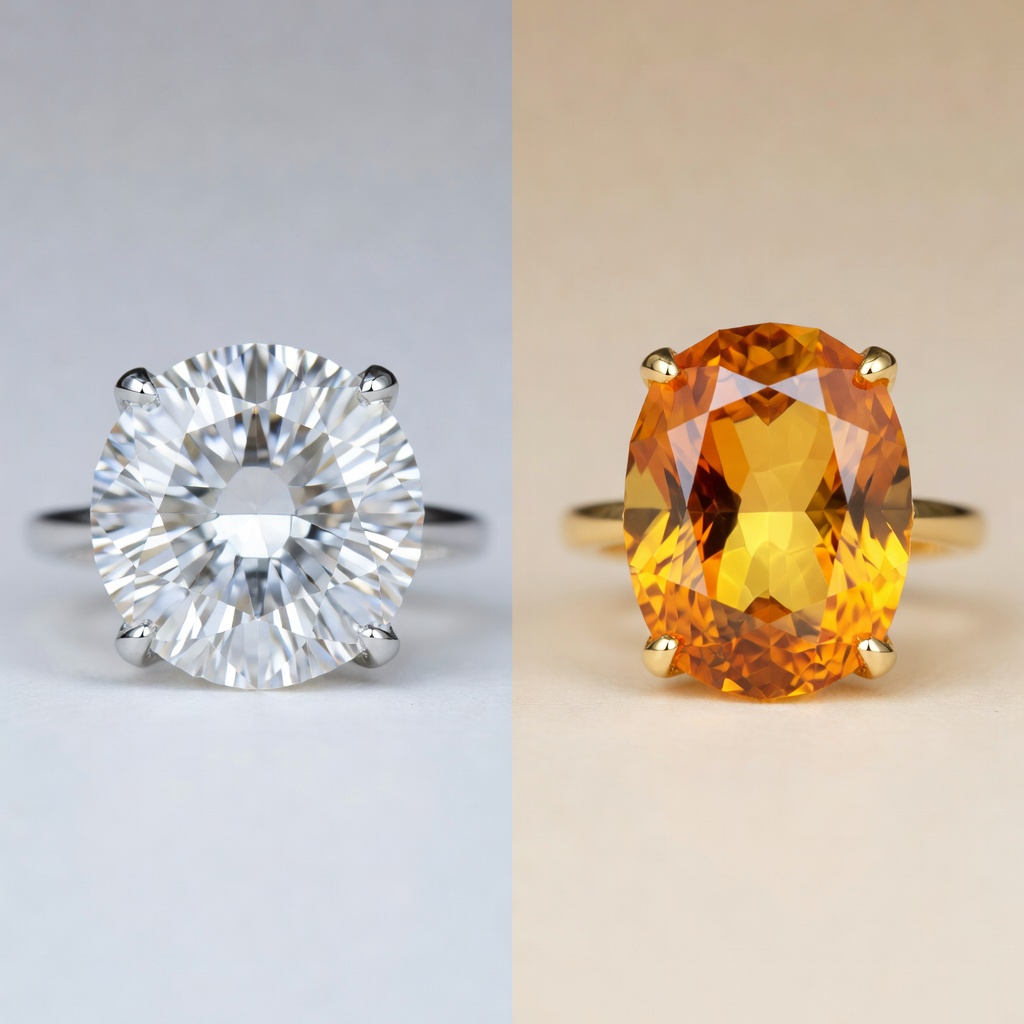
The aesthetic differences between these gemstones create distinct visual statements that appeal to different personal styles and jewelry traditions. Diamonds traditionally showcase colorless perfection graded on the D-to-Z scale, with the finest specimens appearing icy white and devoid of yellow or brown tinting. This neutrality makes diamonds versatile chameleons that complement any metal setting or wardrobe choice. In contrast, imperial topaz displays nature's artistry through its signature golden-orange to pinkish-orange hues, ranging from delicate peachy tones to intense sunset colors that immediately draw the eye and warm the complexion.
Light performance comparison reveals why imperial topaz vs diamond price differences reflect genuine optical disparities rather than mere marketing perceptions. Diamonds exhibit exceptional brilliance—the return of white light to the eye—and fire, the separation of white light into spectral colors, due to their high dispersion rate of 0.044. Imperial topaz produces a more subdued vitreous luster with gentle flashes of light rather than explosive sparkle. When evaluating an imperial topaz engagement ring, buyers should expect an elegant glow rather than the disco-ball effect associated with ideal-cut diamonds, creating a more understated, sophisticated presence on the hand.
Clarity characteristics offer another study in contrasts. Diamonds typically contain unique inclusions—internal characteristics like feathers, crystals, or clouds—that serve as fingerprints proving natural origin. Imperial topaz often achieves exceptional clarity with fewer visible inclusions, sometimes appearing "too perfect" to the trained eye, which occasionally raises concerns about synthetic origin until verified by gemological testing. Topaz inclusions, when present, usually manifest as tiny liquid-filled cavities or two-phase inclusions rather than the carbon crystals common in diamonds. Both stones respond beautifully to precision cutting, though diamonds tolerate more complex facet arrangements that maximize light return, while imperial topaz cuts often emphasize color retention and depth over maximum brilliance.
Price and Value Comparison
The economic comparison between these gemstones reveals one of the most dramatic price differentials in the jewelry industry, making imperial topaz vs diamond price analysis crucial for budget-conscious luxury buyers. A quality one-carat natural diamond typically commands $3,000 to $8,000 depending on color, clarity, and cut grades, while a comparable imperial topaz ranges from $100 to $400 per carat. This twenty-fold price difference means that for the cost of a modest diamond solitaire, consumers can acquire an impressive five to ten-carat imperial topaz that creates substantial visual impact and presence.
Diamond pricing structures reflect complex market dynamics extending beyond geological rarity. The traditional four Cs (cut, color, clarity, and carat) create granular pricing tiers, while market control through major mining conglomerates maintains price stability and perceived value. Certification requirements from laboratories like GIA add costs but ensure quality verification. Conversely, imperial topaz value derives primarily from color saturation, size, and natural versus treated origin. Untreated stones displaying the coveted "sherry" or pinkish-orange tones from Brazil's Ouro Preto mines command premium prices approaching $1,000 per carat for exceptional specimens, though these remain bargains compared to equivalent-sized diamonds.
Long-term value retention presents distinct trajectories for these stones. Diamonds benefit from established resale markets, liquidity, and cultural demand that maintain relative value stability over decades. Imperial topaz, while currently undervalued in the broader market, shows appreciation potential as fine specimens become scarcer and collector interest grows. However, the lack of standardized grading for colored gemstones complicates resale compared to diamonds' well-documented certification systems. For investment purposes, untreated, large imperial topaz specimens (exceeding five carats) with documented Brazilian origin offer the strongest appreciation potential, though they lack the immediate liquidity of certified diamonds.
Practical Applications in Jewelry Design
Selecting appropriate jewelry applications requires matching gemstone properties to intended use cases and lifestyle factors. Diamonds excel in high-impact, daily-wear scenarios including engagement rings, wedding bands, and tennis bracelets subjected to continuous contact with hard surfaces. Their unmatched hardness allows jewelers to create delicate prong settings that securely hold stones while exposing maximum surface area to light. For active individuals or those working with their hands, diamond jewelry requires minimal removal during daily activities, maintaining beauty despite decades of wear.
Imperial topaz engagement ring designs require more thoughtful engineering to accommodate the stone's physical limitations while showcasing its unique color. Bezel settings, which surround the gem's perimeter with protective metal, prove ideal for imperial topaz rings intended for regular wear, preventing edge chips and cleavage damage. Earrings and pendants represent safer applications for imperial topaz than rings, as these pieces experience less mechanical stress and impact during normal activities. Halo settings surrounding imperial topaz with small diamonds create stunning contrast while the diamond halo provides a protective buffer against side impacts.
Current design trends increasingly feature these stones in complementary rather than competitive arrangements. Mixed-stone jewelry pieces pair diamond accents with central imperial topaz to combine durability with distinctive color. Art Deco revival designs particularly favor imperial topaz for their warm tones that complement yellow and rose gold settings, while minimalist modern settings often choose diamonds for their crisp, architectural appearance. When selecting diamond alternative gemstones for bridal jewelry, couples should consider lifestyle factors; office professionals might successfully wear imperial topaz engagement rings with proper settings, while construction workers, chefs, or athletes should prioritize diamond durability for daily-wear pieces.
Care, Maintenance, and Longevity
Proper maintenance protocols ensure these gemstones retain their beauty across generations, though specific care requirements differ based on each stone's physical vulnerabilities. Both diamonds and imperial topaz tolerate standard jewelry cleaning solutions and ultrasonic cleaners, though caution proves warranted with imperial topaz due to its cleavage planes. Warm water mixed with mild dish soap and a soft toothbrush effectively removes accumulated oils and dirt from both stones without risking chemical damage. Professional steam cleaning remains safe for diamonds but should be avoided for imperial topaz, as rapid temperature changes can stress internal fractures or cleavage planes.
Heat sensitivity presents particular concerns for imperial topaz value preservation. While diamonds withstand extreme temperatures encountered during jewelry manufacturing repairs, imperial topaz requires protection from excessive heat that can alter color or cause thermal shock. Jewelers working on imperial topaz pieces must use protective heat shields or remove the stone entirely during soldering procedures near the setting. Home care should avoid exposing imperial topaz to sudden temperature changes, such as wearing rings while washing hands with very hot water immediately after coming in from cold weather.
Storage solutions must account for the gemstone hardness comparison between these materials. Diamonds can scratch imperial topaz, other gemstones, and even metal settings, necessitating separate storage compartments or individual soft pouches for diamond jewelry. Imperial topaz, while hard enough to scratch softer gems like opals or pearls, remains vulnerable to scratches from corundum and diamonds. A jewelry box with divided compartments or fabric-lined individual pouches prevents accidental contact damage. Professional inspection every six to twelve months allows jewelers to check for loose prongs on imperial topaz settings or worn mountings on diamond pieces, addressing minor issues before stone loss occurs.
Ethical and Environmental Considerations
Modern consumers increasingly prioritize provenance and mining ethics when selecting significant jewelry purchases, making the distinction between precious vs semi-precious stones less relevant than sourcing transparency. Diamond mining historically generated significant environmental disruption through open-pit mining operations and created human rights concerns regarding conflict financing. The Kimberley Process Certification Scheme, established in 2003, attempts to prevent conflict diamonds from entering legitimate markets, though critics argue the system contains loopholes regarding labor practices and environmental standards. Canadian diamonds and those from specific Botswana mines offer documented ethical alternatives with rigorous environmental protections and fair labor practices.
Imperial topaz mining generally occurs on smaller scales than diamond extraction, primarily through artisanal and small-scale mining operations in Brazil's Ouro Preto region. These operations typically create less environmental devastation than massive diamond mining projects, though concerns remain regarding fair wages and safety standards in informal mining sectors. The imperial topaz meaning extends beyond aesthetics to encompass support for traditional mining communities where gem extraction provides crucial economic stability. Direct sourcing from reputable dealers who maintain relationships with specific Brazilian mining cooperatives ensures better traceability than the complex, multi-layered diamond supply chain.
The emergence of lab-grown diamonds introduces another ethical dimension to the diamond vs imperial topaz comparison. Laboratory-created diamonds offer identical chemical and physical properties to mined stones while eliminating environmental extraction concerns, though they currently command higher prices than imperial topaz. Some consumers view natural imperial topaz as preferable to synthetic diamonds, valuing the stone's natural origin and geological history over manufactured alternatives. Fair trade certification programs for colored gemstones, including topaz, continue developing to provide consumers with the same ethical assurances available in the diamond market, though standardization remains less comprehensive than the Kimberley Process framework.
Symbolism, Meaning, and Cultural Significance
Beyond physical properties and market values, these gemstones carry distinct symbolic weight that influences selection for ceremonial and commemorative jewelry. Diamonds have dominated Western engagement traditions since De Beers' mid-20th century marketing campaigns cemented their association with eternal love, durability, and marital commitment. The "diamond is forever" concept resonated with consumers seeking tangible representations of unbreakable bonds, while the stone's clarity came to symbolize purity and transparency in relationships. This cultural positioning elevated diamonds from luxury goods to essential components of matrimonial ritual, creating expectations that persist despite evolving attitudes toward marriage and materialism.
Imperial topaz meaning encompasses themes of luxury, creativity, and personal confidence rather than traditional marital symbolism. Ancient Egyptians associated golden topaz with Ra, the sun god, attributing healing and protective properties to the stone's warm radiance. During the Renaissance, European nobility prized imperial topaz for its rarity, believing the stone could break magic spells and dispel anger. Modern crystal healing practitioners attribute imperial topaz with properties that enhance creativity, attract abundance, and boost self-confidence, making it popular among artists and entrepreneurs seeking inspirational talismans.
Historical usage patterns reveal fascinating overlaps and divergences in royal regalia. The Portuguese Crown Jewels feature spectacular imperial topaz specimens mistaken for diamonds until modern gemological testing confirmed their identity, demonstrating how historically these stones commanded equal respect with precious gems. The Braganza "diamond"—a 1,640-carat stone set in the Portuguese crown—actually proved to be colorless topaz, illustrating the confusion possible before advanced testing methods. Today, both stones appear in high jewelry collections from houses like Cartier and Tiffany, with designers utilizing diamonds for classic, timeless pieces and imperial topaz for bold, artistic statements that challenge conventional luxury aesthetics.
Diamond vs Imperial Topaz: Comparative Analysis
| Characteristic | Diamond | Imperial Topaz |
|---|---|---|
| Mohs Hardness | 10 (Maximum) | 8 |
| Refractive Index | 2.42 | 1.62-1.64 |
| Dispersion (Fire) | 0.044 (High) | 0.014 (Low) |
| Color Range | Colorless to Fancy Colors | Golden-Orange to Pinkish-Orange |
| Price per Carat (1ct, Quality) | $3,000-$8,000 | $100-$400 |
| Toughness | Good to Excellent | Fair (Perfect Cleavage) |
| Best Jewelry Applications | Daily Wear Rings, Bridal | Earrings, Pendants, Occasional Rings |
| Geological Rarity | Commercially Available | Genuinely Rare (Natural Color) |
| Care Requirements | Minimal (Very Durable) | Moderate (Avoid Heat/Impact) |
| Investment Liquidity | High (Established Market) | Moderate (Collector Market) |
Final Verdict: Which Gemstone Is Right for You?
Selecting between these distinguished gemstones ultimately depends on aligning stone characteristics with personal priorities, lifestyle constraints, and aesthetic preferences. For budget-conscious buyers seeking maximum visual impact, diamond alternative gemstones like imperial topaz offer extraordinary value, allowing the purchase of impressive, high-quality center stones that would cost tens of thousands as diamonds. Couples prioritizing uniqueness and color over traditional brilliance find imperial topaz particularly appealing for non-traditional engagement rings that stand apart from conventional solitaire settings.
Engagement ring suitability assessments must honestly evaluate daily wear patterns and risk tolerance. Active individuals, healthcare workers, or mechanics should prioritize diamond durability for rings worn continuously, accepting the premium pricing as insurance against damage. Those with office-based lifestyles who remove jewelry during physical activities can successfully choose imperial topaz for engagement rings, provided they select protective bezel or halo settings and commit to careful wearing habits. The imperial topaz engagement ring particularly suits fashion-forward individuals who view jewelry as changeable expression rather than permanent fixture, comfortable with the possibility of replacing or resetting stones over a lifetime of wear.
From an investment perspective, diamonds maintain advantage in liquidity and market recognition, making them safer choices for those viewing jewelry as portable wealth storage. However, connoisseurs seeking appreciation potential might consider untreated, large imperial topaz specimens from documented Brazilian sources as alternative investments, capitalizing on current market undervaluation. Personal style matching ultimately determines the best choice: classic, minimalist aesthetics favor the icy neutrality and brilliant fire of diamonds, while romantic, vintage-inspired, or artistic sensibilities align with imperial topaz's warm glow and distinctive character. Neither choice represents compromise when selected thoughtfully; both stones offer legitimate paths to owning beautiful, meaningful fine jewelry that reflects individual values and style.
Frequently Asked Questions
Is imperial topaz a good diamond alternative for engagement rings?
Imperial topaz can be a beautiful, budget-friendly alternative to diamonds for engagement rings, offering unique golden-orange hues at approximately 1/20th the cost. However, with a Mohs hardness of 8 versus diamond's 10, it requires more careful wear and protective settings to prevent scratches over decades of daily use. For those prioritizing uniqueness and color over traditional brilliance, it's an excellent choice.
Which is more expensive: diamond or imperial topaz?
Natural diamonds are significantly more expensive than imperial topaz. A quality 1-carat diamond typically costs $3,000-$8,000, while a comparable imperial topaz ranges from $100-$400 per carat. This dramatic price difference reflects diamonds' marketing, perceived rarity, and established resale market, whereas imperial topaz, despite being genuinely rare, remains undervalued in the semi-precious market.
Can imperial topaz be worn every day like a diamond?
While imperial topaz is durable enough for regular wear (hardness 8), it's not as suitable as diamonds for rough daily activities. Topaz has perfect cleavage, making it vulnerable to hard impacts if struck at the wrong angle. We recommend removing imperial topaz rings during gym workouts, heavy cleaning, or manual labor, whereas diamonds can withstand most daily abuse without issues.
How can I tell the difference between diamond and imperial topaz?
The most obvious difference is color—imperial topaz displays distinctive golden-orange to pinkish tones, while diamonds are typically colorless. Diamonds also show superior brilliance and fire (rainbow flashes) due to higher refractive index (2.42 vs 1.62). For definitive identification, a gemologist can use thermal conductivity testers (diamonds dissipate heat rapidly) or magnification to examine crystal structure and inclusions.
Does imperial topaz sparkle like a diamond?
Imperial topaz sparkles beautifully but differently than diamonds. Diamonds have exceptional brilliance and fire due to their high refractive index and dispersion. Imperial topaz produces a more subdued, elegant luster with warm color flashes rather than intense rainbow sparkles. The sparkle is softer and relies more on quality cutting and the stone's natural clarity than on inherent optical properties.
Is imperial topaz rarer than diamond?
Natural imperial topaz is genuinely rarer than diamonds in terms of geological occurrence. True imperial topaz (with natural golden-orange color from Brazil's Ouro Preto region) is extremely limited. However, diamonds command higher prices due to controlled supply, marketing, and demand. Most 'imperial' topaz on the market is heat-treated yellow topaz, making naturally colored specimens exceptionally rare and valuable to collectors.
What makes imperial topaz turn orange?
Natural imperial topaz's signature orange-to-pink color comes from trace chromium impurities and natural irradiation within the crystal structure over millions of years. Most commercial imperial topaz starts as yellow or brownish topaz that's heat-treated to achieve the prized golden-orange hue. Naturally colored imperial topaz from Brazil's Ouro Preto mines is the most valuable and requires no treatment.
Which gemstone is better for investment: diamond or imperial topaz?
Diamonds generally offer better liquidity and established resale value, making them safer short-to-medium term investments. However, fine natural imperial topaz has strong appreciation potential due to true rarity and increasing collector interest. For investment purposes, purchase GIA-certified diamonds or untreated, large (5+ carat) imperial topaz from reputable sources. Avoid treated stones if investment is your primary goal.