Rarity Meets Durability: Understanding the Diamond vs Euclase Distinction
When collectors and jewelry enthusiasts evaluate precious stones, the comparison between diamond and euclase presents a fascinating study in contrasts that defines two distinct philosophies of value. Diamond represents the pinnacle of durability as the hardest known natural mineral, composed of pure carbon crystallized in the isometric cubic system, while euclase stands as one of the mineral kingdom's rarest treasures—a beryllium aluminum silicate prized not for toughness but for extreme scarcity and mesmerizing color. This central conflict between unmatched physical resilience and extraordinary rarity creates a compelling narrative for anyone considering a significant gemstone acquisition, whether for daily adornment or serious collection. Understanding why seasoned gemologists and mineral collectors frequently juxtapose these seemingly different gemstones requires examining how durability metrics intersect with aesthetic uniqueness in the luxury stone market.
Geological Origins and Formation: From Deep Earth to Pegmatite Veins
Diamonds form under extraordinary conditions approximately 150 to 200 kilometers beneath Earth's surface, where temperatures exceed 1,050°C and pressures reach 45 to 60 kilobars within ancient continental keels. These carbon crystals travel to the surface via rare volcanic eruptions through kimberlite or lamproite pipes, with major commercial deposits currently extracted in Botswana's Orapa and Jwaneng mines, Russia's Yakutia region, and Canada's Northwest Territories. The geological age of most diamonds spans 1 to 3.5 billion years, making them ancient windows into Earth's early history, while modern mining operations process millions of tons of kimberlite annually to recover these dispersed gems.
Euclase crystallizes under distinctly different conditions within granite pegmatites and high-temperature hydrothermal veins, typically forming at shallower crustal levels where beryllium-rich fluids interact with aluminum-bearing minerals. The finest specimens emerge from the historic mines of Ouro Prêto in Minas Gerais, Brazil, where 18th-century gold rush miners first discarded these blue crystals as worthless byproducts before their gemological significance was recognized. Significant deposits also occur in Zimbabwe's Mwami belt, Colombia's emerald mines, and Russia's Ural Mountains, though production remains sporadic and limited compared to diamond's commercial abundance. While the diamond market supplies millions of carats annually to satisfy global jewelry demand, fine euclase crystals exceeding five carats of gem quality represent true museum-grade rarities that surface perhaps once or twice per decade at major mineral shows.
Physical Properties and Durability Analysis
The disparity in physical resilience between these gemstones becomes immediately apparent when examining the Diamond hardness Mohs scale rating of 10, representing the maximum possible resistance to scratching, compared to euclase's 7.5 rating. While euclase can resist minor abrasion from household dust (quartz, hardness 7), it remains vulnerable to scratching from harder materials including topaz, chrysoberyl, and of course diamond itself, making it unsuitable for jewelry that encounters daily wear. Diamond's atomic structure features each carbon atom bonded tetrahedrally to four neighbors, creating a three-dimensional network of exceptional strength, whereas euclase possesses perfect basal cleavage along one plane that creates a structural weakness despite its respectable hardness number.
Examining cleavage characteristics reveals critical differences for jewelry applications: diamond exhibits perfect cleavage in four octahedral directions, which allows cutters to split rough efficiently but requires skill to avoid fractures during polishing, yet the gem maintains excellent toughness due to its compact atomic bonding. Euclase presents a more concerning scenario with its single direction of perfect cleavage, rendering the stone brittle and susceptible to cleaving or chipping upon impact, particularly if struck parallel to the basal plane. Specific gravity measurements further distinguish these gems, with diamond density at 3.52 grams per cubic centimeter creating a substantial heft in hand, while euclase's lighter density of 3.00 to 3.10 feels noticeably different when handling stones of comparable dimensions.
Gemstone Comparison Table
| Property | Diamond | Euclase |
|---|---|---|
| Chemical Composition | Carbon (C) | Beryllium Aluminum Silicate (BeAlSiO4(OH)) |
| Crystal System | Isometric (Cubic) | Monoclinic |
| Mohs Hardness | 10 (Maximum) | 7.5 |
| Cleavage Quality | Perfect Octahedral (4 directions) | Perfect Basal (1 direction) |
| Specific Gravity | 3.52 | 3.00 - 3.10 |
| Refractive Index | 2.42 (Isotropic) | 1.65 - 1.67 (Biaxial Positive) |
| Dispersion (Fire) | 0.044 (High) | 0.016 (Low) |
| Typical Colors | Colorless to Fancy Colors | Colorless, Blue, Green, Yellow |
| Market Availability | Commercially Abundant | Extremely Rare |
| Optimal Jewelry Use | All Settings Including Daily Wear Rings | Pendants, Earrings, Occasional Wear |
Optical Characteristics and Visual Appeal
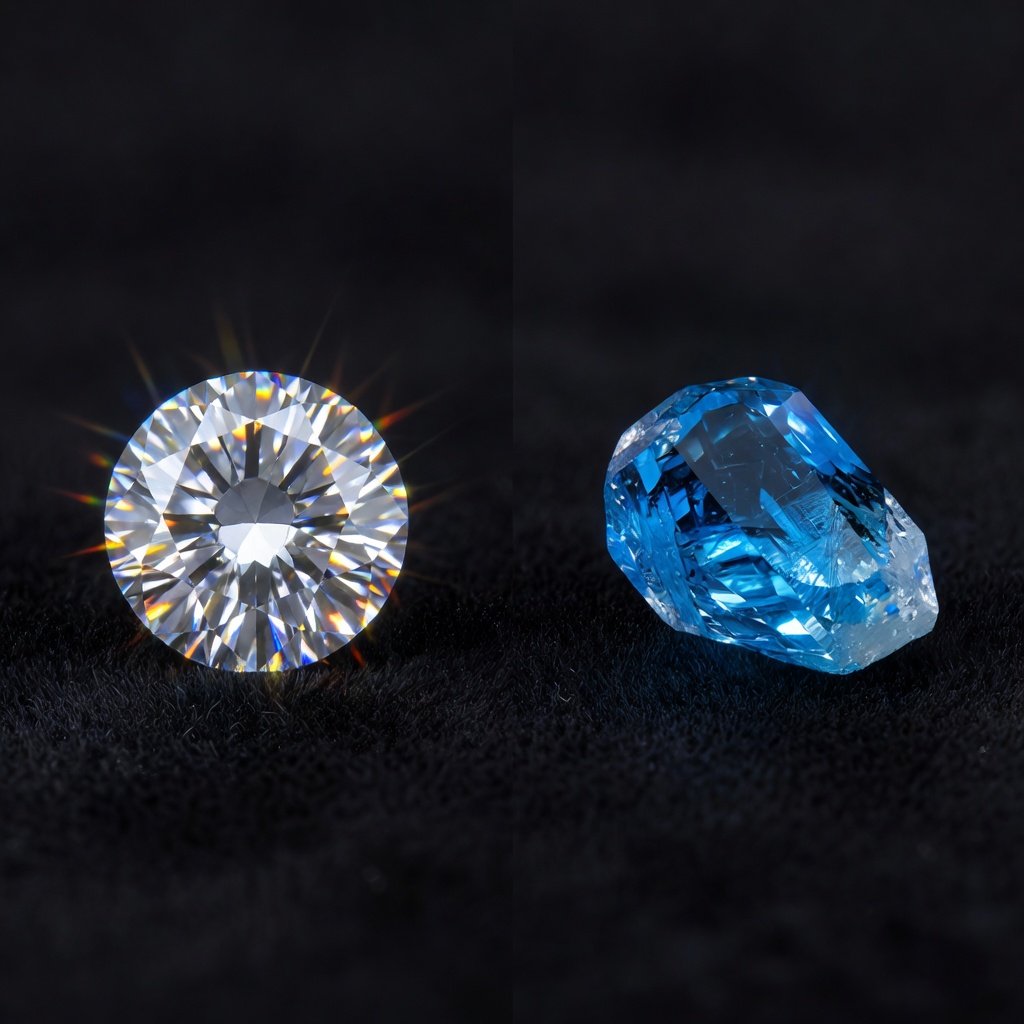
The optical performance of these gemstones diverges dramatically, with diamond displaying exceptional brilliance and fire resulting from its high refractive index of 2.42 and dispersion rating of 0.044, which separates white light into spectral colors creating those coveted rainbow flashes. When expertly cut in modern round brilliant or fancy shapes, diamonds optimize light return through total internal reflection, appearing to glow from within even under modest lighting conditions, a phenomenon that has established the gem as the ultimate symbol of enduring brightness. Euclase gemstone properties present a distinctly different visual character featuring a vitreous or glassy luster with moderate brilliance but minimal fire, creating a more subtle, aqueous glow reminiscent of fine aquamarine or blue topaz rather than diamond's explosive sparkle.
Color ranges offer another point of divergence, with diamonds occurring across the D-to-Z color grading scale from perfectly colorless to light yellow or brown, alongside rare fancy colors including canary yellow, pink, blue, and green that command premium prices. Euclase specializes in the blue spectrum, ranging from pale sky blue to intense saturated sapphire-like hues, with the most valuable specimens displaying a rich cerulean tone caused by trace iron and chromium substitutions within the crystal lattice. A unique optical phenomenon distinguishes euclase through strong pleochroism, where crystals display different colors—typically blue, greenish-blue, or colorless—when viewed from different crystallographic directions, unlike diamond's isotropic nature which appears identical from every angle. Gemologists use this pleochroism as a key identifying feature, as rare blue gemstones like euclase require careful orientation during cutting to maximize the preferred blue face-up color while minimizing windowing or extinction.
Cutting Challenges and Jewelry Optimization Strategies
Diamond cutting has evolved into a highly standardized science over centuries, with established proportions and angles optimized for specific shapes including round brilliant, princess, cushion, and emerald cuts, utilizing laser sawing and automated bruting to achieve precise symmetry. Master diamond cutters calculate pavilion and crown angles to maximize light return, knowing that the material's hardness allows for aggressive polishing and thin girdles without compromising structural integrity, enabling designers to create delicate settings that showcase the stone's optical properties. The industry's ability to cut diamonds efficiently has created a vast inventory of standardized gems suitable for every conceivable jewelry application, from micro-pavé engagement rings to elaborate statement necklaces.
Euclase cutting presents exponentially greater challenges due to its perfect cleavage and relative brittleness, requiring lapidaries to orient the table perpendicular to the cleavage plane to minimize risk during polishing and subsequent wear. Cutters must avoid thin girdles or sharp points that could initiate fractures, typically opting for thicker girdles and protective mounting styles such as bezels or halo settings that cushion the stone's edges from direct impact. Gemstone durability comparison studies consistently recommend reserving euclase for pendants, earrings, and brooches where impact risk remains minimal, while suggesting that rings feature protective bezels and be worn only for special occasions rather than daily activities. Practical examples include the famous 300-carat euclase crystal from Brazil's Sapucaia mine, which remained uncut for decades due to the difficulty of extracting clean faceted material without cleaving the valuable rough along its structural weakness.
Market Value and Investment Potential Assessment
Price per carat analysis reveals contrasting market dynamics, with commercial-quality diamonds ranging from $3,000 to $30,000 per carat depending on the four Cs (carat, color, clarity, cut), while investment-grade D-flawless stones command significantly higher premiums in auction settings. Euclase crystal value fluctuates based on color saturation and size, with pale blue specimens under one carat selling for $500 to $2,000 per carat, while intense blue crystals exceeding five carats can achieve $5,000 to $15,000 per carat or higher when exhibiting exceptional clarity and cutting quality. The liquidity differential proves stark: diamonds benefit from the Rapaport Price List establishing global benchmark pricing and immediate resale through thousands of dealers worldwide, whereas precious stone investment in euclase requires specialized knowledge of mineral collector markets and auction houses like Christie's or Heritage Auctions that host dedicated mineral sales.
Long-term value retention factors include certification requirements, with diamonds grading through GIA or AGS laboratories providing universal quality assurance that facilitates resale, while euclase lacks standardized grading reports and relies on expert opinion and provenance documentation. Treatment disclosures significantly impact value, as untreated natural blue diamonds command astronomical prices while irradiated or HPHT-treated stones trade at discounts, similarly, untreated euclase holds premium value over heated or oiled specimens that might appear on the market. Case studies from the mineral collecting world demonstrate that exceptional euclase specimens purchased in the 1990s for $10,000 have appreciated to $100,000 or more at current mineral shows, representing percentage gains that exceed diamond appreciation, though with significantly higher liquidity risk and longer holding periods required to realize profits.
Care, Cleaning, and Maintenance Protocols
Diamond maintenance remains remarkably straightforward due to the gem's chemical inertness and exceptional hardness, allowing owners to utilize ultrasonic cleaners and steam cleaning systems safely to remove accumulated oils and debris without risk of damage to the stone itself. Jewelry professionals routinely place diamond pieces in heated ultrasonic baths that vibrate away dirt from behind settings, though they must check for loose prongs beforehand since the cleaning process might dislodge poorly set stones. This low-maintenance requirement makes diamonds ideal for heirloom pieces meant to last generations with minimal intervention beyond occasional professional inspections.
Euclase care requires significantly more caution and represents a critical aspect of gemstone durability comparison for potential owners, as ultrasonic vibrations can exploit the mineral's perfect cleavage plane causing catastrophic fractures or complete separation of the gem. Owners should clean euclase using only lukewarm water with mild dish soap and a soft-bristled toothbrush, gently scrubbing around the setting while avoiding sudden temperature changes that might stress the crystal structure. Storage recommendations emphasize individual soft cloth pouches or dedicated compartmentalized boxes for euclase jewelry, as contact with harder gems like diamonds, rubies, or sapphires will scratch the euclase surface, whereas diamonds can be stored more casually without fear of damage from neighboring pieces. Practical tip: When traveling with euclase earrings or pendants, wrap them in acid-free tissue within a rigid box to prevent pressure points that might induce cleaving, unlike diamond jewelry which can withstand standard jewelry rolls with minimal risk.
Making Your Decision: Lifestyle Compatibility and Purpose
Engagement ring suitability represents the most common decision point for diamond vs euclase comparisons, with diamond's superiority for daily wear established through decades of practical use in wedding jewelry that withstands hands-on careers, household chores, and active lifestyles. Couples seeking unique alternatives might consider euclase for engagement rings only if selecting protective bezel settings in low-profile designs and accepting that the ring requires removal during physical activities, cooking, or cleaning to prevent cleavage damage. Real-world examples include a 2022 custom commission where a collector commissioned an euclase engagement ring with a platinum bezel and cathedral shank, specifically designed for a bride with a sedentary office job who understood the fragility constraints, whereas a nurse or construction worker would face unacceptable risk with such a choice.
Collector considerations shift the value proposition significantly, as building a serious mineral collection essentially requires representative specimens of euclase due to its status as a classic rare species, while diamonds serve more as portfolio anchors or liquidity reserves within high-net-worth collections. Aesthetic preferences ultimately guide many decisions, with traditionalists favoring diamond's classic brilliance and fire that symbolizes eternal commitment and sophistication, while connoisseurs of rare blue gemstones gravitate toward euclase's distinctive color and extreme rarity that signals sophisticated taste and mineralogical knowledge. Investment-minded collectors might allocate 80-90% of their gemstone budget to diamonds for stability while dedicating 10-20% to exceptional euclase specimens for appreciation potential and collection completeness.
Conclusion: Two Different Worlds of Value
The comparison between diamond and euclase ultimately illuminates two distinct paradigms of value within the gemstone universe—one founded on unmatched durability and commercial liquidity, the other on extreme rarity and unique aesthetic character. Diamond remains the pragmatic choice for daily-wear jewelry, heirloom creation, and wealth preservation, offering standardized quality assessment and immediate marketability that euclase cannot match. Conversely, euclase rewards the sophisticated collector with mineralogical significance, investment appreciation potential, and the exclusivity of owning a true earth treasure that few will ever encounter. Before committing to either significant purchase, prospective buyers should consult certified gemologists (GG or FGA credentials) who can verify natural origin, assess treatments, and match the specific stone's characteristics to the intended use, ensuring that whether you choose the eternal resilience of diamond or the fragile beauty of euclase, your acquisition aligns perfectly with your lifestyle, collection goals, and aesthetic desires.
Frequently Asked Questions
Is euclase harder than diamond?
No, euclase has a Mohs hardness of 7.5, while diamond ranks 10 (the highest possible). Diamond is significantly harder and more scratch-resistant than euclase, making it far more suitable for daily wear jewelry like engagement rings.
Why is euclase expensive despite being softer than diamond?
Euclase commands high prices due to extreme rarity and collector demand rather than durability. Fine blue crystals over 5 carats are exceptionally rare, and the gem's perfect cleavage makes cutting difficult, resulting in low yield from rough material.
Can euclase be used in engagement rings?
Euclase is generally not recommended for engagement rings due to its perfect cleavage and 7.5 hardness rating, making it vulnerable to chipping during daily activities. It is better suited for pendants, earrings, or occasional-wear rings in protective settings.
Which gemstone has more sparkle, diamond or euclase?
Diamond displays superior sparkle (brilliance and fire) due to its high refractive index (2.42) and dispersion (0.044). Euclase has a glassy luster and moderate brilliance but lacks the intense fire and scintillation that make diamonds appear so lively.
What colors do diamond and euclase come in?
Diamonds occur in colorless, yellow, brown, and rare fancy colors including blue, pink, and green. Euclase typically ranges from colorless to pale blue, with intense saturated blue being the most valuable; it occasionally occurs in green or yellow hues.
How can I tell the difference between diamond and euclase?
A gemologist can distinguish them using refractive index testing (diamond is isotropic at 2.42, euclase is biaxial positive with RI 1.65-1.67), specific gravity, and pleochroism observation (euclase shows color variation in different directions, diamond does not).
Is euclase a good investment compared to diamond?
While high-quality diamonds offer better liquidity and established resale markets, exceptional blue euclase specimens have shown strong appreciation among mineral collectors. However, euclase requires specialized collector knowledge to sell, unlike the standardized diamond market.
Where are the best euclase and diamond specimens found?
The finest diamonds come from Botswana, Russia, and Canada. Premium blue euclase crystals historically come from Ouro Prêto, Brazil, with significant deposits also in Zimbabwe, Colombia, and Russia's Ural Mountains.