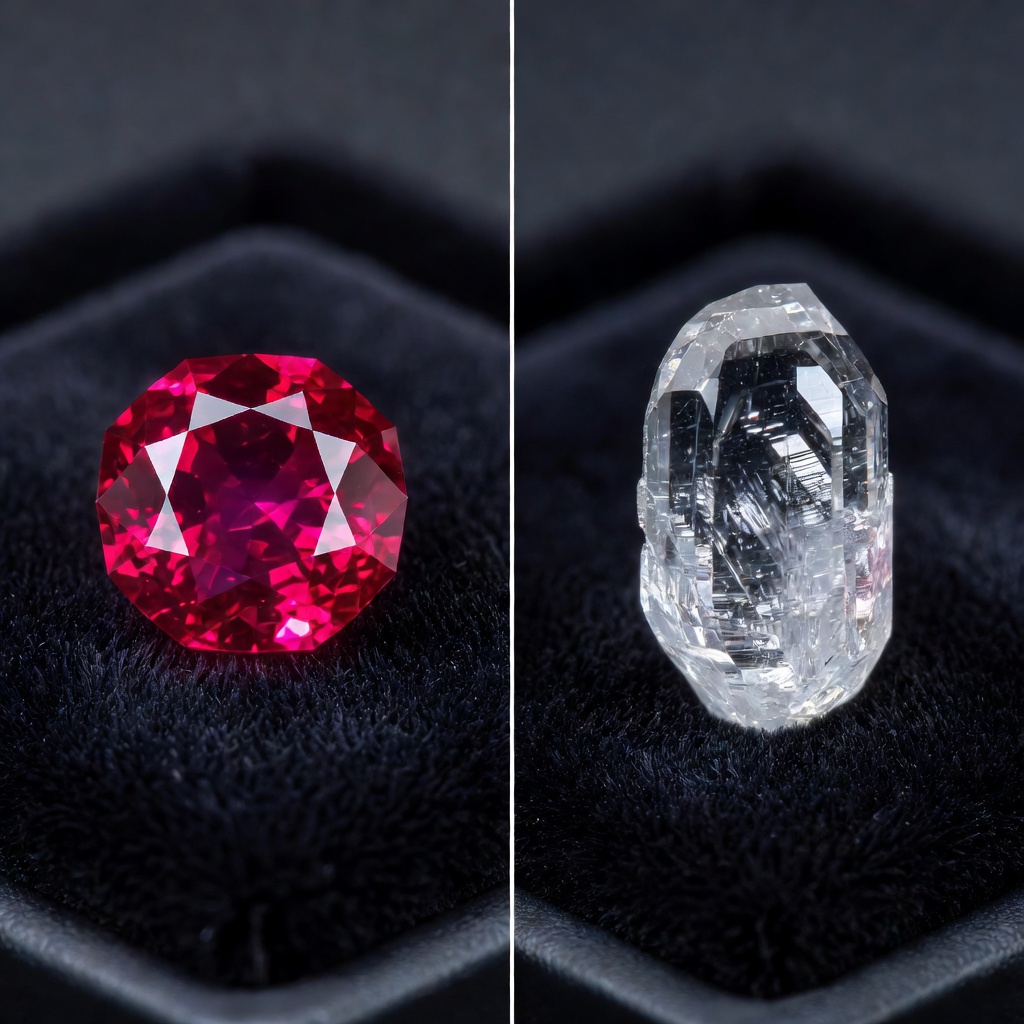
The Ultimate Hardness Showdown
When examining the vast spectrum of crystalline materials available to jewelers and collectors, the comparison between Diamond vs Enstatite presents one of the most striking contrasts in durability, rarity, and optical performance. Diamond stands as the hardest known natural material, achieving a perfect 10 on the Mohs hardness scale and serving as the universal benchmark for industrial cutting applications and bridal jewelry standards. In contrast, enstatite emerges as a fascinating magnesium silicate mineral belonging to the pyroxene minerals group, possessing a modest hardness of only 5.5 and remaining largely unknown outside of specialized mineralogical circles despite its gemological intrigue.
The fundamental differences between these stones extend far beyond their relative resistance to scratching, encompassing distinct formation environments that speak to their unique characters. Diamonds crystallize under extreme pressure and temperature conditions approximately 140 to 190 kilometers deep within Earth's mantle, transported to the surface through rare volcanic kimberlite eruptions. Conversely, enstatite typically forms during high-grade metamorphism of ultramafic rocks or arrives on Earth within chondrite and achondrite meteorites, carrying with it the chemical signatures of the early solar system. Understanding these orthorhombic vs cubic crystal distinctions matters significantly for collectors seeking rare collector gemstones and jewelry buyers evaluating diamond alternatives for specific applications.
Chemical Composition and Crystal Structure
Diamond represents nature's purest expression of elemental carbon, arranged in an isometric cubic crystal system characterized by sp3 hybridization that creates an extraordinarily rigid three-dimensional lattice. Each carbon atom forms four strong covalent bonds with neighboring atoms in a tetrahedral configuration, resulting in a network solid of exceptional stability and uniform physical properties in all crystallographic directions. This perfect atomic architecture explains diamond's unmatched hardness and its isotropic optical behavior, where light travels at identical speeds regardless of the crystal orientation.
Enstatite, designated chemically as MgSiO₃, crystallizes within the orthorhombic crystal system as a member of the pyroxene solid solution series, specifically representing the magnesium-rich end member of the enstatite-ferrosilite continuum. Its structure consists of single chains of silicon-oxygen tetrahedra linked by magnesium cations, creating a directionally dependent framework that exhibits different physical properties along different crystallographic axes. This chain silicate structure fundamentally differs from diamond's covalent network, resulting in distinct cleavage patterns, optical anisotropy, and lower overall density that gemologists must consider when evaluating Enstatite gemstone properties for jewelry applications.
The structural divergence between these materials manifests practically in their cleavage behavior and optical characteristics. Diamond's cubic symmetry produces perfect octahedral cleavage on four planes, allowing skilled cutters to predictably split crystals along specific directions with controlled force. Enstatite's orthorhombic symmetry generates two directions of good prismatic cleavage intersecting at nearly 90 degrees, creating blocky fracture patterns that cutters must navigate carefully during the faceting process to prevent accidental breakage of valuable rough material.
Hardness, Durability and Wearability
The gemstone hardness comparison between these materials reveals dramatic differences that directly impact their suitability for various jewelry applications. Diamond occupies the apex of the Mohs scale at 10, possessing an absolute hardness approximately 1600 times greater than talc and demonstrably superior to corundum (sapphire and ruby at 9). Enstatite measures merely 5 to 6 on the same scale, placing it in the same category as ordinary window glass and making it susceptible to scratching from steel knives, quartz dust, and even vigorous contact with harder gemstones stored in the same jewelry box.
When evaluating diamond durability against enstatite's wear characteristics, jewelers must consider not only hardness but also toughness and cleavage susceptibility. Despite its supreme hardness, diamond exhibits moderate brittleness due to its perfect cleavage, potentially fracturing if struck sharply against a hard surface at the correct angle. Enstatite demonstrates moderate toughness with less pronounced brittleness, though its significantly lower hardness means it accumulates surface scratches and abrasions rapidly during daily wear, requiring eventual re-polishing to restore luster.
Comparative Analysis Table
| Property | Diamond | Enstatite |
|---|---|---|
| Chemical Formula | C (Pure Carbon) | MgSiO₃ (Magnesium Silicate) |
| Crystal System | Isometric (Cubic) | Orthorhombic |
| Mohs Hardness | 10 (Maximum) | 5.5 - 6 |
| Refractive Index | 2.417 - 2.419 | 1.650 - 1.668 |
| Dispersion (Fire) | 0.044 (High) | 0.010 (Low) |
| Specific Gravity | 3.51 | 3.20 - 3.30 |
| Cleavage Type | Perfect Octahedral (4 directions) | Good Prismatic (2 directions at 87°) |
| Toughness | Good to Excellent | Moderate |
| Price Range (per carat) | $1,000 - $50,000+ | $50 - $500 |
| Ideal Jewelry Applications | Engagement rings, bracelets, daily wear | Pendants, earrings, collector specimens |
Practical application of these hardness differences guides professional jewelers when recommending stones for specific jewelry types. Diamond remains the undisputed choice for engagement rings, tennis bracelets, and other high-impact jewelry subjected to daily mechanical stress, maintaining pristine surfaces for generations. Enstatite requires protective settings and limited exposure to abrasive environments, making it suitable primarily for pendants, earrings, and brooches that receive minimal physical contact during wear.
Optical Properties: Brilliance, Fire and Color
The optical performance gap between these gemstones becomes immediately apparent when examining their refractive indices and light-handling capabilities. Diamond boasts a refractive index of 2.417 to 2.419, among the highest of any transparent natural material, creating the intense brilliance and mirror-like luster that defines its visual appeal. This high refractive index, combined with a dispersion value of 0.044, enables diamond to separate white light into spectral colors, producing the characteristic rainbow flashes or "fire" that captivates viewers and justifies premium pricing in the luxury market.
Enstatite presents a more subdued optical personality with refractive indices ranging from 1.650 to 1.668 and a dispersion of merely 0.010, resulting in a vitreous or glass-like luster without the prismatic fire associated with diamond. As a biaxial positive crystal in the orthorhombic system, enstatite exhibits weak to moderate pleochroism, showing different colors when viewed from different crystallographic directions—typically variations between green and yellowish-brown tones. This optical anisotropy contrasts sharply with diamond's optical isotropy, which presents identical color and brilliance regardless of viewing angle.
Color varieties further distinguish these materials in the marketplace. While diamond occurs across the complete color spectrum from colorless D-grade specimens to fancy vivid blues, pinks, and yellows, enstatite remains predominantly within earth-tone boundaries. Gem-quality enstatite typically displays green, yellowish-green, brown, or grayish-brown hues, with truly colorless varieties remaining exceptionally rare and prized by specialist collectors seeking unusual Enstatite gemstone properties.
Rarity, Sourcing and Market Availability
The global availability of these gemstones diverges dramatically, with diamonds benefiting from sophisticated industrial mining operations while enstatite remains a true exotic among rare collector gemstones. Major diamond producers including De Beers, Alrosa, and Rio Tinto operate large-scale mines across Botswana, Russia, Canada, and Australia, extracting millions of carats annually with controlled releases of gem-quality material maintaining stable market pricing. This established supply chain ensures diamond availability at virtually every jewelry retailer worldwide, supported by standardized grading systems and certification protocols from laboratories like GIA and AGS.
Enstatite exists under radically different market conditions, with transparent, facet-grade crystals representing extreme geological rarities rather than commercial commodities. Fine specimens suitable for cutting originate primarily from alluvial deposits in Mogok, Myanmar, the gem gravels of Sri Lanka, and the historic mines of the Czech Republic, with additional sources in Tanzania and Madagascar yielding limited material. The sporadic nature of these discoveries means that enstatite rarely appears in conventional jewelry stores, instead circulating through specialist mineral dealers, high-end gem shows, and auction houses catering to sophisticated collectors.
Perhaps most intriguingly, enstatite holds special significance in planetary science as a primary constituent of certain stony meteorites, specifically enstatite chondrites and achondrites. These extraterrestrial specimens occasionally yield translucent crystals with unusual optical phenomena or chemical compositions distinct from terrestrial examples, adding premium value for collectors interested in cosmic mineralogy. Such meteoritic enstatite represents some of the oldest material available for private ownership, predating Earth's formation and offering tangible connections to the early solar nebula.
Jewelry Applications and Setting Considerations
When designing jewelry incorporating these materials, craftsmen must account for their vastly different mechanical properties and wear expectations. Diamond's supreme hardness and excellent toughness make it suitable for every conceivable jewelry application, from delicate pavé settings in eternity bands to substantial solitaire engagement rings subjected to decades of daily impact. Prong settings, bezel mounts, and tension settings all accommodate diamond securely, with the stone's durability ensuring that sharp edges and delicate points (as in marquise or pear cuts) resist chipping and abrasion throughout generations of wear.
Enstatite requires significantly more restrictive treatment as a diamond alternative, demanding protective settings that minimize exposure to mechanical damage and environmental abrasion. Bezel settings that wrap the gemstone's girdle with metal provide optimal protection compared to exposed prong settings, while cabochon cuts eliminate vulnerable facet junctions that might chip under impact. Step cuts and emerald-style faceting patterns prove more practical for enstatite than brilliant cuts, as the former emphasize the material's clarity and color rather than attempting to maximize brilliance through complex facet arrangements better suited to higher refractive index materials.
Metal compatibility presents fewer restrictions, with both gemstones pairing effectively with traditional precious metals including 14K and 18K gold in various colors, platinum, and palladium. However, enstatite settings require additional structural considerations such as protective galleries that prevent the stone from contacting hard surfaces during wear, and designs that orient the crystal to minimize stress along cleavage planes. Jewelers working with enstatite should advise clients regarding appropriate wearing occasions, recommending these pieces for special events rather than daily office wear or athletic activities.
Pricing, Value and Investment Potential
The gemstone value comparison between diamond and enstatite reflects their disparate market positions, availability, and cultural significance. Diamond pricing follows established formulas based on the 4Cs (carat weight, cut quality, color grade, and clarity), with fine one-carat stones ranging from $1,000 for commercial grades to well over $50,000 for flawless, colorless D-grade specimens with excellent cut proportions. This pricing structure enjoys global recognition, with certified diamonds maintaining liquid secondary markets and functioning as portable wealth instruments accepted by pawnbrokers, auction houses, and private buyers worldwide.
Enstatite operates within a niche collector marketplace lacking standardized grading systems or universal pricing guidelines, with fine transparent specimens typically commanding $50 to $500 per carat depending on size, clarity, and color intensity. Exceptional large crystals exceeding five carats with high transparency might achieve premiums among mineral enthusiasts, but these stones lack the immediate liquidity and broad buyer base supporting diamond transactions. Investment potential for enstatite remains speculative, driven by rarity and geological significance rather than consumer demand or industrial utility.
From a portfolio diversification perspective, high-quality diamonds represent conservative tangible assets with historical price appreciation and crisis-resistant value retention, while enstatite appeals to collectors seeking mineralogical rarities with potential long-term appreciation based on increasing scarcity. Prospective buyers should recognize that enstatite purchases primarily satisfy collecting passions and scientific interests rather than providing readily convertible financial instruments, whereas certified diamonds offer established exit strategies through buy-back programs and international resale channels.
Identification and Authentication Methods
Distinguishing between these materials requires specific gemological testing beyond casual observation, though several diagnostic characteristics enable reliable separation. Thermal conductivity testing provides the quickest differentiation, as diamond's exceptional heat transfer properties (the highest of any bulk material) cause diamond testers to indicate "diamond" immediately, while enstatite's poor thermal conductivity produces negative or ambiguous results. However, advanced verification should include refractive index determination using a refractometer, revealing diamond's singly refractive nature (isotropic) with a reading of 2.417 versus enstatite's biaxial positive character with readings around 1.658 and 1.668, showing double refraction when rotated under polarized light.
Microscopic examination reveals distinctive inclusion patterns that assist in gemstone identification and origin determination. Diamonds typically contain characteristic inclusions such as pinpoints, clouds, feathers (cleavage cracks), and crystal inclusions of garnet or olivine, viewed under 10x magnification. Enstatite frequently displays rutile needle inclusions, lamellar twinning patterns, and occasional magnetite crystals, with some specimens showing chatoyancy or asterism when cut as cabochons due to aligned needle inclusions. Spectroscopic analysis provides definitive confirmation, with diamond showing the characteristic 415nm cape line in the blue region (among other absorption features depending on type), while enstatite displays distinctive absorption bands in the blue-violet region related to iron content and structural characteristics.
For collectors acquiring high-value specimens, laboratory certification from respected institutions provides essential documentation of identity and any treatments. While GIA and similar laboratories routinely certify diamonds with detailed reports including plotting diagrams of inclusions, enstatite rarely receives such documentation unless specifically requested for significant museum-quality specimens, meaning buyers must often rely on dealer reputation and personal gemological knowledge when acquiring these rare pyroxene minerals.
Care, Cleaning and Maintenance Requirements
Maintaining these gemstones requires markedly different protocols reflecting their chemical stability and physical durability. Diamond care remains remarkably straightforward due to the material's chemical inertness and hardness, allowing safe cleaning through ultrasonic baths, steam cleaners, and immersion in harsh solvents including acetone or alcohol without risk of damage. Owners can store diamond jewelry with minimal precautions, though separating pieces prevents harder diamonds from scratching softer gemstones in mixed collections, and periodic inspection of settings ensures stones remain secure despite the metal wear that occurs long before the diamond itself shows age.
Enstatite demands significantly more delicate handling as part of any comprehensive gemstone care guide, requiring gentle cleaning with mild soap, lukewarm water, and soft brushes only. The material's susceptibility to acids, thermal shock, and mechanical abrasion precludes ultrasonic cleaning, steam treatment, or exposure to household chemicals that might etch surfaces or exploit existing fractures. Thermal shock presents particular risk, as rapid temperature changes can induce cleavage along the prismatic planes, potentially splitting stones during careless cleaning with hot water followed by cold rinsing.
Long-term maintenance considerations favor diamond dramatically, as the material essentially remains unchanged over geological timescales when protected from traumatic impact. Enstatite, conversely, accumulates surface scratches and abrasions with normal wear, eventually requiring professional re-polishing to restore original luster—a process that reduces carat weight and potentially alters facet proportions. Storage recommendations mandate keeping enstatite pieces in individual soft pouches or compartmentalized boxes away from harder materials, while diamond storage requires only basic separation from other diamonds to prevent mutual abrasion of facet edges.
Frequently Asked Questions
Is Enstatite Harder Than Diamond?
No, enstatite is significantly softer than diamond. Diamond ranks 10 on the Mohs hardness scale (the highest possible rating), while enstatite measures only 5-6. This means enstatite can be scratched by a knife blade or steel file, whereas diamond can only be scratched by another diamond.
Can Enstatite Be Used as a Diamond Substitute in Engagement Rings?
Enstatite is not recommended for engagement rings or daily-wear jewelry. With a hardness of only 5-6, it scratches easily and shows wear quickly. Unlike diamond (10 Mohs) which withstands decades of daily wear, enstatite is best reserved for pendants, earrings, or collector specimens that receive minimal physical contact.
How Can You Tell the Difference Between Diamond and Colorless Enstatite?
Several tests distinguish them: Diamond feels cold to the touch due to high thermal conductivity, while enstatite feels warmer. Diamond has higher brilliance and fire (rainbow flashes). A hardness test will scratch enstatite but not diamond. Gemologically, diamond is singly refractive (isotropic) while enstatite shows double refraction (biaxial) when viewed through a polariscope.
Is Gem-Quality Enstatite Rare?
Yes, transparent, facet-grade enstatite is extremely rare. While the mineral is common in Earth's mantle and meteorites, gem-quality crystals large enough to cut are uncommon. Fine specimens primarily come from Myanmar (Mogok), Sri Lanka, and the Czech Republic, making them collector's items rather than commercial jewelry stones.
Which Gemstone Has Better Sparkle and Brilliance?
Diamond possesses significantly superior brilliance and fire due to its higher refractive index (2.42) and dispersion (0.044). Enstatite has a vitreous (glass-like) luster with lower refractive indices (1.65-1.67) and minimal dispersion, resulting in a more subdued sparkle compared to diamond's intense brilliance.
What Colors Does Enstatite Occur In?
Enstatite typically occurs in green, yellowish-green, brown, or grayish-brown colors. Rarely, it appears colorless or white. The green color comes from iron content, while pure magnesium enstatite approaches colorlessness. Unlike diamond's vast color range including blues, pinks, and yellows, enstatite's palette remains relatively limited to earth tones.
Does Enstatite Have Any Special Gemological Significance?
Enstatite is scientifically significant as a major component of Earth's upper mantle and as a common mineral in stony meteorites (chondrites). Some extraterrestrial enstatite specimens display unusual optical phenomena. However, it lacks the cultural and commercial significance of diamond, which dominates the jewelry market and industrial applications.
Is Enstatite Valuable Compared to Diamond?
Enstatite is much more affordable than diamond, typically costing $50-$500 per carat for fine specimens versus diamond's thousands per carat. However, enstatite lacks diamond's liquidity and established resale market. While large, clean enstatite gems command premium prices among mineral collectors, they do not represent the same financial investment as high-quality diamonds.