Introduction to These Distinct Gemstones
When considering precious gemstones for fine jewelry or investment portfolios, diamond has long served as the undisputed standard for excellence, brilliance, and durability in the global market. This carbon crystal structure, formed under immense pressure deep within Earth's mantle, represents centuries of tradition, romance, and financial security for collectors worldwide. However, a fascinating contender from the humite group minerals has emerged as a compelling subject for comparison among sophisticated gem enthusiasts seeking something beyond conventional choices.
Clinohumite stands as one of the world's rarest collectible gemstones, offering a distinctive warm palette that contrasts sharply with diamond's typical colorless appearance. First discovered in 1876 within the limestone formations of Italy's Mount Vesuvius, this calcium silicate mineral remained virtually unknown to the jewelry industry until significant deposits were unearthed in Tajikistan's Pamir Mountains during the 1980s. Understanding the diamond vs clinohumite distinction requires appreciating how these stones occupy opposite ends of the rarity spectrum while both commanding respect among serious collectors.
While diamonds are celebrated for their unmatched hardness and optical performance, clinohumite attracts connoisseurs who prioritize extreme scarcity and unique coloration over traditional gemological metrics. The comparison between these stones illuminates fundamental choices facing modern buyers: whether to invest in universally recognized liquidity and durability or to acquire a piece of geological history that fewer than a thousand people worldwide currently own in faceted form. This analysis serves both the practical jewelry shopper seeking diamond alternatives and the sophisticated collector interested in portfolio diversification through ultra-rare specimens.
Geological Origins and Formation Processes
Diamond Formation in Earth's Mantle
Diamonds crystallize approximately 90 to 120 miles beneath Earth's surface within the rigid lithospheric mantle, where temperatures exceed 2,000 degrees Fahrenheit and pressure reaches 725,000 pounds per square inch. These conditions enable carbon atoms to arrange themselves into the isometric crystal system, creating the hardest known natural substance through kimberlite and lamproite volcanic eruptions that rapidly transport stones to the surface. Major mining operations currently extract these gems from ancient volcanic pipes in Botswana's Orapa mine, Russia's Mirny deposit, and Canada's Diavik mine, with annual global production exceeding 150 million carats of rough material.
Clinohumite Genesis in Metamorphic Environments
Unlike diamonds born from primordial carbon, clinohumite forms through high-temperature contact metamorphism when silicate-rich fluids interact with limestone and dolomite deposits near igneous intrusions. This clinohumite origin story requires specific geochemical conditions where fluorine and magnesium-rich solutions penetrate sedimentary rocks at temperatures between 600 and 800 degrees Celsius, creating the monoclinic crystal structures characteristic of this rare gemstone. The process yields significantly smaller crystals than diamond formation, typically producing rough specimens under five carats with substantial inclusions that prevent faceting.
Geographic Distribution and Mining Challenges
While diamond formation occurs across multiple continents with established industrial extraction infrastructure, gem-quality clinohumite remains restricted to two primary localities: the Pamir Mountains of Tajikistan and the Koksha Valley in Afghanistan. These remote, politically unstable regions present extreme logistical challenges for mining, with most clinohumite recovered as secondary deposits in marble bedrock rather than primary veins. The Tajikistan discovery in the 1980s produced the only known deposit yielding crystals large enough and clean enough for jewelry use, making this single source responsible for virtually every faceted clinohumite gemstone available today.
Physical Properties and Durability Analysis
Hardness and Wear Resistance Comparisons
The gemstone durability comparison between these materials reveals dramatic differences that directly impact their suitability for daily wear jewelry. Diamond ranks maximum on the Mohs hardness scale at 10, allowing it to scratch virtually any other material while maintaining a polish indefinitely through decades of continuous wear. Conversely, clinohumite hardness registers at 6 on the Mohs scale, comparable to feldspar or orthoclase, meaning it can be scratched by common household dust (which contains quartz at hardness 7) and requires significantly more protective considerations in jewelry settings.
Crystal Structure and Cleavage Properties
Diamond crystallizes in the isometric system with perfect octahedral cleavage in four directions, creating potential vulnerability to chipping despite its extreme hardness, particularly along girdle edges in poorly cut stones. Clinohumite forms in the monoclinic crystal system with imperfect cleavage and conchoidal fracture patterns that distribute impact forces differently, often resulting in greater toughness relative to its hardness though still inferior to diamond's overall durability. Specific gravity measurements further distinguish these stones, with diamonds averaging 3.52 compared to clinohumite's 3.2 to 3.3, creating subtle but detectable weight differences between same-size specimens.
Comparative Analysis Table
| Property | Diamond | Clinohumite |
|---|---|---|
| Mohs Hardness | 10 (Maximum) | 6 (Moderate) |
| Crystal System | Isometric (Cubic) | Monoclinic |
| Specific Gravity | 3.52 | 3.2 - 3.3 |
| Refractive Index | 2.42 | 1.63 - 1.67 |
| Color Range | Colorless to Fancy Colors | Yellow-Orange to Brownish-Orange |
| Global Rarity | Millions of carats annually | Fewer than 1,000 faceted specimens |
| Price Range (Per Carat) | $3,000 - $30,000+ | $200 - $1,000+ |
| Best Jewelry Application | Rings, bracelets, daily wear | Pendants, earrings, occasional wear |
Practical Implications for Jewelry Longevity
When selecting between these stones for specific applications, consider that a diamond engagement ring worn daily for fifty years will likely show minimal surface wear, while a clinohumite ring under identical conditions would develop visible scratches and require periodic repolishing. For collectors considering clinohumite jewelry, protective bezel settings become essential rather than optional, particularly for stones intended for ring wear, as exposed table facets face abrasion risks from everyday activities like reaching into purses or gardening. Case studies from major gemological laboratories indicate that clinohumite specimens consistently show surface scratching after three to five years of regular wear, whereas diamonds maintain their polish for generations.
Visual Characteristics: Color, Brilliance, and Fire
Spectral Color Differences and Causes
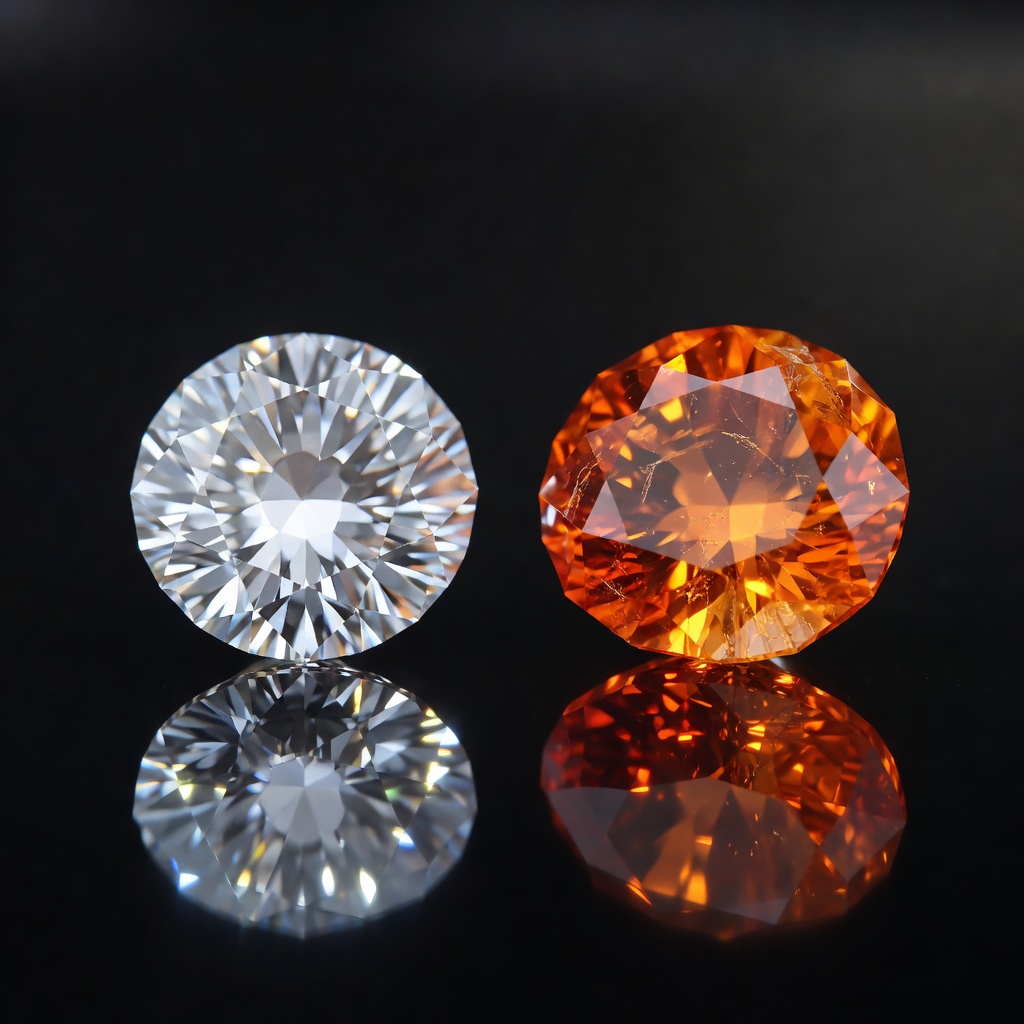
Diamonds typically present in colorless to near-colorless grades (D-Z scale), with fancy vivid colors including orange occurring rarely and commanding astronomical prices when natural. In contrast, clinohumite naturally exhibits the warm rare orange gemstone hues ranging from bright yellow-orange to deep reddish-brown and golden amber tones caused by iron content and hydroxyl substitutions within the crystal lattice. This consistent warm coloration makes clinohumite immediately distinctive, whereas an orange diamond might be mistaken for citrine or topaz without advanced testing.
Optical Performance and Light Return
Diamonds achieve their legendary brilliance through a combination of high refractive index (2.42) and strong dispersion (0.044), creating the characteristic fire that separates white light into spectral colors. Clinohumite possesses a more modest refractive index of 1.63 to 1.67 with lower dispersion, resulting in a vitreous luster and moderate brilliance that emphasizes body color over spectral flash. When evaluating gemstone brilliance, diamonds excel in step cuts and brilliant cuts that maximize light return, while clinohumite performs optimally in mixed cuts or step cuts that showcase its saturated color rather than attempting to mimic diamond's sparkle.
Clarity Characteristics and Transparency
Most diamonds available in the commercial market contain inclusions ranging from microscopic crystals to feather fractures, with clarity grades determining significant portions of their value. Clinohumite almost universally contains characteristic inclusions including calcite crystals, tremolite needles, or two-phase fluid inclusions that often create a slightly sleepy appearance rather than diamond's potential for flawless transparency. When cutting clinohumite, lapidaries must orient the stone to minimize the visibility of these inclusions, often choosing deeper pavilion angles that sacrifice some brilliance for improved face-up clarity, a compromise rarely necessary with high-grade diamonds.
Rarity and Market Availability
Production Volume Disparities
The global diamond industry produces approximately 150 million carats of rough diamonds annually, with gem-quality material representing roughly 20 percent of total output, creating readily available inventory across all market segments. Gem-quality clinohumite gemstone material constitutes perhaps a few hundred carats total global supply per year, with faceted stones over two carats considered extraordinary finds comparable in scarcity to major museum pieces. This production disparity means that while diamond shopping involves selecting from abundant options, acquiring clinohumite requires patience, specialized dealer relationships, and immediate action when specimens become available.
The Tajikistan Discovery and Supply Constraints
The 1980s discovery of clinohumite in Tajikistan's Pamir Mountains revolutionized the gem world by providing the first source of crystals exceeding one carat in clean enough condition for faceting. However, political instability, extreme elevation (over 4,000 meters), and limited infrastructure have prevented systematic mining, with most material recovered by local prospectors during summer months when snow recedes. This rare orange gemstone effectively exists as a finite resource, with each recovered crystal potentially representing years of searching, unlike diamond deposits that continue yielding consistent quantities through industrial mining operations.
Size Limitations and Collector Market Dynamics
Diamonds are readily available in all sizes from melee stones under one millimeter to the 530-carat Cullinan I, allowing jewelry designers unlimited creative flexibility. Clinohumite rarely produces faceted stones exceeding two to three carats clean, with specimens over five carats commanding immediate attention at major auction houses like Christie's or Sotheby's when they appear perhaps once every few years. Collector market dynamics favor clinohumite for portfolio diversification among ultra-high-net-worth individuals seeking assets uncorrelated with diamond market fluctuations, though liquidity remains significantly lower than the highly standardized diamond trade.
Pricing Analysis and Investment Value
Market Value Structures and Entry Points
Commercial-quality diamonds typically start around $3,000 to $5,000 per carat for one-carat stones with acceptable color and clarity, while investment-grade diamonds can command $30,000 or more per carat for D-flawless specimens. High-quality clinohumite generally ranges from $200 to $1,000 per carat, making it accessible to serious collectors with moderate budgets, though exceptional specimens over three carats with intense orange coloration can exceed $2,000 per carat. This pricing structure positions clinohumite as an affordable alternative for those seeking unique colored stones, though it functions differently than diamond alternatives like moissanite that attempt to simulate diamond appearance at lower prices.
Value Drivers and Quality Determinants
Diamond pricing follows standardized grading systems evaluating the four Cs (cut, color, clarity, carat), with transparent market reporting and liquid resale channels through dealers and auction houses. Clinohumite value derives primarily from color saturation, with vivid orange-red specimens commanding premiums over brownish or pale yellow examples, followed by clarity and size as secondary considerations. Provenance significantly impacts clinohumite pricing, with documented Tajikistan-origin stones selling at 20-30 percent premiums over Afghan material due to the former's association with the finest gem-quality crystals.
Investment Liquidity and Appreciation Potential
Diamonds offer relatively high liquidity through established dealer networks, online marketplaces, and auction houses, though resale values typically range 40-60 percent below retail purchase prices for consumer-grade stones. Clinohumite functions as an illiquid alternative investment comparable to fine art or rare manuscripts, requiring specialized dealers or collector networks for disposition but showing stronger appreciation potential due to absolute scarcity. Long-term trends indicate that while diamond prices fluctuate with economic cycles and laboratory-grown competition, natural clinohumite prices have appreciated steadily at 8-12 percent annually over the past two decades as awareness grows among colored stone connoisseurs.
Jewelry Applications and Setting Requirements
Protective Settings for Moderate Hardness Stones
Given the clinohumite hardness of 6, jewelry designers must employ protective settings that shield the gemstone's edges and pavilion from direct impact and abrasion during wear. Bezel settings, where metal completely surrounds the stone's perimeter, provide optimal protection for clinohumite rings, though they slightly reduce light return compared to prong settings. Flush settings or partial bezels offer compromises for those seeking visibility of the stone's profile while maintaining adequate protection against the chipping risks present in this moderately durable gemstone.
Diamond Versatility Across Jewelry Categories
Diamonds accommodate virtually any jewelry design from delicate pave-set eternity bands to substantial solitaire engagement rings and tennis bracelets subjected to daily impact. Their extreme hardness allows for sharp facet edges and precise cutting styles that maximize brilliance without durability concerns, enabling designers to create intricate openwork settings or tension mounts that leave stones exposed. For active individuals or those working with their hands, diamond jewelry requires minimal restrictions, whereas clinohumite jewelry demands conscious removal before activities involving potential contact with hard surfaces.
Optimal Applications and Design Aesthetics
Clinohumite performs beautifully in pendant necklaces and earrings, where protection from impact is naturally greater than in rings or bracelets, allowing for more open setting styles that showcase the stone's warm color. Occasional wear rings featuring clinohumite work well for cocktail events or special occasions rather than daily wear, particularly when set in protective yellow gold that complements the orange tones while providing durable metalwork. Metal pairing considerations favor yellow or rose gold for clinohumite to enhance its warm color palette, while diamonds traditionally pair with white metals for maximum brilliance or yellow gold for vintage aesthetics.
Care, Maintenance, and Longevity
Cleaning Protocols and Chemical Sensitivities
Diamonds tolerate ultrasonic cleaning, steam cleaning, and most chemical jewelry cleaners without damage, making maintenance straightforward for consumers. Clinohumite requires gentler treatment due to its lower hardness and potential sensitivity to thermal shock; warm soapy water with a soft brush remains the safest cleaning method, with strict avoidance of ultrasonic vibrations that might loosen inclusions or cause fractures. When considering gemstone durability comparison for maintenance routines, owners should schedule professional cleaning for clinohumite pieces every six months rather than attempting aggressive home cleaning methods suitable for diamonds.
Storage Strategies and Scratch Prevention
Proper storage significantly impacts the longevity of clinohumite jewelry, which should never contact harder materials including diamonds, sapphires, or even quartz-containing dust. Individual soft cloth pouches or compartmentalized jewelry boxes prevent scratching when pieces contact each other during storage or travel. For collectors rotating between diamond and clinohumite pieces, maintaining separate storage systems prevents accidental damage that could occur if a diamond ring scratches a clinohumite pendant stored in the same container.
Professional Maintenance and Damage Assessment
Diamond jewelry requires annual prong inspection to prevent stone loss, though the gems themselves rarely need repolishing or repair during a lifetime of wear. Clinohumite maintenance should include quarterly professional inspections checking for surface scratches, loose prongs, or developing chips along facet edges, with repolishing services every three to five years to restore luster worn away by daily abrasion. Active lifestyle assessments prove crucial for clinohumite owners; those regularly engaging in sports, gardening, or manual labor should reserve their clinohumite pieces for special occasions only, while diamonds accommodate such activities with minimal risk.
Buyer Decision Framework: Which Gemstone to Choose
Lifestyle Assessment and Wear Patterns
When evaluating diamond vs clinohumite for personal acquisition, honestly assess your daily activities and jewelry removal habits before committing to either stone. If you seek a center stone for an engagement ring worn continuously through workouts, household chores, and professional activities, diamond's unmatched durability provides worry-free longevity that clinohumite cannot match at hardness 6. However, if you desire a distinctive collector's piece for evening events or gallery openings where uniqueness matters more than durability, clinohumite offers conversation-starting rarity that diamonds—despite their expense—cannot provide due to their relative abundance.
Budget Optimization for Maximum Impact
Budget-conscious buyers seeking large visual presence might acquire a three-carat clinohumite for the price of a modest half-carat diamond, though this strategy requires accepting the orange coloration and reduced durability. For those prioritizing traditional symbolism and liquidity, diamonds remain the superior choice despite higher costs, particularly for significant life events like engagements where cultural expectations favor these stones. Consider hybrid approaches: selecting a diamond for daily-wear pieces and reserving diamond alternatives like clinohumite for accent stones or special-occasion jewelry that showcases your individual taste without compromising practicality.
Symbolic Significance and Emotional Resonance
Diamonds carry centuries of symbolism representing eternal love, invincibility, and commitment, supported by sophisticated marketing campaigns and cultural ubiquity that ensure immediate recognition and appreciation. Clinohumite offers alternative symbolism tied to rarity, individuality, and geological uniqueness, appealing to those who value owning something that few others possess rather than participating in established traditions. When gifting, consider the recipient's personality: traditionalists often prefer diamonds for milestone gifts, while artists, geologists, or free spirits might treasure the clinohumite gemstone for its distinctive story and warm, glowing coloration.
Occasion Appropriateness and Long-term Strategy
For engagement rings intended for daily wear across decades, diamonds provide the only practical choice among these two options, as clinohumite's moderate hardness makes it unsuitable for such rigorous demands. Anniversary gifts celebrating significant milestones might appropriately feature clinohumite as a "collector's upgrade" for someone who already owns diamond jewelry and appreciates rare colored stones. Investment acquisitions favor clinohumite for portfolio diversification due to its extreme scarcity, while diamonds offer better liquidity for those who may need to convert assets to cash quickly, making the choice between them partly dependent on your financial strategy and holding timeline.
Frequently Asked Questions
What is clinohumite and why is it compared to diamond?
Clinohumite is a rare calcium silicate mineral from the humite group, discovered in 1876. While chemically and physically distinct from diamond, collectors compare them because clinohumite represents extreme rarity versus diamond's abundance, offering unique orange coloration that diamonds rarely exhibit naturally.
Is clinohumite durable enough for an engagement ring?
With a Mohs hardness of 6, clinohumite is significantly softer than diamond (10) and requires protective bezel settings for ring wear. While suitable for engagement rings for careful wearers, it scratches more easily and is better suited for pendants or earrings that encounter less impact.
Why is clinohumite rarer than diamond despite diamond's luxury status?
Though diamonds command high prices due to marketing and demand, millions of carats are mined annually. Gem-quality clinohumite exists in only a few locations globally, primarily Tajikistan's Pamir Mountains, with fewer than 1,000 faceted specimens known to exist, making it thousands of times rarer.
What colors does clinohumite come in compared to diamond?
Clinohumite naturally occurs in yellow-orange to reddish-brown and golden-orange hues due to iron content. Diamonds occur colorless most commonly, but natural orange diamonds (comparable to clinohumite color) are among the most expensive diamonds, whereas clinohumite offers affordable vibrant orange.
Is clinohumite more expensive than diamond?
Generally no. High-quality clinohumite typically ranges $200-$1,000 per carat, while quality diamonds start around $3,000-$5,000 per carat. However, large, flawless clinohumite specimens (over 3 carats) can command premium prices due to extreme scarcity, sometimes exceeding small commercial diamonds.
Can clinohumite be used as a diamond alternative?
Clinohumite serves as an alternative for those seeking unique orange color rather than diamond imitation. Unlike cubic zirconia or moissanite, clinohumite doesn't mimic diamond's appearance but offers distinct beauty. It appeals to collectors wanting rarity over traditional brilliance.
How can I verify if a gemstone is genuine clinohumite versus diamond?
Professional gemological testing is essential. Diamonds have distinct thermal conductivity, isometric crystal structure, and specific gravity of 3.52. Clinohumite shows different optical properties, monoclinic crystal system, specific gravity of 3.2, and moderate heat conductivity. Always request certification from GIA or AGL.
Where are the best places to purchase clinohumite gemstones?
Due to extreme rarity, clinohumite is primarily available through specialized high-end gem dealers, auction houses like Christie's or Sotheby's, and select colored stone specialists. Unlike diamonds, clinohumite is rarely found in standard jewelry stores or mainstream online retailers.