Understanding Diamond and Cassiterite: A Comprehensive Mineral Comparison
When examining the fascinating world of minerals and gemstones, the comparison between diamond and cassiterite presents an intriguing study in contrasts. Diamond represents the pinnacle of gemstone prestige, composed entirely of carbon atoms arranged in an isometric crystal structure that creates the hardest known natural substance. In contrast, cassiterite serves as the primary ore of tin, a tin oxide mineral with distinct physical properties that make it valuable for industrial applications rather than fine jewelry. Despite their vastly different classifications and end uses, both minerals share certain optical characteristics that occasionally lead to confusion among novice collectors and geology enthusiasts. Understanding the fundamental differences between these minerals requires examining their formation environments, with diamonds crystallizing under extreme mantle conditions while cassiterite forms in hydrothermal veins closer to the earth's surface.
Chemical Composition and Crystal Structure
The atomic architecture of diamond and cassiterite reveals why these minerals exhibit such divergent physical behaviors. Diamond consists of pure carbon (C) arranged in an isometric cubic crystal system where each carbon atom forms strong covalent bonds with four neighboring atoms in a tetrahedral configuration. This network of sp³ hybridized bonds creates an incredibly rigid three-dimensional lattice that requires tremendous energy to disrupt. Gemologists recognize this structure as the foundation for diamond's legendary durability and thermal conductivity. Conversely, cassiterite crystallizes in the tetragonal crystal system with the chemical formula SnO₂, representing a tin oxide mineral where tin atoms bond with oxygen in a rutile-type structure. The bonding in cassiterite involves a combination of ionic and covalent characteristics, resulting in a less rigid framework that explains its moderate hardness of 6-7 on the Mohs scale.
Formation temperatures and geological conditions further distinguish these minerals. Diamonds typically crystallize between 900°C and 1,300°C under pressures of 45 to 60 kilobars, conditions found approximately 140 to 190 kilometers deep within the earth's mantle. These crystals subsequently travel to the surface via kimberlite or lamproite volcanic eruptions at velocities exceeding 100 kilometers per hour. Cassiterite forms under considerably less extreme conditions, typically precipitating from hydrothermal solutions between 300°C and 500°C in granitic pegmatites and high-temperature quartz veins. This significant difference in formation environments explains why diamonds remain geologically younger than their surrounding host rocks, while cassiterite often exhibits complex zoning patterns recording multiple stages of hydrothermal fluid interaction.
Physical Properties: Hardness and Durability
The physical distinction between diamond and cassiterite becomes immediately apparent when examining hardness and durability characteristics. Diamond occupies the apex position on the Mohs hardness scale with a rating of 10, meaning it can scratch every other mineral and only another diamond can scratch it. This extraordinary hardness stems from the perfect covalent bonding network mentioned previously, making diamond the definitive standard for the hardest mineral comparison in geological studies. Cassiterite, while reasonably hard among minerals generally, ranks only 6 to 7 on the Mohs scale, comparable to orthoclase feldspar or quartz. This hardness differential means that cassiterite can be scratched by common materials like hardened steel files or silicon carbide, whereas diamond remains impervious to virtually all mechanical abrasion except from fellow diamonds.
Specific gravity measurements provide another striking contrast between these minerals. Diamond possesses a specific gravity of approximately 3.52, feeling relatively light when handled due to carbon's low atomic weight. Cassiterite exhibits a notably high specific gravity ranging from 6.8 to 7.1, nearly double that of diamond, resulting from tin's heavy atomic mass (atomic number 50). This density difference provides a simple field identification method: a one-carat cassiterite specimen feels substantially heavier in the hand than a same-sized diamond. Regarding durability, diamond exhibits perfect octahedral cleavage along four planes, making it vulnerable to splitting under sharp impact despite its scratch resistance. Cassiterite displays distinct prismatic cleavage and conchoidal fracture patterns, offering different structural vulnerabilities that gem cutters must navigate when faceting transparent crystals.
Optical Properties and Visual Appearance
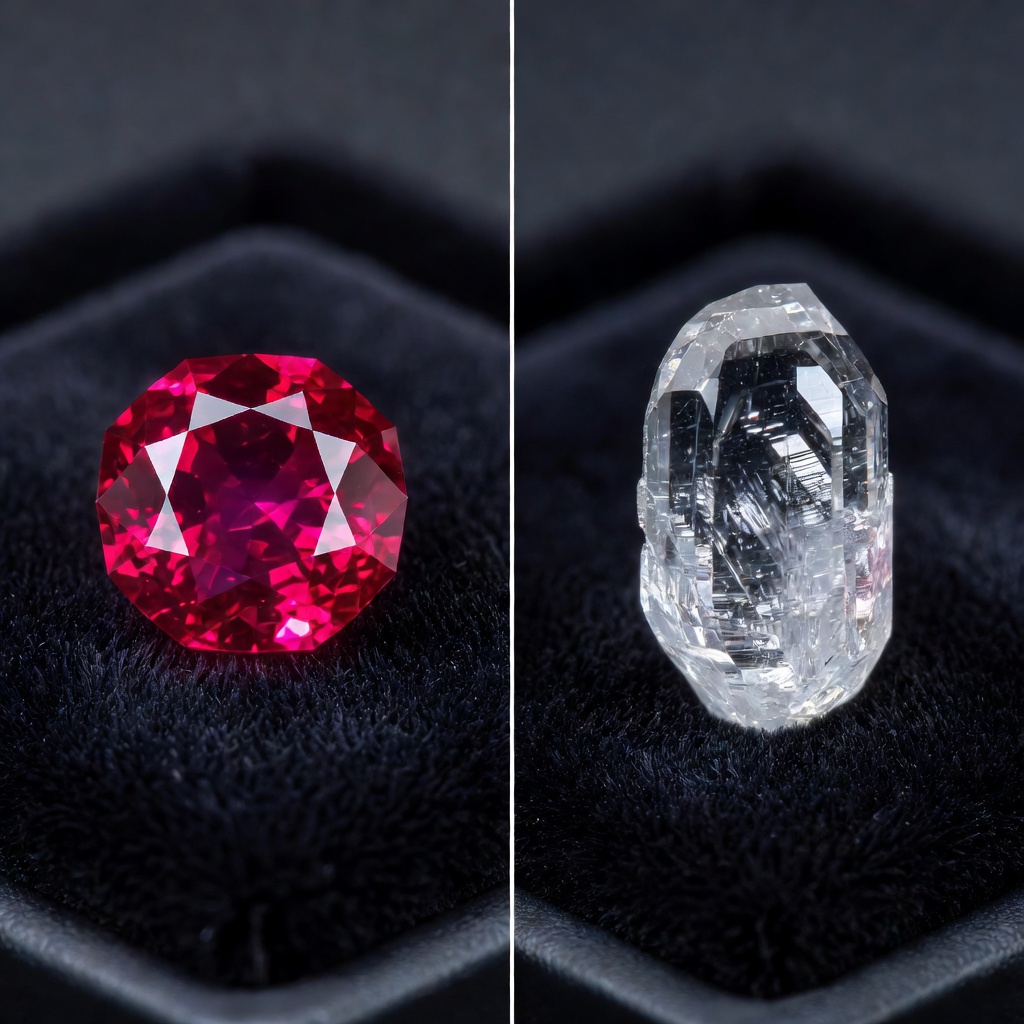
Both diamond and cassiterite can display adamantine luster, that brilliant, mirror-like quality associated with the highest refractive indices in the mineral kingdom, though cassiterite may also exhibit greasy or submetallic luster depending on iron content and surface conditions. Diamond's refractive index of 2.42 creates exceptional brilliance through total internal reflection, while cassiterite's refractive indices of 2.00 to 2.10 produce good brilliance but noticeably less fire than diamond. This optical distinction proves crucial for gemstone identification when examining faceted specimens under magnification. Color ranges differ significantly between the two minerals: diamonds occur in colorless varieties prized for jewelry, as well as fancy colors including yellow, blue, pink, and rare reds, while cassiterite typically presents in brown, black, or gray tones, with transparent colorless or pale yellow crystals occurring only rarely and commanding collector interest.
Dispersion characteristics further differentiate these minerals optically. Diamond exhibits a dispersion of 0.044, separating white light into spectral colors with the famous "fire" that makes it captivating in jewelry settings. Cassiterite demonstrates higher dispersion values around 0.071, theoretically capable of producing more fire than diamond, but this property remains largely unappreciated because transparent gem-quality material remains scarce and typically receives step-cut rather than brilliant-cut faceting to preserve weight. When conducting gemstone identification, professionals observe that cassiterite often shows distinct zoning or twinning patterns under magnification, while diamonds contain characteristic inclusions such as garnet crystals, pyrope, or distinctive cloud patterns. The visual heft of cassiterite combined with its typically darker coloration provides immediate differentiation from the lighter, usually colorless appearance of gem-quality diamonds.
Gemstone Applications and Jewelry Suitability
Diamond maintains undisputed dominance in the fine jewelry market, particularly for engagement rings and wedding bands where durability and symbolic permanence remain paramount concerns. The gemstone's hardness of 10 ensures that faceted diamonds resist scratching and abrasion during decades of daily wear, maintaining their polish and sharp facet junctions indefinitely. Major jewelry houses utilize diamonds in diverse cutting styles including round brilliants, princess cuts, emeralds, and cushion shapes, taking advantage of the mineral's ability to accept extremely thin girdles and sharp edges without chipping under normal conditions. Diamond's thermal conductivity also allows jewelers to use special burs and polishing wheels that would damage softer gemstones, enabling the precise faceting that maximizes optical performance.
Cassiterite finds extremely limited application as a jewelry gemstone due to its cassiterite gemstone properties, specifically its inadequate hardness for daily wear scenarios. While transparent, inclusion-free crystals of cassiterite can receive faceting for collector specimens, lapidaries must employ protective settings and advise owners against wearing these pieces during activities that might cause abrasion or impact. The mineral's perfect cleavage and moderate hardness make it unsuitable for rings or bracelets, though it occasionally appears in protected pendant settings or as rare display pieces in high-end mineral collections. Cutting cassiterite presents unique challenges because the material's brittleness requires gentler grinding speeds and finer grits than diamond cutting, with polishes achieved using tin oxide or aluminum oxide compounds rather than diamond powder. Jewelry designers considering cassiterite must balance its attractive luster and dispersion against the practicality of maintaining a soft gemstone in settings typically designed for harder materials.
Industrial Uses and Economic Importance
The industrial mineral uses of diamond extend far beyond adornment, encompassing critical applications in manufacturing, construction, and high-technology sectors. Synthetic and natural industrial diamonds serve as cutting tools for machining hard materials, drill bits for oil and gas exploration, grinding wheels for precision engineering, and heat sinks for high-power electronics. Diamond's exceptional thermal conductivity—five times greater than copper—makes it invaluable for thermal management in semiconductor devices and laser optics. The industrial diamond market actually exceeds the gem diamond market in volume, though not in value, with annual production reaching approximately 1,400 tons of synthetic material and 26 tons of natural industrial diamonds used primarily for abrasive applications.
Cassiterite functions as the primary economic source of tin, making it one of the most important industrial minerals in modern technology. Approximately 80% of global tin production derives from cassiterite ore, with the metal serving essential roles in solder for electronics, tin plating for corrosion protection, and various chemical compounds. The electronics industry particularly depends on tin-lead or lead-free solders to create reliable electrical connections in circuit boards and semiconductor packaging. Unlike diamond, which commands premium prices in both gem and industrial forms, cassiterite pricing follows standard metal commodity markets, with value determined by tin content percentage rather than crystalline perfection. Major producing countries include China, Indonesia, Peru, Bolivia, and Brazil, with placer deposits in Malaysia and alluvial workings in the Democratic Republic of Congo contributing significantly to global supply chains.
Comparative Analysis of Key Characteristics
| Characteristic | Diamond | Cassiterite |
|---|---|---|
| Chemical Formula | C (Pure Carbon) | SnO₂ (Tin Oxide) |
| Crystal System | Isometric (Cubic) | Tetragonal |
| Mohs Hardness | 10 (Highest) | 6-7 |
| Specific Gravity | 3.52 | 6.8-7.1 |
| Refractive Index | 2.42 | 2.00-2.10 |
| Primary Use | Jewelry, Cutting Tools, Electronics | Tin Ore, Collector Specimens |
| Color Range | Colorless to Fancy Colors | Brown, Black, Rarely Colorless |
| Luster | Adamantine | Adamantine to Greasy/Submetallic |
| Typical Price Range (Gem Quality) | $1,000-$50,000+ per carat | $10-$100 per carat |
| Formation Environment | Mantle (140-190 km depth) | Hydrothermal Veins, Pegmatites |
Rarity, Value, and Collectibility Factors
The concept of rarity operates differently for diamond and cassiterite, creating distinct market dynamics for collector minerals and investment-grade gemstones. While gem-quality diamonds with exceptional color, clarity, and cut command extraordinary prices due to controlled distribution and marketing, industrial-grade diamonds actually remain relatively abundant, with global reserves estimated in the billions of carats. True rarity in diamonds manifests in fancy vivid colors, particularly blues, pinks, and reds, or in large flawless crystals exceeding 10 carats. Investment potential for diamonds relies heavily on certification from recognized laboratories like GIA or AGS, with documented provenance and quality characteristics determining liquidity in secondary markets.
Cassiterite presents an inverse rarity pattern, where the mineral itself remains geologically common as an ore, yet transparent, inclusion-free crystals suitable for faceting constitute extreme rarities that serious mineral collectors actively pursue. Localities such as the Viloco Mine in Bolivia, the Mushston Township in China, and certain pegmatites in Namibia have produced the rare transparent crystals that occasionally reach the collector market. These specimens rarely exceed 5 carats in finished size, with prices typically ranging from $20 to $200 per carat depending on clarity and cutting quality—fractions of diamond pricing but significant for a mineral primarily valued as industrial feedstock. Collector minerals enthusiasts particularly value cassiterite specimens showing twinned crystals, epitactic growth on other minerals, or unusual crystal habits such as barrel-shaped or needle-like forms. While cassiterite lacks the investment liquidity of diamond, exceptional specimens from classic localities appreciate steadily within specialized mineral collecting communities, particularly as historic mines cease production.
Identification Methods and Testing
Accurate gemstone identification distinguishing diamond from cassiterite requires systematic testing using both traditional gemological tools and advanced analytical techniques. Hardness testing provides the most immediate differentiation: a diamond will scratch corundum (Mohs 9) and every other mineral, while cassiterite cannot scratch quartz (Mohs 7) and will itself be scratched by topaz or corundum. Practitioners should exercise caution when performing scratch tests on faceted stones to avoid surface damage, preferably testing on girdle areas or inconspicuous crystal faces rather than table facets. Specific gravity testing using heavy liquids offers a non-destructive identification method; cassiterite sinks rapidly in methylene iodide (SG 3.32), while diamond floats, clearly demonstrating the significant density difference between these minerals.
Visual inspection under 10x magnification reveals distinctive inclusion patterns that separate these species. Diamonds often display characteristic inclusions such as octahedral crystal inclusions, feather-like cleavages, or pinpoint clouds, while cassiterite typically shows zoning patterns, needle-like inclusions, or two-phase liquid and gas inclusions arranged along growth sectors. Advanced mineral testing methods including Raman spectroscopy provide definitive identification by generating unique spectral fingerprints: diamond produces a sharp peak at 1,332 cm⁻¹, while cassiterite shows characteristic bands at 475 cm⁻¹ and 638 cm⁻¹ corresponding to Sn-O stretching vibrations. X-ray diffraction analysis confirms crystal structure, with diamond showing isometric diffraction patterns and cassiterite displaying tetragonal symmetry. For field identification, cassiterite's extreme heaviness serves as a diagnostic property—experienced mineralogists often identify cassiterite in placer deposits by its tendency to concentrate with other heavy minerals like gold, magnetite, and ilmenite in stream gravels.
Care, Maintenance, and Storage
Proper gemstone care for diamond requires understanding that while extremely hard, these gems can chip along cleavage planes or abrade other jewelry items. Diamonds should be stored individually in soft cloth pouches or compartmentalized boxes to prevent scratching softer gemstones like sapphires, rubies, or emeralds that might share a jewelry box. Cleaning diamonds safely involves using warm water with mild dish soap and a soft brush, or professional ultrasonic cleaners that leverage diamond's durability to remove accumulated oils and dirt from setting crevices. Steam cleaning remains safe for most diamonds, though stones with significant inclusions or fracture filling treatments require gentler methods. Regular inspection of prongs and settings prevents loss of these valuable gems during wear.
Cassiterite demands significantly more delicate handling due to its softer nature and perfect cleavage. Owners should avoid ultrasonic cleaning entirely, as the vibrations may cause fracturing along cleavage planes or loosen stones from their settings. Gentle washing with lukewarm water and mild soap using only fingers or extremely soft cloth prevents surface scratching. Storage requires isolation from harder minerals including quartz, topaz, and certainly diamonds or corundum, with individual padded boxes preventing contact abrasion. Mineral storage for cassiterite specimens should maintain stable humidity levels, as some varieties may develop surface oxidation or tarnish in excessively dry environments. Display cases for collector specimens should feature secure mounts that prevent accidental drops, and cleaning should occur only when necessary to preserve original surface lusters and any delicate crystal faces that contribute to specimen value.
Conclusion: Choosing Between Diamond and Cassiterite
The decision between acquiring diamond or cassiterite ultimately depends on intended purpose, budget constraints, and appreciation for different aspects of mineralogy. For those seeking durable jewelry that withstands generational wear while maintaining financial liquidity, diamond remains the unparalleled choice, offering the hardness, brilliance, and market recognition that justify premium pricing. The hardest mineral comparison clearly favors diamond for any application requiring abrasion resistance or long-term optical clarity, making it essential for engagement rings, daily wear pieces, and investment portfolios. Diamond's versatility across industrial and gem applications ensures continued demand and value retention across economic cycles.
Cassiterite serves different but equally valid purposes within the realm of collector minerals and educational collections. Mineral enthusiasts value cassiterite for its crystal morphology, geological significance as the primary tin ore, and the challenge of obtaining rare transparent specimens suitable for faceting. While unsuitable for jewelry that experiences daily wear, cassiterite provides accessible entry points for beginning collectors interested in oxide minerals or those fascinated by the industrial mineral uses that drive modern electronics manufacturing. When building a comprehensive mineral collection, cassiterite represents an essential species demonstrating tetragonal crystal systems and high specific gravity, while diamond serves as the standard for isometric systems and ultimate hardness. Both minerals deserve appreciation for their unique contributions to earth science, technology, and human adornment, with the discerning collector ultimately benefiting from understanding and potentially owning examples of both these remarkable minerals.
Is cassiterite the same as diamond?
No, cassiterite and diamond are completely different minerals. Diamond is pure carbon (C) with a hardness of 10 on the Mohs scale, while cassiterite is tin oxide (SnO2) with a hardness of 6-7. They differ in composition, structure, and physical properties.
Which is harder, diamond or cassiterite?
Diamond is significantly harder than cassiterite. Diamond ranks 10 on the Mohs hardness scale (the hardest known natural mineral), while cassiterite ranks 6-7, making it softer than quartz and unsuitable for daily wear jewelry.
Can cassiterite be used in engagement rings?
Cassiterite is not recommended for engagement rings due to its relatively low hardness (6-7). It scratches easily and lacks the durability needed for daily wear. Diamond, with its hardness of 10, remains the superior choice for engagement jewelry.
What is cassiterite used for?
Cassiterite is primarily used as the main ore of tin for industrial applications including soldering, tin plating, and electronics manufacturing. Rare transparent crystals may be faceted for collectors, but it is not commonly used in commercial jewelry.
How can you tell the difference between diamond and cassiterite?
You can distinguish them by hardness (diamond scratches everything, cassiterite doesn't), specific gravity (cassiterite feels much heavier), and luster. Cassiterite is typically brown or black, while gem diamonds are usually colorless or fancy colored with superior brilliance.
Is cassiterite valuable?
Cassiterite has moderate value as an industrial tin ore, but gem-quality transparent crystals are rare and valuable to collectors. However, even gem-grade cassiterite is significantly less valuable than diamond on a per-carat basis.
What does cassiterite look like compared to diamond?
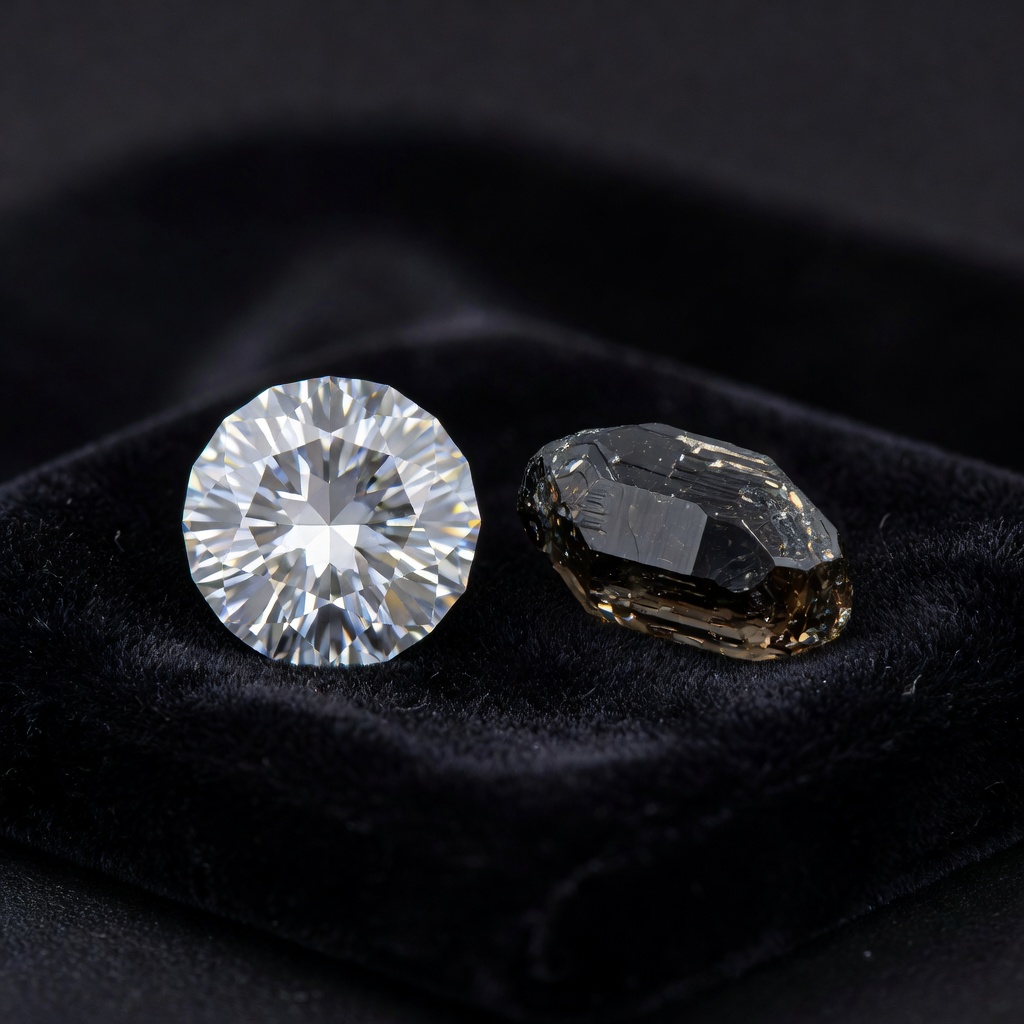
Cassiterite typically appears as brown, black, or rarely transparent crystals with an adamantine to greasy luster. Diamonds are usually colorless with exceptional brilliance and fire. Cassiterite is also much denser, feeling heavier in the hand than a same-sized diamond.
Where is cassiterite found compared to diamond?
Cassiterite forms in high-temperature hydrothermal veins and pegmatites, commonly found in Malaysia, Bolivia, and Indonesia. Diamonds form deep in the earth's mantle under extreme pressure and are found in kimberlite pipes, notably in Africa, Russia, and Canada.