Understanding the Diamond vs Ammolite Debate
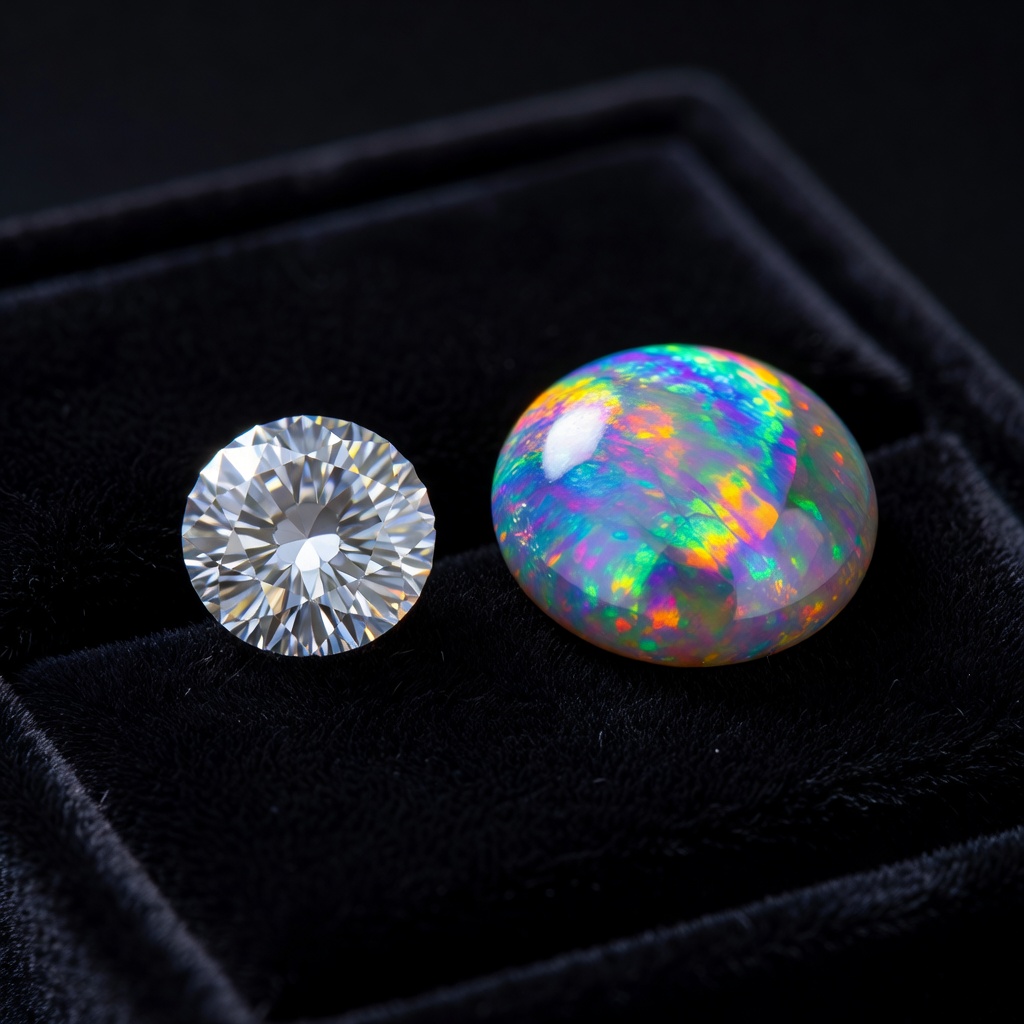
The comparison between Diamond vs Ammolite represents one of the most fascinating discussions in contemporary gemology, pitting centuries of luxury tradition against one of nature's most extraordinary prehistoric treasures. While diamonds have dominated the high jewelry market since the 1940s through strategic marketing and universal recognition, ammolite has emerged from relative obscurity to challenge preconceptions about value, rarity, and beauty in the gemstone world. Collectors and investors are increasingly drawn to this rare gemstones comparison because ammolite offers something diamonds cannot: the preserved iridescence of a 70-million-year-old marine fossil found exclusively in a single Canadian geological formation.
This comprehensive analysis examines these two remarkable stones across multiple dimensions, from their radically different geological origins to their contrasting performance characteristics in jewelry settings. Whether you are considering a significant jewelry purchase, building an investment-grade gemstone portfolio, or simply expanding your knowledge of exceptional minerals, understanding the distinct value propositions of diamond and ammolite will inform your decision-making process. We will explore why one stone commands the highest position on the Mohs hardness scale while the other captivates viewers with an entire rainbow trapped within fossilized shell layers, and how these factors influence their respective places in the luxury market.
Geological Origins: Ancient Fossils vs Eternal Carbon
The stories of how diamonds and ammolites journeyed from deep earth processes to jewelry showcases could not be more different, yet both represent millions of years of natural transformation under extreme conditions. Understanding these origins helps explain not only their physical properties but also their relative scarcity and the technical challenges involved in extracting and preparing them for commercial use. Each stone carries within its structure a unique geological timestamp that contributes to its mystique and market positioning.
The Billion-Year Journey of Diamonds
Diamonds form approximately 100 to 200 miles beneath Earth's surface in the mantle, where carbon atoms crystallize into isometric structures under immense pressure of 725,000 pounds per square inch and temperatures exceeding 2,000 degrees Fahrenheit. This diamond geological origin process began between one billion to 3.5 billion years ago during the Precambrian Eon, making some diamonds older than multicellular life on Earth. Ancient volcanic eruptions called kimberlite eruptions violently transported these crystals to the surface at speeds of 20 to 30 miles per hour, creating carrot-shaped pipes that mining operations target today across Botswana, Russia, Canada, and Australia.
Unlike ammolite's singular source, diamonds occur on nearly every continent, with major mining operations extracting approximately 150 million carats annually from both alluvial deposits and primary kimberlite pipes. The global distribution suggests abundance, yet the diamond market maintains high prices through controlled release strategies and the significant costs associated with extracting ore from increasingly deep deposits. Modern diamond formation continues deep within the mantle, though at rates too slow to be commercially relevant for human timescales, reinforcing their status as non-renewable geological resources.
Ammolite's Prehistoric Transformation
Ammolite represents the rare gem-quality form of fossilized ammonite shells, specifically from the extinct cephalopod Placenticeras meeki and Placenticeras intercalare that thrived in the Bearpaw Formation during the Late Cretaceous period approximately 70 to 75 million years ago. The Ammolite fossil formation process began when these marine creatures perished in the Western Interior Seaway that bisected North America, their shells sinking into bentonite clay on the seabed where they underwent unique mineralization. Unlike typical fossilization that replaces organic material with minerals like silica or pyrite, ammolite formed through the transformation of aragonite in the shell nacre into a new crystalline structure that produces the characteristic iridescence.
The exclusivity of ammolite cannot be overstated: gem-quality specimens occur only within a small radius along the St. Mary River in Southern Alberta, Canada, specifically within the K Zone deposit discovered in 1981. Mining operations extract material from depths of 15 to 30 meters using open-pit techniques, but only 10 to 15 percent of recovered material meets gem-quality standards suitable for jewelry. This geographic restriction means that unlike diamonds, which benefit from multiple producing regions, ammolite represents a finite resource from a single prehistoric event, making it geologically rarer than diamonds despite its lower market recognition.
Physical Properties and Durability Analysis
When selecting a gemstone for jewelry applications, understanding the physical limitations and structural characteristics proves essential for ensuring longevity and appropriate use. The dramatic difference in hardness between these two stones fundamentally dictates their suitability for various jewelry types, daily wear conditions, and setting requirements. While one stone resists virtually all scratching and environmental damage, the other requires careful protection and strategic design choices to preserve its beauty over time.
Mohs Hardness and Wearability Concerns
The diamond durability Mohs scale rating of 10 represents the maximum hardness achievable in natural minerals, meaning diamonds resist scratching from all other substances and maintain their polish indefinitely under normal conditions. This exceptional hardness results from the strong covalent bonding between carbon atoms in a tetrahedral lattice structure, making diamonds ideal for engagement rings and daily-wear jewelry that encounters incidental contact with hard surfaces. In contrast, Ammolite hardness registers between 3.5 and 4 on the Mohs scale, comparable to materials like household dust or a copper penny, rendering it susceptible to scratches, abrasions, and surface damage during routine activities.
Practical implications of this hardness differential become immediately apparent when considering lifestyle factors and jewelry placement. Diamond rings withstand the rigors of office work, household chores, and active lifestyles with minimal risk of surface damage, though they can chip along cleavage planes if struck with sufficient force. Ammolite, however, requires protective settings and conscious wear habits; even casual contact with door frames, desk surfaces, or metal jewelry can mar the surface iridescence that constitutes the stone's primary value. This durability constraint makes ammolite better suited for protective pendant settings, earrings, or occasional-wear pieces rather than rings subjected to daily mechanical stress.
Structural Integrity and Cleavage Patterns
Beyond surface hardness, the internal structures of these gemstones present distinct vulnerabilities and strengths that influence their cutting and setting requirements. Diamonds possess perfect cleavage in four directions parallel to the octahedral crystal faces, meaning skilled diamond cutters can split rough crystals along specific planes, but the same property makes cut diamonds vulnerable to chipping if struck at precise angles. Ammolite presents a different structural challenge: it consists of thin, overlapping layers of aragonite platelets approximately 0.5 microns thick that create the iridescent effect through light interference, but these layers can separate or delaminate if subjected to moisture, temperature extremes, or physical impact.
Jewelry designers must account for these structural realities through specialized setting techniques. Diamonds typically receive prong or bezel settings that protect the girdle while allowing maximum light return, leveraging the stone's durability to minimize metal coverage. Ammolite requires more comprehensive protection, often manufactured as doublets or triplets with clear quartz or synthetic spinel caps bonded to the iridescent layer, then set in bezels or protective frames that shield the edges from impact. These structural differences mean that while a diamond solitaire can survive generations of daily wear with minimal maintenance, an ammolite piece requires conscious design intervention to achieve heirloom status.
Visual Characteristics: Brilliance vs Iridescence
The optical performance of diamonds and ammolites diverges radically, offering collectors and jewelry enthusiasts two distinct aesthetic experiences that appeal to different sensibilities and design philosophies. Where diamonds captivate through the manipulation of white light into spectral fire and brilliant sparkle, ammolite enchants through a phenomenon of structural coloration that displays the entire visible spectrum depending on viewing angle and light source. Understanding these optical properties helps buyers select stones that align with their personal aesthetic preferences and the intended visual impact of the finished jewelry piece.
Diamond Optical Performance
Diamonds achieve their renowned brilliance through a combination of high refractive index (2.42) and dispersion (0.044), which measures the stone's ability to bend light and separate it into spectral colors respectively. When properly cut with precise facet angles, diamonds act as miniature prisms, splitting white light into flashes of colored fire while simultaneously reflecting brightness from the crown facets back to the viewer's eye. This diamond brilliance vs fire creates a dynamic, scintillating effect that changes with every movement of the wearer's hand, producing the "life" that diamond connoisseurs prize above all other visual characteristics.
The cutting process for diamonds follows mathematical formulas developed over centuries to maximize light return, with modern round brilliant cuts featuring 57 or 58 precisely angled facets designed to optimize reflection. Unlike organic gems, diamonds can be polished to achieve consistent optical performance across different specimens, allowing buyers to select stones based on cut quality grades that predict light behavior. This predictability and the cool, clear brilliance of diamonds make them versatile centerpieces that complement any metal color or design style while maintaining their appearance under various lighting conditions from candlelight to bright sunlight.
The Ammolite Color Spectrum Phenomenon
Ammolite displays one of the widest Ammolite color spectrum ranges found in any gemstone, potentially showing all seven spectral colors—red, orange, yellow, green, blue, indigo, and violet—sometimes simultaneously within a single specimen. Unlike diamonds, which derive beauty from clarity and light return, ammolite produces color through thin-film interference, the same optical principle that creates rainbow patterns in oil slicks or soap bubbles. Light entering the microscopic aragonite platelets reflects off both the top and bottom surfaces of each layer, with the interference between these reflections amplifying specific wavelengths while canceling others, creating the intense greens, blues, and rare crimsons that characterize fine specimens.
The visual experience of viewing ammolite differs fundamentally from diamond appreciation because ammolite operates as a directional color stone, meaning the intensity and hue shift dramatically depending on the angle of observation and illumination. A high-grade ammolite might appear predominantly green when viewed straight-on but flash brilliant reds and golds when tilted, creating an interactive relationship between the gem and its observer. This chromatic variability makes ammolite particularly effective in pendants and earrings that move with the body, constantly revealing new color combinations, whereas diamonds maintain more consistent appearance regardless of viewing angle. Rare specimens displaying the full spectral range, particularly those containing vivid reds and purples (the rarest colors), command premium prices rivaling fine diamonds on a per-carat basis.
Comparative Analysis: Diamond vs Ammolite Specifications
When evaluating these two extraordinary gemstones side by side, their contrasting characteristics become immediately apparent across every measurable parameter. The following comparison table illustrates the fundamental differences in composition, durability, optical properties, and market positioning that distinguish these stones, providing a quick reference for buyers weighing their options between traditional carbon brilliance and prehistoric iridescence.
| Characteristic | Diamond | Ammolite |
|---|---|---|
| Chemical Composition | Carbon (C) | Aragonite (CaCO3) fossilized shell |
| Mohs Hardness | 10 (Maximum) | 3.5-4 (Relatively Soft) |
| Refractive Index | 2.42 | 1.52-1.68 (variable) |
| Dispersion | 0.044 (High) | Not applicable (structural color) |
| Primary Optical Effect | Brilliance and Fire | Iridescence/Play of Color |
| Geological Age | 1-3.5 billion years | 70-75 million years |
| Primary Source | Global (Botswana, Russia, Canada, Australia) | Single source: Alberta, Canada only |
| Gem-Quality Yield | Approximately 20-30% of rough | 10-15% of mined material |
| Typical Price Range (per carat) | $3,000-$30,000+ (fine quality) | $50-$500 (standard), $10,000+ (museum grade) |
| Suitable for Daily Wear Rings | Yes (Excellent durability) | No (Requires protective settings) |
| Market Liquidity | High (Universal demand) | Moderate (Niche collectors) |
| Cleaning Method | Ultrasonic, steam, professional | Damp cloth only (no chemicals/ultrasonic) |
| Setting Requirements | Prong, bezel, or tension settings | Must be protected as doublet/triplet with bezel |
Rarity Factor: Market Availability and Supply
The concept of rarity in the gemstone market involves complex interactions between geological scarcity, mining economics, and market manipulation, with diamonds and ammolite presenting starkly different scarcity models. While both stones qualify as rare in absolute terms, their availability in the marketplace follows opposite trajectories: diamonds benefit from massive industrial mining operations and stockpile management, while ammolite suffers from—or benefits from, depending on investment perspective—genuine geological constraints that limit supply regardless of demand. Understanding these supply dynamics helps explain pricing anomalies and future value projections for both materials.
Global Diamond Production Realities
Annual global diamond production extracts approximately 150 million carats of rough diamonds from mines across Botswana, Russia, Canada, Australia, and several African nations, with the five largest mining companies controlling roughly 70 percent of world output. Despite this apparently abundant supply, the diamond market maintains price stability and perceived scarcity through sophisticated inventory management strategies pioneered by De Beers, which historically stockpiled rough diamonds to control release rates and stabilize prices during demand fluctuations. This controlled scarcity differs fundamentally from natural rarity, creating a market where diamonds remain consistently available at various quality tiers, from commercial-grade stones to exceptional D-color flawless specimens.
The diamond market availability extends further through the existence of massive alluvial deposits and secondary markets, ensuring that while individual high-quality stones remain rare, the commodity itself flows continuously through the global jewelry pipeline. New technologies such as underwater mining of marine diamond deposits off Namibia and advanced kimberlite detection methods continue to expand recoverable reserves, suggesting that while diamonds are non-renewable, immediate scarcity remains managed rather than acute. This market structure provides liquidity and price predictability but limits appreciation potential for standard commercial-grade stones purchased at retail.
The Single-Source Scarcity of Ammolite
Ammolite represents true geological rarity with no possibility of market manipulation to increase supply, as gem-quality material occurs exclusively within the Bearpaw Formation extending from Alberta into Montana, with commercial mining concentrated in a 20-kilometer radius near Lethbridge, Alberta. Mining operations by Korite International and Canada Fossils Limited extract approximately 5 to 10 tons of ammonite-bearing material annually, yet only 10 to 15 percent of recovered shells contain sufficient iridescence, thickness, and structural integrity to qualify as gem-grade ammolite suitable for jewelry. This yield rate means that the entire global supply of new Ammolite rarity amounts to roughly 500 to 1,500 kilograms of usable material per year—less than the weight of a single passenger vehicle.
The Ammolite gemstone value derives partially from this absolute supply constraint combined with increasing demand from Chinese and North American markets, particularly as Feng Shui practitioners recognize the stone as the "Seven Color Prosperity Stone." Unlike diamonds, which can theoretically be discovered in new kimberlite pipes globally, ammolite production faces hard geological limits; the Bearpaw Formation represents a specific moment in the Late Cretaceous when conditions perfectly preserved ammonite shells, and no equivalent deposits have been discovered elsewhere on Earth. As surface deposits deplete, mining operations must move deeper and process more overburden, increasing extraction costs while yields decrease, suggesting that high-grade ammolite will become increasingly scarce and valuable over coming decades.
Price Comparison and Investment Potential
Evaluating these gemstones as financial instruments requires understanding their distinct market structures, liquidity profiles, and historical appreciation patterns, as they serve different roles in investment portfolios and wealth preservation strategies. While diamonds function somewhat like currency in the luxury goods market with established resale channels, ammolite behaves more like fine art or rare stamps, requiring specialized knowledge to realize value and appealing to collectors seeking asymmetric appreciation potential. The Ammolite vs diamond price equation changes dramatically depending on whether one considers entry-level specimens or museum-grade rarities, with each stone offering distinct advantages for different investor profiles.
Entry-Level to Museum-Grade Pricing Tiers
Commercial-grade diamonds typically range from $3,000 to $15,000 per carat for stones in the near-colorless to colorless range with VS clarity and good cut grades, while exceptional D-flawless diamonds can command $30,000 to $100,000+ per carat depending on size and certification. This pricing structure remains relatively transparent, with Rapaport price lists providing wholesale benchmarks and established grading systems allowing buyers to compare values across vendors. For investment grade gemstones, diamonds offer stability but limited upside, as retail buyers typically pay 20-40 percent premiums over wholesale values, immediately placing them underwater on resale unless market prices appreciate significantly.
Ammolite pricing operates on a bifurcated model where standard commercial pieces with predominantly green and blue colors sell for $50 to $500 per carat, making them accessible to middle-market jewelry buyers seeking unique pieces. However, investment grade gemstones in the ammolite category—specimens displaying full spectral color including rare reds, purples, and golds with high brightness ratings—command $2,000 to $10,000+ per carat, directly competing with mid-to-high-tier diamonds on a price basis. Large ammolite specimens exceeding 10 carats with complete color rotation become exponentially rarer and can exceed diamond prices on a per-carat basis, though these ultra-rare pieces trade primarily through specialized dealers and auction houses rather than retail jewelry stores.
Liquidity and Market Dynamics
Diamonds maintain superior liquidity in the secondary market, with established networks of dealers, auction houses, and online platforms facilitating resale, though retail buyers should expect to recover only 40-60 percent of purchase price when selling to dealers unless holding exceptional rare stones. The diamond resale market benefits from universal recognition and standardized grading, allowing buyers to verify authenticity and quality without specialized expertise. However, this liquidity comes at the cost of appreciation potential, as diamond prices have historically tracked inflation with occasional speculative bubbles, providing wealth preservation rather than significant capital gains for most investors.
Ammolite presents a liquidity challenge requiring patience and specialized market access, as no standardized wholesale market exists and values depend heavily on subjective assessments of color quality, pattern, and size. Collectors seeking to liquidate high-grade ammolite must typically work through specialized Canadian gem dealers, Asian auction houses catering to Feng Shui collectors, or mineral specimen shows, often waiting months to find appropriate buyers willing to pay fair market value. Despite these liquidity constraints, ammolite has demonstrated remarkable price appreciation, with values increasing approximately 300 percent over the past two decades as Chinese demand surged and supply constraints tightened, suggesting that patient collectors holding museum-grade specimens may outperform diamond investors over extended time horizons.
Long-Term Appreciation Trajectories
Historical data suggests that while diamonds provide stability during economic downturns due to their status as crisis commodities, ammolite offers speculative growth potential driven by genuine scarcity and increasing cultural recognition. The fossilized gemstone jewelry market remains in its growth phase, with ammolite receiving official gemstone designation from the World Jewellery Confederation (CIBJO) only in 1981 and gaining recognition by the Gemological Institute of America (GIA) more recently. As global awareness increases and Chinese luxury markets continue embracing ammolite for its Feng Shui properties, demand appears positioned to outpace the finite supply from Alberta's mines, potentially driving prices toward parity with fine opals or alexandrites in coming decades.
Jewelry Design Applications and Setting Requirements
The physical and optical properties of diamonds and ammolite dictate radically different approaches to jewelry design, with each stone flourishing under specific conditions that protect their integrity while maximizing their aesthetic contributions. While diamonds offer designers virtually unlimited creative freedom due to their durability, ammolite requires thoughtful engineering solutions that balance protection with light exposure to reveal the stone's full chromatic potential. Understanding these design constraints helps buyers select appropriate pieces for their intended use, whether seeking a daily-wear engagement ring or a statement pendant for special occasions.
Diamond Versatility in Modern Settings
Diamonds accommodate virtually every jewelry style imaginable, from delicate pavé bands to bold solitaire statement pieces, thanks to their resistance to both scratching and environmental damage. Prong settings, which expose maximum surface area to light, remain popular for diamond engagement rings because the stone's hardness prevents the metal claws from wearing down the gem's surface over time. Designers frequently employ diamonds in tension settings, eternity bands, and stackable configurations that would destroy softer stones through the constant metal-to-gem contact and exposure to incidental bumps against hard surfaces.
The versatility extends to cleaning and maintenance protocols, as diamonds withstand ultrasonic cleaning, steam treatments, and exposure to household chemicals without damage, allowing for intricate openwork designs that might trap dirt but can be easily cleaned. This durability makes diamonds ideal for heirloom pieces intended for daily wear across generations, with designs ranging from vintage Art Deco patterns to contemporary minimalism all finding suitable expression through diamond's structural reliability. For active individuals or those working with their hands, diamond remains the only prudent choice for rings that will encounter regular impact and abrasion.
Protective Solutions for Ammolite Jewelry
Ammolite jewelry settings must address the stone's softness and layered structure through protective engineering that typically involves creating doublets or triplets rather than setting the raw fossil material directly. A standard ammolite doublet consists of the thin iridescent ammolite layer bonded to a stable backing material such as shale or black onyx, topped with a clear quartz or synthetic spinel cap that provides a hard, protective surface rated 7-8 on the Mohs scale. This sandwich construction protects the delicate ammolite from scratches and environmental moisture while the clear top layer allows light to enter and exit the iridescent layer, maintaining the play of color.
Setting choices for fossilized gemstone jewelry containing ammolite favor bezel settings that wrap metal around the stone's circumference, protecting edges from chipping and impact, or halo designs where small diamonds surround the ammolite center, providing both protection and visual contrast. Ammolite performs best in pendants, earrings, and brooches where the stones encounter minimal physical contact, though protective ring designs with high bezels and recessed stone placement can work for occasional wear. Jewelry designers often pair ammolite with yellow or rose gold to complement the warm reds and golds in the stone, or with white gold and diamonds to contrast with the cooler blue and green hues, creating pieces where the fossilized gem serves as the artistic focal point supported by protective metalwork.
Care, Maintenance, and Longevity
Preserving the beauty of fine gemstones requires appropriate care protocols tailored to their specific vulnerabilities, with diamonds and ammolite occupying opposite ends of the maintenance spectrum. While diamonds tolerate aggressive cleaning methods and active lifestyles with minimal degradation, ammolite demands careful handling akin to museum artifacts or fine opals, with specific environmental restrictions that owners must observe to prevent permanent damage. Understanding these care requirements before purchase helps ensure that your investment maintains its appearance and value across years or decades of ownership.
Professional Cleaning Protocols
Diamonds respond excellently to ultrasonic cleaning, which uses high-frequency sound waves to dislodge dirt and oils from behind the stone and within setting crevices, restoring maximum brilliance without risking damage to the gem itself. Professional jewelers also employ steam cleaners that blast pressurized steam at diamonds to remove buildup, and home care can include soaking in mild dish soap solutions followed by gentle brushing with soft toothbrushes. These aggressive cleaning methods prove safe for diamonds because their hardness exceeds that of any potential contaminant or cleaning tool, allowing owners to maintain sparkle without fear of scratching the surface or dulling the polish.
Ammolite care tips emphasize gentleness above all else, as ultrasonic vibrations can cause the layered aragonite structure to delaminate or separate from the backing material, while steam heat can damage the adhesives used in doublet or triplet construction. Owners should clean ammolite using only a soft, damp cloth lightly moistened with plain water, gently wiping the surface without applying pressure or abrasive materials. Chemical cleaners, including commercial jewelry dips, ammonia, and even some soaps, can damage the organic components of ammolite or attack the cement layers in assembled stones, potentially causing clouding, color fading, or structural failure over time.
Storage and Environmental Considerations
Proper gemstone maintenance guide protocols require storing ammolite pieces separately from other jewelry in soft cloth pouches or lined compartments, as contact with harder gems like diamonds, rubies, or sapphires will scratch the ammolite surface irreparably. Ammolite also requires protection from prolonged exposure to direct sunlight and heat sources, as excessive thermal expansion can stress the adhesion between layers in doublet construction and potentially fade the organic pigments contributing to the red and orange colors. Unlike diamonds, which remain stable across temperature ranges from freezing to boiling, ammolite should not be worn in saunas, hot tubs, or during activities that cause rapid temperature fluctuations.
Diamonds face fewer storage restrictions, though they should be kept separately from other diamonds to prevent mutual scratching (diamonds can scratch other diamonds along cleavage planes) and away from greasy environments that dull their brilliance until cleaned. For both gemstones, annual professional inspections ensure that settings remain secure, though the consequences of a loose setting differ dramatically: a lost diamond represents a significant financial loss, while a lost ammolite might represent an irreplaceable loss given the unique color patterns of each fossil specimen. With proper care, diamonds last essentially forever, while ammolite can provide decades of enjoyment but requires conscious preservation efforts to maintain its iridescent beauty across generations.
Cultural Significance and Symbolism
Beyond their physical properties and investment potential, diamonds and ammolite carry distinct cultural narratives and symbolic meanings that influence buyer preferences and gift-giving occasions. These symbolic associations, built through decades of marketing or ancient spiritual traditions, add intangible value to the stones and connect wearers to broader human stories about love, prosperity, and transformation. Understanding these cultural dimensions helps buyers select stones that resonate with personal values or communicate specific messages through jewelry.
Diamond's Romantic Legacy
The modern association between diamonds and eternal love represents one of the most successful marketing campaigns in history, initiated by De Beers in 1948 with the slogan "A Diamond is Forever" and reinforced through decades of celebrity engagement announcements and Hollywood product placement. This diamond symbolism has become so embedded in Western culture that diamond engagement rings now represent a $13 billion annual industry, with the two-month salary guideline (another De Beers invention) establishing diamonds as the standard demonstration of commitment seriousness. The stone's optical properties—its ability to resist damage while splitting white light into rainbow fire—metaphorically reinforce messages about enduring love that remains brilliant through life's pressures.
Beyond romantic contexts, diamonds historically symbolized power, invincibility, and divine favor among European royalty, who believed the stones provided protection in battle and clarity in judgment. This regal association continues in crown jewels and state regalia worldwide, while modern celebrity culture maintains diamonds as the ultimate status symbol of achieved wealth and success. The universal recognition of diamond's value means that gifting a diamond communicates unambiguous messages about the recipient's worth and the giver's investment in the relationship, making diamonds the default choice for significant lifecycle celebrations and commemorative jewelry.
Ammolite's Spiritual and Feng Shui Significance
Ammolite meaning derives from multiple spiritual traditions, most notably Feng Shui practitioners who designate the stone as the "Seven Color Prosperity Stone" or "Golden Phoenix Stone" due to its display of all seven chakras' colors within a single gem. According to these traditions, ammolite contains the earth's absorbed energy over 70 million years, making it a powerful tool for transforming negative energy into positive vitality while bringing wealth, health, and happiness to owners. The stone's association with ancient marine life connects it to water element energy, believed to enhance flow, flexibility, and abundance in the wearer's life.
Indigenous Blackfoot tribes of Alberta have collected iridescent ammonite fossils for centuries as ceremonial buffalo stones (Iniskim), using them in rituals to call buffalo herds and bring prosperity to the community. This cultural heritage adds authenticity to ammolite's metaphysical reputation, distinguishing it from recently invented "new age" crystals. Modern crystal healers attribute ammolite with properties of personal awakening, transformation, and good fortune, suggesting that wearing the stone helps release trauma and align the wearer with Earth's natural evolution. For buyers seeking jewelry with narrative depth beyond commercial marketing, ammolite offers a connection to deep time, prehistoric ecosystems, and earth mysteries that diamonds, despite their geological age, cannot match through their industrial extraction and processing.
Final Verdict: Which Gemstone Should You Choose?
Selecting between diamond and ammolite ultimately depends on aligning the stone's characteristics with your lifestyle requirements, aesthetic preferences, and long-term objectives for the jewelry piece. Neither stone represents a universally superior choice; rather, each excels in specific contexts that cater to different wearer profiles and intended uses. By honestly assessing your priorities regarding durability, uniqueness, investment potential, and symbolic meaning, you can make an informed decision that brings lasting satisfaction regardless of which gem you select.
Lifestyle and Wear Pattern Considerations
Active individuals, medical professionals, mechanics, or anyone using their hands extensively should choose diamonds for rings or bracelets, as the stone's hardness withstands the inevitable impacts and abrasions of daily life without requiring conscious protection. Diamonds suit those who prefer low-maintenance luxury and want to wear their investment daily without worrying about damaging the stone during gym workouts, gardening, or household chores. For choosing ammolite or diamond in the context of engagement rings or daily wear jewelry, diamond remains the practical and traditional choice that will survive decades of constant use.
Ammolite suits collectors and jewelry enthusiasts who view pieces as artistic expressions rather than utilitarian accessories, and who are willing to reserve certain items for special occasions or carefully managed wear environments. If you regularly attend galas, ceremonies, or professional events where you can showcase statement pieces without risk of damage, ammolite provides conversation-starting uniqueness that diamonds, however beautiful, cannot match due to their ubiquity. For those who already own diamond basics and seek to diversify their collection with something extraordinary, ammolite offers a distinctive alternative that signals sophisticated taste and knowledge of rare gemology.
Investment vs Aesthetic Priorities
For gemstone buying guide purposes focused on wealth preservation and liquidity, diamonds offer the safer harbor, particularly when purchasing certified high-color, high-clarity stones that maintain universal demand and established resale channels. However, buyers should purchase diamonds at wholesale or near-wholesale prices to have any hope of appreciation, as retail markups immediately erode investment value. Ammolite presents a higher-risk, higher-reward proposition for speculative collectors who can afford to hold rare specimens for extended periods and who possess the expertise to identify museum-grade material with full spectral coloration.
Aesthetic priorities favor diamonds if you appreciate geometric precision, mathematical perfection, and the cool brilliance of refracted light, particularly if you prefer jewelry that coordinates easily with any outfit or occasion. Choose ammolite if you are drawn to organic forms, natural art, and the warmth of iridescent color that shifts and changes with your movements, accepting that this beauty requires protection and mindful wear. Many sophisticated collectors ultimately choose both, selecting diamonds for foundational pieces like engagement rings and wedding bands while acquiring ammolite for pendants, earrings, and brooches that showcase the stone's prehistoric artistry without subjecting it to daily mechanical stress.
Frequently Asked Questions About Diamond vs Ammolite
Is ammolite more valuable than diamond per carat?
Generally, diamonds command higher per-carat prices than ammolite, with high-quality diamonds ranging $3,000-$30,000+ per carat versus ammolite's $50-$500 per carat range. However, museum-grade ammolite with full spectral color can exceed $10,000 per carat, making rare specimens comparable to mid-tier diamonds. The value equation depends on color intensity, pattern complexity, and size.
Can ammolite be worn everyday like a diamond engagement ring?
Ammolite is not recommended for everyday wear in rings due to its 3.5-4 Mohs hardness compared to diamond's 10. While diamonds resist scratching and chipping during daily activities, ammolite requires protective settings and is best suited for pendants, earrings, or occasional wear pieces. For daily-wear rings, diamond remains the superior choice for longevity.
Why is ammolite considered rarer than diamond if it costs less?
Ammolite is geologically rarer, sourced exclusively from Southern Alberta's Bearpaw Formation, with only 10-15% of mined material being gem-quality. However, diamonds benefit from massive marketing campaigns, established luxury branding, and universal recognition driving demand. Ammolite's lower price reflects limited market awareness and niche collector status rather than true scarcity.
Which gemstone is the better investment: diamond or ammolite?
Diamonds offer greater liquidity and market stability but limited appreciation potential for retail buyers. Ammolite presents higher appreciation potential (prices have risen 300% over 20 years) but requires specialized knowledge and has a smaller resale market. For pure investment, diamonds are safer; for speculative collectors, high-grade ammolite offers better growth potential.
Do ammolite and diamond complement each other in jewelry designs?
Yes, ammolite and diamond create striking combinations. Diamonds provide neutral brilliance that frames ammolite's vibrant iridescence without competing for attention. Designers often use diamond halos around ammolite centers or diamond accents in bands supporting ammolite pendants. The contrast between diamond's cool sparkle and ammolite's warm rainbow spectrum creates visually compelling pieces.
How can I verify if I'm buying genuine ammolite versus a diamond simulant?
Genuine ammolite displays natural iridescence that shifts with viewing angle, shows organic matrix patterns on the back, and feels warmer than glass imitations. Unlike diamond simulants (CZ, moissanite), ammolite is relatively soft (scratchable with a copper coin) and typically sold as doublets or triplets with clear cap layers. Always request certification from recognized labs like GIA or AGS.
What causes ammolite's rainbow colors compared to diamond's white sparkle?
Ammolite's colors result from structural interference: light refracts through microscopic aragonite platelets (0.5 microns thick), creating iridescence through thin-film interference similar to oil slicks. Diamond's brilliance comes from high refractive index (2.42) and dispersion (0.044), which splits white light into spectral colors (fire) and reflects it back as sparkle through faceting.
Is ammolite durable enough for heirloom jewelry?
With proper care and protective settings, ammolite can become heirloom pieces, though they require more maintenance than diamonds. Store ammolite jewelry separately to prevent scratching, avoid ultrasonic cleaning and harsh chemicals, and have settings checked annually. While diamonds pass down through generations with minimal care, ammolite heirlooms need conscious protection but can last decades with proper handling.