Introduction: Two Distinct Treasures of the Earth
When exploring the fascinating world of gemstones, the comparison between diamond and agate represents one of the most intriguing studies in contrasts within the mineral kingdom. Diamonds stand as the premier precious gemstone, coveted for centuries as symbols of wealth and eternal commitment, while agate emerges as a distinctive semi-precious stone celebrated for its earthy beauty and metaphysical properties. Consumers increasingly find themselves weighing these two gems against each other when making jewelry decisions, not because they serve identical purposes, but because understanding their respective durability, aesthetic appeal, and value propositions helps inform smarter purchasing choices across different lifestyle needs.
The modern gemstone market presents both stones as viable options for collectors and jewelry enthusiasts, yet their fundamental differences create distinct niches in the industry. While diamonds command attention through unmatched brilliance and hardness, agate gemstone properties offer unique advantages in affordability, variety, and spiritual significance that appeal to alternative jewelry markets. This comprehensive analysis will examine critical comparison areas including chemical composition, physical durability, visual characteristics, market valuation, and practical applications to help you determine which stone aligns with your specific requirements and values.
Chemical Composition & Geological Formation
The Carbon Marvel: How Diamonds Form
Diamonds represent one of nature's most remarkable achievements in crystalline structure, composed exclusively of pure carbon atoms arranged in an isometric crystal system. These precious stones form approximately 90 to 150 miles beneath Earth's surface within the upper mantle, where temperatures exceed 2,000 degrees Fahrenheit and pressure reaches 725,000 pounds per square inch. This extreme environment, maintained for periods spanning 1 to 3 billion years, allows carbon atoms to bond in tetrahedral arrangements that create the hardest known natural substance.
The journey of a diamond from mantle to surface requires violent volcanic eruptions through kimberlite or lamproite pipes, which transport these crystals rapidly upward to prevent degradation into graphite. This rarity of formation and extraction contributes significantly to diamond composition and value, as each stone represents an ancient geological survivor that survived billions of years of tectonic activity. Geologists studying diamond inclusions have used these stones to understand deep Earth processes, with some diamonds containing minerals that formed over 4.5 billion years ago.
Silica Sedimentation: The Agate Creation Process
Agates develop through an entirely different geological narrative, beginning as microcrystalline quartz (silicon dioxide) that precipitates from silica-rich waters within cavities of volcanic rocks. Unlike diamonds that require mantle conditions, agates form relatively near Earth's surface when groundwater percolates through basaltic lava flows, depositing microscopic quartz crystals in concentric layers within vesicles and geodes. This process occurs over thousands to millions of years, creating the distinctive banding patterns that characterize agate gemstone properties and make each specimen unique.
The banding variations in agate result from changes in water chemistry, temperature fluctuations, and pressure variations during formation, with different mineral impurities creating diverse color palettes. Iron oxides produce red and brown bands, while manganese and chromium generate pink, black, or green variations. Lake Superior agates, for example, formed approximately 1.1 billion years ago during the Midcontinent Rift system, yet the actual silica deposition occurred over mere thousands of years compared to the eons required for diamond formation.
Physical Properties & Durability Analysis
Hardness Hierarchy on the Mohs Scale
The most dramatic difference in the diamond vs agate hardness comparison appears on the Mohs scale of mineral hardness, where diamond occupies the apex position with a perfect rating of 10. This absolute hardness means diamonds can scratch any other natural material while remaining impervious to abrasion from lesser minerals. Agate, while reasonably durable for daily wear, scores between 6.5 and 7 on the Mohs scale, placing it in the same category as steel, quartz, and feldspar materials.
Practical implications of this hardness differential become apparent when considering jewelry longevity and maintenance. A diamond engagement ring worn daily for decades will resist scratching from household dust (which contains microscopic quartz particles), maintaining its polish indefinitely with proper care. Conversely, an agate ring worn with similar frequency would gradually develop surface abrasions and microscopic scratches that diminish its luster over time, requiring periodic professional polishing to restore its original appearance.
Toughness, Cleavage, and Structural Integrity
Despite diamond's supreme hardness, gemstone durability comparison reveals surprising vulnerabilities in its crystalline structure. Diamonds possess perfect octahedral cleavage, meaning they can split cleanly along four specific planes when struck with sufficient force at precise angles. This characteristic makes diamonds susceptible to chipping or breaking if subjected to sharp impacts, particularly at their girdle edges or pointed culet areas. Jewelers must exercise extreme caution when setting diamonds to avoid applying pressure along these cleavage planes.
Agate demonstrates superior toughness compared to diamond due to its microcrystalline structure, where interlocking quartz crystals create a more flexible, less brittle composite material. While agate cannot match diamond's scratch resistance, its cryptocrystalline composition allows it to absorb impacts without cleaving or shattering. This property makes agate particularly suitable for carved objects, cabochons, and beads that might experience occasional bumps or drops. Specific gravity measurements also differ significantly, with diamonds averaging 3.52 compared to agate's 2.60, creating noticeably different heft when handling similar-sized specimens.
Visual Characteristics & Optical Performance
Diamond Brilliance and Light Dispersion
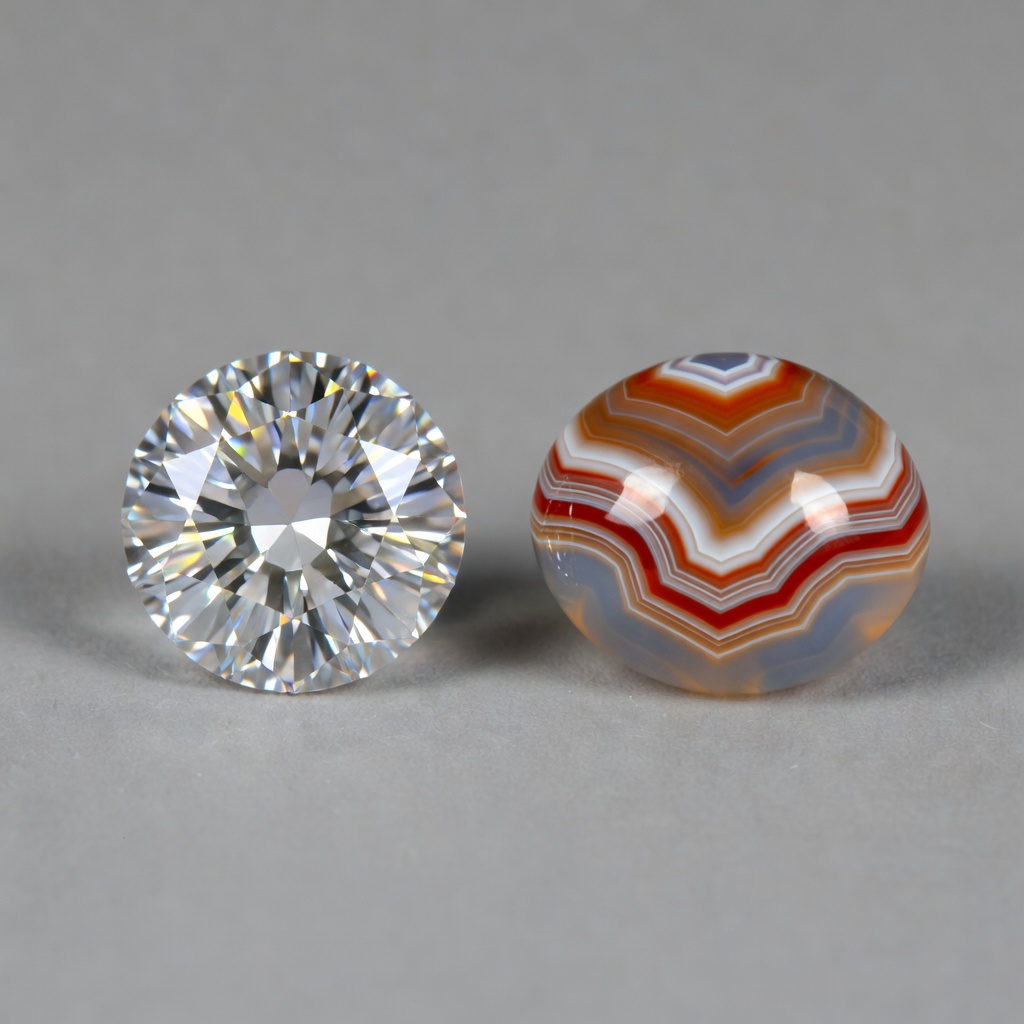
Diamonds captivate viewers through exceptional optical performance characterized by three distinct properties: brilliance (white light reflection), fire (spectral color dispersion), and scintillation (sparkle from movement). These effects result from diamond's high refractive index of 2.42, which causes light to bend dramatically when entering the stone, and its dispersion rate of 0.044, which separates white light into spectral colors. The adamantine luster of diamonds creates a mirror-like surface reflectivity unmatched by any other gemstone, contributing to their perceived value and desirability in fine jewelry.
Master diamond cutters exploit these optical properties through precise facet arrangements that maximize light return while minimizing leakage through the pavilion. Modern round brilliant cuts feature 57 or 58 specifically angled facets designed to act as tiny mirrors and prisms, creating the characteristic "crushed ice" or "hearts and arrows" patterns that command premium prices. This engineering of light makes diamonds instantly recognizable even to untrained observers, distinguishing them from simulants and other natural gems.
Agate Aesthetics and Pattern Recognition
Agate presents an entirely different visual philosophy, trading brilliance for depth and pattern complexity. Rather than sparkling through internal reflection, agate gemstone properties emphasize translucency, banding patterns, and rich earth-tone colorations that range from milky white to deep burgundy and moss green. The waxy to vitreous luster of agate creates a softer, more organic appearance compared to diamond's metallic shine, appealing to those who appreciate natural artistry over manufactured brilliance.
Collectors and lapidaries value agate specifically for its infinite variety of patterns, including fortification agate with its angular, wall-like bands, moss agate containing dendritic inclusions resembling plant material, and fire agate displaying iridescent optical phenomena similar to opal. Lake Superior agates feature distinctive red banding against white or gray backgrounds, while Brazilian agates often reveal stunning contrasts between amethyst centers and outer agate layers. This diversity in agate stone value derives from pattern uniqueness rather than standardized grading metrics, making each specimen a one-of-a-kind geological artwork.
Market Value & Price Determinants
Diamond Valuation Framework
The diamond market operates through a sophisticated pricing structure based on the 4Cs grading system: carat weight, cut quality, color grade, and clarity rating. Certified diamonds suitable for fine jewelry typically range from $1,500 to $25,000 or more per carat, with exceptional fancy colored diamonds or flawless D-color stones commanding significantly higher premiums. This pricing reflects not only geological rarity but also extensive marketing investments, controlled supply chains, and the technical expertise required for cutting and certification.
Investment-grade diamonds require certification from recognized laboratories such as GIA (Gemological Institute of America) or AGS (American Gem Society), with documentation verifying natural origin, absence of treatments, and precise quality parameters. Retail markups on diamonds often range from 100% to 300% above wholesale costs, affecting resale value and making immediate liquidation difficult without substantial loss. However, high-quality diamonds over one carat with excellent cuts and color grades generally retain value better than smaller or lower-quality stones.
Agate Accessibility and Affordability
Agate occupies the opposite end of the pricing spectrum, with most specimens retailing between $5 and $100 depending on size, pattern complexity, and craftsmanship. This affordability stems from abundant global deposits found on every continent, with significant commercial mining operations in Brazil, Uruguay, India, and the United States. Unlike diamonds, which require complex extraction from deep kimberlite pipes, agates often occur in surface deposits or shallow quarries accessible through basic mining techniques.
Premium agate pricing emerges for rare varieties such as Fire Agate from Mexico and Arizona, which displays iridescent color play rivaling opal and commands $50 to $500 per carat for fine specimens. Lake Superior agates with intense red fortification banding, Turkish dendritic agates resembling landscape paintings, and specific historical specimens with documented provenance also achieve collectible prices exceeding standard market rates. However, the agate secondary market remains limited compared to diamonds, with liquidity depending heavily on finding specialized collectors rather than established wholesale channels.
Comparative Analysis Table
| Characteristic | Diamond | Agate |
|---|---|---|
| Mohs Hardness | 10 (Highest possible) | 6.5 - 7 |
| Chemical Composition | Pure Crystalline Carbon | Microcrystalline Quartz (SiO₂) |
| Price Range (Retail) | $1,500 - $25,000+ per carat | $5 - $100 per piece (typical) |
| Formation Environment | Upper mantle, 90-150 miles deep | Volcanic rock cavities, near surface |
| Formation Time | 1 - 3 billion years | Thousands to millions of years |
| Optical Properties | Brilliant, Adamantine luster, High dispersion | Waxy/Vitreous luster, Banded patterns |
| Toughness | Brittle with perfect cleavage | Good toughness, chip resistant |
| Primary Applications | Fine jewelry, Industrial cutting | Cabochons, Carvings, Beads |
| Market Liquidity | High (with certification) | Limited (specialist collectors) |
Symbolic Meaning & Cultural Significance
Diamond Heritage and Modern Symbolism
Diamonds have accumulated layers of cultural meaning spanning millennia, from ancient Indian beliefs that they were fragments of lightning bolts to medieval European concepts of diamonds as tears of gods or splinters from falling stars. The modern association of diamonds with eternal love and marital commitment emerged primarily from De Beers' twentieth-century marketing campaigns, which successfully established the diamond engagement ring as a Western cultural standard. As the April birthstone and the gemstone associated with sixtieth wedding anniversaries, diamonds represent invincibility, clarity, and unbreakable bonds in contemporary symbolism.
Beyond romantic connotations, diamonds historically signified power and divine favor among royalty and religious leaders. The British Crown Jewels incorporate numerous historic diamonds including the Cullinan stones, while the Koh-i-Noor diamond passed between Mughal, Persian, and British rulers as a symbol of sovereignty. This legacy of exclusivity continues to drive diamond demand for milestone celebrations and status signaling, reinforcing their position at the pinnacle of the gemstone hierarchy despite emerging ethical concerns regarding mining practices.
Agate Meaning and Symbolism Across Civilizations
Agate meaning and symbolism encompass protection, grounding, and stability across diverse cultural traditions, predating diamond symbolism by several millennia. Ancient Babylonians placed agate amulets at property entrances to ward off evil spirits, while Greek warriors carried agate talismans into battle believing the stone provided courage and protection from injury. In Islamic tradition, agate (particularly red carnelian agate) holds special significance, with Prophet Muhammad reportedly wearing a carnelian seal ring that established precedent for subsequent generations.
Metaphysical practitioners associate different agate varieties with specific chakras, zodiac signs, and healing properties. Moss agate connects to nature spirits and agricultural abundance, blue lace agate facilitates communication and stress relief, and fire agate stimulates vitality and creativity. Unlike diamonds, which primarily serve the solitary role of April birthstone, agates correspond to multiple zodiac signs including Gemini and Virgo, offering broader accessibility for personalized spiritual jewelry. This versatility in agate meaning and symbolism supports its continued popularity in holistic healing communities and artisanal jewelry markets.
Practical Applications & Jewelry Uses
Diamond Dominance in Fine Jewelry
Diamonds reign supreme in high-end jewelry applications, particularly for engagement rings, wedding bands, tennis bracelets, and stud earrings designed for daily wear over generations. Their unmatched hardness ensures that diamond jewelry maintains its polish and structural integrity despite decades of exposure to household activities, environmental factors, and continuous skin contact. Industrial applications further demonstrate diamond utility, with synthetic diamonds serving as cutting tools, drill bits, and heat sinks in high-performance electronics.
When selecting diamond jewelry for specific applications, consumers must consider setting styles that protect vulnerable points while maximizing light performance. Bezel settings offer superior protection for active lifestyles by surrounding the diamond's girdle with metal, while prong settings maximize light exposure but require periodic inspection to ensure stones remain secure. Diamond pendants and earrings experience less mechanical stress than rings, allowing for more delicate settings, whereas diamond bracelets and daily-wear rings benefit from robust mountings that accommodate the stone's brittleness despite its hardness.
Agate Versatility in Artisanal and Decorative Arts
Agate finds its primary applications in cabochon-cut rings, pendants, and beads that showcase its distinctive banding and color patterns rather than faceted brilliance. Lapidaries often create freeform cabochons that follow natural banding contours, producing one-of-a-kind statement pieces impossible to replicate with standardized faceted gems. Beyond personal adornment, agate serves ornamental functions including bookends, paperweights, knife handles, and architectural inlay work, leveraging its durability and aesthetic variety for both functional and decorative objects.
Metaphysical practitioners utilize agate in healing grids, meditation malas, and chakra balancing sets, valuing the stone's purported energetic properties alongside its physical beauty. When designing agate jewelry, artisans typically employ protective settings such as thick bezels or recessed channels that shield edges from impacts, recognizing that while agate resists chipping better than diamond, it remains susceptible to scratching and chemical damage. Agate beads strung with pearls or other soft materials require knotting between each bead to prevent abrasion, while agate rings should be designated for occasional wear rather than daily manual labor.
Care, Maintenance & Longevity
Maintaining Diamond Brilliance
While diamond vs agate hardness comparisons favor diamonds for scratch resistance, these precious stones require specific care protocols to address their vulnerability to impact damage and grease accumulation. Diamonds possess strong affinity for oils and fats, causing them to attract skin sebum, cosmetic products, and cooking oils that create a film diminishing their brilliance. Professional cleaning every six to twelve months using ultrasonic or steam methods removes accumulated grime from settings and pavilion facets, while at-home maintenance with mild dish soap and soft brushes maintains interim sparkle.
Storage practices for diamond jewelry demand isolation from other pieces to prevent diamonds from scratching softer gemstones including rubies, sapphires, and emeralds. Individual soft pouches or compartmentalized jewelry boxes prevent contact damage, while removing diamond rings before gym sessions, rock climbing, or heavy manual labor protects against cleavage fractures. Insurance appraisals should be updated every two to three years to reflect current replacement values, particularly for investment-grade stones where market fluctuations affect coverage adequacy.
Agate Preservation Protocols
Agate maintenance requires different strategies focused on chemical avoidance and structural preservation rather than scratch prevention. As a porous microcrystalline quartz, agate exhibits sensitivity to acids, harsh chemicals, and extreme temperature changes that can damage its surface integrity or alter coloration. Cleaners should avoid ultrasonic cleaning devices for agate jewelry, as the vibrations may exacerbate existing fractures or loosen agates set in composite materials. Instead, mild soap and lukewarm water applied with soft cloths provide safe cleaning without compromising agate gemstone properties.
Storage for agate collections allows for more consolidated arrangements than diamonds, as agates will not scratch each other significantly given their similar hardness levels. However, agates should be separated from harder materials like diamonds, sapphires, and topaz to prevent surface damage. Avoid exposing agate to prolonged direct sunlight, which may fade certain dyed varieties or alter natural coloration over decades. For carved agate specimens or geode displays, maintaining stable humidity levels prevents cracking in dry climates, while occasional mineral oil application preserves the luster of polished surfaces.
Investment Potential & Collectibility
Diamonds as Financial Instruments
The diamond investment market offers mature infrastructure with standardized grading systems, certified resale channels, and established liquidity for high-quality stones. However, retail investors face significant challenges including substantial markups at initial purchase, limited appreciation for commercial-grade stones, and the absence of a public exchange similar to precious metals markets. Investment-grade diamonds typically require minimum specifications of one carat or larger, D to F color grades, IF to VVS clarity, and excellent cut quality to attract serious collectors and maintain value retention.
Fancy colored diamonds, particularly pink, blue, and red varieties, have demonstrated stronger appreciation trajectories than colorless stones, with some Argyle pink diamonds appreciating 500% over two decades before the mine's closure. Institutional investors increasingly view rare diamonds as portable wealth stores and inflation hedges, though successful diamond investment requires specialized knowledge of certification protocols, market trends, and authentication techniques to avoid treated or synthetic stones masquerading as natural gems.
Agate Collecting and Specimen Markets
Agate collecting presents an accessible entry point for mineral enthusiasts, with investment potential concentrated in rare locality specimens, exceptional pattern variations, and historically significant pieces. Unlike diamonds, where value correlates with standardization, agate stone value in collector markets derives from uniqueness, with specimens like Lake Superior eye agates, Fairburn agates from South Dakota, or fire agates from specific Arizona deposits commanding premiums based on scarcity rather than size alone.
The geological specimen market operates differently from the gemstone market, with museums, universities, and serious mineral collectors competing for museum-quality pieces that may never be cut or polished. Aesthetic factors including banding sharpness, color saturation, and overall form influence prices more than technical specifications, creating opportunities for knowledgeable collectors to identify undervalued specimens. While agate markets lack diamond liquidity, online platforms and mineral shows provide active trading environments where dedicated collectors can realize profits on rare pieces, particularly as mining restrictions limit new supplies of classic locality materials.
Conclusion: Choosing the Right Stone for Your Needs
The diamond vs agate decision ultimately hinges on aligning gemstone characteristics with personal priorities, lifestyle requirements, and aesthetic preferences rather than inherent superiority of either material. Choose diamond when seeking unmatched brilliance, absolute durability against scratching, and traditional recognition for milestone events such as engagements, major anniversaries, or legacy heirlooms intended for multi-generational transmission. The diamond composition and value proposition supports situations where budget flexibility allows for certified quality and where daily wear demands require the hardest known natural substance.
Select agate when prioritizing unique natural artistry, metaphysical symbolism, budget accessibility, or distinctive statement pieces that reflect individual personality rather than conventional luxury. The gemstone durability comparison favors agate for specific applications like carved objects, beads, and occasional-wear jewelry where chip resistance matters more than scratch immunity. Both stones represent extraordinary geological achievements—diamonds through their journey from deep mantle origins to symbols of human commitment, and agates through their patient accumulation of silica layers creating infinite patterns of natural beauty. By understanding their distinct properties and appropriate applications, collectors and jewelry enthusiasts can appreciate each stone for its unique contribution to the mineral kingdom.
Frequently Asked Questions
Can Agate Scratch a Diamond?
No, agate cannot scratch a diamond. Diamond is the hardest natural substance with a Mohs hardness of 10, while agate scores 6.5-7. Only diamond can scratch another diamond. However, agate can scratch many other common materials like steel (5.5-6.5) and glass (5.5).
Which Is More Expensive: Diamond or Agate?
Diamonds are significantly more expensive than agate. While fine diamonds can cost $1,500-$25,000+ per carat, most agates range from $5-$100 per piece depending on size and pattern rarity. Agate is a semi-precious stone that's abundantly available worldwide, whereas diamonds are marketed as rare precious gemstones with controlled distribution.
What Are the Main Differences Between Diamond and Agate?
The main differences are: 1) Composition - diamond is pure crystalline carbon, agate is microcrystalline quartz (silicon dioxide); 2) Hardness - diamond is 10/10 Mohs, agate is 6.5-7; 3) Appearance - diamonds are transparent with brilliance/fire, agates are translucent with banded patterns; 4) Value - diamonds command premium prices while agates are affordable; 5) Formation - diamonds form deep in mantle, agates in volcanic cavities near surface.
Can Agate Be Used for Engagement Rings?
While possible, agate is not recommended for daily-wear engagement rings due to its lower hardness (6.5-7) and sensitivity to chemicals. It can scratch, chip, and dull over time with constant wear. Diamonds or sapphires (9 Mohs) are superior choices for lifetime daily wear. However, agate makes beautiful occasional-wear rings or alternative engagement rings for those prioritizing unique aesthetics over durability.
How Can I Tell if a Stone Is Agate or Diamond?
Key tests include: 1) Visual inspection - diamonds are transparent/translucent with bright sparkle, agates show banding with waxy luster; 2) Hardness test - diamond scratches glass easily, agate scratches glass with difficulty; 3) Fog test - breathe on it: diamond clears instantly, agate stays fogged longer; 4) Professional appraisal - a jeweler's loupe reveals diamond's single refraction vs. agate's aggregate structure. For definitive identification, consult a certified gemologist.
Do Agates Have Any Special Meanings or Benefits?
Agate has rich symbolic meaning across cultures. It's known as a stone of protection, grounding, and stability. Many believe it promotes emotional balance, mental clarity, and physical strength. Different agate varieties are associated with specific chakras and zodiac signs (e.g., Gemini). While not scientifically proven, agate remains popular in crystal healing for its calming energy. Historically, agates were worn as amulets to ward off evil and bring good fortune.
Are Diamonds and Agates Formed in Similar Ways?
No, they form through completely different geological processes. Diamonds form 90-150 miles deep in Earth's mantle over 1-3 billion years under extreme pressure and temperature, brought to surface by volcanic kimberlite pipes. Agates form near surface in volcanic rock cavities when silica-rich groundwater deposits microscopic quartz layers over thousands to millions of years. Diamonds require carbon and extreme conditions; agates require silica, water, and vesicles in volcanic rock.
Which Gemstone Is Better for Collections: Diamond or Agate?
It depends on your collecting goals. For investment-grade collections with high capital, certified diamonds offer liquidity and established grading. For aesthetic/geological collections with modest budgets, agates provide incredible variety - banding patterns, colors, localities (Lake Superior, Brazilian, Fire Agate). Agate collecting is accessible and educational, while diamond collecting requires expertise and significant funds. Many collectors appreciate both for different reasons: diamonds for rarity and fire, agates for natural artistry and variety.